Strength Training in Perimenopause: The Plan That Keeps You Strong, Stable, and Consistent
A quick note before we start: this is fitness coaching, not medical advice. If you are navigating bleeding changes or new symptoms, or weighing hormone therapy or other medication, loop in your physician. Good coaching runs alongside their guidance, not instead of it.
Perimenopause has a sneaky way of making you question yourself. You are not new to effort. You have trained before. You know what consistency feels like. But suddenly your body feels unpredictable: sleep gets choppy, stress hits harder, joints feel touchier, your cycle does whatever it wants, and the workout that used to leave you refreshed now feels like it borrows from tomorrow.
That is the moment most advice goes vague. You hear "just do gentle workouts" or "listen to your body," without anyone telling you what that actually means on a Tuesday when you barely slept and still want to feel like yourself.
This article is the missing middle: a perimenopause training framework that keeps strength as the anchor, uses mobility as the glue, and gives you simple ways to adjust when symptoms spike. What it is not is a rigid, week-by-week program. The reason is deliberate. The single most useful thing we have learned coaching women through this transition is that the plan has to bend to the symptoms, and a printable template cannot do that. So below you get the structure and a handful of real adjustments, and the fine-tuning is the part we build with you one to one.
Perimenopause, in plain English
Perimenopause is the transition leading up to menopause, when ovarian hormones fluctuate and menstrual cycles often change. The Menopause Society explains that cycle length can vary by seven days or more as the ovaries release hormones erratically, and ACOG's overview of the menopause years describes the same arc. Vasomotor symptoms like hot flashes and night sweats are the most commonly reported part of it, affecting up to 80 percent of women at some point in the transition.
Here is the coaching translation. Your body is not failing you, and it is not winding down. This is a normal passage, and it is one you can train through with the right tools. The goal is not a perfect routine. The goal is a training system that flexes with the variability and still moves you forward.
Strength training matters more now, not later
Strength training is the most direct way to protect the things women tend to lose ground on as the decades pass: lean muscle, joint capacity, bone strength, and tolerance for everyday stress.
In Harvard Health's
coverage of perimenopause, Hillary Wright, a senior dietitian at Harvard-affiliated Dana-Farber, puts it bluntly: if you are not doing regular exercise and strength training, you are progressively losing muscle mass from your late thirties onward, which feeds the tendency to gain weight. The same article notes that the share of women meeting both the aerobic and strength guidelines actually drops with age, from roughly 23 percent of women ages 35 to 49 down to under 18 percent at 50 to 64.
What that means for you is simple math: the sooner you build and keep strength, the less you have to rebuild from scratch later. Starting now is how you protect future-you. It is how stairs stay easy, travel stays fun, and the daily stuff, groceries, kids, yard work, long workdays, stops costing so much.
What hormone-friendly workouts should actually mean
"Hormone-friendly workouts" gets used two very different ways online. One version implies a magic routine that balances your hormones if you do the right moves in the right order. That is not how it works.
The useful definition is plainer: hormone-friendly workouts are recovery-friendly workouts. They create progress without overwhelming your system.
A grounded floor to build from is the national guideline.
The CDC's adult activity guidance calls for at least 150 minutes of moderate aerobic activity a week plus muscle-strengthening work on at least 2 days. That guideline is not your program, but it is a sensible baseline.
If you have felt like you can push through and then pay for it later, you are not weak and you are not bad at consistency. You are getting feedback. A hormone-friendly approach means learning to respond to that feedback while still building strength and momentum.
The real problem is not effort, it is recovery math
In perimenopause, recovery becomes more sensitive to sleep quality, stress load, nutrition, and life demands. That is why the same workout you handled fine six months ago can suddenly feel like too much.
So instead of chasing a brand-new routine every time symptoms shift, we manage three levers:
- Load: how heavy it is.
- Volume: how much total work, meaning sets and reps.
- Density: how rushed it feels, meaning rest times and pacing.
Holding the movements steady and moving these three dials is how you keep your training structure without letting training run your life. If you have been stuck in the start-stop loop, this is usually the missing piece. You do not need a different identity. You need a plan with more than one speed.
Your perimenopause strength framework
This is the structure we use because it is repeatable, measurable, and adjustable. It gives you enough to make smart decisions on your own, while the individual tuning stays where it belongs, in coaching.
The minimum effective weekly structure
You have two reasonable starting points, and which one fits depends on your joints and your calendar, not on willpower:
- Option A, two strength days a week: a full-body day, then a second full-body day.
- Option B, three strength days a week: full-body, or a lower-upper-full split depending on joints and schedule.
Two days can sound like barely anything. Two days is an anchor. When you prioritize consistency over chasing a perfect week, progress shows up again.
What goes inside a strength day
We keep exercise selection simple on purpose. A solid perimenopause day usually covers six patterns:
- Squat: box squat, goblet squat, or sit-to-stand.
- Hinge: hip hinge, RDL pattern, or a deadlift variation.
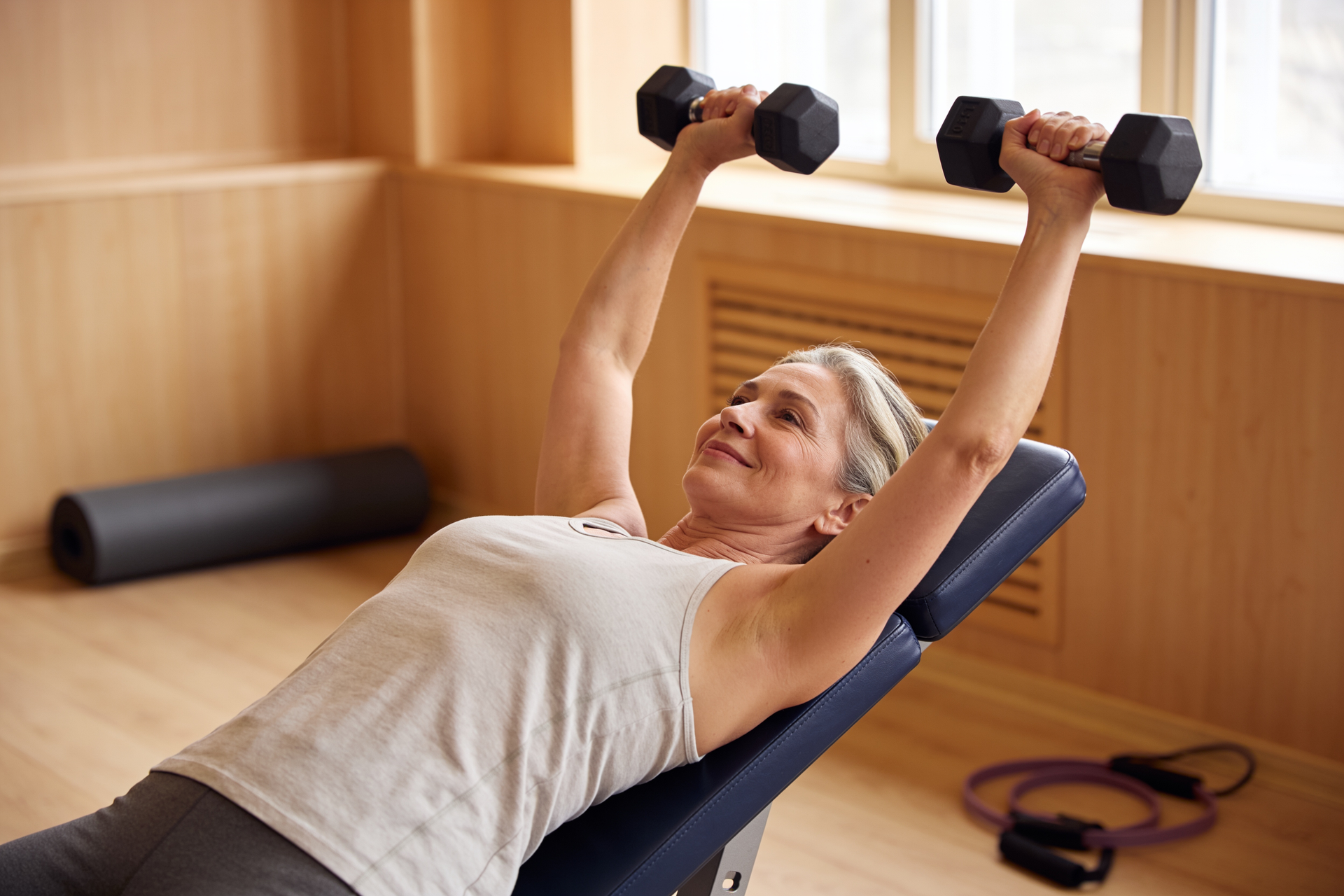
- Push: incline press, dumbbell press, or landmine press.
- Pull: row, pulldown, or supported row.
- Carry: farmer carry or suitcase carry.
- Core: anti-rotation work, dead-bug variations, or breathing plus brace.
This keeps training from becoming a confusing maze. You are not doing random workouts. You are building a capable body through repeatable patterns, which makes it far easier to stay consistent when symptoms are loud.
How hard a set should feel
Most strength sets should live in a zone where you could do about two more reps if you had to. You are working, but not emptying the tank. Picture goblet squats: you hit rep eight and think, "I could maybe do two more, but they would get ugly." That is the right neighborhood, hard enough to adapt and controlled enough to recover.
There is real science behind leaning into strength here rather than defaulting to only light movement.
Stanford Lifestyle Medicine's breakdown on strength training during perimenopause, written with exercise physiologist Stacy Sims, PhD, argues that maintaining muscle is critical for aging well and that resistance training offers more for body composition in this window than long endurance work alone. Their phrasing is worth keeping in mind: lift heavy, whatever heavy means for you, while always doing what feels safe.
Mobility: the glue that keeps strength comfortable
Mobility work in perimenopause is not about chasing extreme flexibility. It is about keeping joints moving through comfortable ranges so strength training stays available. Practical mobility looks like this:
- Five to ten minutes after lifting for hips, upper back, and ankles.
- Short reset breaks during workdays.
- Longer warm-ups on stiff days, then fewer junk sets.
What that buys you is calm. Stiffness can start to feel like a warning sign, and mobility gives you a proactive answer, so you do not read every tight hip or achy back as proof that you cannot lift anymore.
Auto-adjustments: keep the plan, change the dose
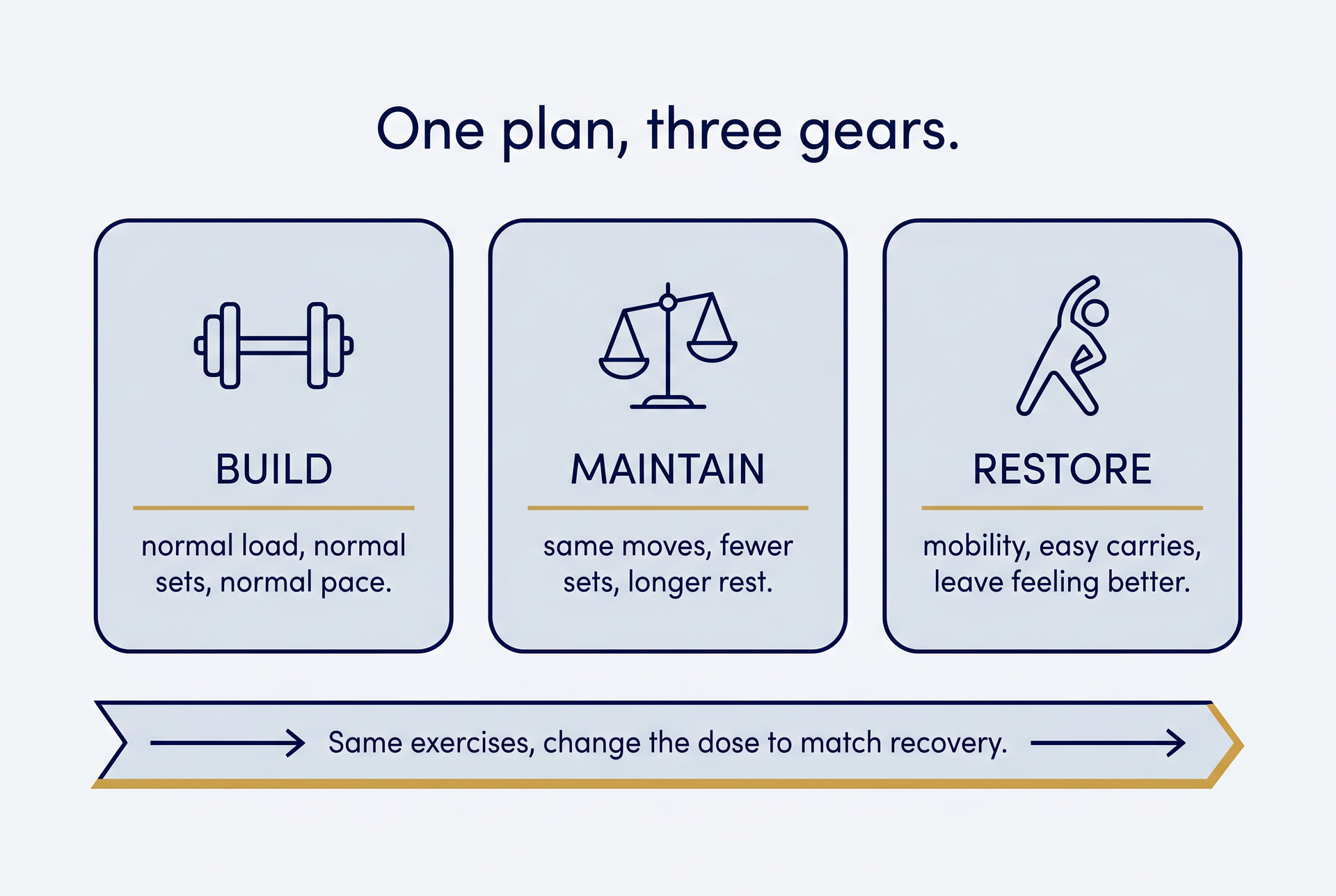
Here is where the framework earns its keep, and where a rigid program would fall apart. Perimenopause training gets simple when your plan has three session types. The exercises stay similar. The session type changes with how your body is recovering that week:
- Build session: normal weights, normal sets, normal pace.
- Maintain session: same movements, fewer sets or slightly lighter load, longer rests.
- Restore session: mobility, easy carries, low-impact cardio, leave feeling better than you arrived.
This is how you stop quitting. Quitting usually happens because a plan has only one gear, so a hard week becomes a missed week, which becomes a missed month. When the plan has three gears, you stay consistent even when life gets messy. Coaching is largely about reading which gear today calls for, which is the judgment a printout cannot make for you.
Symptom-specific examples
These are illustrations, not a prescription. They show how the same framework bends in different directions depending on what is flaring. Your own adjustments come out of your assessment and how you respond week to week.
If sleep is wrecked
Instead of skipping the whole week, keep the appointment with yourself and cut the dose. Reduce the number of hard sets, slow the reps, extend the rest, and keep the pattern. If you normally do three work sets, do two. If you normally push close to fatigue, stop earlier. You keep your momentum without digging a recovery hole.
The quiet win is that you prove to yourself you can still care for your body even when life is loud. That is the identity shift many women describe to us as the turning point.
If joints feel touchy or creaky
Joint sensitivity usually responds to smarter options and calmer progression rather than to pushing through:
- Shorten the range temporarily.
- Add tempo, meaning a slower lowering phase.
- Choose stable positions like a supported split squat, a goblet squat to a box, or chest-supported rows.
- Progress in smaller jumps.
Say lunges suddenly feel awful. You do not need to grit through them. Swap to a supported split squat, reduce depth, slow the lowering, and rebuild tolerance. Joints learn safety through good reps, not through suffering.
If hot flashes and night sweats are loud
You do not have to wait for symptoms to disappear before you train. Resistance training has been studied as a supportive tool for vasomotor symptoms, most directly in a randomized controlled trial published in Maturitas. Over 15 weeks, postmenopausal women who strength-trained three times a week saw moderate-to-severe hot flushes drop by about 44 percent, compared with almost no change in the control group, and the authors called it an effective and safe option. Keep one caveat front of mind: that trial was in postmenopausal women, so it is supportive evidence rather than a promise for the perimenopause years. And if hot flashes are severe or disrupting your life, talk with your clinician about all your options, including the medical ones.
Why this matters: feeling powerless makes everything harder. Training is one of the few levers that lets you influence how strong, stable, and resilient you feel, even when the symptoms themselves are unpredictable.
If stress and anxiety feel higher than usual
Strength training can be unusually grounding because it is structured and measurable. Low-impact cardio supports recovery too, but lifting gives many women a centered feeling because it organizes the body and the nervous system around a clear task. On the hard weeks, that structure is often the point as much as the training effect is.
If pelvic floor symptoms show up, meaning leaking, heaviness, or pressure
This is a change-strategy sign, not a stop-training sign. Many women need better breathing mechanics, pressure control, and smarter exercise selection before they need more kegels. The adjustments that tend to help are exhaling on effort, easing off the heaviest loads for a while, and choosing positions that let you stay in control. If symptoms are persistent or significant, see a pelvic floor physical therapist or your provider, and your coaching can run alongside their guidance rather than instead of it.
Bone health: a quick reality check
Bone responds to load over time. That is one reason strength training belongs in a perimenopause plan even if you also love walking or Pilates. The NIH's NIAMS explains that resistance training puts stress on bone, which helps make it stronger, and that exercise prevents bone loss and supports osteoporosis prevention and management. One note from the same source: if you already have low bone density or other limitations, talk with your provider before starting, so the plan is built for your body.
The deeper reason is not about being good at fitness. It is about protecting your freedom. Strong bones and strong muscles keep your world big.
Low-impact exercise has a job too
Low-impact movement is valuable, but it works best when it has a job:
- Recovery support.
- Mood support.
- Daily consistency.
- A cardiovascular base.
Walking, cycling, swimming, incline treadmill work, and gentle mobility flows can all be great support alongside strength, especially on restore days. If you have been told to do only low-impact and it left you feeling stuck, the reframe is simple: low-impact is a tool, not a ceiling. Strength is the anchor that makes low-impact work feel better and stay available long term.
Perimenopause strength training in Pleasant Hill: the Royal Blue Fitness approach
The whole point of this article is that a perimenopause plan needs more than one gear, because your recovery math keeps changing. That is the genuinely hard part to run on your own, and it is the part we are built for at Royal Blue Fitness in Pleasant Hill. We do not throw random workouts at a changing body. We hold the strength-first structure steady and move the dose up or down with your real recovery, so the plan keeps working on the weeks that do not go to plan.
We see what that adaptability does over time. A lot of our women clients arrive after years of putting themselves second, to their families or their careers. As they build real strength and start to trust it, there is a visible shift, a new confidence that shows up first in the gym and then everywhere else. That is a big reason we work to be the best in this profession.
A
Strength and Range of Motion Assessment is where it starts. It tells us your baseline, your joint tolerances, and which movement options fit you right now, so your build, maintain, and restore days are set to your body rather than to a generic template. You should not have to choose between pushing through and hurting or doing gentle stuff forever and feeling stuck. There is a third option, and it is the whole plan: train smart, build strength, and feel like yourself again.
Start now so the next decade feels easier
Perimenopause is not the time to downgrade your expectations. It is the time to upgrade your strategy. When you build strength now, you give yourself options later. Your joints tolerate more, your confidence returns faster, and your body stops feeling like a question mark.
The day-to-day that actually matters, carrying groceries, lifting your kid, getting down to the floor and back up, sleeping better, feeling steady in your own skin, starts to feel possible again. Build the strength now, keep more than one gear in the plan, and let the next decade arrive with you ready for it. If you want a plan that flexes with your symptoms instead of fighting them,
book a Strength and Range of Motion Assessment and we will build yours together.
Frequently Asked Questions
Can I really build strength during perimenopause, or am I just fighting my hormones?
You can absolutely build strength. Hormone shifts change your recovery math, not your ability to adapt. The practical move is to hold your movement patterns steady and adjust load, volume, and pace to how you are recovering that week. Consistency through a flexible plan beats a perfect plan you keep abandoning.
How many days a week should I strength train in perimenopause?
Two full-body days a week is a strong, realistic anchor, and three days works well if your joints and schedule allow it. More important than the number is showing up consistently and scaling the session, build, maintain, or restore, to match your recovery. Two steady days beat four ambitious weeks followed by a month off.
Will lifting weights help with hot flashes?
It may help as a supportive tool. A randomized controlled trial in postmenopausal women found that 15 weeks of resistance training cut moderate-to-severe hot flushes by about 44 percent. That study was in postmenopausal women, so treat it as encouraging rather than guaranteed for the perimenopause years. If hot flashes are severe or disrupting your life, talk with your clinician about all your options, including medical ones.
Is low-impact exercise enough on its own?
Low-impact movement like walking, cycling, and swimming is genuinely valuable for recovery, mood, consistency, and heart health, but it is a tool, not a ceiling. Bone and muscle respond specifically to load, so strength training is the anchor, and low-impact work supports it rather than replacing it.
I have pelvic floor symptoms when I lift. Do I have to stop?
Not usually. Leaking, heaviness, or pressure is a signal to change strategy, not to quit. Exhaling on effort, easing off the heaviest loads for a while, and choosing positions you can control often help. If symptoms persist or are significant, see a pelvic floor physical therapist or your provider, and coaching can run alongside their care.
Should I exercise differently if I am considering or using hormone therapy?
Hormone therapy decisions belong with your physician, not your coach. Training complements medical care, it does not replace it. Once you and your clinician have a plan, good coaching adapts around it, adjusting load and recovery to how you actually feel. If you are weighing hormone therapy, weight-loss medication, or are dealing with new symptoms, loop in your provider first.
Here are our latest articles! Click to read more.