Strength Training Plateaus After 40: How to Tell Whether the Issue Is Load, Recovery, Technique, or Consistency
You were making progress. The weights were going up, the workouts felt productive, and then somewhere along the way the numbers stopped moving. Same lifts, same loads, week after week.
The natural reaction is to push harder, add more exercises, and train through the frustration. That usually makes things worse rather than better. If you are over 40 and feel like your strength training has flatlined, the worst assumption you can make is that your age is the problem.
A stall is almost never a single mysterious failure, and it is rarely about the calendar. It is usually one of four specific things. Once you know which one is holding you back, the fix is often simpler than you expect. This guide hands you a clear diagnosis so you can find your limiter and start progressing again. At Royal Blue Fitness, this is the same order we walk a client through when their numbers stop moving.

Stalling is normal and fixable
Plateaus are a normal stage of getting stronger, not a sign that something is broken or that your best days are behind you. When you first start lifting, almost everything works, because your body is responding to a completely new stimulus. Those early months produce fast, satisfying gains.
Over time, the easy adaptations get used up, and your body needs a more deliberate reason to keep changing. That shift is not a decline. It is the predictable point where casual training stops being enough and intentional training takes over.
Recognizing a plateau as a checkpoint rather than a wall changes how you respond to it, and that response is what decides whether you break through or stay stuck.
The anatomy of a plateau
A plateau is a stretch of time where your performance holds flat despite consistent, honest effort. The keyword is stretch. A single bad session is not a plateau, and one missed personal record after a poor night of sleep is not a plateau.
What qualifies is a genuine stall across roughly three to four weeks or more, on lifts you would normally expect to inch forward. The distinction matters, because the response to a real plateau is structural, while the response to a rough week is simply to rest and show up again.
If you treat every off day as a crisis, you will change your program constantly and never give anything time to work. So before you adjust a single variable, confirm you are looking at a pattern, not a moment.
The four-bucket diagnostic
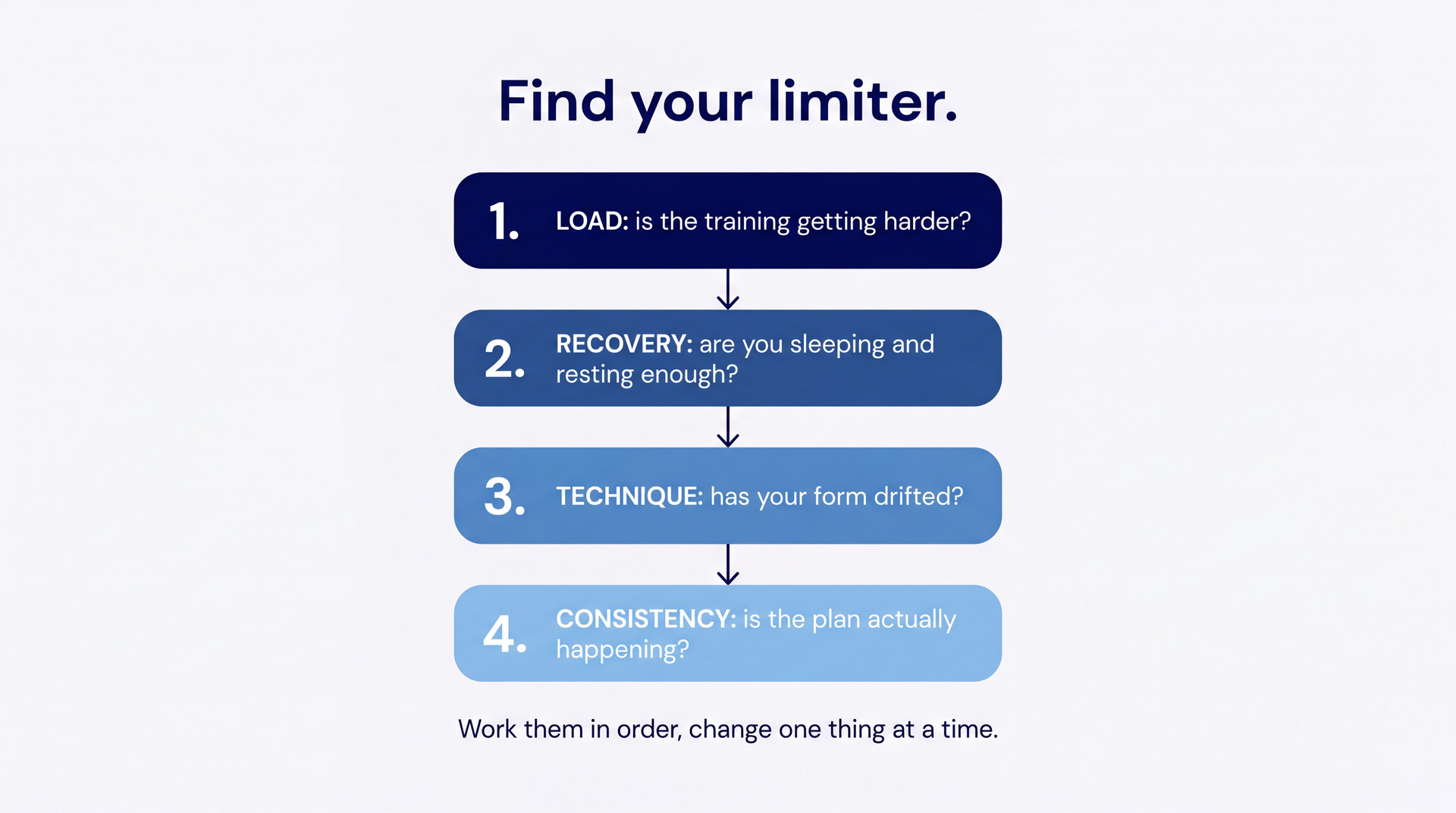
Almost every training stall traces back to one of four buckets. The table below is your map, and the rest of this guide walks each one in order.
| Bucket | The question it asks | What it looks like when it is the problem |
|---|---|---|
| Load | Are you actually making the training harder over time? | Same weights and reps for weeks, last set never truly demanding. |
| Recovery | Is your body getting the conditions it needs to adapt? | Short or broken sleep, sessions leave you drained, late-week performance drops. |
| Technique | Has your form on the stalled lift quietly drifted? | One lift feels harder than the bar warrants, range of motion has shrunk. |
| Consistency | Is the plan actually happening, week after week? | Strong stretches broken by gaps, frequent program hopping, scattered weeks. |
The point of naming them is to replace guessing with a process. Instead of randomly adding exercises, switching programs, or grinding yourself into the ground with more volume, you work through the four buckets in a set order, find the one that fits your situation, and change that one thing.
This works because most people misdiagnose their own stall. They assume they need a harder program when they actually need more sleep, or they pile on exercises when their real problem is that the plan only happens half the month.
Here is the trap worth naming: the bucket that feels true is often not the real one. The lifter who is certain they need a fancier program is frequently the one whose own log shows they simply stopped adding weight months ago. The person frantically stacking exercise on exercise is often the one whose training weeks keep getting interrupted. Working the buckets in order protects you from your own assumptions, which are usually the least reliable part of the whole picture.
Bucket 1: load, the progression you may be skipping
The single most common reason strength stops climbing is that the training quietly stops getting harder. Your muscles adapt to the demand you place on them, so if the demand never increases, neither does your strength.
This is the principle of progressive overload, and it is easy to drift away from without realizing it, particularly once a given weight starts to feel familiar and comfortable. Comfortable is exactly the problem.
Signs this is your issue
- You have used the same weights and the same reps for several weeks.
- Your final set still feels manageable, never genuinely demanding.
- You finish workouts without ever approaching the point where one more rep would be a real struggle.
- Your numbers look nearly identical month to month, and you can hold a conversation through your working sets.
People often resist this one because the sessions still feel like effort. Feeling tired is not the same as progressively overloading.
The fix
Give your body a concrete reason to adapt again. The simplest method is double progression: add a rep or two each week until you hit the top of your target range, then add a small amount of weight and start the range again. On lifts where jumping the standard plate is too big a leap, micro-loading with smaller increments keeps progress smooth.
There is a clean rule of thumb to anchor this. The American College of Sports Medicine progression position stand recommends raising the load by roughly 2 to 10 percent once you can perform one to two reps over your target on a lift, with smaller jumps on small-muscle exercises and larger jumps on big lifts. The increase does not need to be dramatic. It needs to be regular and tracked. Write down every working set so progression becomes a deliberate decision rather than a hopeful accident, and revisit the log weekly to confirm demand is genuinely rising. Tracking is also the first thing we check at Royal Blue Fitness when a client says they have stalled, because the log usually answers the question before anything else does.
Here is what that looks like in practice. If your plan calls for three sets of eight and eight reps feels solid, aim for nine or ten next time at the same weight. Once you can complete ten clean reps across all your sets, add the smallest available increment and return to eight at the new load. That one habit, repeated patiently, is most of what consistent progress actually requires.
Bucket 2: recovery, the adaptation you may be blocking
Training is only the stimulus. The actual adaptation, the part where you get stronger, happens while you recover between sessions. After 40, recovery does not disappear, but it does demand more respect.
If you are training hard and still stalling, the problem may not be your training at all. It may be that your body never gets the conditions it needs to rebuild what your workouts break down, so you accumulate fatigue instead of progress.
Signs this is your issue
- You feel drained rather than energized by your sessions, and that feeling lingers into the next day.
- Your sleep is short, broken, or inconsistent.
- You train the same muscle groups frequently with little real rest between hard efforts.
- Your performance is reliably worse late in the training week than at the start.
When your effort is high but your results are flat and you feel beat up, the line between productive training and overreaching is worth an honest look before you change anything else. A scoping review of overreaching in strength sports describes how a short two to four week stretch of harder-than-usual training followed by real recovery can produce a rebound in performance, called functional overreaching, while the same hard training without that recovery tips into a stale, flattened response instead. The review also notes the evidence here is mixed, so treat your own fatigue, not a formula, as the signal.
The fix
Protect the inputs that actually let your body adapt. Prioritize sleep first, because it is the highest-leverage recovery tool you have and the one most people shortchange. Space your hardest sessions so the same muscles are not hammered on back-to-back days.
When fatigue has clearly accumulated, take a planned lighter week, intentionally cutting your weights or volume to let your body catch up. Structured backing off is not lost progress. As a mini-review of periodized resistance training describes, building deliberate lighter periods into a plan is a normal part of how strength keeps climbing over the long run, because it lets the work you already did finally turn into adaptation.
A practical lighter week keeps your exercises and schedule exactly the same, but cuts your working weights or sets by roughly a third for that one week. It feels almost too easy while you are doing it. Then you often return the following week feeling stronger rather than weaker, which is the clearest possible sign that recovery, not effort, was the missing ingredient all along.
Bucket 3: technique, the drift you cannot feel
Strength is partly a skill, not just a quality. The more precisely you perform a lift, the more weight you can move safely and the more the intended muscles actually do the work.
Form tends to drift slowly and invisibly over months, so a lift that feels stubbornly heavy may be limited by sloppy or shortened mechanics rather than by a true lack of strength. Fixing the movement often unlocks weight that was always within reach.
Signs this is your issue
- A specific lift feels harder than the weight on the bar should warrant.
- You feel it in the wrong places, or one side clearly takes over.
- Your range of motion has quietly shrunk, so you are doing less actual work per rep than you believe.
- One movement has stalled while similar lifts keep climbing.
If a lift has become a grind that other exercises have not, technique is the prime suspect.
The fix
Step back and rebuild the movement deliberately. Reduce the load enough to perform full, controlled reps with clean mechanics, then progress from that honest starting point. Filming a set from the side almost always reveals a drift you cannot feel in the moment, such as a hip shooting up early or a depth that has crept shorter.
Tightening one specific element, like bracing your core before you descend, can transform how a lift feels. The American Council on Exercise exercise library shows clean technique for the major lifts and is a useful self-check. If a pattern keeps breaking down no matter what you try, a single session with a qualified coach is usually faster and cheaper than months of frustrated guessing. A trained eye catches in one set what video alone can miss, and that is a large part of what we do at Royal Blue Fitness.
Bucket 4: consistency, the plan that is not happening
This is the bucket people least want to examine, and the one that quietly stalls the most progress. A good program only works if it actually happens, week after week. Missed sessions, frequent program hopping, and stop-start months all sabotage the steady accumulation on which strength is built.
You cannot out-train an inconsistent schedule, no matter how hard the sessions you do complete.
Signs this is your issue
- Your weeks look uneven, with strong stretches separated by gaps where life took over.
- You change programs often, chasing the next promising routine before the last one has had time to produce anything.
- You can train hard, but you struggle to train regularly.
Be honest here. If your effort is high on the days you show up but those days are scattered across the month, consistency is your limiter, and no amount of program tweaking will fix a problem that is really about frequency.
The fix
Trade ambition for reliability. A modest plan you complete almost every week will always beat an aggressive plan you abandon after ten days. The national Physical Activity Guidelines for Americans recommend muscle-strengthening work for all major muscle groups at least twice a week, which is a realistic anchor most people can actually keep.
Build your schedule around the days you reliably have, not the days you wish you had, and treat showing up as the non-negotiable. Then give that plan months, not weeks, before you judge whether it works. Consistency compounds quietly, and the results rarely show up on the timeline impatience expects.
Working the buckets in order
If you are not sure which bucket fits, the order is the answer. Changing one bucket at a time is essential, because if you change three things at once and progress returns, you will never know which fix actually mattered. Walk it as a simple sequence.
- Check the load first. Has the weight or the reps gone up in the last few weeks? If not, fix the load before anything else. It is the most common limiter and the easiest to verify from your log.
- Then check recovery. If the load is moving, are you sleeping well and recovering between hard sessions? If not, fix recovery.
- Then check technique. If recovery is genuinely fine, does the stalled lift feel clean and full range when you film it? If not, rebuild the technique.
- Then look at consistency. If load, recovery, and technique all check out, look squarely at how often the plan truly happens across a typical month.
One worked example. A lifter convinced they needed a tougher program checked their log and found identical weights for two months. That is a pure load problem, solved by adding reps and tracking it, with no new program required. The order did the diagnosing for them.
Stalls that are not training problems
Sometimes a plateau is your body signaling something unrelated to sets and reps. Persistent fatigue that rest does not fix, pain that lingers or sharpens, an unexplained drop in capacity, or new symptoms can have causes well outside of training, including sleep disorders, nutrition gaps, high life stress, medication effects, or an underlying health condition.
Strength coaching is not a substitute for medical care, and no training adjustment can address a medical issue. If something feels wrong rather than simply hard, or if pain is part of the picture, check in with a qualified medical provider before you push through it.
Training should challenge you and leave you better. It should not hurt you, and respecting that line is part of training intelligently for the long run.
None of this is meant to alarm you. The large majority of plateaus are ordinary training problems with ordinary training fixes, and you will resolve most of them yourself by working patiently through the four buckets. The point is simply to stay alert to the few times when your body is flagging something that belongs in a doctor's office rather than in your next training block.
Frequently Asked Questions
How long does a strength plateau usually last?
That depends entirely on the cause. A load or consistency plateau often breaks within a few weeks once you make the right change, because you are finally giving your body the demand or the regularity it was missing. A recovery-driven stall can resolve quickly after a lighter week and a stretch of better sleep. The honest exception is when you have genuinely addressed all four buckets and still see no movement for a couple of months. That is the signal to get an outside set of eyes on your training rather than keep experimenting alone.
Is it harder to build strength after 40?
Building strength after 40 is entirely achievable, and your body continues to adapt to training at any age. What changes is the context, not the capacity. The fast, automatic progress of your first year is behind you, and recovery deserves more attention than it did at 25. That means deliberate load progression, honest technique, and consistency matter more than they used to. The four-bucket approach works just as well for an adult in their fifties or sixties. It simply rewards a little more patience with recovery.
Should I just add more exercises to break a plateau?
Usually not. Adding random exercises is the most common wrong response to a stall, because it spreads your effort and attention thinner rather than fixing the actual bottleneck. More movements feel productive, but they rarely address why progress stopped. Identify your bucket first. Far more often, the fix is progressing the lifts you already do, recovering better, or training more consistently, not piling extra exercises onto a program that was not the problem.
Do I need to change my whole program?
Rarely, and doing so often makes things worse. A plateau is a signal to adjust one variable, not to scrap everything and start over. Wholesale program changes reset your progress tracking and make it impossible to learn what actually moved the needle, which traps you in an endless cycle of new routines that never get a fair trial. Change one bucket, hold the rest of your training steady, and watch what happens over the next several weeks before deciding anything else.
Could my diet be causing the plateau?
It can contribute, especially to recovery. If you are eating far too little, training hard, and sleeping poorly, your body may simply lack the resources to adapt, which shows up as a stall. That said, nutrition is individual and outside the scope of a training diagnostic, so this guide treats it as part of the broader recovery picture rather than a prescription. If you suspect your fueling is working against you, it is reasonable to discuss it with a qualified professional.
Find your limiter, then move again
A stall feels discouraging, but it is information, not a verdict on what you are capable of. Once you stop blaming the calendar and start working through load, recovery, technique, and consistency in order, the fix usually reveals itself faster than you would think.
Three of the four buckets you can read from your own log. Technique is the one you usually cannot, because the drift that limits a lift is the part you cannot feel under the bar. A
Strength and Range of Motion Assessment is built to show you exactly that: an objective look at how you move and where your training is genuinely limited. If you have worked the buckets honestly and still cannot name your limiter, an outside read around Pleasant Hill or the East Bay beats another month of guessing.
Here are our latest articles! Click to read more.


Strength for Independence After 50: Training for Stairs, Carrying, Travel, and Getting Off the Floor