Knee Pain on Stairs After Rehab: How to Rebuild Strength and Control
Three steps up, the knee speaks. You slow, reach for the rail, and wonder why the one thing you do a dozen times a day still feels like a test.
Stairs have a way of exposing what rehab did not quite finish. You were discharged walking, maybe even cleared for the gym, but the staircase keeps finding the gap.
What follows is a step-by-step way to close that gap. Treat it as general strength education to use with, not in place of, the provider who knows your knee history. The goal is a staircase you stop bracing for.
Stairs feel harder after knee rehab for a reason
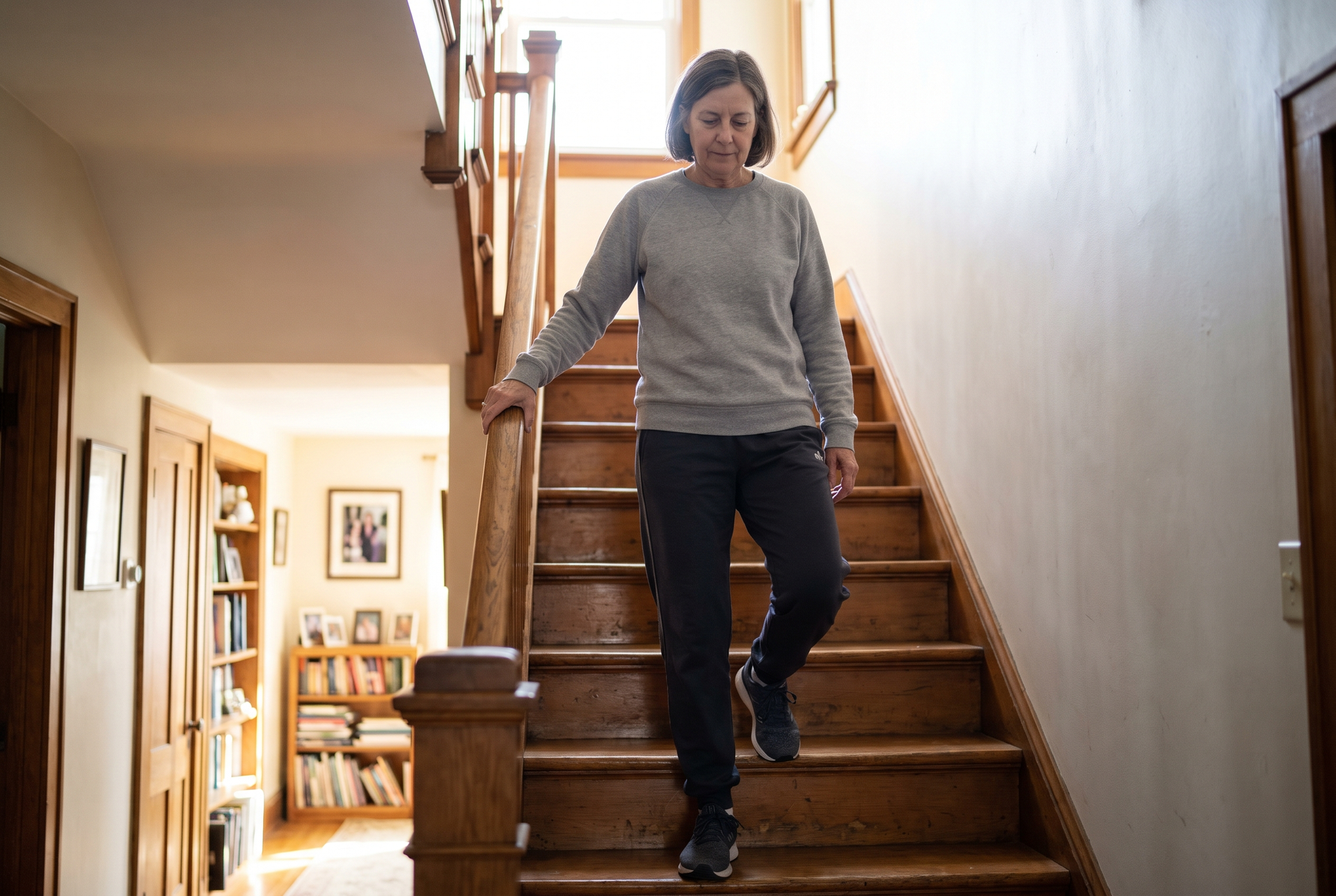
A staircase presses roughly three times more load through the front of your knee than level walking, which is exactly why it lingers as a sticking point. Walking is forgiving. Stairs are not. A flat hallway lets your knee coast, while a staircase makes it produce force and then control that force on every single step, which is exactly why stairs stay hard long after walking feels easy again.
Going down asks more of the knee than going up
Going up is mostly a strength task: your muscles shorten to push your body weight upward, step after step. Going down is the harder job for the muscles that control your knee. They have to lengthen under load to lower you with control, and motion-lab research shows the demand on the knee-straightening muscles runs higher on the way down than on the way up, with the knee bending deeper on every step.
That single difference explains most stair pain after rehab. The descent demands control your rehab may not have rebuilt yet, and control is a skill you can train. That is the hopeful part: because the descent is a skill rather than a fixed limit, teaching the muscles to lower you slowly tends to quiet the pain that came with uncontrolled lowering.
Rehab often stops short of stair confidence
Rehab is built to settle symptoms and restore safe, basic function, and it does that job well. It tends to end when you can walk and manage daily life, not when stairs feel automatic again.
So you are left in the gap between cleared and confident. That gap is normal, it is common, and it is yours to close with the right work. Think of rehab as having poured a solid foundation and this plan as building the next floor on top of it: nothing down low is wrong, the structure is simply unfinished.
On stairs, control means a quiet, steady descent
Control is the quiet ability to lower yourself one step at a time without your knee wobbling, collapsing inward, or dropping the last inch. It is strength you can steer, not just strength you can produce.
Climb, descend, and trust: those are the three things you are rebuilding, and only the first is mostly about raw power. The other two are about control, and that is where this plan spends its time. A knee can be plenty strong and still feel unsafe on a staircase if that strength has nowhere to steer, so control gets trained here just as deliberately as raw strength does. The plan runs in four steps:
Test the stair, not trust it: a calm self-check to find where your knee stands today.
Build the engine: the quad, hip, glute, calf, and ankle strength stairs run on.
Earn the step-down: supported partial step-downs progressing to single-leg control.
Take it back to the staircase: going up, going down, and from handrail to no handrail.
Start by testing the stair, not trusting it
Before you train stairs hard, find out honestly where your knee stands today. A short, calm self-check tells you where to begin without turning the staircase into a provocation.
A simple self-check without provoking pain
Find a single step or a low, sturdy platform. Step up and down a few times slowly, holding a rail, and notice what your knee does rather than chasing how many you can do.
You are watching for smoothness, not speed. Can you lower yourself with control, keep your kneecap tracking roughly over your toes, and stay under a level of discomfort that fades quickly? Do a handful of slow reps, then stop and pay attention over the next few hours, rather than grinding out more in the moment to prove something.
Reading what your knee tells you
Some responses say keep going: mild effort, a knee that feels stable, and discomfort that settles soon after you stop. Some say ease in: a little achiness, a knee that feels unsure, or fatigue that arrives quickly, all of which mean start smaller and progress more slowly. Most knees sit somewhere in the middle on any given day, and an honest read of where yours is right now keeps you from either coddling it or bullying it.
And some say stop for now: sharp pain, the knee buckling or catching, swelling that builds, or symptoms that climb the more you move. Those are a cue to pause and check in rather than push. None of these signals mean you are broken; they mean today's dose was wrong, and with a small adjustment, tomorrow's can be right.
Check with your provider first if these apply
If your knee gives way, locks, swells noticeably, or carries pain that is sharp rather than achy, talk to your provider before you load stairs harder. Loss of confidence is something you can train through, but instability and swelling deserve a professional set of eyes first. Ruling those things out early is not a detour; it is what lets you train everything else with confidence instead of a nagging worry in the back of your mind.
Build the engine stairs run on
Stairs draw on a chain of muscles from your hips to your ankles, so before you drill steps, you build the engine that powers and brakes them. Stronger muscles around the knee share the load and let the joint absorb shock instead of bracing against it.
Quad and knee-control basics
Your quadriceps do much of the work of straightening and bending your knee on stairs, powering the climb and controlling the lowering, so they sit at the center of stair work. Start with controlled, pain-free knee extension and supported sit-to-stands, where you can build strength without the full demand of a step.
The aim early on is a clean, controlled effort rather than a heavy load. You are teaching the knee to produce force and steer it at the same time. A wall sit held for time, or a slow sit-to-stand from a higher chair, often beats any machine as a starting point because it demands control rather than just contraction.
Hip and glute contribution
The knee rarely works alone, and weak hips quietly force the knee to do more than its share. Strong glutes and hip muscles keep the knee tracking properly and stop it from caving inward as you climb and descend.
This is not a detail to skip. Clinical practice guidelines for stubborn front-of-knee pain give their strongest grade of evidence to
combining hip and knee strengthening, and prefer it over knee-only work. On the stairs, your hips are half the staircase. This split is something we measure rather than guess. In a Strength and Range of Motion Assessment, we compare how the knee and hip each hold up under single-leg work, and it is common to find a rehabbed knee testing fine while the same-side hip does half its share. When that shows up, the first month of stair work is mostly hip work. A simple side-lying leg raise or a banded sideways walk can wake up glute muscles that have been coasting since your injury, and the knee usually feels the benefit within a couple of weeks.
Calf and ankle support
Below the knee, your calves and ankles manage balance and absorb part of each landing. Simple calf raises and balance work give the knee a more stable platform to work from.
When the foundation under the joint is steady, the knee has less to compensate for. Small ankle gains pay off on every single step. Try slow calf raises and a thirty-second single-leg balance at the kitchen counter, and notice how much steadier the whole leg feels once the foot beneath it goes quiet.
Earn the step-down
The descent is the hardest part of a staircase, so you train it deliberately rather than hoping it sorts itself out. The step-down progression rebuilds the braking control that makes going down feel safe again.
Start with supported partial step-downs
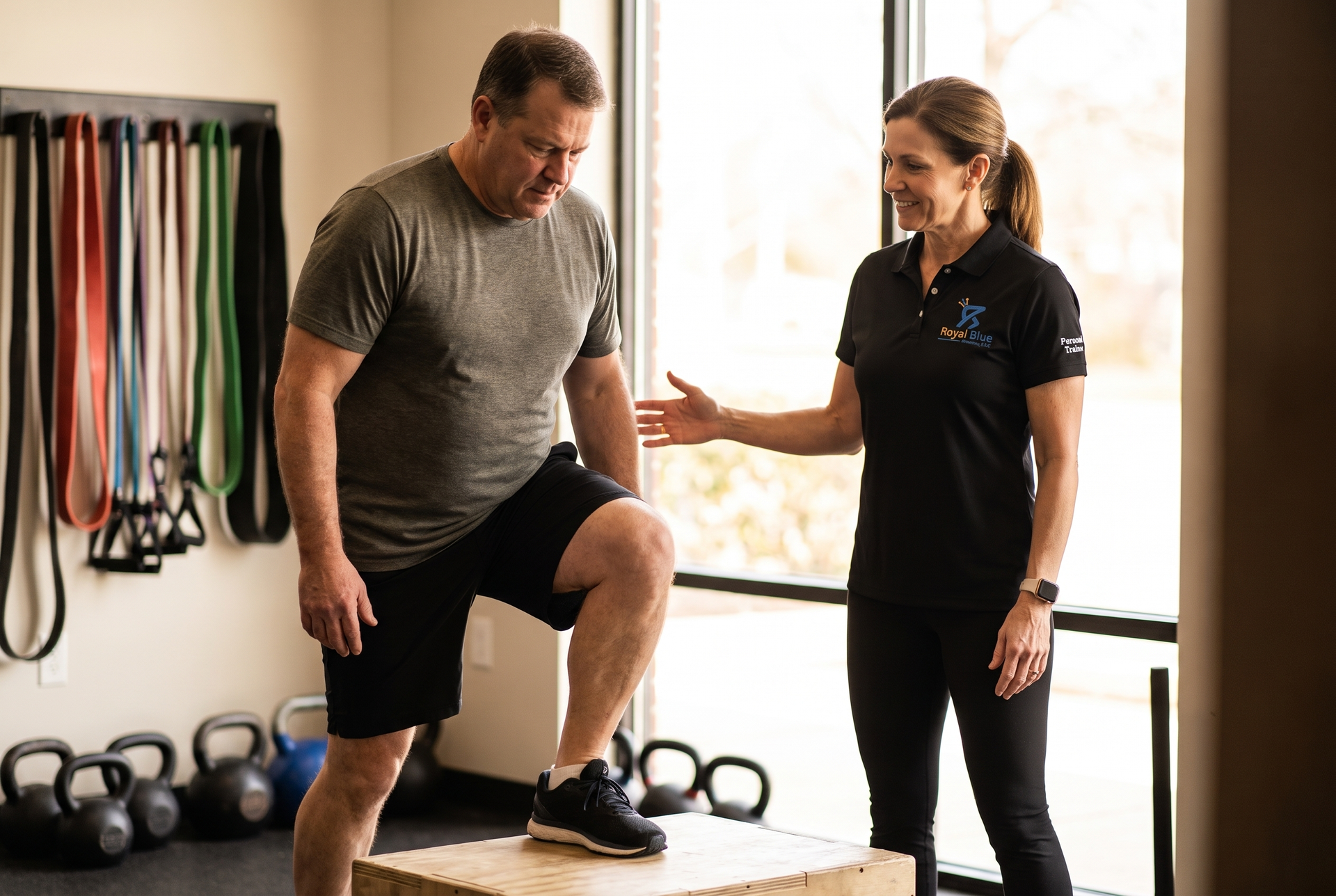
Begin on a low step with a hand on a rail, lowering only a few inches before returning to the top. Keep the movement slow and the knee tracking over the foot, stopping well short of any sharp discomfort.
Shallow and controlled beats deep and shaky, every time, at this stage. You are building a habit of clean lowering, not testing your limit. A two-inch step you can lower onto with complete control is worth more than a full step you crash down onto every time.
Progress depth and control
As the shallow version feels easy and your next day stays quiet, lower a little farther and lean a little less on the rail. Add depth or reduce support, but change only one of them at a time so you always know what your knee is responding to.
Progress here is measured in inches and in steadiness, not in how sore you can get. A useful rhythm is to add a little depth one week and reduce a little support the next, so no single jump is ever big enough to startle your knee.
Add tempo and single-leg control
Once you can lower with control through a useful range, slow the tempo down further and shift toward more single-leg work, since real stairs are a series of single-leg lowerings. A three to five second descent builds the eccentric control stairs actually demand.
When one leg can lower you slowly and smoothly under its own control, you are most of the way to confident stairs. Counting the seconds of each descent out loud keeps you honest, because the moment you start rushing the lowering is usually the moment the knee speaks up. In sessions we watch two things on every step-down: whether the knee drifts inward past the big toe, and whether the last inch is placed or dropped. When either slips, we raise the step or slow the count rather than pushing through.
Take it back to the staircase
Strength built on a single step has to graduate to a real flight, so you reintroduce actual stairs on your terms rather than the world's. You decide the pace, the support, and the number.
Going up with confidence
Lead with your stronger leg at first, drive through the whole foot, and let your hips help rather than letting the knee do everything. Climbing usually returns first, so use it to rebuild trust before you push the descent. There is no shame in leading with a stronger leg; it is simply a tool for stacking easy wins until both sides feel equal.
Going down with control
Descend slowly, keep your weight balanced over your foot, and resist the urge to drop the last inch onto a locked knee. If a full flight feels like too much, do a few controlled steps down and walk the rest, then add steps over time. Splitting a flight into two halves with a brief pause in the middle is a perfectly good stage on the way to one smooth, continuous descent.
From handrail to no handrail
The rail is a tool, not a crutch to be ashamed of, and you wean off it gradually. Move from a firm grip to fingertips to a hand that simply hovers nearby, then to no rail in the easier direction first.
Letting go of the rail is its own milestone, and confidence earned a step at a time tends to stay. The aim is a knee you stop thinking about on stairs.
When a step trips you up, adjust the plan
Progress on stairs is rarely a clean climb, so expect the occasional stumble and know how to respond. Most setbacks have a simple read:
| What you notice | What it usually means | What to do |
|---|---|---|
| The knee aches the next day | The last session asked a little more than the knee was ready for | Drop back to the level that felt solid, hold a few sessions, then rebuild |
| One leg lags behind | The rehabbed leg is trailing, and the strong leg is taking over | Give the weaker leg extra focused work, and lead with it on some sets |
How long does stair confidence usually take
There is no universal timeline, but many people feel real change within a few weeks of consistent, progressive work, with steady gains over a couple of months. The curve is rarely straight, and a flat week or a small step back is part of it, not a failure of it.
What matters is the trend. If your stairs are gradually getting easier and your setbacks are getting smaller, the plan is working, even when a single day disappoints.
Coaching beats going it alone when stairs stay stubborn
Some knees rebuild stair confidence on a simple home plan, and some get stuck, plateau, or keep flaring no matter how careful you are. If that is you, or you would simply rather not guess, a coach can read your movement and build the progression around your specific knee.
If the staircase stays stubborn no matter how carefully you train, that is exactly the gap Royal Blue Fitness helps close. We pick up where rehab left off and shape each step around the knee you actually have, beginning with a Strength and Range of Motion Assessment and staying connected to the providers already on your team. The aim stays the same: a staircase that no longer asks anything of you.
Frequently Asked Questions
Why does going downstairs hurt more than going up?
Because descending asks your muscles to lengthen under load to brake your body weight, and that braking demand on the knee-straightening muscles runs higher than the push of climbing. That braking, or eccentric, control is also the part rehab most often leaves unfinished. The reassuring part is that it responds well to the slow, controlled step-down work in this guide. If only the descent bothers you, that is a classic sign that your braking control, rather than your overall strength, is the piece to rebuild.
Should I push through stair pain?
Mild discomfort that settles quickly is usually fine to work near, but sharp pain, a knee that buckles or swells, or symptoms that climb as you go are signals to back off rather than push. Pain is information about your current limit, not an obstacle to bulldoze. When in doubt, do less and check your response the next day. A simple rule of thumb is that discomfort that fades by the next morning is usually acceptable, while pain that lingers or sharpens is not.
Which exercises help most for stairs?
Controlled step-downs are the most stair-specific tool because they train the exact braking your descent needs. Pair them with quad strengthening, hip and glute work to keep the knee tracking, and some calf and balance work underneath. Choose the specific movements your provider has cleared and build them gradually. If you only have time for one thing, controlled step-downs give sensitive, stair-shy knees the most direct return.
How long until stairs feel normal again?
Many people notice meaningful change within a few weeks of consistent work, with fuller confidence over a couple of months. The timeline depends on your starting point and your history, so treat it as a direction rather than a deadline. If things are not improving at all, that is a reason to check in with a provider. Keeping a short weekly note on how stairs felt turns a vague timeline into visible, motivating progress.
Is stair climbing good exercise for sensitive knees?
It can be, once you have the strength and control to handle it, because stairs build exactly the capacity daily life demands. The key is to earn it gradually rather than using a hard staircase as your starting point. Build the engine and the braking first, then let stairs become training rather than a trial. Used well, a staircase turns into a free, always-available gym for the exact muscles your knees lean on most.
Here are our latest articles! Click to read more.

Strength for Independence After 50: Training for Stairs, Carrying, Travel, and Getting Off the Floor