Why Random Workouts Stop Working: The Strength Progression Problem Most People Miss
"Keep your muscles guessing." It is one of the most repeated lines in fitness, and it sounds clever. Switch things up constantly, the idea goes, so your body never adapts and you never plateau.
For a while it feels great. You are never bored, every session is a surprise, and the novelty alone makes each workout feel hard. Then, somewhere along the way, the progress quietly stops. You are still showing up, still mixing it up, and still not getting any stronger.
Here is the short of it. The problem was never that you failed to keep your muscles guessing. The problem is that guessing was never what made them grow. Strength is built by repeating a core of key movements and asking a little more of them over time, with enough structure to measure that you actually did. This article explains why random training stalls, why it can feel like it is working at first, and how to trade the guessing game for a plan that keeps moving forward.

At first, almost anything works, and that is the trap
If random training is so flawed, why does it ever feel effective? Because at the very beginning, it genuinely is, and that early success is exactly what sells the myth.
When you are new to training, almost any activity is a new stimulus. Pick up a weight you have never lifted, and your body responds with a burst of early strength and some muscle, the window many people call "newbie gains." In those first weeks the body is so unaccustomed to the work that nearly anything you throw at it produces a response. Random workouts feel like they are working because, for that short window, the bar for getting a result is on the floor.
That window closes. As your body catches up to the demand, the easy gains taper, and the first real plateau arrives. In our coaching experience, that first wall usually has nothing to do with not enough variety. It comes from never sticking with a routine long enough for the body to adapt to it. A week or two of a workout is not a routine; it is a sample. Without a plan you repeat and build on, there is nothing for your body to adapt to in the first place.
Soreness signals novelty, not growth
Part of what keeps the guessing game going is soreness. A brand new movement almost always leaves you sore, simply because your body is not used to it, and most of us were taught to read soreness as proof of a productive session.
But soreness mostly tracks unfamiliarity, not progress. Chase it by constantly swapping exercises and you can keep yourself perpetually sore while building very little, which is a frustrating place to be precisely because it feels like it should be working. The ache is the cost of doing something new, not the receipt for getting stronger.
Two things actually drive progress, and neither is novelty
If newness is not the engine, what is? Strength and muscle are built by a specific, well-understood process, and it is almost the opposite of randomness. It rewards doing similar things repeatedly while gradually making them harder, and being able to measure that you did. Two ideas carry most of the weight.
Progressive overload
The real engine is progressive overload: the gradual increase in demand on your body over time. Your body adapts to the stress you repeatedly place on it, so to keep getting stronger you have to keep asking a little more of the same movements, whether that is more weight, more reps, or more quality range of motion. The National Institute on Aging puts the mechanism plainly: gradual increases in the amount of weight, the number of sets or reps, or the days you train will result in stronger muscles. The operative word is gradual, and you cannot gradually load a movement you only do once before trading it away.
Programming guidance from the National Academy of Sports Medicine centers the same principle: without progressive overloading, muscle growth plateaus, and the body adapts by meeting the demands of the stress placed on it. By definition that requires returning to the same core movements and asking a little more of them, rather than constantly trading them out for something unfamiliar.
Structure that lets you measure
The second piece is structure, which is what makes progression visible and therefore possible. When you repeat key movements across weeks, you can see what you did last time and deliberately do a little more. That small, deliberate increase is the entire mechanism of getting stronger, and it only exists because you repeated the movement and recorded it.
This is not just gym lore. A 2017 meta-analysis in Sports Medicine pooled 81 effects from 18 studies and found organized, periodized programs produced greater one-rep-max strength gains than non-periodized training, with the authors concluding that planned variation in the training stimulus is vital for building maximal strength. Notice the word: planned. Randomize the exercise every session and your log becomes meaningless, because there is nothing to compare today against.
The "muscle confusion" claim, examined fairly
The popular justification for random training is "muscle confusion," the idea that constantly varying your workouts confuses your muscles into nonstop growth. It is worth examining honestly rather than just dismissing, because like most durable fitness myths, it wraps a real grain of truth in a misleading conclusion.
The grain of truth
Some variation genuinely helps. It keeps you engaged, reduces the overuse that comes from doing the exact same thing forever, and exposes you to a fuller range of movement. A mini-review of periodized resistance training describes periodization as the planned manipulation of training variables, and finds periodized programs superior to non-periodized ones for strength. So the instinct that some variety belongs in a good program is not wrong. If you did the identical workout, with identical weights, for years, you would stall, from boredom and overuse as much as anything. Rotating an accessory movement or changing rep ranges in planned phases keeps training well-rounded.
The part that gets overstated
What gets overstated is the leap that confusion itself drives growth, and that more randomness means more progress. Your muscles do not get "confused"; they adapt, and adaptation needs a consistent enough stimulus to respond to. The same periodization research that endorses planned variation still treats progressive, organized loading, not novelty for its own sake, as the foundation. Change everything every session and you never repeat a movement enough to load it more over time, which is the very thing growth depends on.
The tell is in the word itself. Confusion is something you do to an opponent, not to a system that is trying to adapt to you. Your muscles are not an enemy to be outwitted into growing; they are tissue responding to a signal. A signal that changes completely every session never resolves into a clear adaptation, because you keep sending a new instruction before the body has answered the last one.
The quiet costs of training at random
When your training is random, you pay a real price that rarely shows up until results stall:
- You cannot progressively overload, because you rarely repeat a movement enough to deliberately load it more.
- You cannot measure progress, because there is no consistent benchmark from week to week, so you are flying blind.
- You spend your energy on the learning phase, burning effort on the inefficient early stage of new movements instead of loading patterns you have already mastered.
- You mistake soreness for progress, reading the fatigue of constant novelty as productive work when it is often just the cost of doing something unfamiliar.
Guidance from the
National Institute on Aging on building strength as we age reinforces that consistent, progressive training is what builds and maintains strength over time. Random training feels busy, but it quietly robs you of the mechanism that actually works, and beginners burn the most potential this way, mistaking the busywork and soreness of constant novelty for the steady, slightly repetitive work that genuinely builds a stronger body.

Once you have a plan, you can fix the weakest link
Here is what random training can never give you, and it is the part most people miss. Once you commit to a structured routine long enough to adapt to it, you stop guessing and start diagnosing. A consistent plan reveals where you are actually weak.
That is where real strength training becomes a craft. With your core compound lifts, the meat and potatoes, stable and progressing, you can see which links in the chain are lagging and add specific accessory work to bring them up, fixing imbalances and strengthening the weakest link rather than chasing whatever looked interesting online this week.
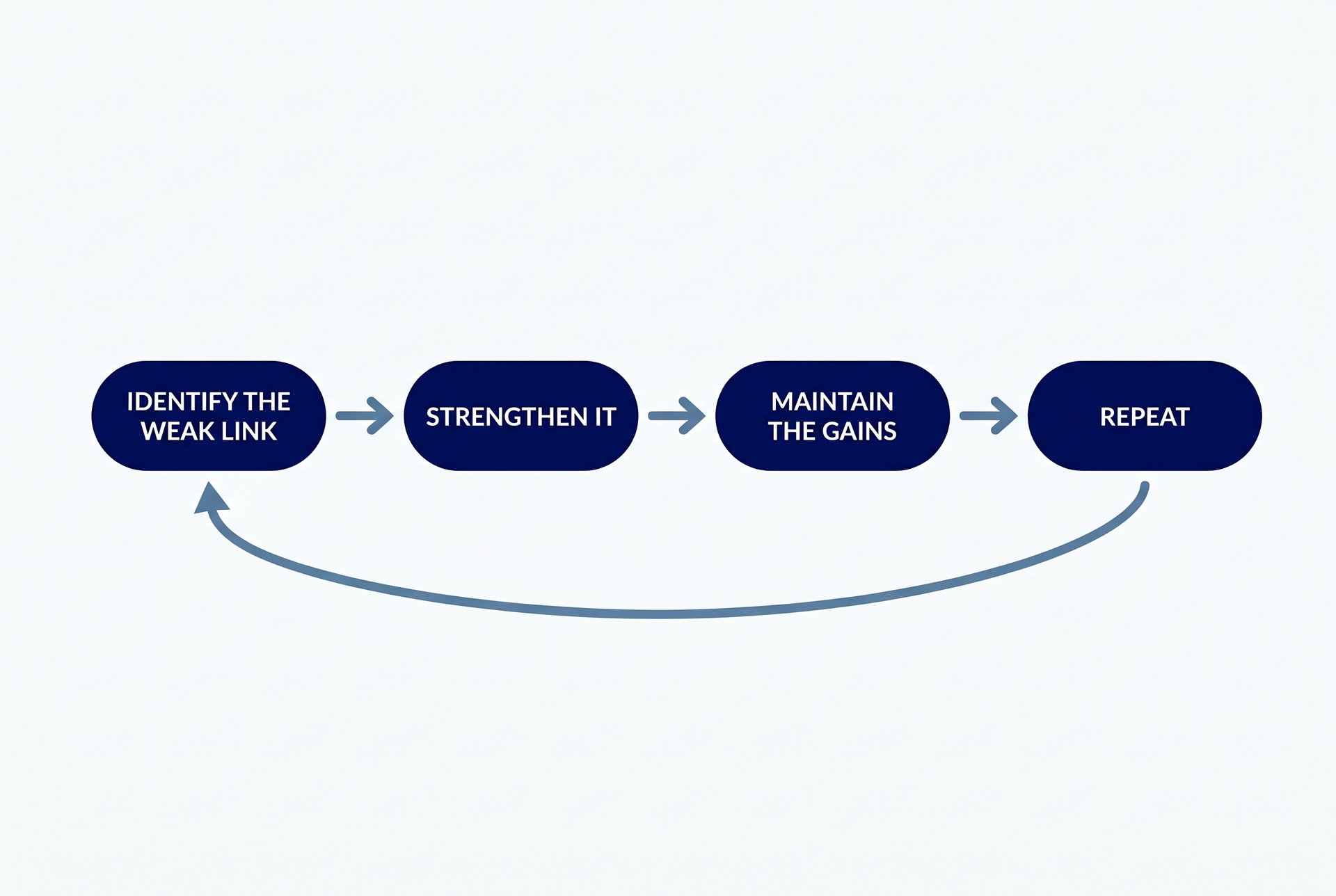
We think of intentional strength training as a perpetual cycle: find the weakest link, make it stronger, then maintain what you have already built while you hunt for the next one. Repeat. That loop is how a body keeps improving for years instead of months, and it is simply not available to someone doing random workouts and chasing the latest influencer "try this" video. You cannot strengthen a weak link you never held still long enough to find.
Structure first, variety in service of it
The fix is not to make training rigid and never change anything. It is to flip the relationship between structure and variety. Structure comes first: build your training around a core of key movements that you repeat and progressively load over weeks, so your body has something consistent to adapt to and you have something to measure. Then variety serves that structure rather than replacing it.
A tree is a useful picture. The trunk is your core set of movements, stable and slow to change, and that is where strength is actually built. The branches are your variation: the accessory work, the swaps, the new challenges, which can grow and change freely without ever threatening the trunk. Problems begin only when people mistake the branches for the trunk and let constant change reach the part that was supposed to stay steady. Keep the trunk solid, and you can enjoy as many branches as you like.
How much variety is the right amount
In practice, healthy variety means keeping your main movements consistent for a meaningful block, long enough to progressively load them, while allowing sensible variation around the edges. A practical anchor: hold your core lifts steady for a four to six week block before you make any major changes, then adjust in planned phases rather than from session to session.
Within that block, you still progress, you just do it on the same movements. Say your plan calls for goblet squats. In week one you do three sets of eight with a given weight. The next week you aim for three sets of nine, then ten, then you nudge the weight up and drop back to eight and climb again. The movement stays put; the demand keeps rising. That is variety doing its real job, freshness without abandoning the pattern.
The test is simple. Does the change still let you track and progress your key lifts? If yes, it is useful variety. If it means you are starting over every session, it is randomness wearing a disguise.
Frequently Asked Questions
Is muscle confusion a real thing?
Not in the way the phrase implies. Your muscles do not get confused; they adapt to the stress you place on them, and adaptation needs a consistent enough stimulus to respond to. There is a grain of truth that some variation is useful, but the idea that constantly confusing your muscles drives growth is overstated. What actually drives growth is progressive overload, gradually doing more of similar movements over time, which constant randomness prevents.
So is variety in workouts bad?
No. Variety is not bad; it is just not the main driver, and too much of it backfires. Sensible variation keeps you engaged, reduces overuse, and exposes you to a fuller range of movement, all genuinely useful. The key is that variety should serve a structured plan rather than replace it. Keep your core movements consistent enough to progress them, layer variation around the edges, and you get the benefits of both.
Why did my workouts stop working even though I kept changing them?
Most likely because changing them constantly is what stopped them from working. When you never repeat movements enough to load them progressively, you cannot apply the overload that strength and muscle depend on, and you have no way to measure whether you are improving. Hard, varied, sore-making sessions can feel productive while delivering little. Switching to a structured plan you repeat and progress is usually what restarts results.
How often should I change my program?
Less often than the muscle-confusion advice suggests. A common, effective approach is to keep your core movements consistent for a block of roughly four to six weeks so you can progressively load them, then adjust in planned phases rather than session to session. You can keep things fresh by progressing the same lifts in different ways, with more weight, reps, or range. The right cadence is one that still lets you track and advance your key lifts over time.
Do I need a rigid, never-changing program to make progress?
No. The goal is structure, not rigidity. You need enough consistency in your key movements to load them progressively and measure your progress, but that leaves plenty of room for sensible variation around the edges and planned changes over time. Structure first, variety in service of it, is the balance. A plan can be both organized enough to drive progress and flexible enough to stay engaging.
Trade randomness for a plan that progresses
"Keep your muscles guessing" is catchy advice that gets the mechanism backward. Strength is built by repeating key movements and progressively loading them over time, with enough structure to measure and advance, not by constant novelty that leaves you busy but stalled. Keep your core lifts consistent, progress them deliberately, find and strengthen your weakest link, and let variety serve the plan rather than replace it.
A structured plan has to start somewhere: an honest read of which movements belong at your core and where you can safely load them today. A
Strength and Range of Motion Assessment gives you that baseline, so you can build a plan you progress and measure rather than one you only survive. If you have been busy but stuck around Pleasant Hill or the East Bay, it is a practical way to trade the guessing game for steady, visible progress.
Here are our latest articles! Click to read more.