Why Golf Injuries Usually Start Before the Swing
You feel it in the swing. The back tightens on the follow-through, the shoulder pinches at the top, the elbow aches after a round, or the wrist complains after a long session on the range. Because the pain shows up while you are swinging, it is natural to decide that the swing itself is the problem.
Most of the time, the swing is where you notice the problem, not where it started. Golf asks your body to rotate, stabilize, transfer force, and recover, over and over, and the spot that hurts is usually the one absorbing what the rest of the body did not handle.
A 2024
systematic review of golfers found that more than half experience a musculoskeletal injury at some point, with the lower back, hand, and wrist among the most common sites.
That pattern is the clue. The issue is rarely one motion. Think of the golfer who tweaks a shoulder, rests it for two weeks, feels fine, plays a full round, and wakes up sore again.
The tissue calmed down, but nothing about how the body produced the swing actually changed, so the same stress found the same spot. This article walks the movement chain from the ground up, so you can see where golf injuries actually begin and what prevention looks like when you want to keep playing.

Golf is a whole-body chain, not a single moving part
A golf swing is not an arm movement. It is a coordinated sequence that runs from the feet through the hips, trunk, shoulders, and out to the hands, and the quality of that sequence decides where stress finally lands.
When people picture golf as a small, low-impact game, they miss how much rotational force runs through the body on every full swing, and how often that force gets redirected when one area cannot keep up.
Force travels from the ground up through the swing
The power in a swing starts at the ground. You push into the turf, and that force travels up through the legs and hips, into the trunk, and out through the arms and club. Researchers describe this as proximal-to-distal sequencing: the big, slow segments fire first, then hand their speed to the smaller, faster ones, so energy builds as it moves up the kinetic chain.
When each segment contributes on time, the clubhead moves fast without any single joint being asked to do everything.
The swing is a relay, not a single effort. That framing matters because a relay only works when every runner does their part. Picture the back nine of a long round when your legs are tired. The lower body stops driving, the sequence falls apart, and the swing quietly becomes an arms-and-shoulders move.
The ball still goes somewhere, but the force that used to flow through the chain is now being produced and absorbed by a much smaller set of structures.
One weak link shifts the load onto the next
When one link in the chain cannot contribute what the swing needs, the work does not disappear. It moves to the next available structure. A stiff mid-back from years at a desk, a hip that will not rotate, or a trunk that cannot stay stable all force a neighbor to pick up the slack.
That neighbor was not built to carry the extra share, so it is the one that starts to complain.
This is the heart of the idea: the painful area is often the messenger, not the original cause. A golfer with a locked-up mid-back does not feel the mid-back. They feel the lower back that twisted further to make up for it, or the lead elbow that gripped harder to steer a swing the trunk could not finish.
Treat only the place that hurts, and you leave the real bottleneck untouched.
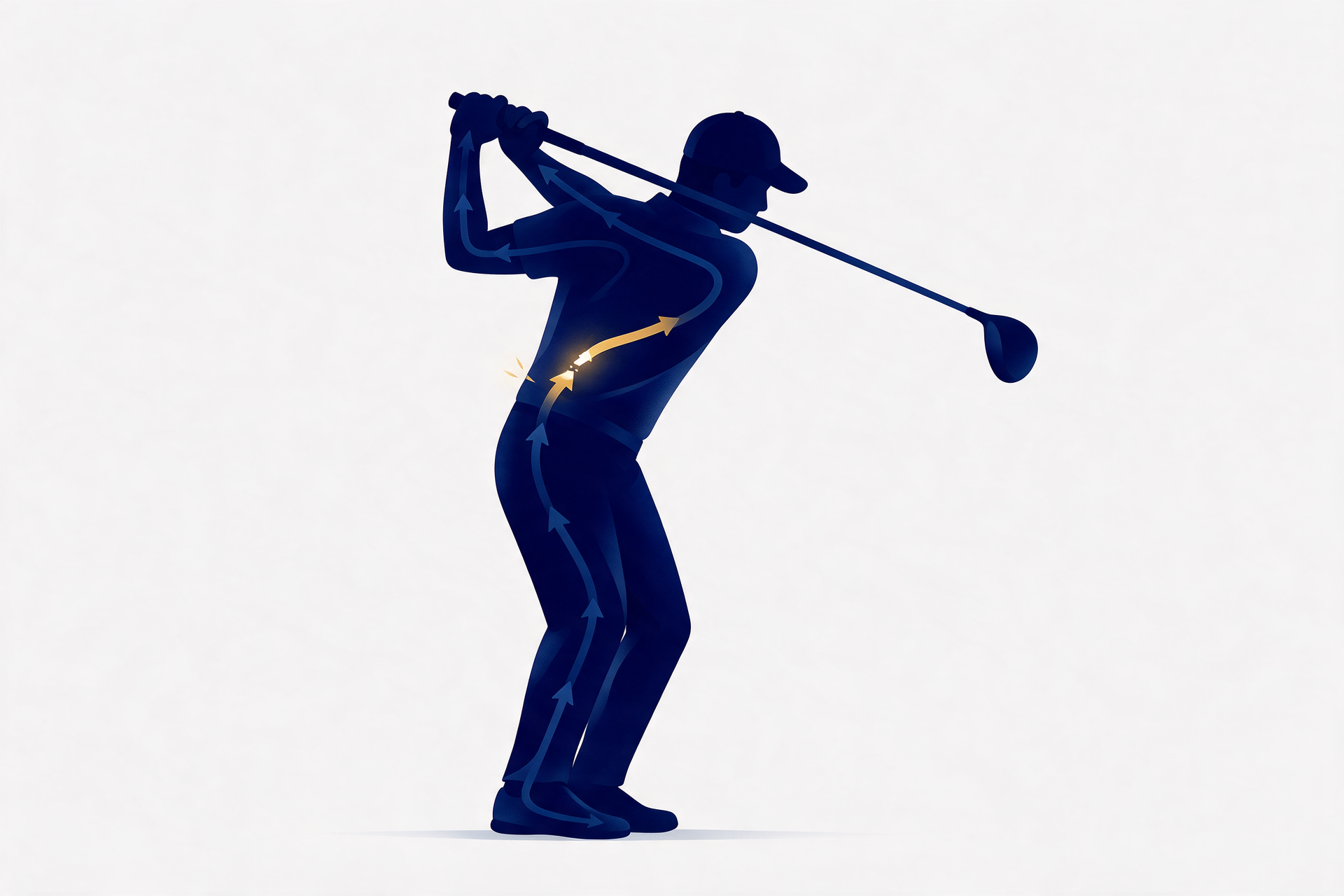
Trace one example all the way through. A golfer sits at a desk all week, so the mid-back loses some rotation. To still make a full backswing, they over-rotate the lower back and let the lead arm pull across the body.
For a while, nothing hurts. Then the volume of a weekend golf trip arrives, the lower back tightens by the second round, and the lead elbow starts aching from steering every shot. Three different areas were involved, but only two ever produced symptoms, and neither was the stiff mid-back that started it.
The lower back often pays for limited rotation
The lower back is where golfers feel this most often. When the hips and the thoracic spine, which is your mid-back, do not rotate well, the lumbar spine tends to make up the difference, twisting and side-bending to find a range the body could not produce above or below it.
The lumbar spine is good at supporting loads, but it is not designed to be your main source of rotation, and the golf swing requires a lot of rotation at speed.
A golf specialist at the
University of Utah Health golf clinic puts it plainly: the hips and thoracic spine are the joints built for rotation, and when they are limited, the body often compensates by overloading the lower back, shoulders, or knees. That is also why stretching the back again and again can feel better for a day and then return.
Picture the golfer who foam-rolls and stretches the lower back every night and still tightens up by the twelfth hole. The back is doing exactly what it has been forced to do. It was never the source. It was the place the problem surfaced.
Hip and thoracic mobility shape the swing
If the hips and mid-back are this important, it is worth being clear about what they actually need to provide, because more flexibility is not automatically the answer.
Controlled rotation requires more than flexibility
Being able to twist far is not the same as being able to rotate well under speed. A useful swing needs controlled rotation, which means the ability to move into a range and stabilize through it while force is moving up the chain. You can see the difference in the range.
A very flexible golfer with no control can still tweak the back because they pour into end range and have nothing to slow them down. A golfer with moderate range but real control of it stays organized through the turn.
Looseness without control tends to leak energy and invite compensation. Stiffness without range forces other areas to overwork. The goal sits in between: a range you can own and steer, not just reach.
That is why mobility work for golf is usually paired with strength and control work rather than done on its own. Control is also what protects the lower back, because a trunk that can resist and decelerate rotation keeps the lumbar spine from being whipped into the end of its range on every downswing.
Common compensations when rotation is limited
When rotation is restricted, the body finds the range somewhere else, and the substitutes are predictable. Golfers often reach for the same substitutes:
- Arching the lower back to fake a bigger turn.
- Swaying or sliding sideways instead of rotating over a stable hip.
- Standing up out of posture early in the downswing.
- Letting the arms take over the swing.
None of these feels dramatic in the moment, and most golfers never notice they are doing it.
Each substitution quietly moves stress onto a structure that did not sign up for it. Early extension, where the hips push toward the ball and the torso lifts, is common and tends to load the lower back and alter how the arms deliver the club.
That is how a mobility limitation in one place becomes pain in a completely different place, and why chasing the pain rarely solves it. Coming over the top is another familiar one: when the body cannot sequence from the ground up, the upper body fires first, the club steepens, and the lead shoulder and elbow take on the load the trunk and hips should have produced.
The swing fault and the ache are two views of the same missing capacity.
Shoulder, elbow, and wrist pain can start downstream
Arm pain in golf is not always an arm problem. The same chain logic runs out to the hands. If the trunk does not rotate well, the arms generate more power.
If the shoulder lacks endurance, the elbow and wrist tend to grip and steer harder to keep control. If the hands over-control the club, the forearm absorbs the cost. A golfer who catches a heavy lie in the rough and instinctively grips and yanks through it is asking the forearm to do a job the whole body should have shared.
Hospital for Special Surgery built a
golf-specific guide to what hurts that walks the body region by region, from the neck and shoulders down through the elbow, wrist, and back, precisely because golf loads the whole system rather than one joint.
When you treat an aching elbow or wrist as a standalone problem, you can miss the part of the chain that kept overloading it, which is often why the same elbow flares again a few rounds later.
Tempo and timing feed this too. When the shoulder fatigues late in a round, many golfers unconsciously cast or release the club early and snatch at impact with the hands and wrists. Over a few dozen swings that is a lot of repeated, poorly shared load funneled into the smallest joints in the chain, which is exactly the recipe for a sore wrist or elbow.
The warm-up problem: preparing the body, not just loosening up
A warm-up should prepare you for golf, not simply make you feel looser. The job is to raise your temperature, rehearse rotation, wake up balance, and give the hips, trunk, and shoulders a chance to coordinate before any full-speed swings.
A practical version takes only a few minutes: some easy movement to raise your heart rate, a handful of controlled rotations for the hips and mid-back, and a progression of swings that starts at half effort and builds, rather than walking up and ripping a driver cold.
This is where the type of warm-up matters. A
systematic review of golf warm-ups found that dynamic, movement-based preparation tended to help performance, while static stretching alone was inferior and could even work against you. Many golfers either skip the warm-up entirely or treat a few held stretches in the parking lot as enough.
Golf asks for controlled movement at speed, so the warm-up should look like controlled movement, not a stretch you hold while scrolling your phone.

The first few swings of the day are also the ones most likely to catch you cold, when the tissues are least prepared and the sequence is least grooved, so building up to full speed is as much about protecting the back and shoulders as it is about scoring well on the opening holes.
A real prevention plan covers the whole chain
Because the problem is rarely one spot, prevention should not be one spot either. A plan that actually fits the demands of golf builds capacity across the chain rather than chasing the latest sore area.
A useful golf prevention plan tends to include:
- Hip mobility and thoracic rotation, so the spine is not forced to find a range it should not. Think open-half-kneeling hip openers and slow, controlled trunk rotations from all fours.
- Trunk and core control, so rotation is stable rather than loose. Anti-rotation holds with a band and dead bugs are simple staples here.
- Balance and weight transfer, so the ground-up sequence has a stable base. A daily single-leg stand and slow, deliberate weight shifts cover a lot of ground.
- Shoulder endurance and grip capacity, so the arms are not the only engine. Band pull-aparts and a set of farmer carries go a long way.
- Gradual workload progression, so practice and rounds build instead of spike. Add a few holes or one range bucket at a time, not a full golf trip after a month off.
Strength and movement work sit at the center of that list. National
physical activity guidance for adults already recommends muscle-strengthening activity that works the major muscle groups at least twice a week alongside regular aerobic activity, which is a sensible floor before you layer on the rotation, balance, and workload pieces that golf specifically demands.
In practice, that might look like two short strength and mobility sessions during the week, a proper warm-up before you play, and a plan to add holes or range volume gradually rather than jumping straight from rest into 36 holes on a golf trip. The best plan is not complicated for its own sake. It is specific to the game and to the body playing it.
Some golf pain needs more than training
Training builds capacity, but it is not a substitute for care when something is wrong. Pain that is sharp, that keeps worsening, that follows a specific incident, or that comes with numbness, tingling, or weakness is a signal to check in with a qualified medical professional rather than train through it.
Coaching can support a return once you have guidance, and it should never replace an evaluation when your body is telling you something has changed.
Royal Blue Fitness builds a more resilient golf body
If you have been chasing one sore spot and watching it move around your body, that is the pattern this article is about, and it usually responds to a whole-chain approach rather than another stretch for the sore part.
At Royal Blue Fitness, we start by looking at how you actually move, where your workload is concentrated, and which links in the chain need rebuilding so you can play more consistently.
That work often blends strength training, mobility, rotational control, balance, and a sensible return-to-activity progression, matched to where you are now rather than where a generic program assumes you should be.
If you want a clearer picture of your own chain before the next sore spot finds you, the simplest next step is a Strength and Range of Motion Assessment.
Book your assessment and start building a golf body that holds up to the game you love.
Frequently Asked Questions
Why do golfers get injured?
Golfers usually get injured when the repeated demand of swinging outpaces the body's current strength, mobility, control, or recovery. The swing is high-repetition rotation under load, so when one part of the chain cannot do its share, another part absorbs the extra stress until it complains.
That is why injuries often trace back to preparation and capacity rather than a single bad swing, and why the same spot tends to flare again if only the symptom was addressed. In other words, the swing exposed a capacity gap that was already there.
Can poor mobility really cause golf injuries?
Limited mobility does not act alone, but it is a common contributor. When the hips or mid-back cannot rotate well, the lower back, shoulders, or arms often compensate, concentrating stress in areas not built to handle it. Improving controlled rotation where it belongs and backing it with strength can take pressure off the areas that keep flaring.
Should golfers strength train?
For most golfers, yes. Strength work supports rotational control, balance, endurance, and the tissue tolerance that lets you repeat swings without breaking down. It is less about hitting the ball harder and more about being able to play often without the body paying for it the next morning.
Strength training does not have to be heavy or complicated to be useful for golf.
How can I prevent golf injuries without quitting the game?
You rarely need to quit. The more sustainable path is to build capacity across the chain, hips and mid-back mobility, trunk control, balance, shoulder and grip endurance, and to progress your practice and playing volume gradually instead of in spikes. A short, consistent preparation routine, plus a genuine warm-up before you play, usually does more than an occasional heavy stretch session.
It also helps to pay attention to how you feel the next morning, since the day-after response is often a more honest report card than how the round felt in the moment.
When should golf pain be checked by a professional?
Pain that is sharp, steadily worsening, associated with a specific injury, or accompanied by numbness, tingling, or weakness warrants evaluation by a qualified medical professional. Training is for building capacity, not for pushing through symptoms that may signal a need for care first. When in doubt, get it looked at, then build the plan around what you learn.
Here are our latest articles! Click to read more.


Strength for Independence After 50: Training for Stairs, Carrying, Travel, and Getting Off the Floor