Strength for Independence After 50: Training for Stairs, Carrying, Travel, and Getting Off the Floor
Think about the moments that actually make up an independent life. Climbing the stairs to your own bedroom without thinking about it. Carrying a full laundry basket or a grandchild across the room.
Hauling a suitcase through an airport and walking on uneven ground in an unfamiliar city. Lowering yourself to the floor to reach something, and getting back up under your own power. None of these happen in a gym, and none of them care what you can bench press.
For adults over 50 who value daily capability over gym identity, this is the real goal of strength training: not a number on a bar, but a life you can keep living on your own terms. This guide maps the tasks of an independent life to the strengths that support them and shows you how to train for what actually matters. You will not need to become a gym person to do this, and you will not be chasing numbers that mean nothing outside the weight room.
The aim is the opposite: to keep the stairs easy, the suitcase manageable, and the floor a place you can get down to and back up from without a second thought, well before any of it feels urgent.

What independence actually requires
Independence is not a single ability; it is a collection of physical capacities working together quietly in the background of your day. When people lose independence, it rarely happens all at once. It happens gradually, as strength, power, and balance slip below the level required by daily tasks, until one day a flight of stairs or a curb feels like an obstacle.
Understanding independence this way, as a set of trainable capacities rather than an inevitable decline, is the first and most important shift. It is well supported that
maintaining strength and balance is closely tied to staying able to do the things you want to do as you age.
The capacities are trainable, which means the slide is not inevitable. It helps to think of it as a margin. Every daily task requires a certain amount of strength, power, and balance, and as long as your capacity sits comfortably above that requirement, the task feels effortless, and you never give it a thought.
The trouble starts when your capacity drifts down toward the requirement, so that an activity which was once automatic now takes real effort. Training widens that margin again, which is why it so often restores a sense of ease that had slipped away without your noticing.
The daily-task lens
The most useful way to train for independence is to start from the tasks themselves and work backward. Instead of asking what a generic workout should include, ask what your life actually requires of your body, then build the strength qualities those tasks demand. This daily-task lens keeps your training honest and relevant because every exercise has a clear reason to exist.
It also makes progress meaningful in a way the scale never can: when training carries over to easier stairs and steadier travel, you can feel it in your life.
Targeted strength work is repeatedly linked to better real-world physical function in mature adults.
The practical beauty of this lens is that it tells you immediately whether your training is worth doing. If an exercise has no clear connection to a task you care about, you are allowed to question why it is in your program at all.
And if a daily activity has started to feel hard, the lens points straight to the quality worth training. It keeps your effort focused on your own life rather than on someone else's idea of what a workout should include.
The map: daily tasks to strength qualities
Here is the organizing model. Four common categories of daily tasks each map to a specific strength quality, and once you see the connection, your training stops being abstract. The point is not to memorize a list, but to recognize that the things you want to keep doing are the things you can train for directly.
This map is also how we read a Strength and Range of Motion Assessment. When rising from a chair looks effortful but grip tests fine, the plan starts at lower-body power. When the single-leg balance wobbles early, balance work moves to the front. The assessment tells us which row of this map your training should start from.
| Daily task | Strength quality it draws on |
|---|---|
| Stairs and standing up | Lower-body strength and power |
| Carrying and lifting | Grip, core stability, and posterior chain |
| Travel and uneven ground | Balance, mobility, and endurance |
| Getting up from the floor | Lower-body strength, mobility, and balance together |
Stairs and standing up
Climbing stairs and rising from a chair both come down to lower-body strength and power, particularly the ability to produce force quickly. Power, meaning strength applied with speed, tends to decline faster than raw strength as we age, and it is exactly what you use to push up out of a low seat or drive up a step.
Clinicians treat the sit-to-stand as a direct window into this quality: the
five times sit-to-stand test is used to quantify functional lower-body strength, and taking longer than about 15 seconds flags elevated fall risk in adults 65 and up. If stairs or low chairs have started to feel like work, this is usually the quality asking for attention.
You can often feel this one declining before you consciously register it: pausing a beat before rising from a deep couch, or pressing on your knees to get out of a chair. Those small workarounds are your body quietly compensating for lost lower-body power. This quality responds quickly to training, though, and many adults are genuinely surprised at how quickly rising and stair-climbing begin to feel easier once they train it on purpose rather than avoiding it.
Carrying and lifting
Carrying groceries, lifting a grandchild, and moving a bag of soil all draw on grip strength, core stability, and the muscles along the back of your body, the posterior chain. These are the capacities that let you pick something up safely and hold onto it without your body buckling or your back complaining.
Grip strength in particular is a
simple but well-studied marker of overall capability. When carrying things starts to feel precarious, the answer is usually to train these supporting qualities, not to simply carry less and shrink your life.
There is a slow trap in adapting by avoidance: making two trips instead of one, leaving the heavier bag in the car, asking for help with things you used to handle on your own. Each accommodation seems reasonable in isolation, but together they steadily shrink what you are capable of, and capability tends to follow use. Training the carrying qualities lets you keep doing these things yourself, which is a meaningful part of staying independent rather than slowly handing your tasks away to other people.
Travel and uneven ground
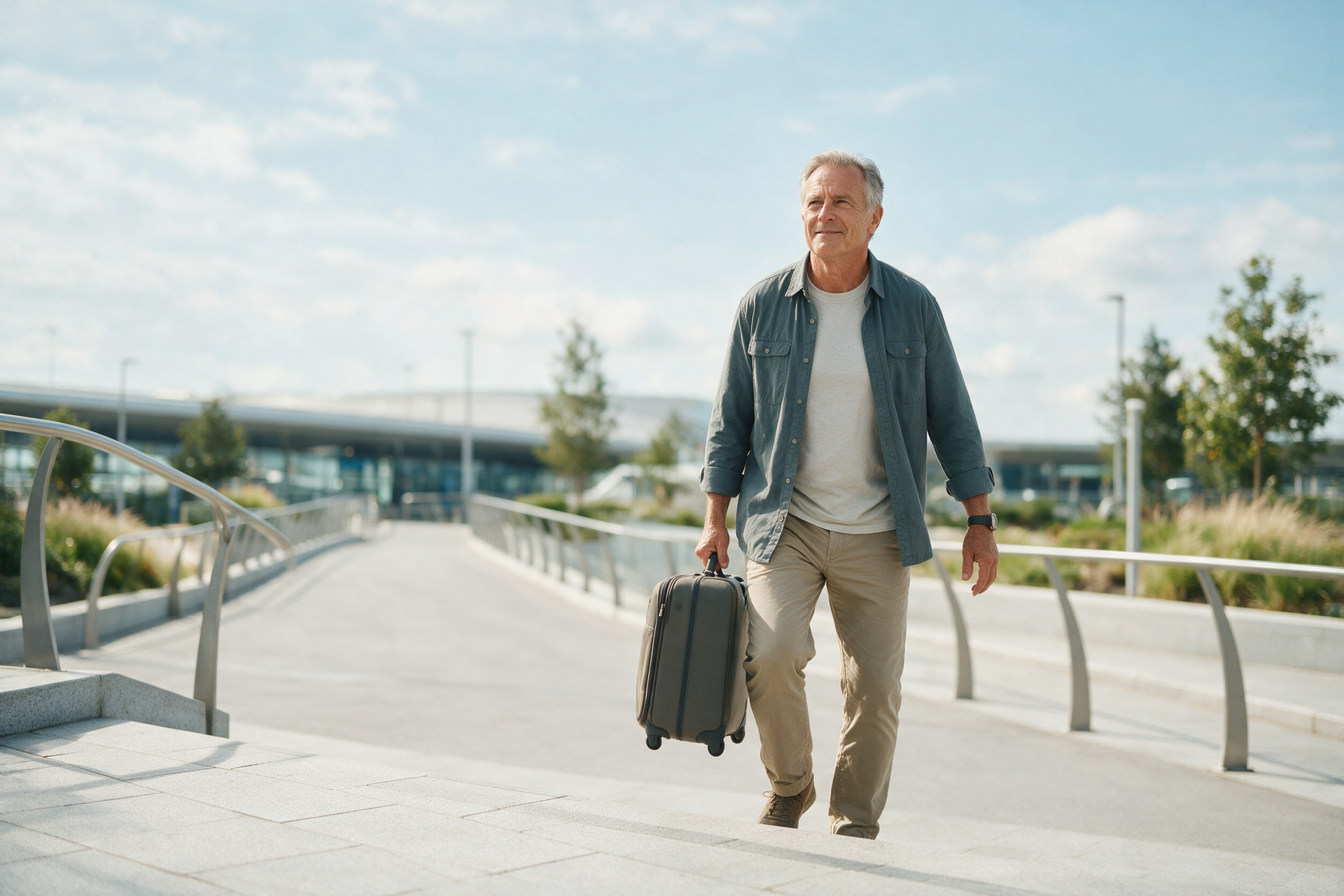
Walking through an airport, navigating a cobblestone street, or hiking a gentle trail all demand balance, mobility, and the endurance to keep going. Uneven ground is where balance reveals itself, because your body has to make constant small corrections that flat floors never require.
Global guidance backs this up: the World Health Organization recommends that adults 65 and up do
varied activity emphasizing functional balance and strength on three or more days a week, specifically to enhance functional capacity and prevent falls. If travel has started to feel risky rather than exciting, balance and mobility are the qualities worth building, so the world stays open to you rather than slowly shrinking to the places that feel safe.
Uneven ground is genuinely more demanding than a flat floor because your ankles, hips, and core are constantly making tiny adjustments to keep you upright. That is a trainable skill, not a fixed limit you have to accept. Practicing balance and moving over varied surfaces in a controlled, safe way builds the confidence to say yes to the trip, the trail, and the cobblestone street, rather than politely declining them and watching your world contract.
Getting up from the floor
The ability to get down to the floor and back up is one of the most telling capacities of all, because it combines lower-body strength, mobility, and balance in a single demanding task. It is also the one many adults quietly stop practicing, which is exactly how it slips away.
Being able to get up off the floor under your own power, whether you are playing with a grandchild or recovering from a stumble, is a cornerstone of genuine independence. The good news is that, like the others, it is a trainable skill, and practicing it safely is far better than avoiding the floor entirely.
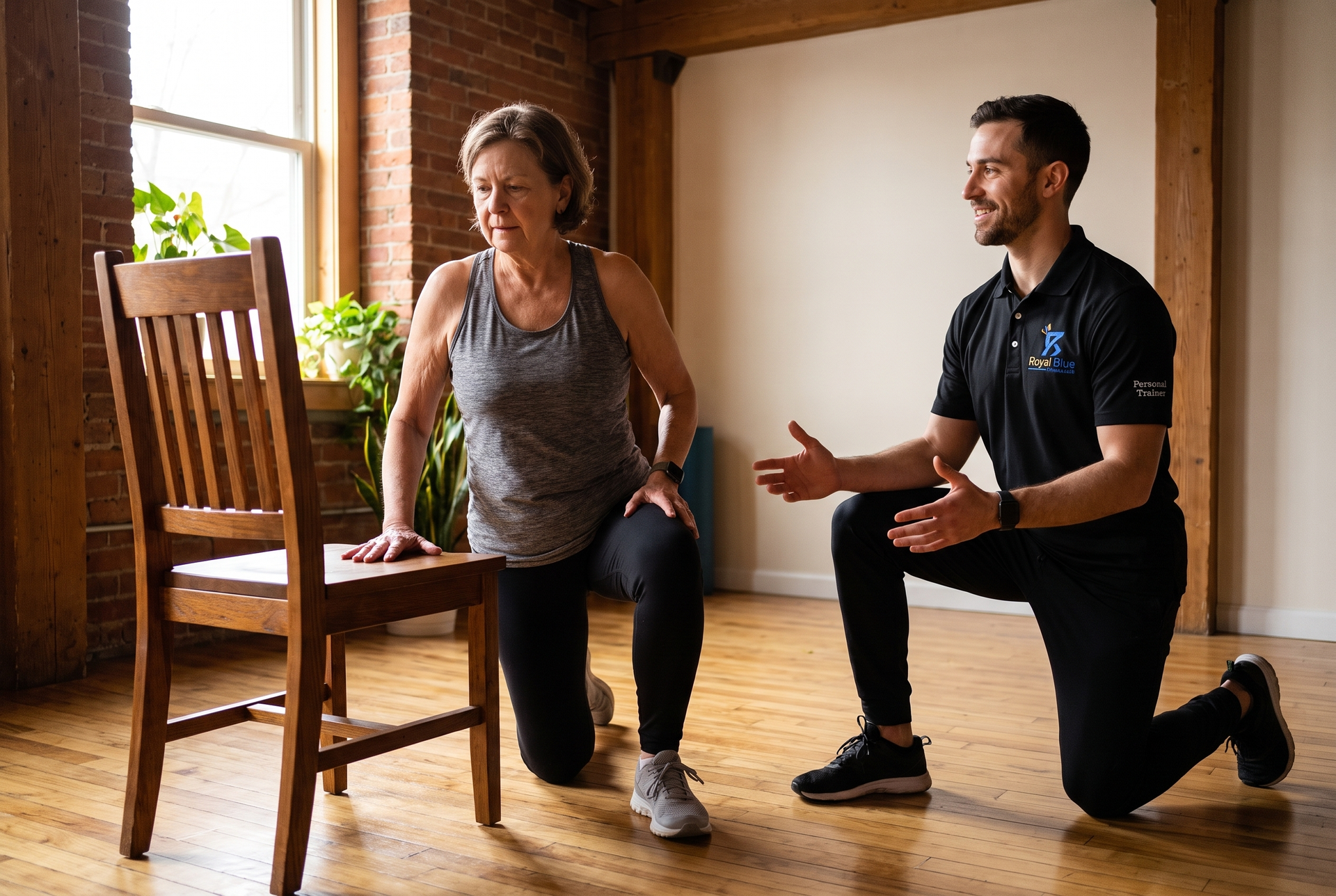
A staged path works best. Start by lowering to and rising from a firm couch, then practice kneeling beside a sturdy chair and using it to step one foot forward and stand. From there, reduce how much you push on the support, and eventually practice the whole trip to the floor and back with no hands at all. Treat each stage as earned, not rushed. Treating floor transfers as a skill you keep sharp, rather than something you avoid until the day you have no choice, is one of the most practical investments you can make in staying independent. Like any skill, it fades when neglected and comes back with practice.
How to train these qualities safely
Knowing which qualities matter is half the picture. The other half is training them in a way that fits where you are now and progresses sensibly. The aim is steady, controlled work that builds capacity over months, not heroic efforts that leave you sore or sidelined.
Everything below is general education, and the right starting point and progression for you depend on your individual situation. The throughline across all of it is gradual progression within your control: begin at a level you can manage with good form, and increase the challenge only as each movement becomes comfortable. That one habit, applied patiently, is what turns these qualities from a list on a page into lasting capability.
Lower-body strength and power
Build your legs with controlled, full-range movements like sit-to-stands, supported squats, and step-ups, progressing in difficulty as you get stronger. Once basic strength is in place, you can introduce a little speed on the way up, since training that quickness is what preserves the power stairs and chairs demand.
Professional guidance supports
progressive resistance training for building and maintaining physical function as we age. Start where you can move well, and add challenge gradually rather than all at once.
A simple progression might begin with sit-to-stands from a higher, supportive surface, move to a standard chair, then to a lower seat, and eventually add a light weight held at your chest. The same logic applies to step-ups: start with a low step and increase the height as you get stronger. The principle throughout is to keep working at a level you can genuinely control, then make it a little harder only once it has started to feel easy.
Grip, core, and posterior chain
Train the carrying and lifting qualities with movements that mimic real demands: holding and walking with a manageable weight, hinging at the hips to lift from the ground with a strong, neutral back, and rows that build the muscles along your spine. Grip improves simply by holding meaningful loads, and core stability builds when you brace against weight rather than crunching for its own sake. These patterns rehearse the actual demands of daily life, so the strength shows up where you need it, in your driveway and your kitchen rather than only in the gym.
A loaded carry is a perfect example of training that looks exactly like life: pick up a manageable weight in each hand, stand tall, and walk a controlled distance, and you have trained grip, core, and posture all at once in a way that transfers straight to carrying groceries or luggage. Hip hinges, learned carefully, teach you to lift from the ground using your strong posterior chain instead of your back, a skill worth having every single time you pick something up off the floor. In sessions we watch the carry, not the clock: the set ends when posture starts negotiating, shoulders rounding or ribs flaring, because a carry that stays tall is the one that transfers to your driveway.
Balance and mobility
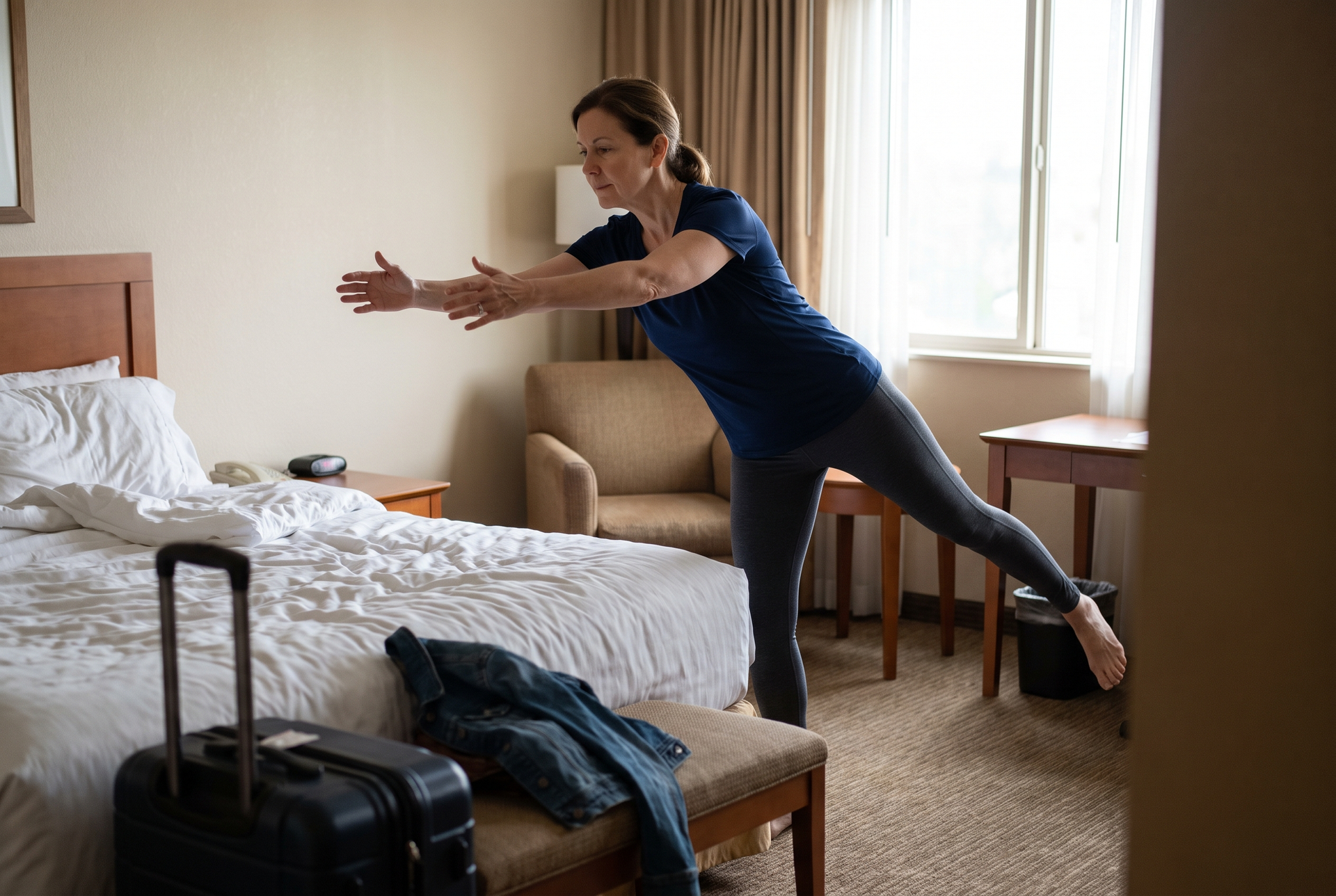
Balance is trainable at any age, and it improves with practice that gently challenges your stability, such as standing work that narrows your base or carefully practiced single-leg movements, always within a setup where you can catch yourself safely. Mobility work keeps your joints moving through the ranges that travel and uneven ground require.
Balance and mobility deserve deliberate attention rather than being left to chance, because they underpin so much of what keeps mature adults confident on their feet.
Balance work does not require anything elaborate. Standing with your feet close together, or practicing standing on one leg beside a counter you can grab if needed, gently challenges the systems that keep you steady, and those systems improve with regular practice.
The key word is regular, because balance, like strength, responds to consistent attention and quietly fades without it. Progress it the way you would progress a lift: feet together, then heel to toe, then one leg with a fingertip on the counter, then one leg free, and only then on a softer surface like a folded towel. A few minutes woven into your routine genuinely add up over the months.
What this is NOT
Because independence is precious, it is important to be clear-eyed about what training can and cannot do. Strength training is one of the most valuable things you can do to support your capability as you age, but it is not a guarantee, and it is not medical care.
No program can promise to prevent falls or guarantee you will stay independent, because those outcomes depend on many factors beyond training, including health conditions, medications, and circumstances outside anyone's control. Public health guidance frames
leg-strengthening and balance exercise as one strand of fall prevention, alongside medical checkups, vision care, and home safety, not a standalone cure.
If you have a medical condition, a balance disorder, a history of falls, or any concerns, please work with your medical provider and consider
trusted resources on preventing falls. This guide offers general education, not diagnosis or treatment.
The honest framing is that training stacks the odds in your favor without ever removing uncertainty. It is one of the most worthwhile things you can do for your future capability, pursued alongside good medical care rather than in place of it.
How RBF builds this with an assessment
At Royal Blue Fitness, training for independence starts with understanding how you actually move and where your strength stands today, because a plan built on guesswork helps no one. That is the purpose of the Strength and Range of Motion Assessment: an honest, personal read of your strength, mobility, and movement, so your training targets the daily-task qualities that matter most for your life.
From there, the Strong for Life approach for adults 50+ builds those qualities gradually and safely. Healthy-aging organizations consistently point to
strength and balance as foundations of staying capable, and the assessment is simply how we make sure your plan is built on your real starting point rather than a template.
That starting read matters most for exactly the people this article is written for, because daily-life capability is so individual. Two adults of the same age can have very different strengths, limitations, and goals, and a plan that ignores those differences tends to either underwhelm or overreach. Beginning with an honest assessment is simply how the training stays pointed at your life rather than at an average, which is the whole point of training for independence in the first place.
Frequently Asked Questions
Is it really possible to stay independent longer through strength training?
Strength training is strongly associated with better physical function and capability as we age, and it is one of the most meaningful ways to support an independent life. It is not a guarantee, because many factors influence independence, but training the strength, power, and balance that daily tasks require gives you the best foundation to keep doing the things you value. The research consistently points in this hopeful direction.
What if I already feel unsteady or weak?
That is a reason to start thoughtfully, not a reason to avoid training, but it is also a reason to involve the right people. If you feel unsteady, have had falls, or have a medical condition, talk with your medical provider first and consider starting with professional guidance so your program fits your situation safely. Many adults who feel weak or unsteady make real gains in capability with appropriate, gradual training, but the starting point should be matched to where you genuinely are.
Do I need heavy weights to train for independence?
No. Training for independence is about building usable strength, power, and balance for daily tasks, which you develop through controlled, gradually progressed movements, not through maximal lifting. Some meaningful resistance is important because your body needs a real reason to adapt, but the emphasis is on quality movement and steady progress rather than chasing heavy numbers. The goal is capability, not a personal record.
How often should I train for this?
A common, effective starting point is strength and balance work a couple of times a week on non-consecutive days, which gives your body time to recover and adapt. Consistency over months is what builds and maintains the qualities that support independence, far more than occasional intense sessions. As always, the right amount for you depends on your health and starting point, which is worth discussing with a qualified professional. For many adults, pairing two short strength sessions with a little balance practice woven into other days is a sustainable and effective rhythm to aim for.
What is the single most important thing to train?
There is no single answer, because independence relies on several qualities working together, but lower-body strength and power, used for stairs and standing up, and balance, used for everything on your feet, are foundational for most people. The daily-task lens helps you prioritize based on which activities feel hardest in your own life. If stairs are the struggle, start there. If travel feels risky, prioritize balance.
Can I undo years of lost strength?
Your body retains its ability to respond to training throughout life, so meaningful improvement is realistic even after years of decline. Many adults regain noticeable strength, steadiness, and confidence with consistent, appropriate training, though the extent and pace vary from person to person. The point is not to return to who you were at 30, but to build the capability you need for the life you want now, and that is very much within reach.
Is it ever too late to start training for independence?
It is rarely too late to make meaningful progress, because the body retains its ability to respond to appropriate training across the lifespan. Adults who begin in their 70s and 80s can still improve strength, steadiness, and confidence with a program suited to them. How much and how quickly depends heavily on your health and current capacity, which is exactly why beginning with professional guidance and your medical provider's input is especially wise if you are starting from a low baseline or managing health concerns.
Stay strong for the life you want
Independence is not a single thing you either have or lose; it is a set of capacities you can train, starting with the strength, power, and balance behind stairs, carrying, travel, and getting off the floor. Training for those is training for the life you actually want to keep. Because daily-life capability is so individual, the place this naturally begins is an honest read of where your own strength, mobility, and balance stand today, matched to the tasks you most want to protect. That is what a Strength and Range of Motion Assessment provides, and it is the starting point of our Strong for Life approach for adults 50+, built around your daily life rather than a generic routine. Our clients around Pleasant Hill, Walnut Creek, and the wider East Bay usually arrive with one task already worrying them. The assessment turns that worry into a starting point, alongside the guidance of your own medical provider. The goal was never the gym. It was the life the gym makes possible.
Here are our latest articles! Click to read more.