Functional Training Near Pleasant Hill: How Strength, Mobility, and Real-Life Movement Work Together
"Functional" might be the most overused word in fitness. It gets stuck on balance-ball circus tricks, on sweaty random workouts that leave you tired but no more capable, and on just about anything done while standing up.
So here is a more useful question than "is this functional?" Does this training actually show up in your life?
Can you carry the groceries, climb the stairs, and get off the floor more easily because of it? That is the real test, and it is the one most programs quietly fail.
The good news is that spotting the difference takes a simple framework, not a fitness degree.

Functional Training Is Defined by Transfer, Not Variety
The point of functional training is transfer: usable capacity that carries from the gym into the rest of your day. Variety, novelty, and sweat are not the goal.
A workout can be hard, creative, and exhausting, and still leave you no better at the things you actually do, because difficulty and carryover are not the same thing. A spin class and a set of weighted step-ups can both leave you breathless, but only one of them makes climbing the stairs at home easier, and that gap is the entire game.
Functional training is built on a handful of basic movement patterns: the squat, hinge, lunge, push, pull, rotation, and loaded carry that daily life runs on. Our functional fitness guide covers each of those patterns in depth, so this article will not re-teach them.
The job here is narrower and, honestly, more useful when you are choosing where to train: how do you judge whether a given program is training those patterns in a way that pays off? For that, you need a lens.
The Access, Control, Capacity, Transfer Framework
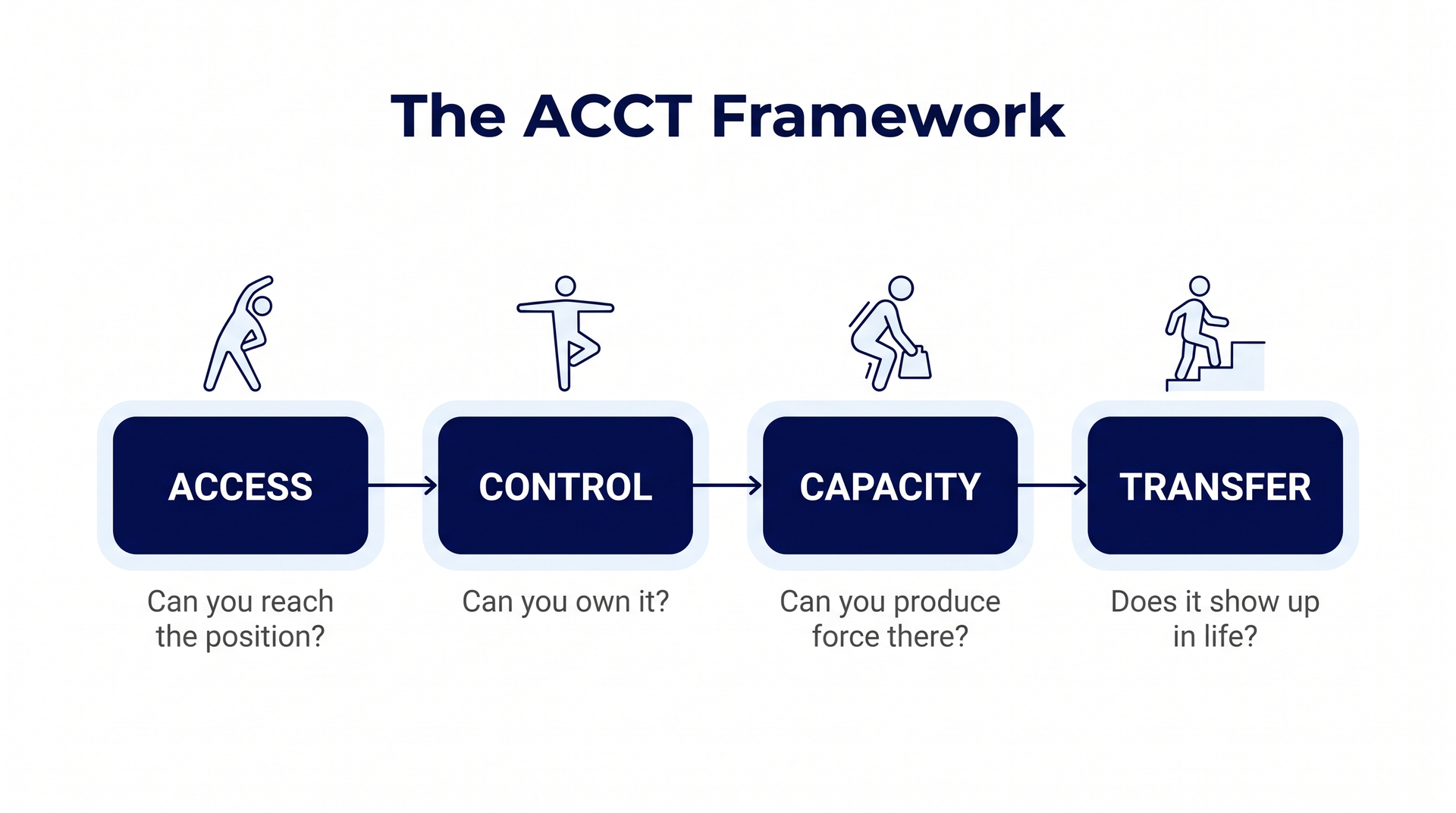
Good functional training answers four questions about any movement, in order. Skip one and the whole thing wobbles. We use them as a checklist for building a plan and judging it, and once you have seen them, you will spot gaps in a program within a single session.
Access: Can You Get Into the Position?
Access is whether your body can reach the position the movement requires, without forcing it.
If you cannot get your hips below your knees, loading a deep squat is a problem looking for a place to happen. Access is the mobility layer, and it comes first.
Mayo Clinic frames a complete program as five elements working together: aerobic fitness, strength, core work, balance, and flexibility; flexibility and range of motion are what open the door to the rest. A good program checks access before it adds weight, rather than bolting load onto a position you cannot actually reach.
Picture someone whose shoulders will not comfortably travel overhead being handed a weight to press overhead anyway. The body finds the range somehow, usually by arching the low back, and a quiet mobility gap turns into a loud back complaint a few weeks later. Access first is not fussiness; it is how you avoid paying for a missing range somewhere else.
Control: Can You Own the Position?
Control is whether you can hold and steer the position once you are in it. Reaching the bottom of a squat is access; staying balanced, organized, and steady there is control.
This is the coordination layer, and it is where most "random hard workout" programs fall, piling speed and load onto positions the person cannot yet own. Control is unglamorous, and it is the difference between training and just surviving a session.
If a movement looks frantic, it is usually missing this. A useful tell when you are sizing up a program: if nearly every set looks rushed and slightly out of control, the plan is testing fitness rather than building it.
Capacity: Can You Produce Force There?
Capacity is whether you can produce real strength in the position, not just visit it.
This is the strength layer, where carryover is actually built. A systematic review and meta-analysis of older adults found that building strength through straightforward, machine-based resistance training improved measured functional capacity on everyday tests like rising from a chair and getting up to walk.
The practical lesson is reassuring: you do not need exotic, unstable, circus-style drills to be "functional." You need to get genuinely stronger in the patterns that matter, then let that strength do its job out in the world.
A pair of strong, well-trained legs is what turns a daunting flight of stairs with a suitcase into a non-event, while the same errand ambushes someone who only ever trained on machines that quietly did the stabilizing for them.
Transfer: Does It Show Up in Life?
Transfer is the only question that ultimately matters: did it change your life outside the gym?
Access, control, and capacity are the inputs; transfer is the output. The CDC puts the stakes plainly: being unable to do everyday activities is called a functional limitation, and physically active adults have a lower risk of those limitations than inactive ones.
That is the scoreboard. Stairs that feel easier, a suitcase that goes overhead without drama, getting up off the floor without a strategy session: transfer is measured in your Tuesday, not in your workout log.
Pick one or two ordinary tasks that used to annoy you, the heavy trash bag, the top shelf, the car seat buckle, and let those be your scoreboard rather than the soreness or the sweat.
Random Functional Workouts Miss the Point
This is why the random-hard-workout model disappoints so many people. It chases novelty and fatigue, throwing a constantly changing pile of exercises at you so no session is ever boring.
The variety feels productive. But because it never moves any one pattern cleanly through access, control, and capacity, it rarely builds the kind of strength that transfers.
You end up conditioned to do random hard workouts, which is a real but oddly narrow skill. It is a little like memorizing trivia for a quiz that never gets asked: impressive in the room, oddly useless the moment you walk out.
There is also a cost beyond wasted effort. Practicing complex movements while fatigued, under-coached, and frequently changed is how positions get sloppy, and joints get cranky.
Hard is easy to manufacture; useful is harder. The goal was never to get good at the gym; it was to get better at your life, and those two things are not automatically the same.
Match the Demand to the Pattern
Once you stop chasing variety, programming gets simpler. You start with your life and work backward to the movements, rather than starting with a clever exercise and hoping it matters.

Start With the Demand, Then Choose the Pattern
Name the real-life demand first; the exercise is just a tool that serves it. If your life involves stairs and getting off the floor, lunges and squats lead.
If it involves lifting and carrying, hinges and loaded carries lead. If you garden, travel, or chase grandchildren, the pattern mix follows those demands.
This sounds obvious, and yet most programs run the other way, starting from a list of exercises and never asking what you actually need them for. Try writing down three things you want to do more easily a year from now; that short, personal list, and not a menu of exercises, is what a good program should be built to serve.
Progress the Pattern, Not the Novelty
Improve by getting better at the same pattern, not by constantly swapping it out.
Progress comes from doing a movement a little better over time, a bit more load, a longer carry, a steadier tempo, not from a new trick every week. Colorado State University Extension is refreshingly concrete about how strength work should advance: train each major muscle group two to three days a week and build up gradually, adding load in slow progressions rather than swapping in a new exercise each session.
Novelty entertains; repetition with small, honest progression is what actually changes your body and your capability. The boredom people feel with repetition is usually impatience wearing a disguise; the movements that look the same week to week are precisely the ones getting stronger underneath you.
What Good Functional, Mobility, and Flexibility Training Looks Like Near Pleasant Hill
If you are choosing where to train around Pleasant Hill, the framework turns into a short checklist. Good functional training tends to share a few visible traits:
- It starts with your goals and your life, not a fixed class template, so the plan can explain why each exercise is there.
- It includes a real movement check before loading, so access and control are handled before capacity gets stacked on top.
- It progresses the same patterns over time and can show you that progress, rather than reaching for a new gimmick every session.
- It scales every movement to the body in front of it, offering pain-free options instead of running everyone through the same workout.
That is the kind of coaching we built Royal Blue Fitness around: assessment-led, pattern-based, and judged by whether your daily life gets easier. The label matters less than the result.
And if a place cannot tell you why a given movement is in your plan, treat that as a real warning sign, not a small one; it usually means the plan was assembled from a template rather than designed for a person.

Why Assessment Makes the Plan Simpler
It seems backward, but starting with an assessment makes training simpler, not more complicated. When you know where your access, control, and capacity actually stand, you can stop guessing and stop doing a little of everything just in case.
The National Institute on Aging notes that staying active is how adults maintain and improve the strength and balance that protect independence, and an assessment simply pinpoints the effort to your specific weak links. Fewer random exercises, more of the few that move your particular needle.
That is what makes a plan feel light to follow instead of overwhelming. It is the difference between a tailored short list and a sprawling buffet you feel obligated to sample from, and the short list is both easier to stick with and far more likely to work.
The Simple Test: Does Training Make Life Easier?
Strip away the jargon, and you are left with one honest gut-check: is daily life getting easier? The federal physical activity guidelines name this directly: among the proven benefits of regular activity for adults, they list better physical function and quality of life, not just a lower risk of disease.
If the stairs are less of an event, if the groceries are less of a grind, if you move through your week with more confidence and less hesitation, the training is working. If you are only getting better at the workouts themselves, it is time to ask the four questions again.
That is not really a failure; it is feedback, and it usually means one of the four layers, access, control, capacity, or transfer, got skipped. The fix is to find which one, not simply to train harder.
Make Functional Training Feel Useful: Start With an Assessment
Functional strength and mobility training in Pleasant Hill should translate into something you can feel outside the gym. The fastest way to get there is to find out where your patterns actually stand and aim your training at what matters most for your life.
A Strength and Range of Motion Assessment maps your access, control, and capacity so we can build training that adds up, near Pleasant Hill, for your body and your week. If you are tired of hard workouts that do not seem to make any difference, that is the place to start.
Functional Training: Quick Answers
What is functional training?
Functional training is strength and movement training designed to transfer to real-life tasks. It is a purpose, not a particular style: any session that improves how easily you carry, climb, lift, and move through your day is doing the job.
It is built on the body's basic movement patterns, which our functional fitness guide covers in full, and it is best judged not by how hard it feels but by whether daily life gets easier because of it.
How do strength and mobility work together?
Think of them as two halves of one capability. Mobility gives you access to a position, the range to actually get there, while strength and control let you produce force and stay organized once you are in it.
Mobility without strength is a position you can reach but not use; strength without mobility is power trapped in too small a range. Functional training deliberately builds both, which is why a good program checks your range before it loads a movement.
What should I look for in functional training near me?
Look for coaching that starts with your goals, includes a real movement check before piling on load, explains why each exercise is in your plan, and shows you visible progress in the same patterns over time. Be cautious of programs that are mostly novelty and fatigue, where every session is different, and nothing is ever measured.
The right fit near Pleasant Hill is the one that can tell you what it is training and why, and scales each movement to your body.
Is functional training the same as circuit training?
No. A circuit is a format, a way of organizing exercises back to back with little rest, while functional training is a purpose, training movements that transfer to life.
A circuit can be functional or not, depending entirely on what is in it and how cleanly it is run. Judge the substance, not the format: a tidy, well-coached circuit of squats, carries, and presses can transfer beautifully, while a frantic circuit of random drills may not.
How soon will I notice it transferring to life?
Often sooner than you would expect, and usually in small, specific ways before any change shows in the mirror. Within a few weeks of consistent training, many people notice steadier stairs, easier lifting, and more confident carries.
Those quiet wins are the transfer showing up, and they are the signal that the training is doing its real job. Bigger changes in strength and capability build over months, so the early signs are a reason to keep going, not a finish line.
Here are our latest articles! Click to read more.