Lifting Form vs Lifting Load: How to Know Which One Should Come First
Every lifter hits this question eventually, usually mid-set, with a weight that is right at the edge of what they can handle cleanly. Do you grind out the rep with form that is starting to slip, because the heavier weight feels like progress? Or do you stop, drop the load, and keep the movement clean, even though it feels like going backward?
It gets framed as a tradeoff, form or load, as if you have to sacrifice one for the other. You usually do not. Form and load are not rivals; they are a sequence, and knowing which comes first at any given moment is one of the most useful skills in strength training.
This guide settles the question. The short version is that you almost never have to choose between them permanently. The lifter grinding out a sloppy maximum and the lifter too timid to ever add weight are making opposite mistakes, and both of them stall.
The real skill is knowing, in the moment, which one your situation calls for. The rest of this article gives you a clear way to decide rather than guess.

Why this feels like a tradeoff (and usually is not)
The tension feels real because in the short term, you genuinely can lift more weight by letting your form degrade, and heavier numbers feel like the obvious measure of progress. So in any single set, there does seem to be a choice between a cleaner rep and a heavier one.
But that framing collapses as soon as you zoom out. Over weeks and months, sloppy form under heavy load tends to stall progress and invite tweaks and strain, while good form lets you keep adding load safely for far longer. The apparent tradeoff in one set is a false economy across a training career.
Picture the same lifter across a full year. If they chase weight at the expense of form, they spend that year accumulating tweaks, backing off from strain, and restarting from a lower point again and again. If instead they build clean form and add weight only as it holds, they spend the year steadily loading patterns that keep working session after session.
Same person, same starting point, wildly different outcome.
The reason this false tradeoff is so persistent is that the costs and the benefits arrive on completely different schedules. The heavier number rewards you immediately, with a satisfying jolt of progress, while the price, the tweak, the stall, the foundation you have to rebuild, shows up weeks or months later.
By then, it is easy to blame something else entirely. Good lifters learn to discount the instant reward and respect the bill that arrives on delay.
What good form really means
A lot of confusion here comes from a fuzzy idea of what good form actually is. People imagine it means picture-perfect, identical-to-a-textbook movement, and then either chase an impossible ideal or dismiss form entirely as fussiness.
Neither is right. Good form is more practical and more forgiving than the perfectionist version, and understanding it makes the whole form-versus-load question easier to answer.
What good form is
Good form means performing a movement with control, through an appropriate range of motion, with your joints and spine in safe, effective positions, and using the muscles the exercise is meant to train. It is the technique that lets you produce force safely and direct the work where you want it.
Good movement is best understood as robust and adaptable rather than rigidly perfect. Good form is the foundation that makes loading productive, because it ensures the weight you add builds strength rather than grinding down a vulnerable position.
Progression guidance from the
American College of Sports Medicine frames sound technique as the basis for safely increasing training demands over time, not as an optional nicety you can skip once you are eager to load.
What good form is not
Good form is not robotic perfection, and it is not identical for everyone. Bodies differ in proportions and structure, so the exact look of a sound squat or deadlift varies from person to person, and small natural variation is normal, not a flaw.
Chasing a single idealized template can become its own trap, leaving people too afraid to ever load a movement. Form should be safe and effective for you, not a rigid ideal that paralyzes progress. Good enough, controlled, and safe is the standard, not flawless.
What load does, and when chasing it backfires
Load is not the enemy here. Adding weight is essential to getting stronger, and treating form as an excuse to never progress is a mistake in itself. The problem is not the load itself but loading faster than your form can support, which is where the trouble starts.
Why load matters for progress
Progressive overload, gradually increasing the demand on your body, is what drives strength gains, and adding load is one of the primary ways to do it. Without ever increasing the weight, your training eventually stops challenging you, and progress stalls. Consistent, progressive loading is central to building strength.
So load is not something to avoid out of caution. It is something to earn and then add deliberately, once your form can handle it.
This is worth stressing because the form-first message gets misheard as permission to stay comfortable forever. It is nothing of the kind. A program where the weight never climbs is not cautious; it is simply stalled, because your body adapts to the demand you place on it and then stops improving.
The entire purpose of building good form is to earn the right to keep adding load, which means the destination was always a heavier weight, just reached in a safe way rather than a reckless one.
How ego-lifting goes wrong
The classic failure is ego lifting: piling on weight your form cannot support, turning clean reps into heaving, partial, compensated movements. It feels like progress because the number is bigger, but it trains a degraded pattern, takes the target muscles out of the work, and raises the risk of tweaks and strain.
Injury research bears this out. A recent review found that
improper technique and excessive loading are among the leading contributors to resistance-training injuries, and that prevention rests on sound technique and well-managed progression. That is exactly the combination ego lifting abandons.
Ego lifting front-loads a heavier number today at the cost of stalled, riskier training tomorrow, which is a bad trade. The point is not fear of weight, since loading is necessary to get stronger, but respect for the order: the weight should follow your movement quality, never outrun it.
The principle: form earns load
Here is the principle that resolves the whole question: form earns load. You establish good form first, then add weight on top of that foundation, and you only keep adding weight as long as your form holds.
Form is not a phase you graduate from; it is the standard you maintain while load climbs. This sequence lets you progress as heavy as your body can handle, for as long as possible, which is exactly what builds the most strength over time. The table below sums up the decision, and the sections after it walk through each situation in detail.
| Your situation | What it means | The right move |
|---|---|---|
| Learning a new movement, form gets shaky as the weight climbs, a joint complains, or you are returning after a layoff | Your technique cannot yet support more load | Hold or reduce the weight and reinforce the pattern (form comes first) |
| Form is clean and controlled at your current weight, the movement feels good, and the weight feels manageable | Your technique is supporting the load with room to spare | Add a small increment, because you have earned the load |
| Your form only holds through a shortened range | The weight is outrunning your honest range | Earn a fuller, controlled range at the current weight before adding load |
When form comes first
Form takes priority when you are learning a new movement, when your technique gets shaky as the weight climbs, when a joint starts to complain, or when you are returning after a layoff. In all of these, the right move is to reduce or hold the load and reinforce the pattern until it is solid.
This is not going backward. It is building the foundation that lets you go heavier safely later, and it almost always pays off faster than grinding through compromised reps.
A practical way to apply this is to treat any persistent breakdown as a stop sign for load. If the same fault keeps appearing on your heavier sets week after week, that is not a cue to try harder at the same weight; it is a cue to drop down, reinforce the pattern at a load you can genuinely own, and climb back up on a foundation that holds. The lifters who do this almost always pass their old number sooner than they expect.
When you are ready to add load
You are ready to add load when your form is clean and controlled at your current weight, the movement feels good on your joints, and the weight has started to feel manageable for your target reps. In that situation, adding a small increment is exactly right, and hesitating out of perfectionism just leaves progress on the table.
Filming from the side is exactly what we do in the assessment, because the breakdowns that decide this are the ones you cannot feel: a squat whose depth quietly shrinks as the weight climbs, or a deadlift whose back rounds a few degrees on the final rep. When a pattern holds from the first rep to the last, that is the green light to add load; when it frays, that is the signal to hold and reinforce.
When you have earned it, actually add the weight, because hesitation carries its own cost. A lifter whose form has been clean for weeks but who never nudges the load up is leaving real strength unbuilt. Confidence in solid technique is not arrogance; it is the green light the entire form-first sequence was designed to produce.
A simple readiness test is to ask whether your last rep looked like your first. If the final reps at a given weight stay as clean and controlled as your opening ones, your form is comfortably supporting that load, and you have room to add a little. If the set visibly degrades from start to finish, you are already at the edge of what your technique can hold, and more weight would only buy you more breakdowns rather than more strength. Controlled technique is what makes added load productive rather than risky. Earn it, then add it.
Where range of motion fits
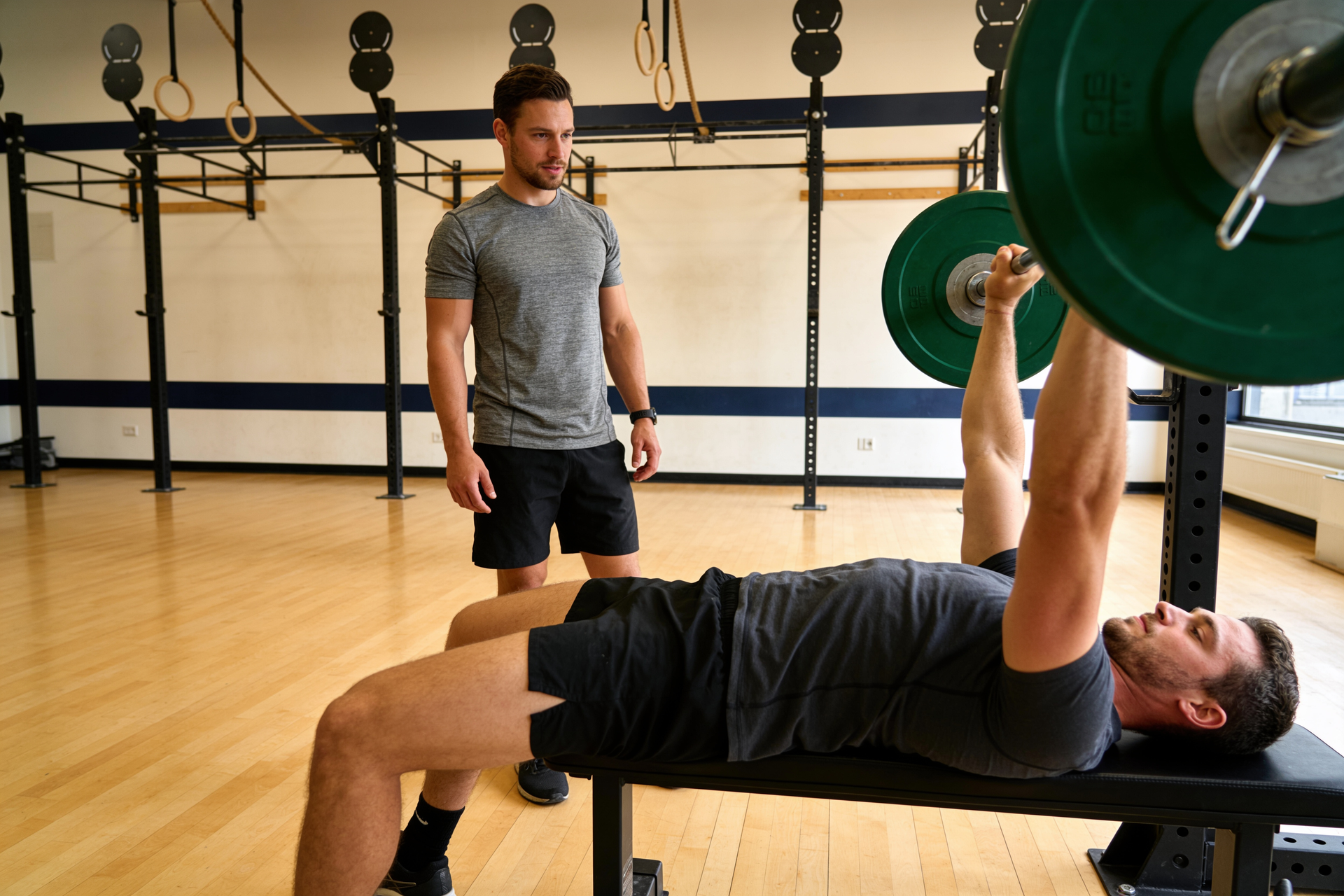
Range of motion is the quiet third element that ties form and load together.
Performing a movement through a full, controlled range is part of good form, and it also increases the demand without any added weight, which makes it a progression tool in its own right. In fact,
a meta-analysis of range-of-motion research found that training through a fuller range produced greater strength and muscle gains than cutting it short.
If you are tempted to add weight but your form only holds through a shortened range, the better move is often to earn a fuller range at the current weight first. Range is where form and load meet, and protecting it keeps both honest.
In effect, range of motion acts as a built-in check on ego lifting. If adding weight forces you to shorten the movement, the weight is simply too heavy for honest progress, no matter what the number on the bar says. Defending your range keeps you from mistaking a heavier partial rep for a genuinely stronger full one, which is one of the most common ways progress turns out to be an illusion.
Common wrong turns
Two opposite mistakes capture how people get the sequence wrong, and most lifters lean toward one or the other. Recognizing your tendency is half the fix.
Lifting too heavy too soon
The first wrong turn is rushing the load, adding weight faster than your form can support because heavier feels like progress. This is the more common and more costly error, leading to degraded patterns, stalls, and the tweaks that interrupt training entirely.
If your form predictably falls apart on your heaviest sets, you are lifting too heavy too soon; the fix is to back the weight down to a weight where you move well and rebuild from there.
Cleveland Clinic notes that pain or recurring strain is a signal to reassess rather than push through, and if pain is involved, that is a matter for your medical provider.
Perfectionism that never progresses
The opposite wrong turn is using form as an excuse never to add weight, chasing an impossible ideal of perfect technique, and staying at the same light load forever. This stalls progress just as surely as ego lifting, because without increasing demand, your body has no reason to get stronger.
If your form has been solid for weeks and you still have not added load out of caution, perfectionism is holding you back, and it is time to trust your technique and progress. Good form is meant to enable loading, not to replace it.
Frequently Asked Questions
Should I always prioritize form over weight?
Mostly yes, in the sense that you should never sacrifice control and safe positioning just to lift heavier. But the fuller answer is that form and load are a sequence, not a permanent ranking. You prioritize form to build a solid foundation, then add load on top of it as your technique holds. The mental model that helps most people is a staircase: your form is the step you are standing on, and load is the step up, but you only step up once the step beneath you is genuinely solid.
How do I know if my form is good enough to add weight?
Add weight when your technique is clean and controlled at your current load, the movement feels good on your joints, and the weight has started to feel manageable for your reps. Filming a set from the side is a useful check, since it reveals drifts you cannot feel. If your form holds up under those conditions, you are ready to progress. If it frays as the weight climbs, hold the load and reinforce the pattern first.
Is it bad to ever lift with imperfect form?
Form does not have to be flawless, and chasing robotic perfection is its own trap. Good form means safe, controlled, and effective for your body, not identical to a textbook. Small natural variation is normal. What you want to avoid is the breakdown that takes the target muscles out of the movement or puts a joint in a vulnerable position under load. Aim for solid and controlled, not perfect.
What is ego lifting, and why is it a problem?
Ego lifting is loading more weight than your form can support, turning clean reps into heaving, partial, or compensated movements to chase a bigger number. It is a problem because it trains a degraded pattern, takes the intended muscles out of the work, raises injury risk, and tends to stall progress over time. The bigger number feels like progress in the moment, but it usually costs you both strength gains and durability down the road.
Can focusing too much on form actually hold me back?
Yes. If your form has been clean and controlled for weeks and you still refuse to add load out of perfectionism, you are stalling your own progress, because strength requires gradually increasing demand. Good form is meant to enable loading, not to become an excuse to avoid it forever. Once your technique is solid, trusting it and adding weight in small increments is exactly what you should do.
Sequence form and load for safe progress
The form-versus-load question is not really a choice between two rivals. It is a matter of sequence: build good form first, then add load on top of it, and keep adding as long as your form holds. Get that order right, and you avoid both ego-lifting and paralyzing perfectionism, progressing as heavy as your body can safely handle for as long as possible.
The whole sequence depends on judging your own movement honestly, and that is the part that is genuinely difficult, because the breakdown that limits you is usually the thing you cannot feel mid-set. Seeing it clearly is what a
Strength and Range of Motion Assessment is for: an outside look at how you actually move, so you know whether your next step is cleaner form, more weight, or fuller range. If you have been stuck guessing at the edge of a set, that kind of read is a sensible next step for anyone training around Pleasant Hill or the East Bay. Strength built on sound movement is strength that lasts.
Here are our latest articles! Click to read more.