
Knee Pain When Squatting: How to Modify Range, Load, and Position
Your knee complains at the bottom of a squat, and you reach for the obvious fix: stop squatting. Hold on, because that instinct usually trades short-term relief for long-term loss, since squatting is one of the most useful patterns your knees have. Consider what follows general training education, not medical advice, and pair it with the provider who has examined your knee. The aim is to keep the squat by reshaping it, not surrendering it.
Squats bother some knees, but stopping is rarely the fix
Squatting loads the front of the knee, so it is one of the first movements to complain when something there is irritated or under-prepared. That complaint is real, but it is rarely a verdict on the movement itself. A squat that bothers you today is usually telling you about depth, load, or setup, not about whether your knees are allowed to bend under load at all.
Pain signals versus damage signals
Not all knee pain means the same thing. A mild, achy, spread-out discomfort that eases soon after you stop is usually a signal of irritation or load that outpaced readiness, not injury.
Sharp, pinpoint pain, a knee that catches or gives way, or swelling that builds afterward is a different category, and it is your cue to stop and check with a provider rather than modify and continue. Learning to tell these apart is most of the skill. When you can sort an achy, fading discomfort from a sharp, sticking one, you stop fearing every sensation and start responding to the ones that actually matter.
'Just don't squat' backfires over time
Skip squats entirely and the very muscles that protect your knee stop getting the work that keeps them strong, which makes the next squatting moment, and there will be one, harder than this one. Sitting down, standing up, and lowering to the floor are all squats your day demands, whether you train them or not.
Updated training guidance is clear that strength work is safe and effective across the lifespan, and the smarter move with a cranky joint is to modify around it rather than abandon it. Stopping does not protect the knee. Adjusting does. A knee that never squats becomes a knee that is unprepared the next time life demands one, and life always does, from a low couch to a car seat to a child on the floor.
Five dials you can turn before you quit
Instead of an on-off switch, think of your squat as a panel of dials, each one a way to lower the demand without losing the movement:
| Dial | What turning it down does |
|---|---|
| Range of motion (depth) | Less depth clears the symptoms a deep squat provokes |
| Load (how much) | Backing off weight unloads an irritated joint while you keep the pattern |
| Position (stance, foot angle, bar placement) | Shifts load away from a sensitive spot |
| Tempo (speed and control) | A slow descent teaches the knee to manage load, not crash into it |
| Frequency and volume | Fewer hard sets, spread out, give low-stakes practice |
Which dials matter is individual: two people with the same complaint often need entirely different adjustments, and the type and timing of your pain usually point you to the right one. Each is described below.
Range of motion: depth
How deep you go changes how much the knee is loaded, and a shallower squat often clears the symptoms a deep one provokes. Squatting to a box or bench gives you a consistent depth to own before you chase more.
Less depth now is not less progress. Box squats are especially useful here because the box gives you a consistent, honest depth to own instead of a slightly different bottom every rep.
Load: how much
How much weight you carry is the most obvious dial, and the easiest to overturn. Backing off the load while you sort out depth and position lets you keep practicing the pattern without overloading an irritated joint. Even bodyweight or a light goblet hold keeps the movement and the muscle alive while the joint settles, and that maintained pattern is what makes adding load back fast and uneventful.
Position: stance, foot angle, and weight placement
Small changes in how you set up can quietly transform how a squat feels. A slightly wider stance, toes turned out a touch, or weight held in front rather than on your back can shift load away from a sensitive spot.
Position is the dial people forget, and often the one that helps most. Try a stance an inch or two wider, let the toes point out slightly, and experiment with holding the weight in front rather than on your back, since each of these can move load off a sore spot without losing the squat.
Tempo: speed and control
How fast you move matters as much as how far. Slowing the descent and owning the bottom builds control and usually feels better than bouncing through the range. A three-second lower with a brief, controlled pause teaches the knee to manage load rather than crash into it, which is often the difference between a squat that bites and one that builds.
Frequency and volume
How often you squat and how many you do is the last dial, and a useful one when a knee is sensitive. Fewer hard sets, spread across the week, often beat one heavy, ambitious session that your knee pays for the next day. Two or three easy squat sessions across a week give the joint repeated, low-stakes practice, and repetition at a friendly dose is what quietly rebuilds tolerance. A knee that squats a little three times a week is being told, again and again, that loaded bending is normal and safe, and that steady message calms an irritable joint faster than rare heavy efforts do.
Reading your knee's response, during and after
Turning a dial is only half the method; the other half is reading whether the change actually helped. Your knee will tell you if you give it a day to answer. The trick is to change only one dial at a time, so that when the answer comes back, you actually know which adjustment earned it.
Let the next day cast the deciding vote
How a squat session felt in the moment matters less than how your knee feels the following morning. If you are back to your baseline within a day, the version you chose was a good one, and you can repeat or gently progress it.

If the knee is clearly grumpier the next day and stays that way, the demand was too high, and you turn the dial back down. The morning after strips away the adrenaline and the in-the-moment optimism, and tells you plainly whether the version you chose is one your knee can keep doing.
Telling 'acceptable' from 'back off'
Acceptable feels like mild, familiar effort or a little achiness that fades, with the knee staying stable through the movement. Back off feels like sharp or rising pain, an unsteady or unstable knee, or discomfort that lingers well past the session.
You are not chasing zero sensation. You are staying on the useful side of that line. Picture a dial of your own discomfort from zero to ten and aim to train in the low, fading end of it, where the knee is working but not protesting. Over a few weeks, that comfortable ceiling tends to rise on its own, and movements that used to sit at a six quietly drop to a two.
A decision path for modifying your squat
When a squat bothers you, the type and timing of the pain usually point to the dial worth turning first. Use this as a starting map, not a diagnosis:
| What you notice | Dial to turn first |
|---|---|
| Pain at the front of the knee | Position and depth: more upright torso, slightly less depth, knee tracking over the foot |
| Pain with depth | Cap depth at a comfortable point and own it, lowering over weeks |
| Pain under load | Load: drop the weight, hold depth and position, rebuild slowly |
| Pain that lingers the next day | Frequency and volume: trim the total dose, add recovery |
If pain is at the front of the knee
Front-of-knee pain often eases with a slightly more upright torso, a touch less depth, and the commonly advised cue of keeping the knee tracking over the foot rather than caving inward. Try the position and depth dials before anything else. Front-of-knee pain is the most common pattern, and it tends to respond quickly once you stop driving the knees far past the toes and ease off the very bottom of the range.
If pain shows up with depth
When the bottom of the range is the trouble, cap your depth at the point that stays comfortable and own that range fully. Squat to a box set at a friendly height, then lower it over weeks as the comfortable range expands. Owning a shallow range fully teaches your knee that loaded bending is safe, and that lesson is what earns you the depth back. Rushing depth before the shallow range feels genuinely easy is the most common way people stall, because the knee never gets the chance to trust the bottom it already has.
If pain shows up under load
If lighter squats feel fine but heavier ones bite, the load dial is your answer. Drop the weight, hold your depth and position steady, and rebuild the load slowly so you can tell exactly what your knee is accepting. Small jumps, the kind that feel almost too easy, are the ones that stick, because the knee barely registers the change and simply adapts.
If pain lingers the next day
Persistent next-day soreness usually means the total dose, not any single rep, was too much. Trim volume and frequency, give the knee more space between hard sessions, and let recovery catch up before you add anything back. Lingering soreness is almost always an argument about total dose rather than any single rep, so the fix is fewer hard efforts, not better technique on the same pile of them.
Putting it together: a knee-friendly squat
The point is not to fiddle forever, but to land on a squat you can do well today and grow from tomorrow.
A worked example
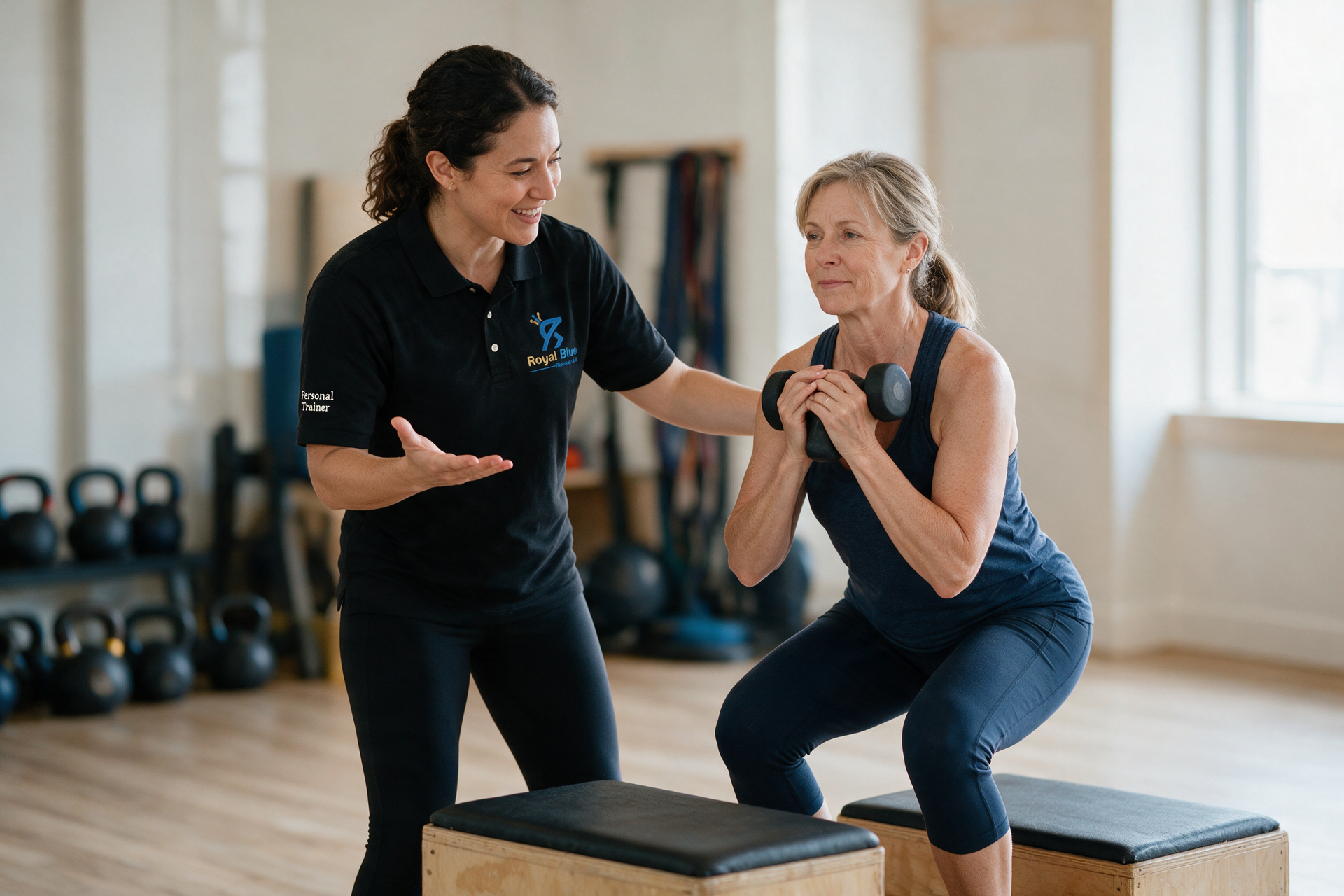
Say deep, loaded back squats flare your knee. You might box-squat to a comfortable depth, hold the weight in front in a goblet position, slow the descent to three seconds, and cut to two lighter sessions a week. Same pattern, four dials turned, and a knee that can train again. Notice that nothing in that example bans squatting; it simply rebuilds the squat into a shape today's knee can handle and tomorrow's can grow from. That is the mindset shift worth keeping: a modified squat is not a smaller goal; it is the on-ramp back to the full one.
From there, you change one variable at a time and let the next morning vote. Resist the urge to turn three dials back up at once the first good week, because a single change at a time is what keeps your knee's feedback readable.
Progressing back toward full squats
Once a version feels easy, and your responses stay quiet, turn a single dial back up: a little more depth, a little more load, or one more set. Strengthening the muscles that support the knee is what earns that progression, so keep building quads, hips, and glutes alongside the squat itself.
Progress is just dials turning slowly in the other direction. Patience here is not caution for its own sake; it is the fastest way back to the squat you want. Every quiet, well-tolerated session is a small deposit, and those deposits compound into a full squat faster than repeated flare-and-rest cycles ever will.
Get an assessment instead of guessing when these show up
If you have turned the dials and your knee still will not settle, if it is unstable or swelling, or if you are simply tired of guessing, a trained eye can save you months of trial and error.
Royal Blue Fitness can watch how you actually squat and rebuild the movement around the joint you have, starting with a Strength and Range of Motion Assessment, and we keep your own care team in the loop as we go.
Schedule your assessment whenever you are ready to trade guesswork for a plan. Often, the fastest fix is simply having someone spot the one tracking or setup habit you cannot feel from the inside, the kind of cue that can undo weeks of guesswork.
Frequently Asked Questions
Should I squat at all if my knee hurts?
Usually, yes, in a modified form, because some version of a squat is almost always tolerable and useful even when the standard one is not. The exception is sharp pain, instability, or swelling, which call for a provider before you continue. For ordinary achiness, turning the depth, load, and position dials down is far better than stopping altogether. The vast majority of cranky knees tolerate some version of a squat, even if the standard barbell version has to wait.
How low should I squat with knee pain?
As low as you can go while staying comfortable and in control, which may be a partial squat at first. Depth is a dial, not a badge, so cap it where your knee stays quiet and expand it gradually as comfort allows. A controlled shallow squat beats a painful deep one every time. Let depth be something you earn back over weeks, not a target you force on day one.
Are partial squats actually effective?
Yes. Partial squats still strengthen the muscles that support the knee, and a range you can train consistently builds more than a deep range you keep flaring. Think of a partial squat as a full-effort movement through a smaller window, not a watered-down version. You progress the depth as your knee earns it. Strength built in a shorter range still carries over, so a partial squat today is a genuine investment, not a holding pattern.
Does foot or stance position change knee pain?
Often, yes, and it is one of the most underused adjustments. A slightly wider stance, toes turned out a little, or holding the weight in front can shift load away from a sensitive part of the knee. Experiment with small changes and keep the setup that lets your knee track comfortably over your foot. Small tweaks like these are free to try and easy to reverse, which makes them the smartest first experiment when a squat bothers you.
When should I get this looked at?
See a provider if your knee is sharply painful, swollen, catches, or gives way, or if careful modification over a few weeks brings no improvement. Those signs point beyond what dial-turning can solve. Getting assessed is not an overreaction; it is how you stop guessing and start progressing. A single session that pinpoints the real driver often saves months of cautious trial and error on your own.
Here are our latest articles! Click to read more.