What Is Functional Strength Training? A Plain-English Guide to the Movement Patterns That Matter Most
You have probably heard "functional strength training" at the gym, in a workout app, or from a friend who swears by it. It sounds important, but most explanations either talk down to you or bury the idea under jargon. Here is the plain version: functional strength training is strength work built around the movements your body actually makes in daily life, so the strength you build shows up when you carry, lift, climb, reach, and stand back up. This guide clearly defines the term, walks through the handful of movement patterns it is built on, and helps you see whether it is relevant to your life.
What Functional Strength Training Actually Means
Functional strength training is resistance training organized around whole-body movement patterns rather than isolated muscles. The simplest way to understand it is to compare two questions. A traditional approach often asks, "Which muscle does this work?" Functional training asks, "Which real-life movement does this make stronger?" Those are different questions, and they lead to different workouts.
Movement Patterns, Not Muscles
A bicep curl trains a muscle. Picking a heavy box off the floor and standing up trains a pattern, the hinge, and that pattern is what you use to lift a grandchild, a suitcase, or a bag of soil. Neither is wrong, but they aim at different targets.
Isolation work grows or rehabilitates a specific muscle. Pattern work builds coordinated strength across the joints and muscles that must cooperate for a real task to occur. Functional training leans hard on the second kind, because that is where everyday capability comes from.
Almost nothing you do in a real day uses one muscle in isolation. Standing up from a low chair, for instance, asks your legs, hips, and trunk to fire in the right order at the right time, and training that whole sequence is what makes the chair feel easy.
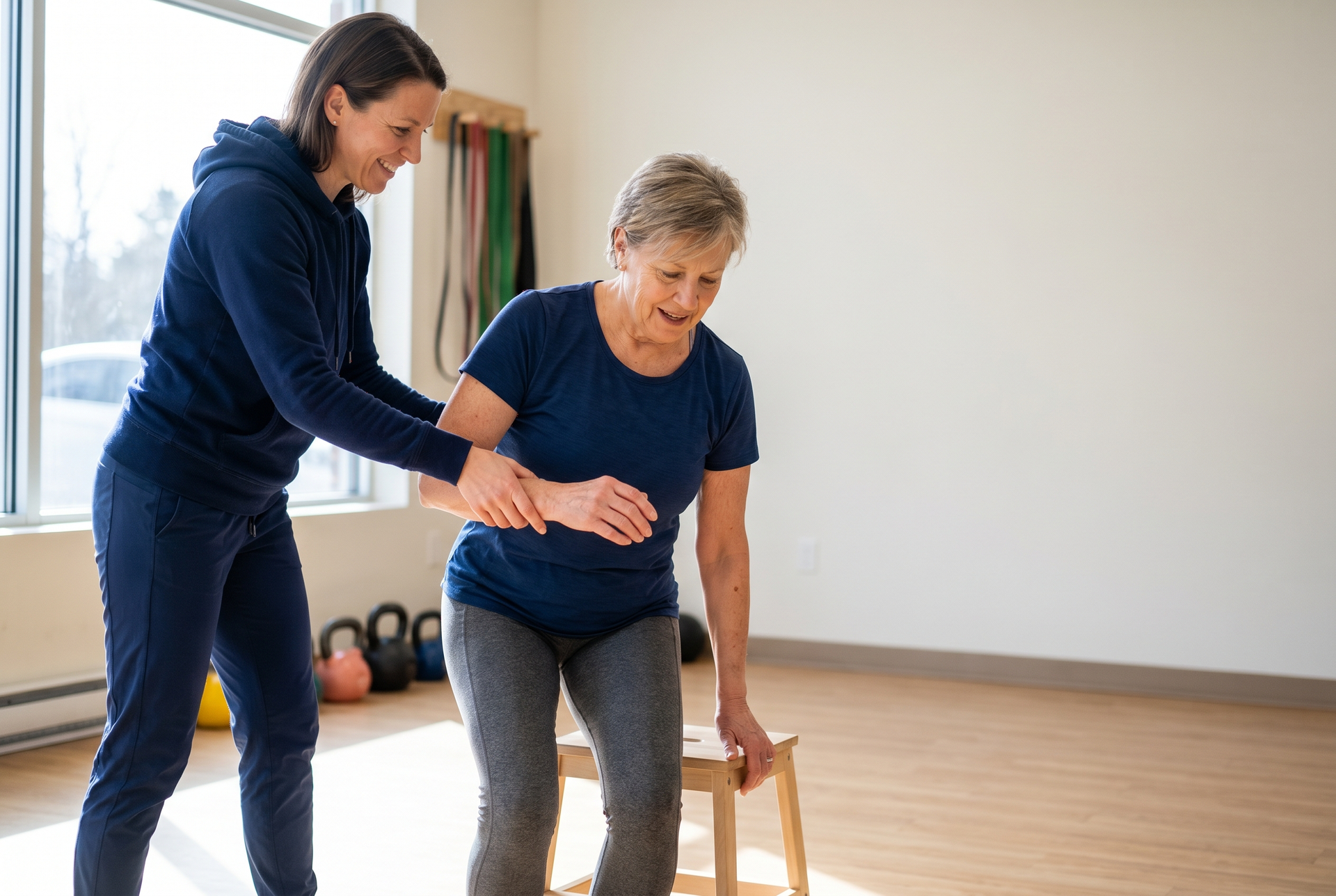
It is also why, when someone starts with us, the first thing we look at is not which muscles are strong but which patterns they trust and which ones they have quietly started to avoid. The pattern someone avoids usually tells us more than the one they are proud of.
Why It's Called "Functional": Transfer
The word "functional" points to one idea: transfer. Transfer is whether the strength you build in training carries over into the rest of your life.
Professional guidance from the American College of Sports Medicine ties resistance training to better physical function, including everyday measures like gait speed, balance, and stair climbing. That carryover into daily life is the whole point. Functional training is less about how a movement looks in the mirror and more about whether it makes your real days easier.
Why "Functional" Matters in Real Life
The payoff of training functionally is carryover. A large review of resistance-training research that pooled 121 trials and more than 6,700 participants found this kind of work improves real tasks like rising from a chair and climbing stairs, and those gains tended to outpace plain walking speed. Strength that only exists on a machine tends to stay there, while strength built through full movement patterns tends to follow you home.
Everyday Tasks Are Loaded Patterns
Think about a normal Saturday. You squat down to weed a garden bed, hinge to lift a planter, push a stuck window open, pull a heavy door, carry groceries from the car, and twist to load the dishwasher. Every one of those is a movement pattern under load.
When those patterns are strong and confident, ordinary days cost you less energy and leave you with fewer aches. When they are weak or avoided, life slowly shrinks around the movements you no longer trust, and that shrinking often happens so gradually you barely notice until a task you used to do without thinking suddenly feels risky.
Why It Matters More With Age
This is why functional training tends to matter more, not less, as the years go on. The ability to get off the floor, carry your own bags, and keep your balance is the difference between an independent life and a cautious one.
The National Institute on Aging makes that link concrete. It points to strength work for everyday tasks like getting up from a chair, climbing stairs, and carrying groceries, and to balance work to lower the risk of falls. Those are the same patterns this guide is built on, and training them directly is how you protect that capability instead of hoping it sticks around on its own.
None of this is about chasing a number in the gym. It is about keeping the freedom to do what you want, when you want, on your own terms.
The Six Movement Patterns That Matter Most
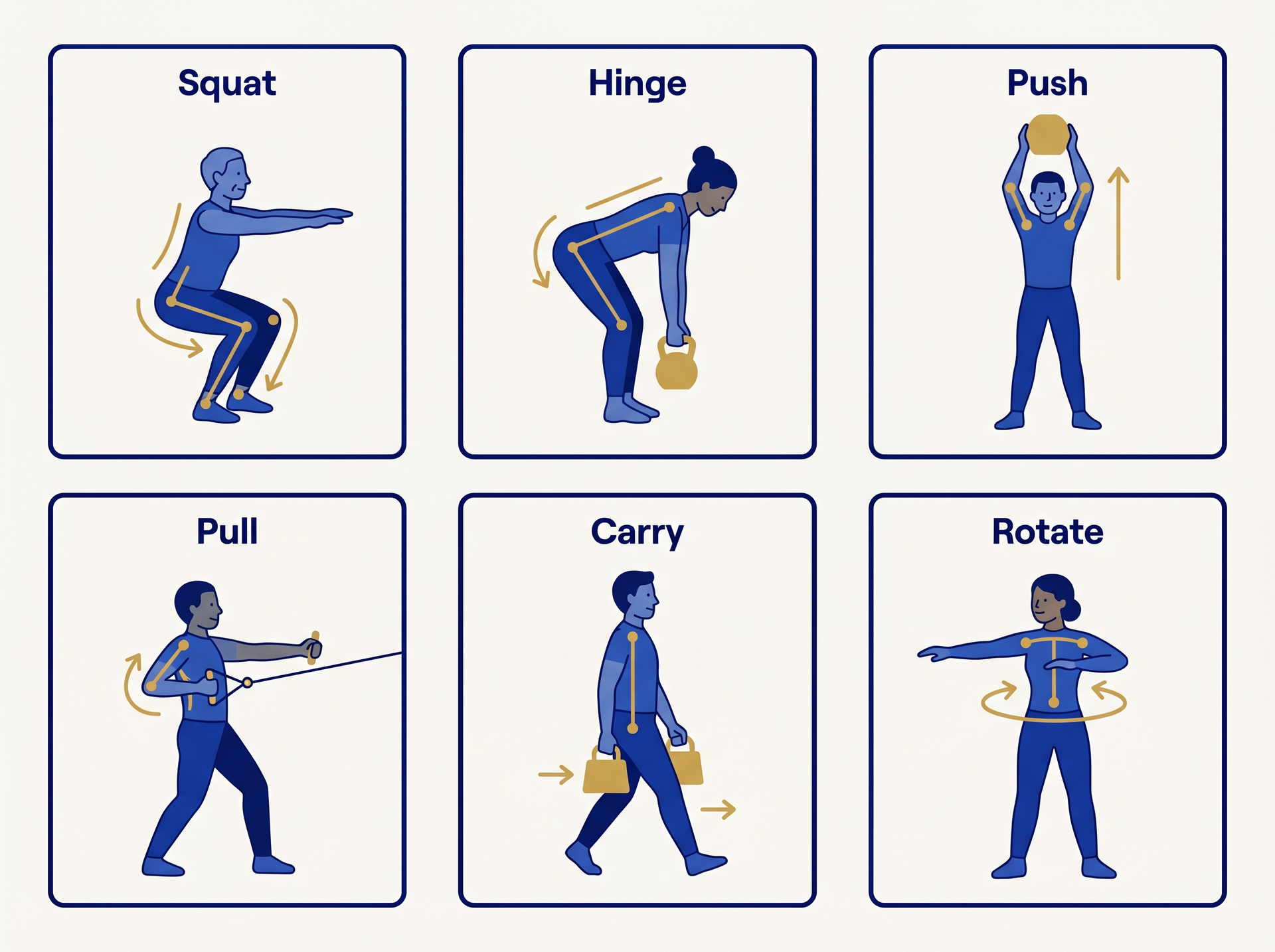
Most functional programs are built from six core patterns. You do not need fancy equipment to recognize them, because you already do all six every day.
Squat
The squat is lowering down and standing back up, like getting out of a chair, sitting onto a low couch, or reaching something on a bottom shelf. It is the pattern behind nearly every "down and up" moment in your day. When the squat gets weak, the first sign is usually that you start pushing off your knees or the armrests to stand.
When we see that in a session, we do not drop the squat. We raise the surface you are lowering to, slow the movement down, or let you hold on lightly at first, then take the support away as the pattern gets stronger. Keeping it strong is one of the most direct ways to protect your independence over time.
Hinge
The hinge is bending at the hips with a long spine to lift from around knee height, like picking up a laundry basket or a bag of mulch. This is how you lift heavier things without overloading your lower back.
For a lot of people, lifting that bothers the back has more to do with hinge technique than raw strength, and learning to lead with your hips instead of your spine can take pressure off the lower back. If back pain is persistent or sharp, that is a conversation for your provider, not a cue to push through.
Push
Pushing is moving weight away from you, either overhead or in front, like pressing a suitcase into an overhead bin, pushing a heavy cart, or getting up off the floor. A capable push keeps your shoulders strong and useful rather than stiff and cranky.
Pull
Pulling is bringing weight toward you, like opening a heavy door, starting a mower, or hauling a bag across a table. Of the six, this is the pattern modern life trains the least, because so much of our day is spent pushing, typing, and reaching forward. That is exactly why it deserves deliberate attention.
Carry
Carrying is holding a load and walking with it: luggage, groceries, water jugs, a toolbox. It trains grip, posture, and balance all at once, and it is one of the most honest tests of whether your strength works while you are moving, not just while you are standing still.
When we watch a carry, we care less about how much you can pick up and more about how far you can hold it before your grip or posture starts to give. That fade point is often where we start.
Rotation
Rotation is turning, or resisting an unwanted turn, like reaching into the back seat, swinging a golf club, or staying steady while you carry something heavy on one side. Good rotational control is quiet. You mostly notice it only when it is missing, and your back starts complaining about tasks it used to handle easily.
How the Patterns Work Together
Here is the part a simple list can miss: these patterns rarely happen one at a time. Carrying a heavy bag up the stairs is a carry, a squat, and anti-rotation all at once. Loading a suitcase into a car trunk is a hinge that turns into a push with a twist.

Real life blends the patterns constantly, which is why training them in isolation is only half the picture. A good functional program builds each pattern and then teaches them to cooperate, so the strength holds together when life asks for two or three of them in the same motion. That cooperation, more than any single exercise, is what makes daily tasks feel light.
It is also why a person can look fit and still feel clumsy under an awkward load: the individual muscles are there, but the patterns were never taught to work as a team.
That is why our assessment does not stop at single movements. We watch how the patterns hand off to one another, because the place they break down together is usually the place daily life feels hardest.
Functional vs Just Working Out
It is fair to ask how this is different from a regular workout, because the line is genuinely blurry. Plenty of traditional exercises are functional, and plenty of "functional" workouts are really just exercises performed on a wobbly surface for show.
The honest distinction is intent and transfer. A workout focused only on isolating muscles or chasing soreness can build size or burn calories without improving how you move through your day. Functional training keeps real-life movement at the center, so progress is measured by what you can now do more easily, not only by what the scale or the mirror says.
A useful test: if your training made you visibly fitter but stairs, lifting, and long days still feel just as hard, it was not very functional, whatever it was called. Most well-built programs use both, borrowing the measurable progress of traditional lifts and the real-life transfer of functional movement training.
When we check progress, that real-life test is the one we lean on. Stronger numbers are good to see, but the question we keep returning to is whether your stairs, your bags, and your long days got easier.
If you want the full side-by-side, our guide comparing functional and traditional strength training breaks down the benefits of functional training and why most people benefit from a blend of the two.
Related Terms and Where to Go Next
This idea connects to a few other terms you will see across our blog: movement patterns, mobility, core or trunk control, and progressive overload, which simply means gradually asking your body to do a little more over time. You will also see "loaded carries" and "rotation versus anti-rotation," which are closer looks at two of the six patterns. If you are ready to put this into practice, our beginner guide to the movement patterns is the natural next step, and the broader functional strength & mobility training pillar ties all of these pieces together.
How Royal Blue Fitness Uses These Patterns
At Royal Blue Fitness, these patterns are not a workout theme; they are a starting map. Coaching begins by looking at how you move through each one and where strength, mobility, or confidence is missing, then building a plan around the patterns that will give you the most freedom in daily life.
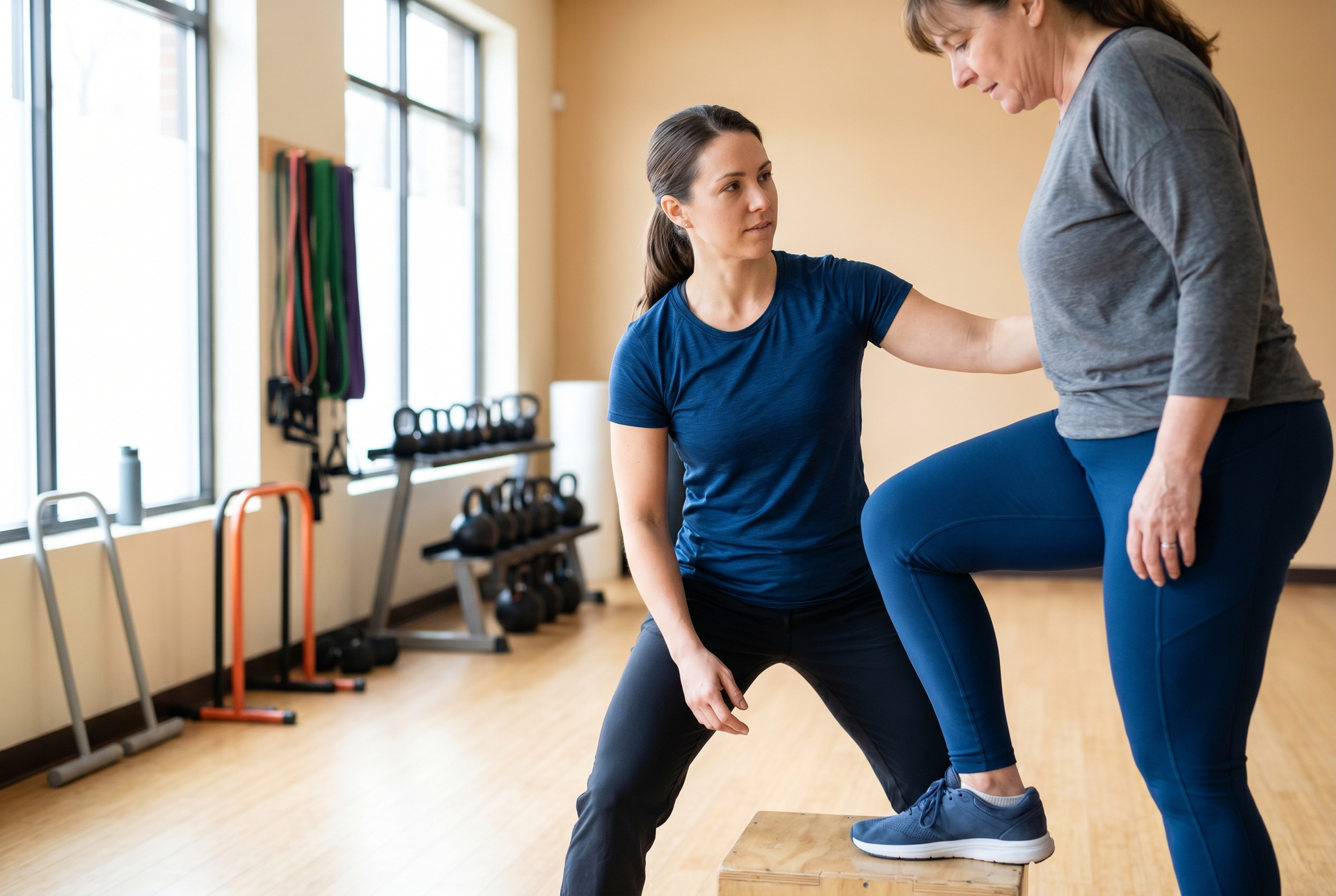
For functional strength training in Pleasant Hill, that means the plan is shaped by how your body handles real movement. If your hinge is strong but your carry falls apart after twenty feet, your plan reflects that.
When a movement does not feel right on a given day, our first move is to reduce the load, shorten the range, or change position rather than cut the pattern out, and we keep notes so the plan adjusts as you do. If something points to a medical question rather than a training one, we say so and work alongside your provider rather than around them.
The goal is never to make you good at exercises for their own sake. It is to make your real life feel lighter and to keep it that way as the years go on.
Common Questions About Functional Strength Training
Is functional strength training the same as functional fitness?
They overlap heavily but are not identical. "Functional fitness" is the broader umbrella, covering strength, mobility, balance, and endurance for daily life. "Functional strength training" is the strength piece of that umbrella, built specifically around movement patterns. If functional fitness is the whole house, functional strength training is the framing and the foundation. The six patterns are the shared core of both.
Do I need equipment to train functionally?
No. You can train every pattern with just your body weight, and many people start exactly there. A chair, a wall, and a couple of household items are enough to begin. National physical activity guidance recommends muscle-strengthening activity at least twice a week, and these patterns cover that together. Dumbbells, kettlebells, and bands add load as you progress, but the pattern matters more than the equipment, and clean bodyweight movement beats sloppy weighted movement every time.
Is functional strength training only for athletes?
Not at all. It is arguably most valuable for people who are not athletes, because the payoff is an easier daily life: stairs, groceries, travel, yardwork, and getting up and down with confidence. Athletes use it too, but you do not need a sport to benefit from being strong in the movements your life already requires.
How is this different from machine-based workouts?
Machines guide and isolate a movement for you, which can be useful for targeting a specific muscle or training carefully after an injury. But real life is rarely guided. Functional training practices the unsupported, whole-body movements you actually use, so the strength carries over to the moments machines cannot rehearse, like catching your balance or lifting an awkward, off-center load.
Where should a complete beginner start?
Start with the patterns you use most and trust least. For many people, that is the squat and the hinge, since they show up dozens of times a day. Begin with bodyweight versions, focus on moving well, and add small amounts of load over time. Our beginner guide walks through all six in a sensible order.
Putting It Together
Functional strength training is not a trend or a special class of exercise. It is simply strength built around the movements your life already asks of you: squat, hinge, push, pull, carry, and rotate. Once you can see those patterns, you can see what your training is really for and stop wondering whether your workouts are actually working. If you are curious where your own movement patterns stand and which ones would give you the most everyday freedom, a Strength and Range of Motion Assessment is a low-pressure way to find out, and our pillar guide is always here when you want to go deeper.
Here are our latest articles! Click to read more.