Summer Strength Training Checklist for Joint Pain: What to Adjust Before You Push Harder
The joint complained again, and now you are standing in front of the rack having the same argument with yourself. Push harder and hope it settles, or stop and write off the session. In the heat of summer, that argument happens more often, and neither answer is very good, because one risks a setback and the other slowly chips away at your momentum. This summer strength training checklist gives you a third option: a short set of checks that lead to one specific next step for a sore joint. Run through it before you decide anything, and the choice usually makes itself.
How to Use This Checklist
Read the pattern, not a single box. No one checks what you do. A sore knee on a cool, well-rested morning means something different than the same knee after a heat wave and four hours of sleep. The checks below fall into three categories: the load around the session, the session itself, and the symptoms that change everything. The goal is to notice how many are flagging, and how loudly.
Work through them in order, because the early ones are the cheapest to fix and the most often overlooked. By the time you reach the end, you will not have a vague feeling about the joint; you will have a clear read you can act on. Keep the checklist somewhere you can glance at it before a session, just as you would check the weather before a long drive. One flag that is shouting matters more than three that are whispering, so weigh the loudest signal the heaviest as you read the pattern.
Category 1: The Load Around the Session
Before you blame the painful area, look at everything stacked around it. In summer, the load that tips a joint over is usually environmental and cumulative, not the exercise itself.
Start With the Heat, Not the Joint
Check the heat before you check the knee. Hot, humid conditions raise the cost of every session and shorten the recovery that keeps joints calm, so a joint that feels reactive may be reacting to the day more than to the workout.

AAOS guidance on training in the heat recommends practical steps that translate straight to your session: schedule activity for the coolest part of the day, build heat tolerance gradually, and postpone hard efforts in extreme heat and humidity. If the answer here is a blazing afternoon, move the session to a cool window or indoors first, then see whether the joint still complains. Often it does not. A useful tell: if the joint feels fine on an early indoor session but cranky after the same workout on a hot driveway, you are looking at a heat problem wearing a joint costume. It is the first box we check with summer clients. Shifting a session to a cooler window is the cheapest fix on this list, and it often quiets a joint before we change anything about the training itself.
Compare Against Your Last Good Session
Check what actually changed, not what you remember. Memory is a poor coach. When a joint flares, the useful question is what has changed since the last session that felt fine.
Run the comparison honestly: Did the load, volume, or speed creep up? Did you add a new exercise, surface, or pair of shoes? Did you skip a warm-up, train later in the day, or stack this on top of a long day on your feet? Nine times out of ten, a flare traces back to one or two specific changes, not to the joint mysteriously getting worse. Find the change, and you have found the thing to adjust, which is far more useful than simply deciding the joint is fragile. A two-line training note, the load you used and how the joint felt the next day, makes this comparison take seconds instead of guesswork, and it turns vague worry into a pattern you can actually see.
Account for Hydration, Sleep, and Recovery
Check your recovery as part of the joint check. A joint does not exist apart from the body recovering it, and summer quietly erodes that recovery before it touches your strength.
Rest, sleep, and fluids are training variables, not afterthoughts. MedlinePlus notes that rest is part of training, and that enough sleep, enough fluids, and avoiding exercise in extreme heat all help you steer clear of overtraining. If you slept five hours, skipped water, and trained in the heat, a reactive joint is a predictable result, not a mystery. Patch the recovery first, and the joint often settles on its own. Watch sleep across the whole week, not just the night before, because heat erodes it gradually, and replace electrolytes, not only water, after heavy sweating, since cramping and poor recovery often trace back to what sweat carried away.
Category 2: The Session Itself
Once the surrounding load checks out, look at the demands of the workout. Safe fitness for joint pain often comes down to small changes in what you are asking the joint to do. Those adjustments usually solve more than stopping altogether.
Separate Impact From Intensity
Check impact and intensity as two different dials. People often dial back effort when the real culprit is pounding. You can train hard with low impact and train gently with high impact; they are not the same thing.
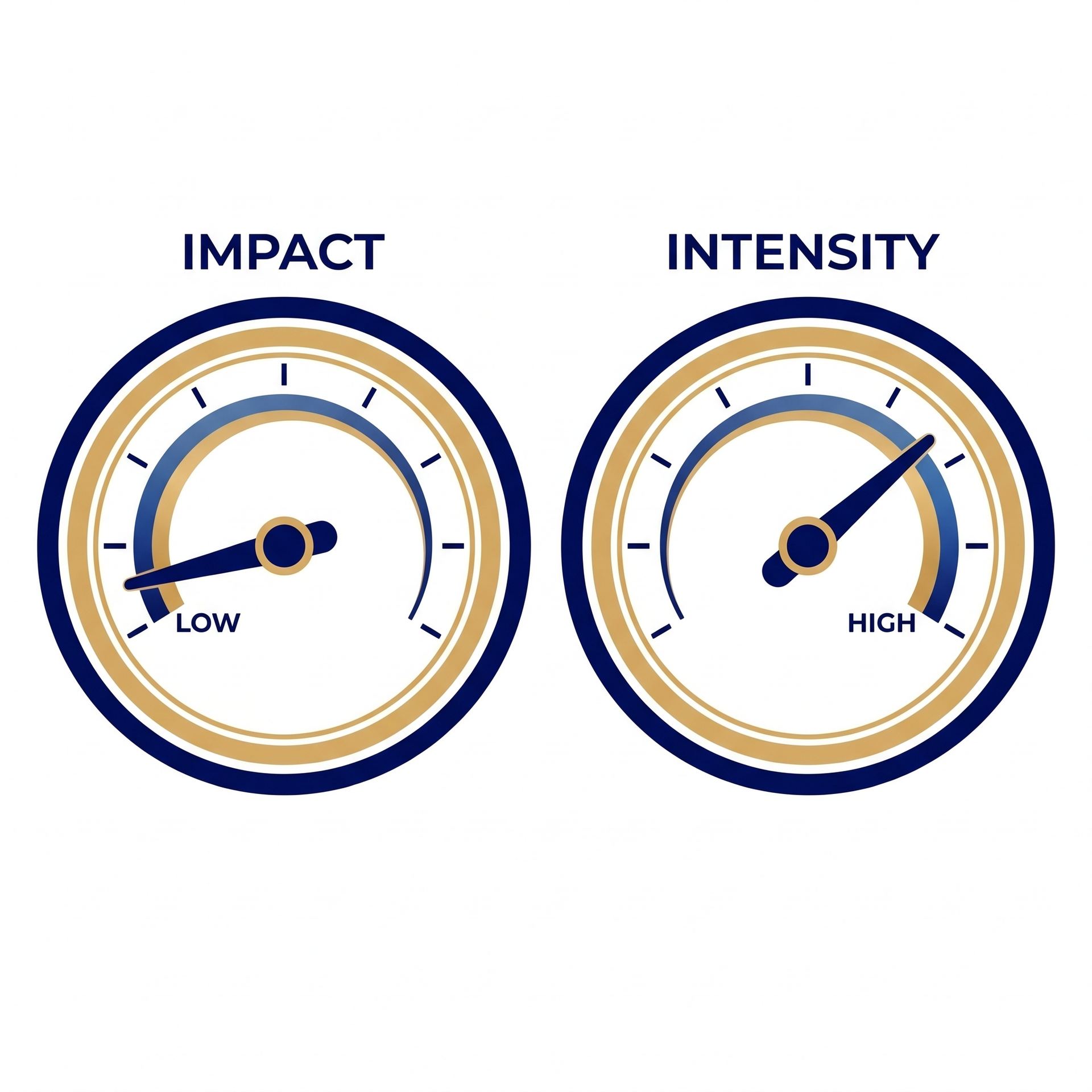
The Arthritis Foundation’s roundup of 14 joint-friendly ways to work out with arthritis lands on a useful point: the right activity, often lower-impact, matters more than avoiding activity altogether. If a joint is loud, try lowering the impact first, swap jumping or running for a sled, a bike, or water, while keeping the effort that drives strength. Cut intensity only if lowering the impact alone does not settle it. A runner whose knee flares in July, for instance, often keeps all the cardiovascular work by moving it to a bike or the pool, and only then discovers that the effort was never the problem.
Match the Exercise to the Day
Check that the exercise still fits the joint you have today. The program is a plan, not a contract. If a movement bites, the goal is to swap in a different version, not abandon the muscle group.
AAOS advice on safe exercise is built on moderation and control: start within your range, move through pain-free motion, and progress gradually rather than forcing a session. A deep squat can become a box squat, a barbell press can become a machine or an incline, and a run can become a brisk shaded walk. Same intent, friendlier shape, and the day’s training still happens. It works the other way too: on a good day, you can climb back toward the harder version, so matching the exercise to the joint is about meeting today’s capacity, not permanently downgrading the movement.
Read the 24-Hour Response
Check how the joint felt the next day, not just during the set. The most reliable signal of whether a workout was right comes a day later. Pain that fades fast is usually fine; pain that lingers is feedback.
Harvard Health offers a simple rule of thumb: joint pain that lasts more than about an hour after you exercise is a sign you did too much. Use the same logic the morning after. If the joint is calmer or the same, your last adjustment worked. If it is more swollen, stiffer, or limping, dial back the next session rather than repeating the one that caused it. Concretely, that means dropping a notch on whatever you pushed, the load, the range, the volume, or the impact, rather than abandoning the exercise outright. We hand clients this 24-hour rule on purpose because once someone learns to read the morning-after signal themselves, they stop guessing mid-session and start adjusting a workout with confidence instead of fear.
Category 3: The Symptoms That Change Everything
Most of this checklist is about adjusting and continuing. This category is different. A few signals mean it is no longer a workout question at all.
Watch for Referral Signals
Check for the signs that call for a professional, not a program change. Some symptoms sit outside the scope of any checklist, and pretending otherwise is how a manageable problem becomes a lasting one.

Mayo Clinic spells out clear reasons to get a knee checked: marked swelling, a joint that feels unstable or gives out, or trouble fully straightening or bending it. NIAMS flags the mechanical version of the same warning in arthritic joints, a joint that locks or gives way. Pair those with any sharp or catching pain, numbness or tingling, fast or hot swelling, or pain that keeps escalating despite rest. If any of these show up, the next step is not a lighter workout; it is contacting a clinician before you load that joint again. The line is not subtle once you know it: ordinary soreness is dull, diffuse, and improving, while a referral signal is sharp, mechanical, or neurological and does not improve with rest.
Putting It Together: Scale, Hold, or Stop
Once you have run the checks, the pattern points to one of three honest decisions. Notice that none of this is a color-coded gimmick: it is just how many checks are flagging, and how loud the loudest one is.
| Pattern you are seeing | Decision | What that looks like |
|---|---|---|
| Normal effort, joint quiet, recovery solid | Scale up or hold | Train as planned, or add a little if the last session felt easy |
| One or two checks flag, 24-hour response, mild | Scale the session | Lower load, range, volume, or impact; train cooler and shorter |
| Several checks flag at once, or a flare is lingering | Hold | Swap for mobility, low-impact, or recovery; protect sleep and fluids |
| A referral signal is present | Stop and get evaluated | End training that joint; see a clinician before loading it again |
The decision is rarely all-or-nothing. Most summer joint days land in the middle two rows, where a small, specific adjustment keeps you training without paying for it tomorrow. When signals conflict, let the most serious one lead: a single referral signal outranks a page full of quiet checks, and one lingering flare outweighs a workout that felt fine in the moment. Reading the pattern is really just asking which signal you cannot afford to ignore.
A Quick Pre-Session Recap
Before your next summer strength training session, run the six-second version. You do not need the full article every time. Once the pattern is familiar, a quick mental pass through these six questions is enough to make the call:
- Heat: is it cooler, shaded, or indoors, and am I hydrated?
- Change: What is different since my last good session?
- Recovery: Did I sleep and eat enough to train hard today?
- Impact: Can I lower the pounding before I lower the effort?
- Fit: Does today’s exercise match how the joint feels right now?
- Red flags: any sharp pain, swelling, instability, or numbness?
If the first five point to a small adjustment, make it and train. If the sixth flag is anything, stop and get it looked at. That is the whole tool.
Make the Next Decision Cleaner
A sore joint in summer does not have to mean push blindly or quit completely. Run the checks, read the pattern, and make one specific workout adjustment for summer. If the same joint keeps forcing the decision, a Strength and Range of Motion Assessment can map the underlying pattern so your next move is based on information, not guesswork. Either way, the goal is the same: make the next heat-safe workout decision cleaner than the last one.
The Royal Blue Fitness Next Step
A summer strength training checklist is powerful when the problem is a single session. When the same joint keeps complaining summer after summer, the issue is usually a pattern the checklist can surface but not fix on its own, a strength gap, a range limitation, or a tolerance that has quietly narrowed.
That is where a trained eye helps. Strength training in Pleasant Hill at Royal Blue Fitness starts by mapping out what is actually driving the pattern, then builds training that works around it rather than repeatedly running into it. One client kept blaming a summer knee, but the assessment traced it to a hip that had quietly lost range, so the plan could finally work the cause instead of nagging the joint. The checklist keeps you making good calls week to week; coaching changes the trend so you are making fewer of those calls in the first place.
Summer Joint-Pain Training: Quick Answers
Should I push through joint pain in the summer?
Not blindly. Before you push, run the checks: the heat and hydration around the session, what changed since your last good workout, the impact and fit of today’s exercise, and how the joint responded in the previous 24 hours. Most of the time, one small adjustment solves it. You should not push through sharp pain, a joint that gives way or locks, fast swelling, or numbness, which call for a clinician instead.
What is the first thing to adjust?
Usually, the load is around the session rather than the joint itself. Move the workout to a cooler window or indoors, hydrate, and shorten or space out the work before you change anything about the painful area. The heat and your recovery are the cheapest variables to fix and the ones most often behind a summer flare, so start there and reassess before you strip down the exercise.
Can strength training help with joint discomfort?
Often, yes, when it is scaled sensibly. Stronger muscles around a joint help support and unload it, which is why backing off strength entirely tends to backfire over time. The key is to keep training in a range and at a load the joint tolerates, adjusting impact and intensity as needed. Persistent or worsening symptoms are the exception and should be evaluated by a professional rather than trained through.
How do I know if the workout was too much?
Watch the 24-hour response. Joint discomfort that fades within an hour or so is usually fine, while pain, swelling, or stiffness that linger into the next day are signs you did too much. Other warnings include new limping, a joint that feels unstable, or sharp pain during the session. If you see those, dial back the next workout instead of repeating the one that caused them.
What does Royal Blue Fitness assess?
An assessment looks at your strength, range of motion, control, and the load your joints can tolerate, along with the patterns in how they respond. In our experience, clients who go through it walk away with something they did not have before: a clear read on where their body actually stands, and that clarity alone tends to replace guesswork with a renewed sense of direction and motivation. That picture lets a plan be modified intelligently, working around the specific joint rather than guessing. We cannot promise a particular outcome, but understanding the pattern behind a recurring summer flare makes the next plan smarter than the last.
Here are our latest articles! Click to read more.