Hybrid Fitness Needs More Than Technology: Why Coaching and Community Still Matter
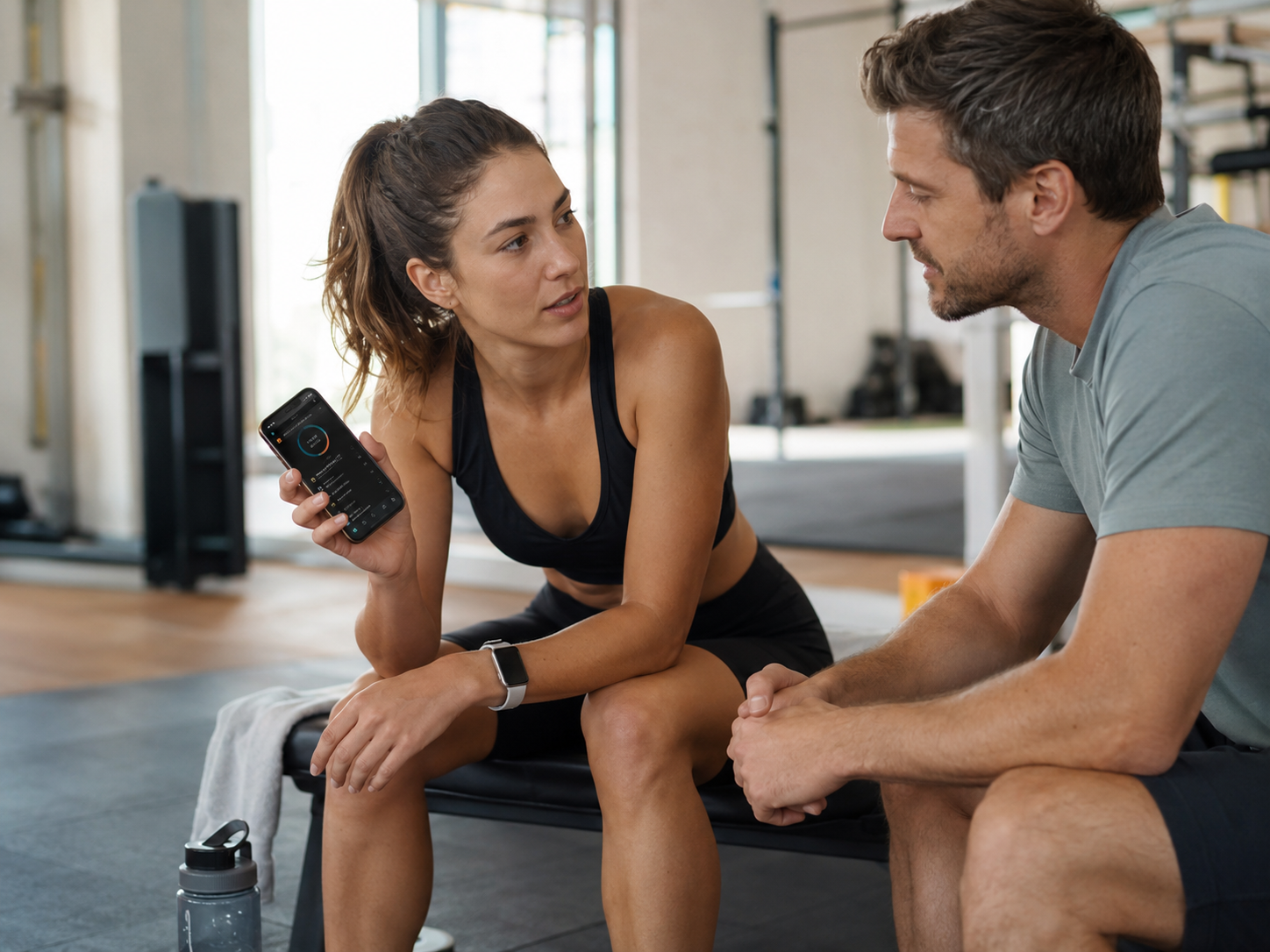
Marcus had everything the brochure promised. A watch that read his heart rate to the decimal. An app with individualized fitness plans, video demonstrations, and a streak counter that lit up green. A gym ten minutes from home. On paper, nothing stood between him and the strongest version of himself.
Three months later, the streak counter read zero, the watch lived in a drawer, and the membership renewed itself, unused, like a magazine he kept meaning to read. The tools were never the problem. Something quieter was, and it is the part of hybrid fitness that no company can sell you, because it cannot be downloaded.
Two things turn a good plan into a kept one: a coach who knows you, and a community that notices when you are gone. Strip those away, and even the best app becomes a very expensive reminder you eventually mute. This is not an argument against technology. It is an argument about what technology is for, and where its job quietly ends.
The Tools Are Better Than Ever. Most of Us Still Stall.
More people own the technology than ever before. Pew Research Center reported that roughly one in five U.S. adults said they regularly wore a smartwatch or fitness tracker in a 2019 survey. The hardware stopped being the bottleneck years ago.
The results are another matter. When researchers pooled the trials on health and activity apps for otherwise healthy adults, the honest summary was that the evidence that these tools reliably move the numbers that matter remains unclear. An app can hand you a flawless plan. It cannot make the plan happen.
That is the gap we pay attention to when a client tells us, "I have the app, I know what to do, but I still keep falling off." Research on health and activity apps is useful because it reminds us not to confuse access with follow-through. At Royal Blue Fitness, we use technology to hold the plan, but we do not ask it to carry the whole behavior-change burden.
When a client misses a week, feels beat up, or starts avoiding a movement, the next step is not another reminder. It is a coaching adjustment: lower the barrier, change the session, check the form, or rebuild the schedule before one off-week becomes a full stop.
Think of it as the last mile of your hybrid fitness. The plan, the demos, and the data carry you almost all the way there, cheaply and conveniently. The final stretch, the part where you actually do the work on a cold morning when no one is watching, is the part that the technology was never built to walk for you. Most people do not quit because their structured fitness program was wrong. They quit because nothing and no one made the cold morning matter, and a notification has never once dragged anyone out of a warm bed.
You can watch the gap open in real life. Someone buys a year of premium, trains hard for three weeks, then hits the first genuinely busy stretch: a deadline, a sick kid, a run of bad sleep. The app has no answer for that week beyond another notification. No plan reaches through the screen to rearrange the schedule, drop the bar to something doable, or simply say it still counts if you only manage twenty minutes. So one missed week becomes two, and the streak that felt motivating becomes one more thing to feel bad about and, eventually, to mute.
Two Things a Screen Cannot Do
The missing piece is not a feature waiting to be built. It is two human functions that resist software entirely: the trained eye that keeps a session safe and productive, and the social pull that gets you through the door on a low day.
The Knee That Needed a Person, Not a Notification
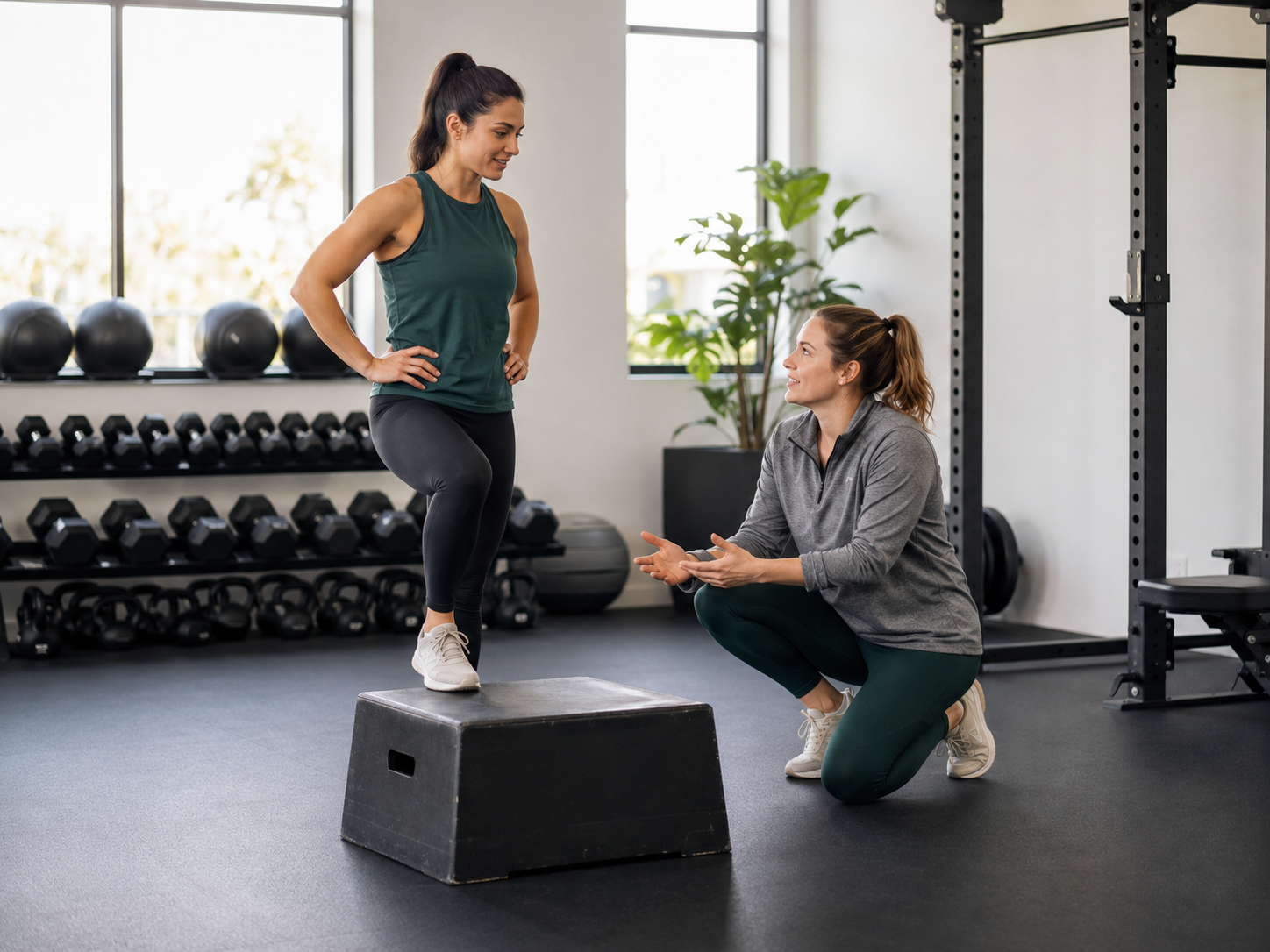
Picture a lunge that does not feel right. A small twinge on the left knee, the kind you could talk yourself into ignoring. The app does not feel it. The app sees a completed rep and cheerfully cues the next set. A coach standing three feet away sees the knee drift inward on the way down, calls the set early, shortens the range, and shifts you to a variation that loads the muscle without nagging the joint.
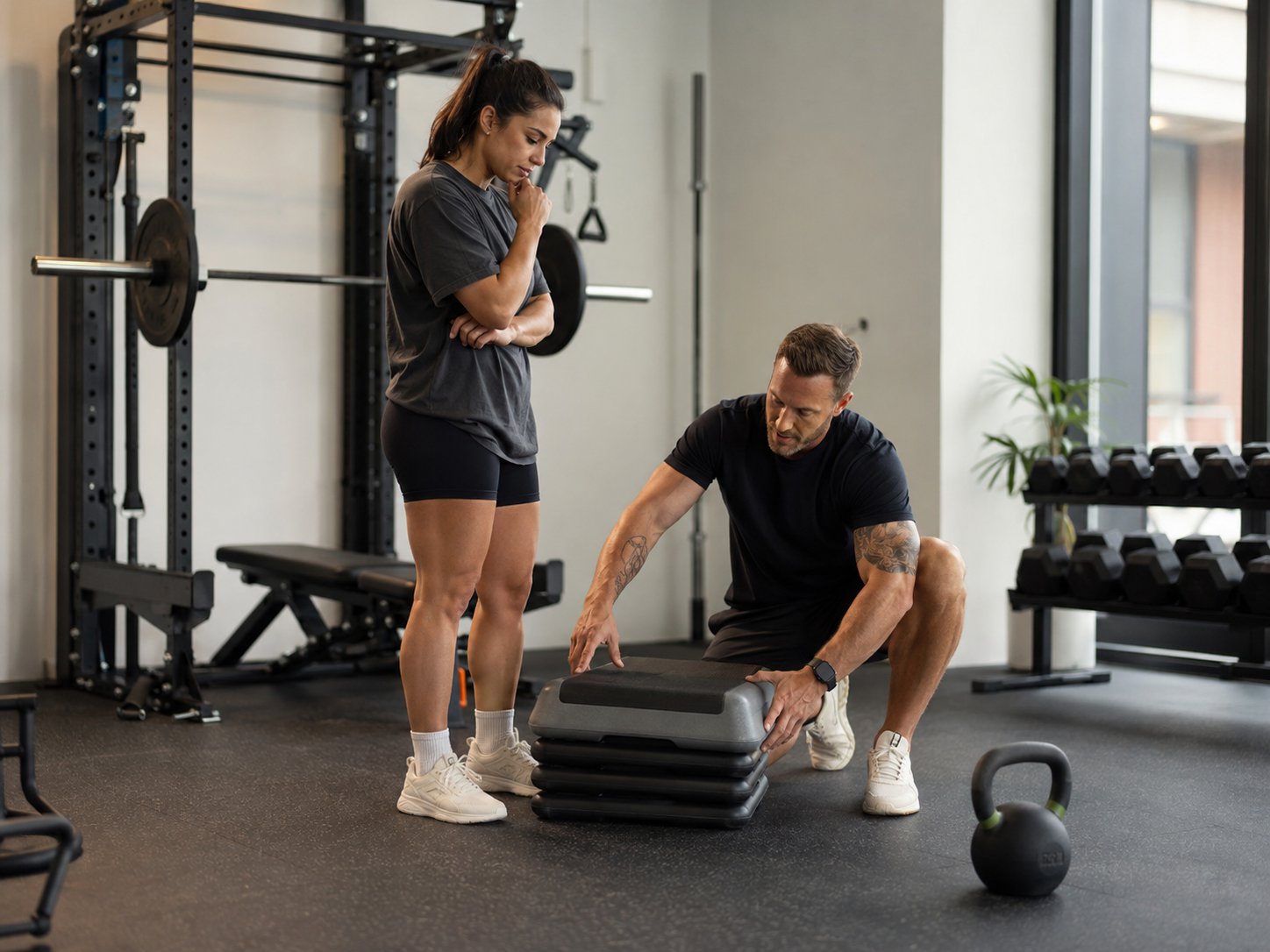
No notification can make that read. To be clear, this is not about treating an injury, which is best handled by the right medical professional. It is about the hundred small reads a trained person makes in an hour: the bar slowing on the third rep, the shoulder creeping toward the ear, the day you clearly have more in the tank than the program assumes and should be pushed, or the day you plainly do not and should be eased back.
An app cannot tell the difference between a productive grind and a risky one. It logs the rep either way. A coach watches the same set and reads it instantly, then does what software cannot: changes the plan in the moment, in response to the person in front of them, rather than to the average person the program was written for.
The reads pile up faster than any feature menu could anticipate. A deadlift that starts rounding at the bottom on the sixth rep. Someone who insists they feel fine while their face says otherwise. A day when the prescribed weight is plainly too light, and leaving it there would waste the whole session. None of these are emergencies. They are the ordinary texture of training a real body on a real day, and reading them as they happen is precisely the job a screen quietly hands back to you.
The research gives us a useful coaching clue. In a 12-week resistance-training study, moderately trained men who trained under direct supervision used greater training loads and gained more maximal strength in the squat and bench press than those training without direct supervision. That does not mean every client needs a coach watching every rep forever. It means supervision can change the quality of effort.
We use that principle when a client is either under-loading because they are unsure, rushing through reps because the app says "next set," or pushing too hard because the number on the screen looks harmless. A coach can read the rep, the speed, the joint position, and the person's day, then decide whether the right move is more load, less load, a shorter range, or a different exercise entirely.
The Room That Notices You Are Gone
Coaching solves the quality problem. Community helps solve the showing-up problem, which for most people is the bigger one. The American Psychological Association's willpower report points to clear goals, tracking progress, and seeking a community of support as tools that help people strengthen follow-through. We use that idea with clients who do not need more information as much as they need a structure that keeps the plan visible when life gets busy.
You feel the difference on the morning you do not want to go. The app sends a cheerful nudge you swipe away without a flicker of guilt. A text from a training partner asking whether you are coming is a different kind of pressure entirely, the warm kind that gets you into your shoes. Multiply that by a handful of people who expect you, and skipping stops being frictionless. The cost of not going is suddenly social, not just personal, and that small shift changes everything.
Walk into a six in the morning group a few times, and something subtle takes hold. People learn your name. They notice when you are missing and mention it the next time you turn up. That noticing is not pressure in any harsh sense; it is belonging, and belonging sticks in a way reminders never do. The app can celebrate a streak only you can see. A room celebrates you out loud, which turns out to be a different and far more durable kind of fuel.

Sports psychology makes the word "support" more useful. A Journal of Sport and Exercise Psychology article breaks physical-activity support into five forms: companionship, emotional support, informational support, instrumental support, and validation. That maps almost perfectly onto real training. Companionship is someone to train with. Emotional support is someone who helps you get through a frustrating week.
Informational support is a coach helping you improve technique. Instrumental support is the practical help that makes training possible, like a fixed appointment or a ride. Validation is the feeling that your effort is seen and normal. When a client keeps disappearing from the plan, we do not just ask, "Do they need more motivation?" We ask which kind of support is missing.
The Accountability Nobody Sells You
Here is the uncomfortable reason the human layer so often gets skipped: it is much harder to package and sell than a gadget. A watch has a price tag and an unboxing video. A coach who knows your history and a community that knows your name do not fit on a shelf, so the market quietly steers you toward the parts it can ship overnight. The result is many people with full toolboxes and empty calendars.
Spending tends to follow what is easy to buy rather than what actually changes behavior. It is simpler to upgrade the tracker than to commit to a standing appointment, simpler to download another app than to walk into a class where strangers might slowly become regulars. Yet the evidence keeps pointing back at the unglamorous things. Being expected. Being watched by someone who can help. Those are the real levers, and they are usually the ones we invest in last, if at all.
Run the math, and the imbalance is almost comic. People will happily spend a few hundred dollars upgrading a watch that already worked fine, then hesitate at the cost of the one thing the research keeps naming: a person who notices and can actually help. The watch was cheaper because it scales to millions of wrists at once. A coach costs more because their attention does not scale at all, and that scarcity is the entire point. You are not overpaying for a human. You are finally paying for the part that moves the needle.
Four Things, and Only Some Come From the App
It helps to separate what technology delivers from what it cannot. Set the four ingredients of a kept habit side by side, and the gap stops being abstract.
| Ingredient | What technology delivers | What still needs a person |
|---|---|---|
| Access | Plans, demos, and reminders, anytime and anywhere. | Very little. This is where the app genuinely shines. |
| Accountability | A streak counter and a buzz you can silence. | Someone who notices, asks, and expects you back. |
| Coaching | Generic cues and a fixed progression. | Live reads on your form, your load, and your off days. |
| Community | A leaderboard full of strangers. | A room of people who know your name and your goals. |
The app tops that list and owns it well. The bottom belongs to people. Hybrid fitness works the moment you stop asking technology to cover for the parts only a human can play and start deliberately pairing each ingredient with whatever it supplies best. Access from the app. Coaching from a person who can see you. Community from a room, a class, or even one reliable partner. Accountability from the simple fact that someone will notice.
The Human Layer in Practice
None of this means deleting the app. It means surrounding it. The simplest version is the one public health guidance has pushed for years: be social about your activity, pull a person into the plan, and lean on the people around you when motivation dips. A coach for the quality, a community for the consistency, an app for everything in between.
In practice, it can be lighter than it sounds. A coached session or two each week to set the loads and catch the form. A standing check-in so a real person tracks how you are actually doing. A training partner or a class that makes a couple of the solo days social. The app fills every gap between holding the plan and firing the reminders. Nobody has to live at the gym. They just have to stop training in total isolation, because isolation is where good intentions quietly go to die.
The exact mix is personal. A busy parent might run four app-guided sessions at home and drive in for one coached check-in every couple of weeks, just enough for a trained eye to catch what the phone camera misses. A returning lifter might flip it, two coached sessions a week, while the app handles mobility on the off days. What does not change across either version is that a real person is somewhere in the loop, watching the parts that matter and expecting you when it counts.
Start With the Read, Then the People
If assembling all of this feels like a lot, build it in order. Start with one honest read from a coach, in person or over video, who can tell you where your form and your starting point actually are. That single session reshapes everything the app does next because the plan is now built around your body rather than a template. Then add the people: a standing slot, a class, or a partner who turns at least one solo day into a shared one. The app comes last, not first, holding the structure once the human pieces are in place.
Done in that sequence, the technology stops being the thing you are trying to obey and becomes the thing that quietly supports a routine real people are already holding up. That is the whole reversal. Most of us buy the app first and hope the discipline follows. It rarely does. Put the humans first, and the discipline mostly takes care of itself.
The common wrong order is the seductive one. Buy the gadget, download the app, promise yourself the discipline will show up on its own, and file a coach under luxuries for later, once you are already in shape. It is exactly backward. The coach and the people are what get you into shape in the first place. The technology is what keeps it efficient once they have it. Inverting that sequence is the single most common reason a full toolbox produces an empty calendar.
The Human Layer Starts Here
If your toolbox is already full and you are still stuck, the missing piece is almost never another gadget. It is a person. The Strength and Range of Motion Assessment is where the human layer starts: a coach reads how you actually move, builds the plan around it, and stays in the loop while your app carries the day-to-day. Begin your custom fitness programs in Pleasant Hill there, and let the technology do what it does well while we cover the rest.
Coaching, Community, and Tech: Common Questions
If the technology is so limited, why use it at all?
Because it is excellent at what it does. Apps and wearables make a plan portable, keep your data in one place, and fill the gaps between coached sessions without complaint. The mistake is asking them to supply judgment and belonging, which they cannot. Use the tool for access and structure, and let people handle the rest. The two are partners, not substitutes.
I am an introvert. Do I really need a community to get fit?
Community does not have to mean a crowded class or a group chat that never sleeps. For some people, it is a single training partner, or one coach who notices a missed week. The research is about being noticed and expected, not about being surrounded. A quiet form of accountability counts every bit as much as a loud one, and often suits introverts better.
Can a coach and an app actually work together, or do they get in the way?
They work best when one person owns the whole plan. A coach who knows what your app is prescribing can adjust around it instead of competing with it. Friction shows up only when the two are run as separate programs that never communicate, which is exactly the situation to avoid.
What does the human layer look like if I mostly train at home?
It can be light and still work. A remote coach who reviews your form on video, a weekly check-in, and one or two people who know your goals can supply the coaching and the accountability without a single gym visit. The setting matters far less than the presence of real people in the loop.
Is the human layer worth the extra cost on top of my app?
For most people who keep stalling, it is the highest-leverage money in the whole budget. An app subscription is cheap precisely because it scales without people. The human layer costs more because it does not scale: a coach's attention and a community's presence are finite, and that scarcity is exactly what makes them work. You are not paying for information you could find for free. You are paying for someone to notice.
How do I find the human layer if my gym is mostly machines and strangers?
Start smaller than a whole community. One coached session to get an honest read on your form. One standing time you keep each week. One person, a friend, a partner, or a regular, who knows you are trying. The human layer is built from a few reliable connections, not a crowd, and even a single set of eyes that expects you changes the math. The rest tends to grow on its own once you keep showing up to the same place at the same time.
Here are our latest articles! Click to read more.