When to Add Weight, Reps, or Range of Motion: How to Choose Your Next Progression
Progress was never supposed to mean piling weight on the bar every session until something finally gives. So you do the obvious thing: you add weight. It is the default move, the one everyone reaches for, and it is often the wrong one.
Adding weight is only one of several ways to progress, and reaching for it on reflex is how many people stall, strain, or plateau. The smarter question is not whether to progress but which lever to move next, and the answer depends on your technique, your recovery, and your goal.
This guide turns that into a clear decision: when to add weight, when to add reps or sets, and when to add range of motion. Think of it as a small check you can run on any lift that has started to feel easy.
Instead of reaching for the same answer every time, you look at a few things about your form, your recovery, and your goal, and the right move usually becomes obvious. That takes the guesswork out of progression and replaces it with a repeatable habit, which keeps people advancing for years rather than stalling after a few months.

"Just add weight" eventually stalls
Adding weight is satisfying because it feels like unambiguous proof you are getting stronger, and sometimes it is exactly the right call. The problem is treating it as the only call.
When you add weight on reflex every time, you eventually outrun your technique, your recovery, or both, and progress stalls or your form breaks down. Weight is one dial among several, and the people who keep progressing for years are the ones who learned to turn the other dials too. Treating load as the default rather than one option among several is a quiet but common reason people get stuck.
Consider the lifter who adds five pounds to every lift every week out of habit. For a while it works. Then their form on a key lift starts to deteriorate, a shoulder or a knee begins to grumble, and suddenly progress halts and frustration sets in.
Nothing was wrong with adding weight earlier. The mistake was never reaching for any other lever, so when load stopped being the right answer, they had no other move to make. The fix is simply knowing the alternatives exist, and we coach clients to build that habit early, before a stall ever forces it.
The real demand of progressive overload
The underlying principle is progressive overload, which means gradually increasing the demand on your body over time. The important word is demand, not weight. You can increase demand in several ways, and weight is just the most visible one.
In one randomized comparison published in PeerJ, increasing reps while holding weight constant produced muscle and strength gains on par with adding load, which makes the point plainly: there is more than one way to keep challenging a muscle. The trial ran eight weeks in resistance-trained adults, so treat it as confirmation that volume is a real progression route, not a precise prescription for every lifter.
Once you see overload as raising demand rather than only adding plates, choosing your next progression becomes a real decision with real options, not an automatic reach for heavier weight.
This reframe is genuinely freeing, because it means a stall is rarely the end of the road. If one path to more demand is blocked by your joints, your recovery, or your technique, two others remain open.
Progress stops being a single narrow staircase you can fall off and becomes a set of routes you can switch between as your body and goals change. That is what lets training keep working long after simply adding weight becomes unrealistic.
The three levers, defined
There are three main levers you can pull to progress a lift:
- Load: the weight you lift.
- Volume: the total work you do through reps and sets.
- Range of motion: how far you move through each rep.
Each increases the demand on your muscles in a different way, and each fits some situations better than others. The point is not that one is best, but that they are tools you rotate between based on what your training actually needs right now.
Load: adding weight
Load is the amount of weight you lift, and adding it is the most direct way to increase demand. When you can complete your target reps with good form and the weight feels manageable, adding a small increment pushes your muscles to adapt again. Load works best when your technique is solid and your recovery is keeping up.
The key is small, trackable increases, since the American College of Sports Medicine supports gradual progression rather than large jumps that outpace your ability to recover and maintain form.
A practical way to use load is the double-progression approach: stay at a weight, add reps each week until you reach the top of your target range with good form, then add the smallest increment available and drop back to the bottom of the range. That way you only add weight once you have clearly earned it, and the jump is always small enough to keep your technique intact. It turns adding load from a hopeful guess into a decision your performance has already justified.
Volume: reps and sets
Volume is the total amount of work you do, which you increase by adding reps to your sets or adding sets to your workout. Instead of lifting heavier, you do more at the weight you can already handle well.
An umbrella review of resistance-training variables for muscle growth points to volume as a major driver, concluding that roughly ten or more sets per muscle group per week is a sensible target. That makes adding reps or sets a powerful lever, especially when adding weight is not realistic or wise at the moment.
As a concrete example, if you have been pressing a given weight for three sets of eight, you might work toward three sets of ten, or even add a fourth set, before ever touching a heavier weight. You are doing more total work, so the demand has clearly risen, but your joints and your form are not being asked to handle a load they may not be ready for. Volume is often the most sustainable lever for exactly this reason.
Range of motion
Range of motion is how far you move through each rep, and increasing it is the most overlooked lever of all. Working a muscle through a fuller, controlled range increases the demand without adding any weight, because the muscle does more work on every single rep. If you have been cutting a movement short, simply earning more depth or reach can reignite progress.
A review of resistance-training technique recommends training through a range that emphasizes longer muscle lengths, which underscores that full, controlled range is a meaningful training variable, not an afterthought.
A clear example is the squat. If you have quietly been stopping a few inches high, working toward a fuller, controlled depth makes every rep harder and more productive, without adding a single pound.
The same applies to a press that does not quite reach full extension or a row that stops short of the chest. Reclaiming honest range is a progression hiding in plain sight, and it tends to improve how the movement feels and carries over at the same time.

The criteria that decide which lever to move next
With three levers available, the question becomes how to choose between them, and three criteria do most of the deciding: the quality of your technique and joint comfort, the state of your recovery and recent progress, and your current goal.
Run a stalled or ready-to-progress lift through these three and the right lever usually becomes obvious. The criteria keep the decision grounded in your actual situation rather than habit.
Technique quality and joint comfort
The first thing to check is whether your form is genuinely solid and the movement feels good on your joints. If your technique is clean and comfortable at your current weight, adding load is reasonable.
If your form gets shaky as the weight climbs, or a joint complains, that is a clear signal to stop adding weight and instead add reps, add range, or refine the movement. Comfort and control come before chasing heavier numbers, every time.
A useful test is to film a working set from the side. If the movement looks clean and controlled at your current weight, you have room to consider adding load.
If you can see the form fraying as the set goes on, that is your signal that the next progression should be reps or range at this weight, not more of it. Your eyes will often catch a drift your body has learned to push through without noticing.
Recovery and recent progress
The second criterion is whether your body is keeping up. If you are recovering well between sessions and have been adding weight successfully, continuing to load is fine.
If you feel beaten up, your progress has stalled, or every session feels like a grind, your body is telling you that piling on more weight is not the answer right now. In that case, adding volume gradually or improving your range often progresses you without the recovery cost that heavier loads demand.
The honest read here takes some self-awareness, because effort can feel like progress even when your body is quietly overreaching. If your sessions have felt like a grind for a couple of weeks, your sleep has been poor, or your numbers have flatlined despite hard work, those are signs to stop adding load and let a lighter lever carry the progression for a while.
Backing off the weight is not backing off your goals. It is often how you get back to advancing toward them.
Your current goal
The third criterion is what you are actually training for. If you are chasing maximal strength in a specific lift, load progression matters more. If your goal is muscle growth or general capability, volume and range carry a great deal of the work, and you have more flexibility in how you progress.
The latest ACSM resistance-training position stand reinforces that the most effective prescription differs by outcome, with strength, muscle size, and physical function each responding best to a somewhat different mix. That is why there is no single right lever for everyone. Match the lever to what you are trying to build.
If you are training mainly to feel capable and stay healthy, you have wide latitude to progress with reps and range and to add weight only when it feels easy and safe. If you are specifically chasing a stronger squat or deadlift, load progression earns more of your attention, because lifting heavier is part of the very thing you are trying to improve. Naming your real goal often resolves the progression question before you even look at the other criteria.
How we actually weigh the call: read the joint, then the goal
Which lever to move next is one of the more genuinely debated calls in training, and the honest answer is that it varies by coach, by what they believe, and by what they have seen work. We will tell you how we make the call, so you can see the reasoning rather than just the rule. It starts with your goal, but it does not stop there, because we also read the joint itself.
Take the shoulder. It is a ball-and-socket joint, so it offers a lot of range but is inherently less stable, and because we coach most clients to be functionally strong, that is where we tend to chase range first if the full range is not already there. The quads are a different story. They drive a quick first step and acceleration, so for someone who needs bursts of speed we add weight, for an endurance athlete we adjust the reps to vary speed and build time under tension and control, and for someone chasing size we work to failure with lengthened partials.
There are a lot of tools here and a lot of conflicting information, which makes it genuinely hard to sift out what is best for you. The throughline that keeps us honest is simple: how you choose the next progression has to line up with your overall goal. Read the joint, name the goal, and the right lever stops being a guess.
The decision path: which to change next
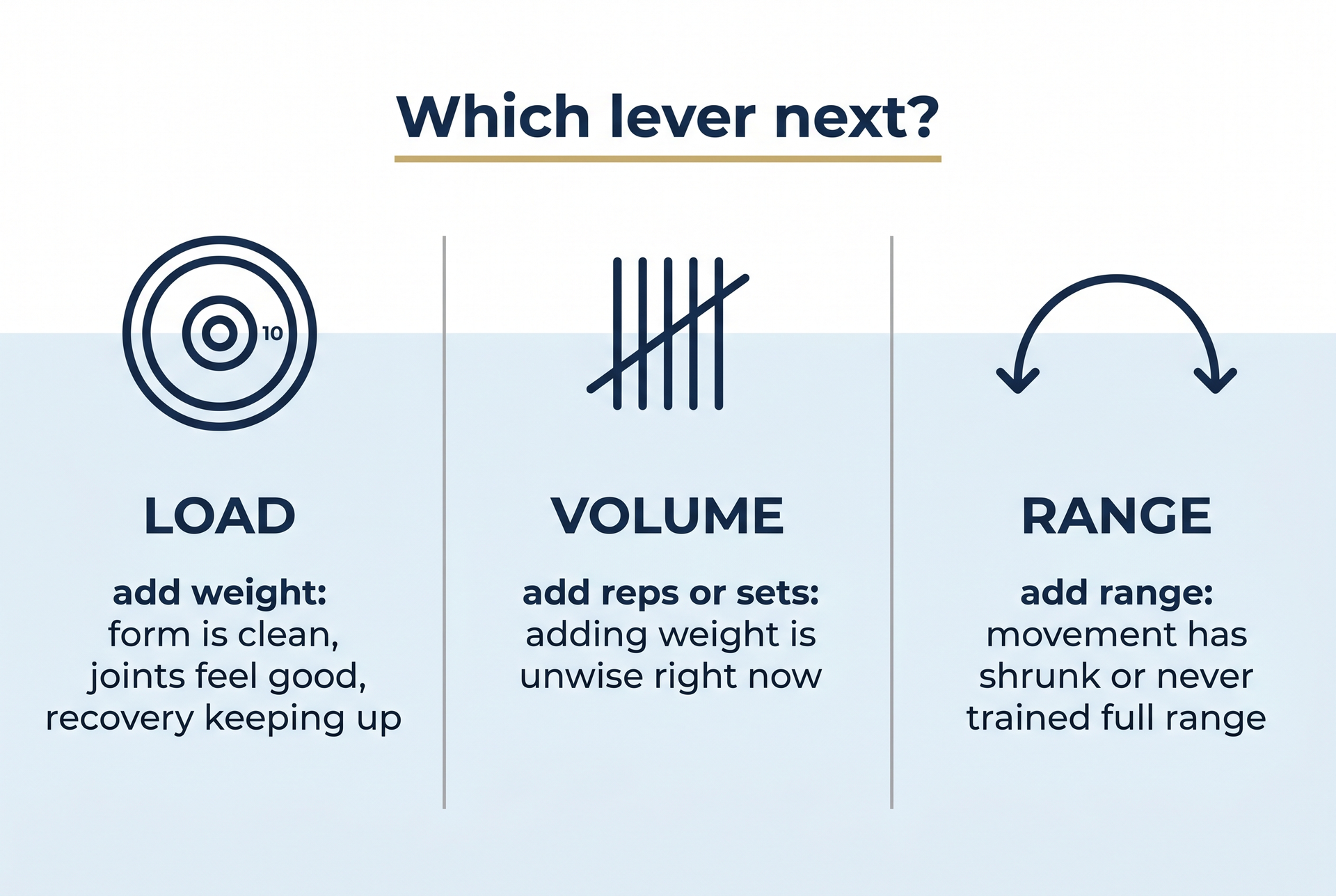
Here is how to put it together into a simple decision you can run on any lift. The table sums up the call, and the sections below walk each route in detail.
| Reach | How it raises demand | Choose it when |
|---|---|---|
| Load (weight) | More weight on the same movement | Your form is clean, your joints feel good, your recovery is keeping up, and the weight has started to feel manageable. |
| Volume (reps and sets) | More total work at a weight you already handle well | Adding weight is unwise right now: form frays as it climbs, a joint is cranky, or your recovery is borderline. |
| Range of motion | More work per rep through a fuller, controlled range | Your range has quietly shrunk, or you never trained the full range to begin with, and adding load or volume both feel unwise. |
Add weight when form is solid and strength is the goal
Add weight when your technique is clean, the movement feels good on your joints, you are recovering well, and the current weight feels genuinely manageable for your target reps. In that situation a small increase is the most direct way forward. Make the jump small, ideally the smallest increment available, so you can hold your form and keep the progression trackable rather than gambling on a leap your body may not be ready for.
Add reps or sets when volume is the limiter
Add reps or sets when adding weight is not wise right now, because your form gets shaky as it climbs, a joint is a little cranky, or your recovery is borderline, but you can still do more good-quality work at your current weight. Adding volume lets you keep increasing demand and driving progress while sparing your joints and technique the stress of constantly heavier loads. This use of volume as a sustainable way to keep advancing also fits the federal Physical Activity Guidelines for Americans, which call for muscle-strengthening activity on 2 or more days per week that works all of the major muscle groups.
Add range when mobility is the bottleneck
Add range when you notice your movement has been getting shorter, or when you simply have not been working through a full, controlled range to begin with. Earning more depth or reach increases the demand and often improves the quality of the movement at the same time, all without touching the weight. This lever is especially valuable when adding load or volume both feel unwise, because it lets you keep progressing through better movement rather than more stress.
Common wrong turns
Two opposite mistakes trip people up, and naming them helps you avoid both. They sit at the extremes of the progression decision, and most stalls come from living at one end or the other.
Always chasing weight
The first wrong turn is treating weight as the only progression, adding it relentlessly until form breaks down or a joint protests. This is the default trap, and it leads to stalls, strain, and frustration. If every progression you have made in months has been adding weight, you are almost certainly leaving the other levers unused, and your body is probably asking you to rotate to volume or range instead.
Never actually progressing
The opposite wrong turn is never increasing demand at all, repeating the same weights, reps, and range week after week and wondering why nothing changes. This is just as common and just as ineffective.
Comfortable training that never gets harder is not progressive overload; it is maintenance, and your body has no reason to keep adapting. If your training has looked identical for weeks, the fix is to pick a lever, any appropriate lever, and move it.
Frequently Asked Questions
How do I know when to add weight versus reps?
Check your form and recovery first. If your technique is clean, your joints feel good, you are recovering well, and the weight has started to feel manageable, adding a small amount of weight is reasonable. If your form gets shaky as the weight climbs or your recovery is borderline, add reps or sets at your current weight instead. The rule of thumb is that load progression requires solid form and good recovery, while volume is the safer way to progress when either is in question.
How much weight should I add when I make progress?
As little as gets the job done. Small, trackable increases, ideally the smallest increment available, let you keep your form and recover between sessions, while big jumps tend to outrun your technique and your recovery. There is no prize for adding weight fast. Steady, modest increases sustained over months build far more strength than aggressive jumps that lead to stalls or strain. For many lifts the smallest jump available, sometimes just a couple of pounds with micro-plates, is exactly the right size.
Is adding range of motion really a form of progression?
Yes, and it is the most underused one. Working a muscle through a fuller, controlled range increases the demand on every rep because the muscle does more total work, all without adding weight. If you have been cutting movements short, simply earning more depth or reach can restart progress. It also tends to improve the quality and carryover of your training, which adding weight alone does not.
Should I change one thing at a time or several?
One at a time. If you add weight, reps, and range all at once and progress returns, you will not know which change worked, and you may overshoot your recovery. Change a single lever, hold the others steady, and watch how your body responds over a couple of weeks. This keeps your training trackable and lets you learn what your body actually responds to.
What if none of the levers seem to be working?
If you have genuinely rotated through the levers and progress has still stalled for weeks, the issue is often outside the progression itself, usually recovery, consistency, or technique on that specific lift. That is a different question than which lever to pull. More often than not the culprit turns out to be recovery or consistency rather than the progression scheme, so an honest look at your sleep, your stress, and how many sessions you actually completed is usually the most productive place to start.
Pick your next progression with confidence
Progressing your training was never supposed to mean reflexively adding weight until something breaks. You have three levers, load, volume, and range, and the right one depends on your technique, your recovery, and your goal.
The catch with all three criteria is that they are hard to judge from the inside, because effort can feel like progress even when your form is fraying or your recovery is slipping. We see this constantly with new clients around Pleasant Hill: someone arrives convinced they need to add weight, and an outside look at the lift shows the real opening is honest depth or a few more quality reps instead.
A
Strength and Range of Motion Assessment is that outside read on your movement and capacity, so your next progression is a deliberate choice rather than a reflex. If you keep landing on the wrong lever and train around Pleasant Hill or the East Bay, it is a reasonable place to get that clarity.
Here are our latest articles! Click to read more.