Progressive Overload: How Strength Actually Improves Over Time
Progressive overload is the idea that strength improves when the body receives a training signal, recovers from it, adapts to it, and then receives a slightly more advanced challenge. It is not a command to add weight every week forever. It is a planning principle.
That distinction matters. Many people think progress means soreness, sweat, or constantly heavier weights. Others think variety is the key, so they change exercises every time they get bored. Both approaches can create effort, but effort is not the same thing as adaptation.
A better way to understand strength is through four words: signal, recovery, adaptation, and progression. Those words give you a simple framework for reading your plan.
The strength progression framework: signal, recovery, adaptation, progression
At the broad public health level, the
HHS Move Your Way Activity Planner frames muscle strengthening as part of a healthy weekly activity mix, recommending muscle-strengthening work on at least two days a week. The
WHO physical activity fact sheet keeps the definition broad: physical activity is any bodily movement that uses energy, and muscle strengthening benefits everyone. Progressive overload is one way to make the strengthening part of that mix purposeful rather than random.
Signal means the workout has to be clear enough for the body to understand what is being asked. If every session is random, the signal gets blurry. If the load is always too easy, the signal may be too quiet. If every workout is maximal, the signal may be so loud that recovery cannot keep up.
Recovery means the body needs enough time, food, sleep, and lower-stress space to respond. Strength does not improve during the hardest rep alone. It improves when the body absorbs the training and returns more capable.
Adaptation means the same task starts to feel more repeatable, more controlled, or more powerful. You may lift the same weight with better form, use a deeper range, need less warm-up, recover faster, or feel more confident under the bar.
Progression means the next challenge is chosen deliberately. It may be more weight, but it may also be more reps, more range, a slower tempo, a harder variation, improved control, better frequency, or a smarter weekly structure.
The same workout eventually stops working
The body is good at adapting. That is the point of training. A workout that once felt difficult may eventually become easy because your body has learned it. That is good news, but it also means the plan needs to evolve.
The reason this works is that the body is deeply resilient, and it adapts to whatever you repeatedly ask of it. If your days are mostly sitting or standing with no real strength demand, the body reads that as the job and quietly adapts down to it. The moment you start asking it to overcome more, the strength to carry groceries, climb stairs, or stand up without using your hands, it begins adapting up to meet that demand instead.
That two-way adaptive response is the real premise underneath progressive overload. Hold on to the plain meaning of the word: progressive means moving forward in deliberate steps. The body will move in the direction you train it. We just have to be diligent about doing the work that drives the improvement, and at Royal Blue Fitness that is exactly what we build, the action plan that leads to increased strength.
The mistake is thinking the only answer is to make everything harder immediately. Sometimes the best progression is small. You might add one rep per set, improve depth, keep the same load but make every rep cleaner, or repeat the same plan for another week to let the skill settle.
The
ACSM position stand on progression models in resistance training gives a more technical version of this idea: training variables are manipulated over time based on goals and training status. It even puts a number on one common decision, suggesting a roughly 2 to 10 percent load increase once you can perform one to two reps over your target on a given exercise. For a normal client, the plain-English takeaway is simple: your plan should have a reason for changing, and the jump should be modest.
Progression is not always more weight
Adding weight is the most obvious form of overload, but it is not the only one. A beginner may progress by learning a clean hinge. A post-rehab client may progress by tolerating a longer range. An adult 50-plus may progress by moving with more balance and confidence. A stronger client may progress by adding load, volume, power, or density.
Here are the main variables a coach can adjust:
- Load: the amount of resistance you use.
- Reps and sets: how many times you perform the movement and how many rounds you complete.
- Range of motion: how far you move through the pattern.
- Tempo and rest: how fast each phase moves and how long you recover between sets.
- Frequency: how often the pattern appears across the week.
- Exercise difficulty and stability demand: how hard the variation is and how much balance or control it requires.
- Total weekly volume: the overall amount of work across the week.
Only one or two should usually change at a time. In our coaching, we pick that one variable from the assessment, not from how the last session felt: if range was the limit at baseline, we move range before load, and we hold the rest steady so the next check-in tells us something honest. That is also why a client who is traveling or training with us virtually can keep progressing, because they can send the set back, we read the one variable we chose, and we adjust it for the next week. When everything changes at once, it becomes hard to know what helped or what irritated the body.
This is why progression requires tracking. You cannot manage what you never observe. The log does not need to be complicated. It simply needs to show what you did, how it looked and felt, and what happened afterward.
Recovery is part of progressive overload
More work is not always more progress. If the plan adds challenge faster than the body can recover from it, the result may be stalled strength, persistent soreness, poor sleep, irritability, or repeated flare-ups. The body may be receiving a signal, but it may not be getting a chance to adapt.
The
newer public conversation around resistance-training guidelines has emphasized that consistency and sustainability matter more than finding the perfect workout. This is important for real clients because most people are not training in a perfect laboratory week. They have jobs, families, stress, travel, sleep changes, and changing energy.
A good plan adjusts to the person. Some weeks, the right progression is heavier weight. Other weeks, it is a better technique with the same load. During a stressful week, the progression might be preserving the routine without piling on fatigue.
Signs your plan is actually progressing
Strength progress is not only a bigger number on the dumbbell. You are progressing when a movement feels more controlled, when you need fewer warm-up sets, when your range improves, when your balance feels steadier, when you can repeat a workout with less soreness, or when a daily task feels easier.
This is especially helpful for people who are not chasing a powerlifting total. If your goal is hiking, travel, golf, pickleball, lifting grandkids, getting off the floor, or feeling more capable at work, the plan should measure signals that matter to that life.
Ask five questions each month: What got stronger? What got more controlled? What recovered better? What still feels stuck? What should change next? Those questions create a feedback loop.
How Royal Blue Fitness builds strength progression
Royal Blue Fitness starts by clarifying the baseline. The
strength and range of motion assessment helps identify current strength, range of motion, control, tolerance, and confidence. Without that baseline, progression becomes guesswork.
The next step is choosing the right first signal. That may be a movement pattern, a strength gap, a balance need, or a capacity goal. Then the plan changes one variable at a time so the coach and client can see what the body is actually responding to.
This is the difference between training hard and training with direction. A hard workout may feel satisfying for a day. A progressive plan should become visible over weeks and months.
The progression variables, in plain English
Load is the amount of resistance you use. Reps are how many times you perform the movement. Sets are how many rounds you complete. Range is how far you move. Tempo is how fast or slow you perform each phase. Rest is how much time you take between sets. Frequency is how often the pattern appears across the week.
Exercise difficulty also matters. A box squat and a deep goblet squat may train a similar pattern, but they do not ask the same thing of the body. A supported split squat and a rear-foot-elevated split squat are not the same challenge. A machine row and a free-weight row may both build pulling strength, but they require different amounts of trunk control.
Progression becomes smarter when the coach knows which variable is supposed to change. If the goal is technique, the load may stay stable. If the goal is strength, the load may rise. If the goal is confidence after a long break, range and repeatability may matter first.
A simple progression example
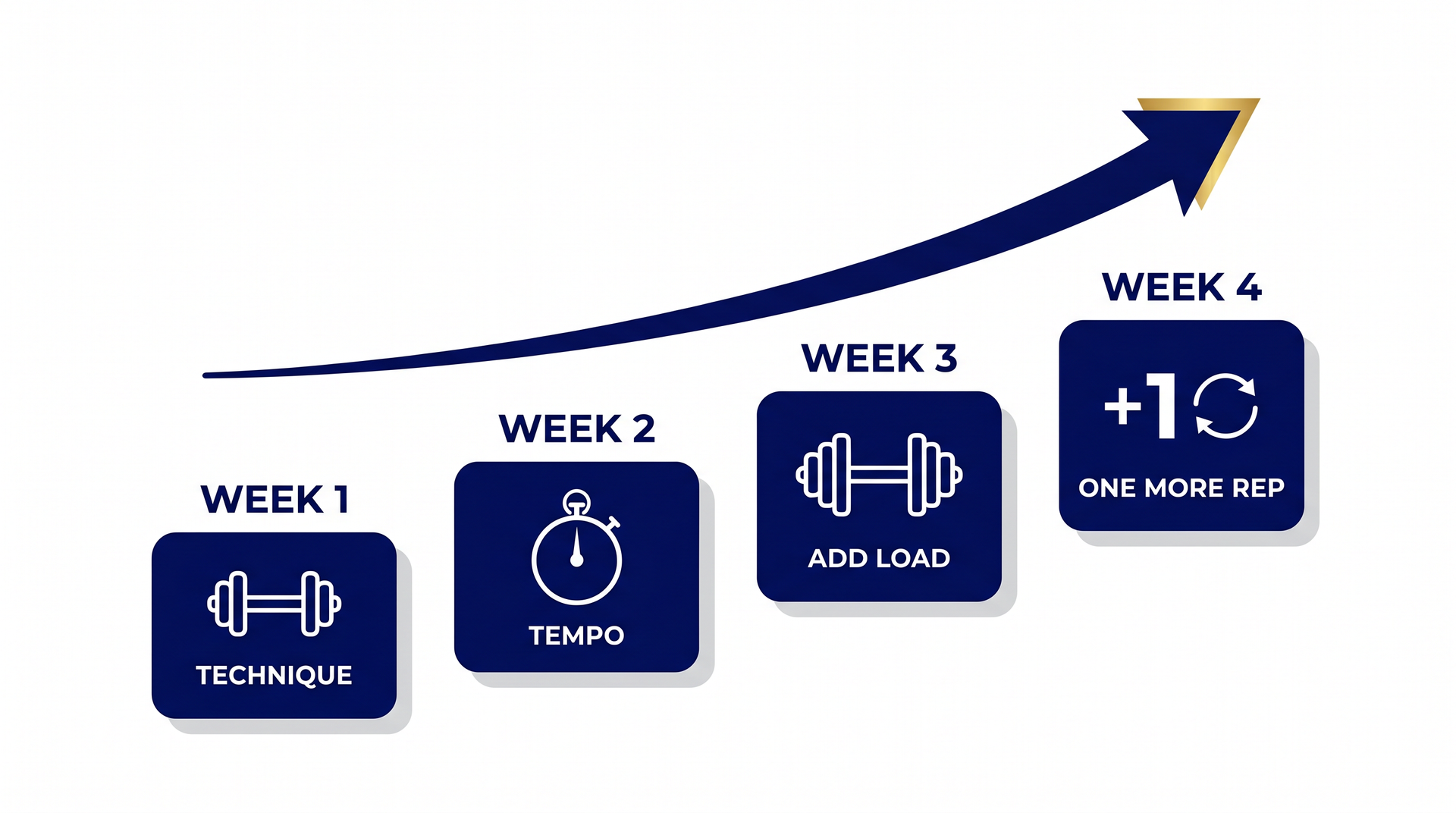
Imagine a client learning a goblet squat. Week one may focus on finding stance, depth, and control with a lightweight. Week two may repeat the same weight but improve tempo and confidence. Week three may add a small amount of weight. Week four may keep the weight steady and add one rep per set. Nothing dramatic happens, but the plan is moving.
Now imagine a different client whose knees feel sensitive after deep squats. The progression might begin with a box squat, then gradually lower the box, then add load, and only remove the box when the movement is repeatable. That is still progressive overload. It is simply using range, control, and tolerance before load.
A third client may already be strong but inconsistent. Their progression might be frequency. Instead of chasing a heavier lift, the first win is completing two quality sessions per week for eight weeks. Consistency can be a progression when inconsistency is the bottleneck.
Restarting progress when you stall
A plateau does not automatically mean you need to work harder. First, check whether the plan has been consistent enough to judge. If workouts have been missed, sleep has been poor, or exercises have changed every week, the issue may be a lack of a stable signal.
Second, check whether you are recovering. If performance is flat and you feel more run down, adding intensity may be the wrong move. You may need a lighter week, better spacing, fewer hard sets, or a plan that more honestly fits your current life.
Third, check whether the progression variable is too narrow. If you only count heavier weight as progress, you may miss improvements in tempo, range, control, and confidence. Sometimes the body is adapting, but the tracking system is too limited to see it.
Finally, decide on the next experiment. Add a rep, adjust the tempo, change the range, improve the exercise setup, or hold the load and clean up the quality. One well-chosen change teaches more than five changes made out of frustration.
Progressive overload should feel calm, not frantic
Progression should create direction, not pressure. A good plan does not ask you to prove yourself every day. It asks you to build a little more capacity over time. That distinction makes training more sustainable for beginners, adults 50-plus, post-rehab clients, and busy professionals.
Calm progression also makes coaching more precise. When the client does not feel rushed, they can report what happened honestly. The coach can see whether the body is adapting or compensating. The plan becomes a conversation with the body rather than an argument against it.
This is one reason Royal Blue Fitness keeps returning to assessment-informed programming. The clearer the baseline, the calmer the progression can be.
Progressive overload in a normal training week
A normal training week does not need to be complicated. Choose a few important patterns, train them consistently, and decide what will change slowly. For many people, that means one lower-body pattern, one upper-body push, one upper-body pull, one hinge or hip pattern, and a few support exercises for balance, core control, or mobility.
Then pick one progression variable at a time. A beginner may keep their weight the same and improve their technique. An intermediate lifter may add a small amount of load. A post-rehab client may progress range or confidence before load. A busy professional may progress consistency before intensity.
The key is to stop treating every workout as a new test. The workout is part of a sequence. When the sequence is clear, you can see whether the body is adapting, holding steady, or asking for a change.
Different goals need different overload
Progressive overload is not one universal recipe. Strength, muscle endurance, mobility confidence, bone-loading tolerance, athletic power, and return-to-activity goals all use progression differently. The principle is the same, but the variable that matters most changes with the goal.
For pure strength, load may become the primary variable once the technique is reliable. For balance, confidence, stance, surface, speed, and support may matter more. For mobility, range, and control may come before load. For someone with a demanding work schedule, the first overload may be showing up consistently enough that the body recognizes a pattern.
This is why progression should be coached, not guessed. The right next step is not always the heaviest. It is the next demand the body can adapt to without losing the quality that makes the training useful.
What a coach is watching while you progress
A coach is not only watching whether the rep was completed. They are watching the setup, the path of the movement, breathing, speed, symmetry, range, effort, and how the person responds after the set. They are also listening to the client’s confidence and recovery report.
Those details change the progression decision. Two clients may lift the same weight for the same reps, but one is ready to progress, and the other is not. One rep may be controlled and repeatable. Another may be technically complete but too close to the edge for the person’s current goal.
That is the value of assessment-informed progression. The plan uses numbers, but it does not worship them. It uses the client’s response to choose the next variable.
Frequently Asked Questions
What is progressive overload?
Progressive overload means gradually increasing or refining the training challenge so the body has a reason to adapt. It can involve weight, reps, range of motion, tempo, control, frequency, or exercise difficulty. The goal is a better-matched challenge, not simply a heavier one. Over weeks, those small, deliberate increases are what turn a workout you can do into a workout that changes you.
Do I have to lift heavier every week?
No. Heavier weight is one progression tool, not the whole system. Some weeks progress means better control, more repeatable reps, a deeper and more comfortable range, or improved recovery. A modest, well-timed change usually beats a big jump, and there will be weeks when holding steady and cleaning up technique is the smartest progression you can make.
How fast should I add weight?
Slower than most people expect. The ACSM position stand suggests a roughly 2 to 10 percent load increase once you can perform one to two reps over your target on an exercise, which is a small jump on most lifts. If a change leaves your form ragged or your joints irritated, it was too big. Small increases you can repeat beat large ones you cannot recover from.
Can beginners use progressive overload?
Yes. Beginners often progress quickly by learning technique, building consistency, and repeating important patterns. The first overload may be skill and control, not a heavy load, and that still counts as real progress. Locking in clean movement early also makes every later load increase safer and more productive.
How do I know if I am progressing safely?
Your plan should show measurable improvement without persistent flare-ups, worsening pain, or recovery problems. Steady, repeatable reps with good control are a green light. If symptoms are unusual, worsening, or medically concerning, get appropriate guidance from a qualified provider before continuing to push.
What should I do when I hit a plateau?
Before adding intensity, check the basics. Has the plan been consistent enough to judge, are you sleeping and recovering, and is your definition of progress too narrow? Often a plateau is really a recovery problem or a tracking problem, not a sign you need to work harder. Then choose one deliberate change and give it a few weeks before judging it.
What is the biggest mistake with progressive overload?
The biggest mistake is treating it as add weight no matter what. The real goal is a better-matched challenge, followed by recovery and adaptation, so the body can absorb the work and come back more capable. Chasing soreness or constant novelty usually produces fatigue, not strength.
Ready for a strength plan that fits your body?
Choose assessment-informed programming when you want your plan to progress deliberately instead of chasing soreness, novelty, or random intensity. You can
book a strength and range of motion assessment to find your baseline and map the next deliberate step for your goals.
Here are our latest articles! Click to read more.