Burnout-Proof Training: How Royal Blue Fitness Keeps You Moving Without Hitting a Wall
When most people think of burnout, they think of work: long hours, constant pressure, no real recovery. The same thing happens in fitness. You push hard for a few weeks, your joints get cranky, your energy tanks, your sleep slips, and suddenly the idea of another workout feels heavy. You skip a few sessions, feel guilty, and the all-or-nothing cycle starts over.
At Royal Blue Fitness, our whole system is built to avoid that cycle. We still train with intent and intensity, but we protect your energy, your joints, and your motivation so you can stay consistent for years, not just for a season. That belief is baked into how we assess, plan, and adjust your program. It is not something we try to bolt on later.
This is how we design training to prevent burnout in the first place.

Training burnout has a recognizable pattern
Burnout is not just being tired. In training, it tends to show up as a cluster of signs that build quietly over time:
- Harder than it should feel: workouts that leave you flattened by efforts that used to be routine.
- Soreness that lingers: muscle or joint aches that never fully settle between sessions.
- Dread instead of drive: sessions you used to enjoy now feel like a chore.
- Choppy sleep: trouble falling asleep, staying asleep, or waking up rested.
- A flat mood: feeling irritable, unmotivated, or emotionally drained about training.
- Stalled progress: numbers and energy plateau even though you are doing everything right.
Broadly, burnout tends to set in when the stress you put on your body is not matched by enough recovery and recharge time. Over days and weeks, that imbalance builds up until you feel drained instead of strong. Our job is to manage that balance on purpose instead of guessing at it.
One important note. The signs above usually ease once training and recovery come back into balance. But if a low mood, deep exhaustion, or a loss of interest in things you normally enjoy stretches across your whole life and not just your workouts, that is worth taking seriously. Please reach out to your doctor or a mental-health professional. That is not a sign of weakness, and it is not something a training plan alone is meant to solve. It is simply the caring, sensible next step.
The principle behind our programming: stress, recovery, adaptation
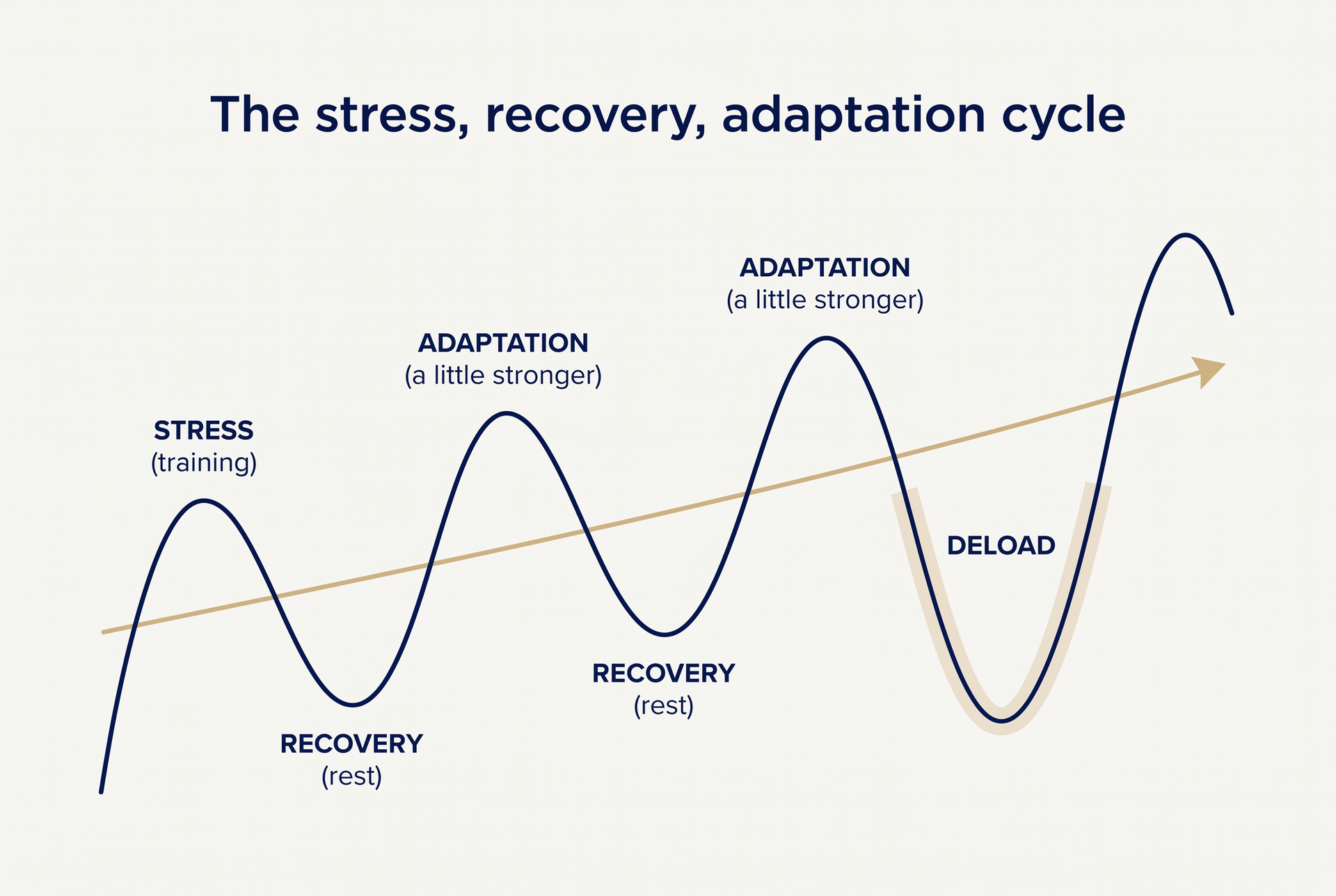
Your body changes through a simple pattern. You stress it with a workout, you recover from that stress, and then you adapt and come back a little stronger. The trouble lives at the two extremes. Too much stress with too little recovery is the imbalance that research on overtraining describes as a maladaptive response, one that drags performance down and shows up as mood changes, lingering soreness, and recurrent overuse injuries. Too little stress with plenty of recovery leads to no real progress at all.
Everything we do at Royal Blue Fitness sits between those extremes. We use structured programming, objective assessment, and your real-world feedback to keep you in the zone where progress happens without leaving you wrecked. That same research describes overtraining as a continuum, not a switch that flips overnight, which is exactly why we watch for the early, reversible signs rather than waiting for a crash.
Assessment, not assumptions
Burnout usually starts when a plan does not match the person in front of it, which is why we never copy and paste generic workouts. At the start, we look at the following:
- Mobility and control: how your major joints move and stabilize under load.
- Strength and asymmetries: where you are strong, and where one side lags the other.
- History: past injuries, surgeries, and the flare-ups that tend to recur.
- Life load: your schedule, your sleep, and the stress you carry outside the gym.
- Preference: the kinds of training you actually enjoy and will stick with.
We combine your story with objective tests, then build a plan that respects your current capacity. As you train, we watch the trends: how your numbers change, how your body feels, and how recovered you are as you show up from one session to the next. That keeps us ahead of burnout rather than reacting to it once we are already exhausted.
We reassess on purpose, and we teach you to read yourself
The first assessment tells us where to start. What actually keeps you off the burnout wall is what comes next: we reassess on purpose, again and again, for as long as we coach you. Most plans are written once and then run on autopilot until something breaks. Ours is a living thing. We keep gathering the inputs that predict a crash before it happens, and we keep adjusting around them.
Those inputs are broad on purpose. We look at your energy day to day, the work and life load you have been carrying, whether you are actually sleeping enough, how high your stress is sitting, and your training volume both overall and muscle group by muscle group. None of those signals means much alone. Read together, they tell a clear story about how much you can absorb this week versus last week.
Here is the part we will keep behind the curtain on purpose: we run those inputs through a structured method we built in house, a proprietary formula that is ours alone. We are not going to publish how it weighs and combines everything, because that engine is a big part of why our clients rarely hit a wall. What we will tell you is what it does for you. It turns a pile of scattered signals into a clear read, and from that read we make adjustments and micro-adjustments to your plan, sometimes a small nudge, sometimes a real change in direction, so the work always fits the person who showed up today.
We do not keep all of that to ourselves, though. A coach cannot sit on your shoulder every hour, so we also teach you a simple version you can run on your own. We help you notice two everyday tells: how well you can focus during a normal work day, and how long your post-workout fatigue lingers compared to your usual. Most people have never been taught what their own baseline feels like, so we coach you to recognize it: what normal feels like, what honest productive effort toward a goal feels like, and what the uh-oh, this should not be happening feeling is when it shows up. You get both the specifics to watch and the bigger-picture sense of where you are trending.
Underneath all of it is one principle we come back to often: pushing yourself into burnout does not speed your progress up, it drags it out. Climbing out of a burnout hole and getting going again takes far longer than simply pacing yourself would have. It is the same lesson a good marathon or cross-country coach drills into a runner. The athlete who paces beats the one who sprints the first mile and walks the last three. We coach your training the same way, so the line of progress keeps climbing instead of spiking and crashing.
Warm-ups that wake you up, not wear you out
A lot of people accidentally burn themselves out in the first ten minutes. They jump straight into intense circuits or long cardio warm-ups and arrive at their strength work already gassed.
Our warm-ups do the opposite. They raise blood flow without spiking fatigue, gently open the joints you are about to load, and rehearse the patterns you will use in the main set. They also give us a read on how your body feels that day. If your back is tight or your balance is off in the warm-up, we see it early and adjust before we ask for heavy effort. The warm-up is not just about getting sweaty. It is a quick daily check-in that helps us avoid overreaching on the wrong day.
Smart intensity: progressions, regressions, and daily adjustments
Most burnout does not come from one big bad workout. It comes from stacking slightly-too-hard days on top of an already stressful life. To prevent that, we build flexibility into your plan in three directions:
- Progressions when you feel great: heavier load, a more challenging variation, or a bit more volume or tempo focus.
- Regressions when life is heavy: lighter load with clean form, lower-impact options for cranky joints, or fewer sets with more quality per rep.
- Autoregulation based on what you report: how you slept, how stressed you are today, and any pain, swelling, or unusual fatigue.
If you show up after a terrible night of sleep and a brutal workday, a green-light workout might become a yellow-light day, where we still train but pull back the intensity and protect your nervous system. That way, you stay consistent without digging a recovery hole you cannot climb out of. The session still counts. It simply meets you where you are that morning instead of demanding a version of you that did not get any sleep. In practice, that call is rarely about the number on the bar. We watch the warm-up: if your usual easy sets look labored, your bar speed is gone, or a joint that is normally quiet starts talking, that is our cue to dial the day back before the heavy work begins, not after something tweaks. Catching it in those first few minutes is the difference between a productive lighter day and a setback you spend the next two weeks paying off.
Periodization: the long-game plan that keeps you from hitting a wall
Periodization sounds technical, but the idea is simple: we plan your effort in waves rather than pushing flat out forever. A periodized plan moves through three kinds of stretches:
- Building phases, where volume or intensity gradually rises.
- Focus blocks, where we emphasize one goal, such as strength, balance, or conditioning.
- Deload weeks, where we intentionally cut back so your body can absorb the work.

In practice, that might look like three weeks of steady, progressive strength followed by one lighter week, heavier days rotated with easier but focused days inside the same week, or joint-heavier work like squats and hinges alternated with more joint-friendly conditioning and mobility. The point is that your plan has built-in seasons of push and consolidation, so your body and brain get real chances to absorb the work rather than grinding without end.
That three-weeks-on, one-week-lighter rhythm is not a guess. It mirrors how sports-medicine clinicians describe periodization, alternating blocks of training with planned recovery so the immune system and tissues get a chance to catch up and adapt. A deload week is not a break from progress. It is the part of the plan where the progress actually sticks.
Recovery is part of the program, not an afterthought
You cannot prevent burnout if recovery is just whatever you remember to do on your own. We build it into your plan from day one. Sports medicine guidance is clear on why: muscles get stronger during rest and recovery, not during the workout itself, so training in a constant high-stress state without it works against strength rather than for it.
Proper cool-downs close each session with gentle breathing to calm your nervous system, light mobility for the muscles you just trained, and simple movements that signal the work is done. That small window helps your heart rate settle, eases post-workout tension, and makes your evening feel better, which supports sleep and long-term consistency.
Active recovery days do a different job from your push days. They might mean easy walking or cycling, gentle mobility, lighter form-focused strength work, or breath work and positional drills. These days help you flush fatigue and keep joints happy while maintaining the habit of movement, all without adding more stress to a busy life. The same guidance makes the point plainly: a recovery day is not a wasted day, it is what lets the training you already did pay off.
We train the whole human: sleep, stress, and life load matter
You are not just a collection of muscles and joints. You have a job, a family, responsibilities, and a brain that carries them all. Burnout arrives faster when life is already running at a nine out of ten and training ignores that reality.
So we routinely ask about your sleep, your workload and mental stress, your energy outside the gym, and your soreness patterns and nagging aches. Your answers shape the plan. This is not a soft add-on: guidance on sleep and recovery explains that the deep-sleep phase is when your body releases growth hormone and repairs the muscle you broke down in training, and that stacking up sleep debt can build toward burnout and the physical signs of overtraining.
If your stress has been pinned high all week, we might swap a high-intensity finisher for low-impact intervals, focus on technique and breathing rather than personal records, or shorten the session and protect the two or three things that matter most. You still train with intention and intensity, but the intensity fits your whole life, not just the sixty minutes you are in the gym.
How we keep progress going without breaking you down
To keep you out of the burnout zone, our coaches are always balancing three things at once:
- Performance: are your numbers and your confidence trending up?
- Tissue and joint health: are we avoiding flare-ups and managing existing issues wisely?
- Psychological load: are you looking forward to training, or starting to dread it?
When one of those starts to drift, we adjust. Bored and unchallenged, and we progress the complexity or load. Sore and dragging for days, and we reduce volume or impact and rethink frequency. Mentally tapped out, and we simplify, shorten, or change the flavor of the work so it feels doable again. The goal is not to see how much you can suffer. It is to build a training life that fits your real life, so you can keep showing up and collecting wins year after year.
Signs your current training might be driving you toward burnout
If you are wondering whether your current routine is helping or hurting, watch for a few patterns:
- Running on stimulants: you regularly need naps or caffeine just to get through the day after workouts.
- Outsized setbacks: minor stumbles feel huge, and you keep thinking about quitting altogether.
- Endless restarts: you feel like you are always starting over every few months.
- Louder aches: nagging pains are slowly getting louder, not quieter.
- Guilt around rest: you feel bad about taking a day off, even when you are clearly exhausted.
Those are not signs of weakness. They are signs that the plan is not respecting how recovery, stress, and adaptation actually work. The fix is rarely more willpower. It is usually a smarter structure.
The Royal Blue Fitness promise
Our promise is simple: structured, pain-smart training that respects your body and your life. We start with assessment rather than assumptions, use warm-ups and cool-downs and active recovery days on purpose, build periodized plans instead of random workouts, adjust intensity around your sleep and stress and feedback, and favor long-term consistency over short-term heroics.
If you feel like you are always running on fumes with your current approach, it is not because you lack willpower. You probably just need a more intelligent system. If your training keeps cycling between hard pushes and burnout, a consultation or a Strength and Range of Motion Assessment is a good place to start. It gives us a clear read on where your body is right now, so we can build progress you can actually live with instead of another plan that runs you into the ground.
Frequently Asked Questions
Is training burnout the same thing as just being tired?
No. Ordinary tiredness lifts after a good night of sleep or an easy day. Training burnout is more stubborn: it is a cluster of signs, like lingering soreness, dread, choppy sleep, a flat mood, and stalled progress, that builds when hard training is not matched by enough recovery. If a day off fixes it, it was fatigue. If the pattern keeps returning, the plan likely needs adjusting.
How many rest days do I actually need?
There is no single magic number, and it depends on your age, your training, and the rest of your life. What matters more is that recovery is planned rather than improvised. Most people do well with at least one genuine rest day each week plus lighter days woven through, and many benefit from an easier deload week roughly every fourth week so the body can absorb the work.
Will training less often actually slow my progress?
Usually the opposite. Your body gets stronger during recovery, not during the workout itself, so well-placed easier days and deload weeks are when adaptation happens. Constantly grinding at high intensity tends to flatten progress and invite flare-ups. We aim for the lowest effective dose that keeps you moving forward, not the highest dose you can survive.
What is autoregulation, in plain terms?
It means letting how you feel on a given day shape that day's training. If you slept badly and had a brutal week, a planned hard session becomes a moderate one. If you feel sharp and recovered, we push a little. The plan stays intact, but the daily dial moves with your real life instead of ignoring it.
When should I talk to a doctor instead of just adjusting my workouts?
Adjusting training handles the gym side of burnout. But if a low mood, heavy exhaustion, or a loss of interest spreads beyond training into the rest of your life, or if pain is sharp, worsening, or does not settle, that is a cue to loop in your doctor or a mental-health professional. A coach can build a smarter plan, but some things sit with a medical provider, and reaching out early is always the right call.
Can I prevent burnout on my own, without a coach?
Many of these principles are doable solo: plan rest days, deload regularly, sleep well, and ease off when life is heavy. Where a coach helps is the honest read, an outside perspective on whether you are progressing or quietly digging a hole, plus a structure that flexes with your week so you do not have to white-knuckle the decisions yourself.
How can I tell on my own whether I am recovering or sliding toward burnout?
Start with two everyday tells we teach our clients. First, how well can you focus during a normal work day. When good focus turns to fog that lingers, that is a signal. Second, how long your post-workout fatigue lasts compared to your usual. A session that normally leaves you tired for an hour but now flattens you until the next morning is worth noticing. The trick is knowing your own baseline, what normal feels like, what honest effort toward a goal feels like, and what the uh-oh feeling is. Track those over a couple of weeks and the trend, not any single day, tells you whether to push or pull back.
Here are our latest articles! Click to read more.

Strength for Independence After 50: Training for Stairs, Carrying, Travel, and Getting Off the Floor