Low-Impact Resistance Training: How Joint-Friendly Strength Workouts Remodel Your Body
Low-impact training is having a moment. It shows up in class descriptions, fitness reels, and blog headlines, often framed as "gentle" or "easy."
In reality, well-designed low-impact resistance training is not the soft option. It is a precise way to send strong mechanical and neural signals into muscle, tendon, and bone without beating up your joints. For adults 40-plus, that combination is gold.
This article unpacks how low-impact resistance training works at a physiological level and how we use it at Royal Blue Fitness to build joint-friendly strength workouts that still deliver serious progress. You will see terms like sarcomeres, mechanotransduction, Golgi tendon organs, and General Adaptation Syndrome. The aim is not to turn you into a physiologist, but to show that low-impact is not a trend; it is physiology applied on purpose.
Low-impact does not mean low stimulus
It helps to separate two ideas:
Impact is the abrupt force spike when your foot hits the ground or you land from a jump.- Load is the overall tension your muscles and connective tissue experience.
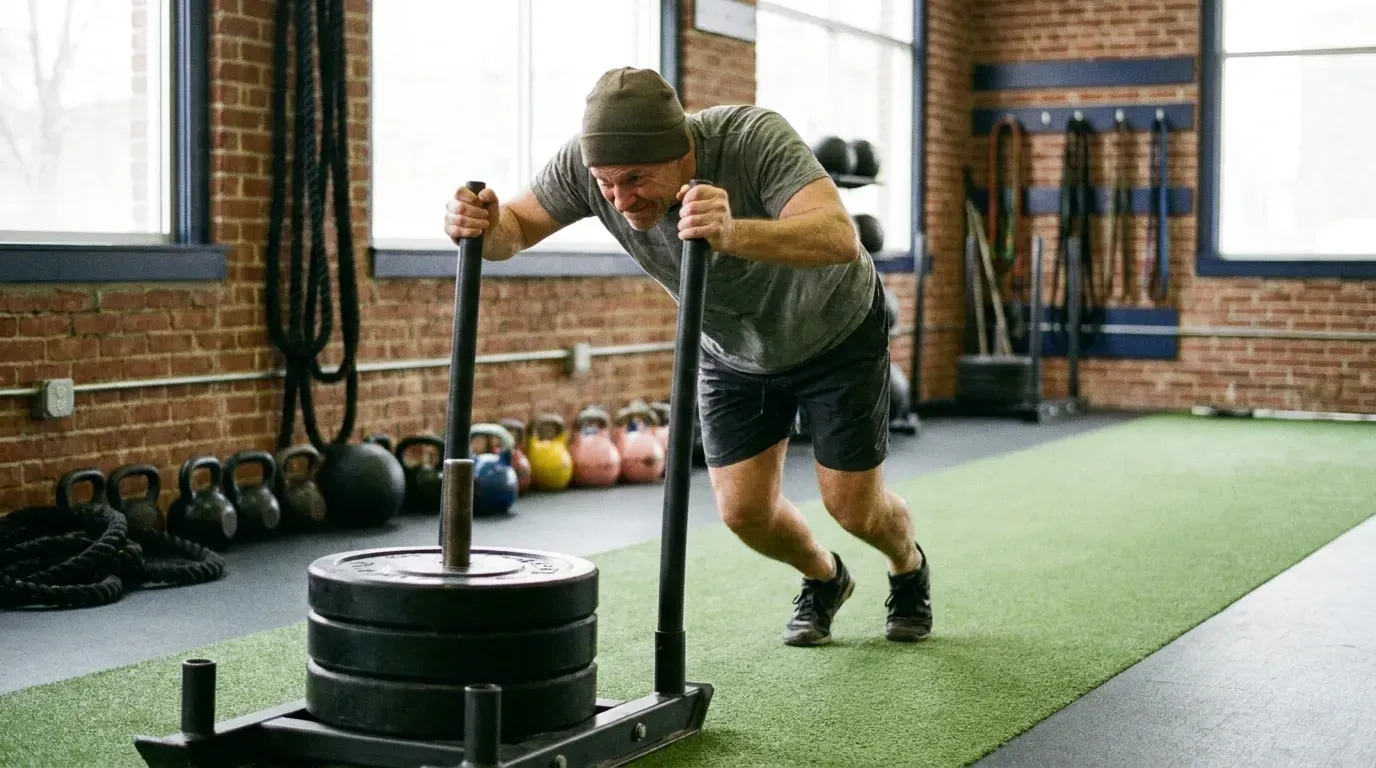
You can have low impact and still have a very high load. Slow split squats, heavy sled drags, and controlled Romanian deadlifts all create significant internal tension with minimal pounding on cartilage and joint surfaces.
Resistance training is widely supported as a primary strategy to counter age-related muscle loss. The federal
Physical Activity Guidelines for Americans recommend muscle-strengthening activity for all major muscle groups at least two days a week, and the
American College of Sports Medicine similarly advises training to maintain or increase muscular strength on at least two days per week. Evidence syntheses on resistance-training prescription support the same idea: when sets are taken to sufficient effort,
a wide range of loads can improve muscle function and strength, not just the heaviest weights.
The takeaway is simple: low-impact resistance training is not light toning. It is safe strength-building that trades high joint stress for smart volume, tempo, and proximity to fatigue.
From sarcomeres to tendons: how your tissues "hear" training
Your muscles generate force through tiny contractile units called sarcomeres. When you lift, lower, or hold a weight, those sarcomeres experience mechanical tension, and that tension is converted into biochemical signals inside the muscle fiber, a process known as mechanotransduction.
Tendon cells respond to mechanical stress too. Repeated, well-dosed loading can:
Increase collagen synthesis over the 48 to 72 hours after training- Improve collagen alignment
- Increase tendon stiffness and sometimes cross-sectional area over time
Stronger, stiffer tendons are not abstract. They transmit force more efficiently, reduce the slack in the system so movement feels more stable, and help protect against overload injuries in sport and daily life. Low-impact resistance work, especially when you emphasize tempo and control, keeps tension on sarcomeres and tendon cells longer in each rep. That time under tension is one of the main ways we stimulate mechanotransduction without high-impact or ballistic drills.
Why eccentric training matters so much here
Most daily movement is concentrically biased: people push up from a chair quickly and drop down without thinking. Over time that builds strength in one direction and sloppiness in the other. Eccentric training slows and strengthens the lowering phase, like a three- or four-second descent into a squat, or a controlled lowering out of a calf raise.
A randomized trial in the
American Journal of Sports Medicine compared traditional eccentric loading with heavy slow resistance for chronic midportion Achilles tendinopathy. Both protocols, which featured slow, controlled loading, produced large and lasting improvements in pain and function over 12 weeks and at one year. That is why we often program low-impact exercises with:
Slower eccentrics, for example three to five seconds on the way down- Short pauses near the lengthened position
- A smooth, less explosive concentric phase
You still get a strong hypertrophy and tendon signal, but with lower impact and more control for knees, hips, and spine.
Golgi tendon organs: your built-in safety circuits
Muscles and tendons are wired with sensory receptors that constantly report to your nervous system. Two of the most important are muscle spindles, which sense stretch and rate of stretch, and Golgi tendon organs (GTOs), which sense tension at the muscle-tendon junction. When tension rises very quickly or reaches a level your system does not trust, the GTOs encourage the muscle to back off, a built-in safety circuit.
Gradually progressive, joint-friendly loading helps these receptors recalibrate what normal tension feels like. When you repeat the same patterns with:
Stable setups- Smooth tempo
- Predictable progression in range and load
the nervous system can allow fuller recruitment without defaulting to protective bracing or shut-down strategies. Over time that feels like more confidence, smoother movement, and less apprehension about loading your joints.
General Adaptation Syndrome: why slow and steady works
The General Adaptation Syndrome (GAS), first described by Hans Selye, is a classic model of how the body responds to stress, and training follows the same pattern:
A new stimulus creates an alarm response: fatigue, soreness, local micro-damage.- With appropriate recovery, the body enters a resistance phase, where tissues rebuild slightly more robustly than before.
- If stress is excessive, too frequent, or poorly recovered from, you slide toward exhaustion and a drop in performance.
Low-impact resistance training works when it consistently lands between alarm and exhaustion: enough tension and volume to feel challenging, enough spacing and recovery for tissues to rebuild. Research on resistance training for sarcopenia and frailty generally shows meaningful gains in strength, walking speed, and chair-rise performance over 8 to 12 weeks at two or three sessions per week. Your nervous system and connective tissue do not care whether the exercises look flashy; they care whether the signal is clear, repeatable, and recoverable.
High load versus low load: what really changes?
People assume heavier is always better, but the research is more nuanced. A well-known meta-analysis in the Journal of Strength and Conditioning Research compared low-load and high-load training taken to failure: high load was more effective for maximal strength, but both produced similar muscle growth when volume and effort were matched. That does not mean load never matters; heavy training is still superior for peak strength. It means you can design low-impact resistance training with moderate loads, strategic tempo, and appropriate volume to create a robust adaptation signal, especially when the priority is muscle and tendon health rather than powerlifting numbers.
For a more specialized example, in a
Medicine & Science in Sports & Exercise trial, low-load blood-flow-restriction training and traditional high-load training induced comparable changes in patellar tendon stiffness and cross-sectional area over 14 weeks. We do not apply blood-flow restriction broadly without careful screening, but it illustrates how tissues respond to mechanical tension, metabolic stress, and effort, not just to heavy external loads.
How we use low-impact resistance training at Royal Blue Fitness
For adults 40-plus who want to stay strong, mobile, and active without aggravating cranky joints, low-impact resistance work is part of the core Strong for Life strategy.
It starts with a
Strength and Range of Motion Assessment, where we look at joint range and asymmetries, strength patterns in key movements, history of pain or surgery, and where you feel unstable or guarded under load. In ours, the limiter we most often find in adults 40-plus is not unwillingness to work hard; it is a joint or single-side range that flinches under speed, so we load it slowly before we load it heavily.
From there we build from movement families rather than random exercises:
Squat and sit-to-stand patterns- Hip-hinge patterns
- Pushing and pulling for the upper body
- Loaded carry and bracing patterns for the trunk
Then we make those patterns joint-friendly by adjusting:
Base of support: a supported split squat instead of jumping lunges, or a landmine press instead of heavy overhead barbell pressing- Tempo and eccentrics: longer lowering phases, brief pauses near the bottom, smooth accelerations instead of jerky movements
- Range of motion: sometimes starting with reduced depth or a higher box, then increasing range as capacity improves
- Implements: dumbbells, cables, trap bars, and machines often allow high tension with better joint alignment than certain barbell positions
We progress using effort, not ego. On main lifts we coach around a 7 to 8 out of 10 effort, with only mild tolerable joint discomfort at most and no symptom spike later that day or the next morning. Progression usually starts by expanding range of motion, then increasing time under tension through tempo, and only when quality is stable does external load go up.
What a joint-friendly strength day can look like
It does not need to be complicated. A typical day for an adult 50-plus with sensitive knees or shoulders starts with a few minutes of easy cardio (an incline treadmill walk or comfortable bike) and a short movement-rehearsal block: cat-cow, controlled hip rotations holding a support, and a few slow sit-to-stands. The main strength work then focuses on four or five movements:
A goblet squat to a box, three-second descent, brief pause before standing- A supported Romanian deadlift with dumbbells, controlled hip hinge
- An incline push-up or landmine press for the upper-body push
- A chest-supported row or cable row for the pull
- A suitcase or farmer carry to integrate core and grip
Each exercise gets moderate reps with enough rest that you feel focused, not rushed, finishing with easy walking and gentle stretching in the ranges you just trained. Everything is low impact, but the internal load is meaningful, and two or three days a week of this adds up: strength improves, joints feel more held together, and everyday tasks demand less effort.
Turning physiology into a plan you can trust
Low-impact resistance training is not a marketing angle. It is what happens when you respect physiology, connective-tissue biology, and real-world recovery. Tissues respond to tension and effort, not just impressive-looking weights; joints appreciate controlled loading far more than repeated impact; and smartly progressed, joint-friendly strength workouts build muscle, protect tendons, and support metabolic health well into later decades.
Ready for joint-friendly strength built around your body?
Our Strong for Life program designs low-impact resistance training that begins with a Strength and Range of Motion Assessment, so you load the right structures at the right time without guessing which movements your body will tolerate. That is how you stay strong, capable, and resilient for the long term, even when low-impact is the starting line.
FAQ: low-impact resistance training
Is low-impact the same as low-intensity?
No. Impact is joint pounding; intensity is effort and load. You can keep impact low while the internal load stays high, which is exactly what makes joint-friendly training effective.
Can I build real muscle without heavy weights or jumping?
Yes. When sets are taken close to fatigue with enough volume, moderate loads build muscle comparably to heavy loads; heavy training keeps an edge for peak strength, but it is not required for muscle and tendon health.
Is low-impact training only for older adults or rehab?
No. It is especially valuable for adults 40-plus and for cranky joints, but anyone can use it to build strength while sparing cartilage and managing total joint stress.
How often should I train this way?
Most people do well with two or three sessions per week for all major muscle groups, which matches national guidance and the timelines seen in strength and sarcopenia research.
How do I know the effort is enough?
On main lifts, aim for about a 7 to 8 out of 10 where the last reps are genuinely challenging, with at most mild tolerable joint discomfort and no symptom spike later that day or the next morning.
Here are our latest articles! Click to read more.