The 20-Minute Anywhere Routine for Busy Adults on the Go
You know the feeling. The day got away from you again; the calendar is wall-to-wall, and the workout you meant to do is the first thing to fall off the list. By the time there is a free moment, it is late, you are tired, and a real session feels like one more thing you do not have the energy for.
Here is the part that gets lost in that story: a workout does not have to be long to be worth doing. Twenty minutes, done with intention, can keep your strength, energy, and momentum alive even during your busiest weeks.
This is a full-body routine you can run almost anywhere, with no equipment, no gym, and no commute. It is general fitness education rather than a personalized program, so use it alongside the people who know your body, but treat it as a real session, not a consolation prize.
Here is the whole session at a glance: about three minutes of easy warm-up, a thirteen-minute five-movement circuit that covers your whole body, and four minutes to cool down. Twenty minutes, no equipment, done. The rest of this guide shows you how to run each block and how to make it easier or harder on any given day.
Twenty minutes is enough to count
The biggest barrier to short workouts is not time. It is the quiet belief that anything under an hour is not worth the effort, so why bother? That belief keeps a lot of busy people doing nothing instead of something.
The truth is kinder, because movement adds up. National physical activity guidance is built around a weekly total rather than a single heroic session, and it now
counts activity gathered in short pieces across the week.
Two or three focused 20-minute sessions stack into something that genuinely supports your strength, your heart, and your mood. A short workout you actually do beats a perfect workout you keep postponing, every time.
Intensity is the other half of the story. Twenty minutes of purposeful effort, where you move steadily and work the major muscles of your body, does far more than an hour of wandering between machines and your phone. When the time is short, the focus goes up, and that is a good trade.
The goal is not to exhaust you. It is to give your body a clear, repeatable reason to stay strong.
A fit for busy people, with room to modify
This routine is designed for real schedules. Like any general routine, it also has a few situations where you should ease off or check first.
Built for busy, time-pressed people
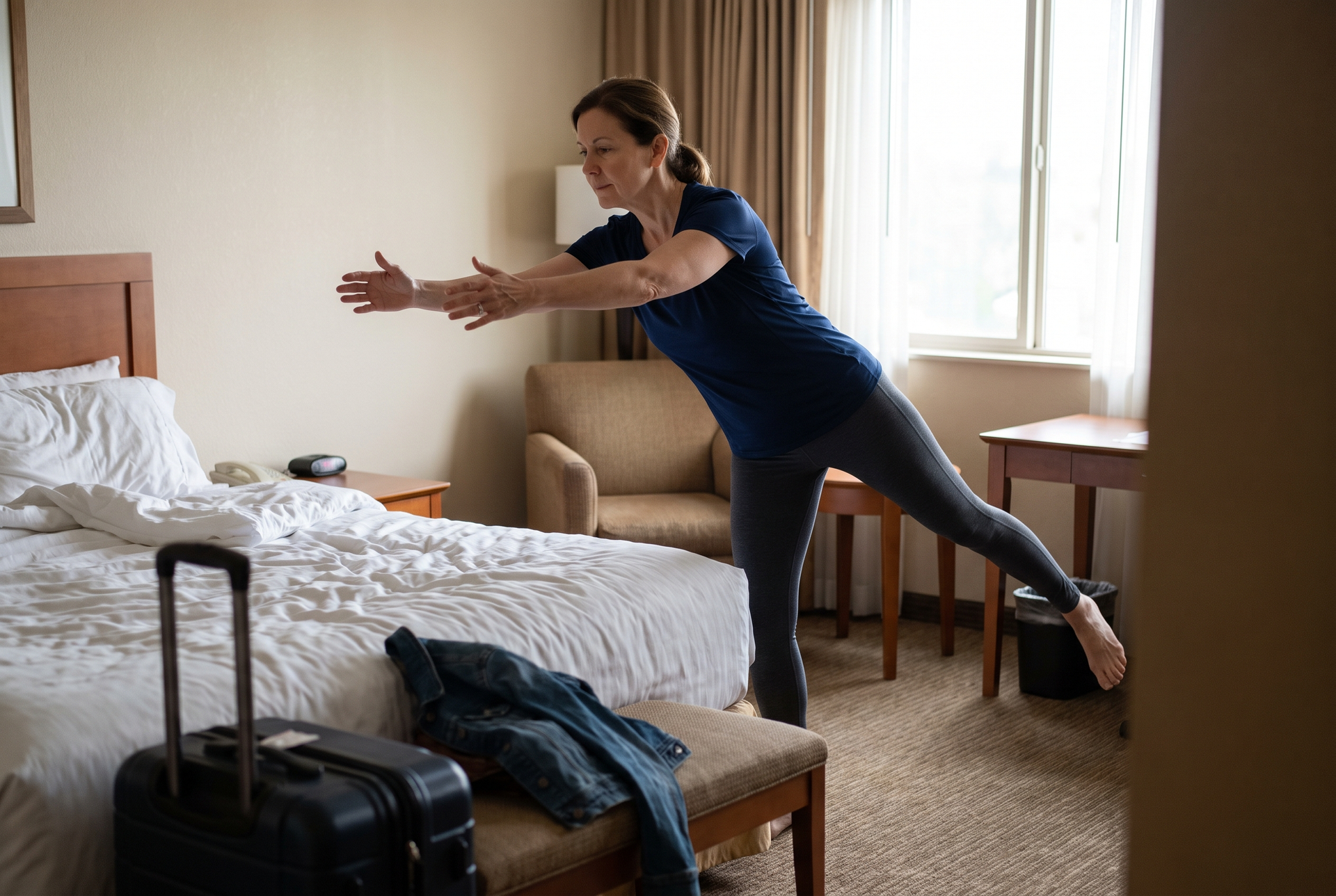
If your week is full and your workouts keep getting squeezed out, this is built for you. It suits beginners who want a simple place to start, people returning to exercise after a long pause, and anyone who travels and needs something that works in a hotel room or a corner of the living room. You do not need to be fit to begin, and you do not need to finish wrecked.
The routine meets you where you are, asks for 20 honest minutes, and lets you build from there. Busy adults in their 40s, 50s, and beyond tend to find it especially useful because muscle naturally begins slipping around age 40, at
about one percent a year, and regular strength work is how you protect the capability that keeps daily life easier, from carrying groceries to keeping up with the people around you, without demanding a lifestyle overhaul.
Signs to scale back or check first
A routine like this is meant for general, everyday fitness, not for working through pain or managing a medical condition. Ease off or get guidance first if you are dealing with sharp or new pain, a recent injury or surgery, dizziness or balance trouble, a heart or blood pressure concern, or any condition where a professional has asked you to be careful with exercise.
None of that means you cannot be active. It means the smart first step is a conversation with your doctor or a qualified coach, so the plan fits your body rather than a generic template. When something hurts sharply or in a worrying way, that is a signal to stop and ask, not to push through.
All you need: 20 minutes, a little space, no gear
The whole point of this routine is that it removes excuses, so it asks for almost nothing. You need about 20 minutes, a patch of floor roughly the size of a yoga mat, and your own body weight. That is the entire equipment list.
If you happen to have a sturdy chair, a wall, or a filled water bottle or two, you can use them, but none of them is required. The chair is handy for support and for adjusting the difficulty of certain moves, and a wall turns a push-up into something almost anyone can do.
Intensity comes from effort, not equipment. A useful gauge is a simple effort scale: on a one-to-ten scale of how hard you are working, aim for most of this routine to sit around a six or seven, where you are breathing harder and working but
could still say a short sentence. That keeps the session productive without tipping into the kind of grind that makes you dread the next one.
The routine, block by block
The 20 minutes are broken into three blocks, each doing a job. You warm up so the work feels good and safe, you do a full-body circuit that is the heart of the session, and you cool down so you finish calmer than you started. Move through them in order, because the sequence is a coaching choice, not a random list.
Warm-up: about 3 minutes
Do not skip this part, even when you are rushed. A few minutes of easy movement gently raise your heart rate, loosen the joints you are about to use, and tell your nervous system that work is coming, which makes everything after it smoother and safer. Keep it light and continuous.
Spend about three minutes flowing through gentle, full-body motion:
March in place or step side to side for 30 to 60 seconds to get warm.
Roll the shoulders and circle the arms forward and back to open the upper body.
Swing into a few slow, shallow squats, sitting back as if reaching for a chair.
Add gentle torso twists and easy hip circles to loosen the middle.
You are looking for warm and ready, not tired. If you finish the warm-up feeling looser and a little more awake, it did its job.
The full-body circuit: about 13 minutes
This is the engine of the routine. You will move through five movements that together cover your whole body: a squat for the legs, a push for the chest and shoulders, a hinge for the back of the body, a core hold for the trunk, and a balance move to tie it together. That last piece earns its place because steady balance is what carries you safely over stairs and uneven ground.
Do each movement for about 40 seconds, rest for about 20 seconds, and then go to the next. After all five, rest for a minute and repeat the whole circle. Two to three rounds fill the time nicely.
Quality beats speed here. Move with control, keep the range comfortable, and stop a movement before your form falls apart rather than chasing one more rep. The table below is your at-a-glance map for each round.
| Movement | Works | Time | Form Focus |
|---|---|---|---|
| Bodyweight squat | Legs and glutes | 40 sec | Sit back, knees tracking over toes, chest tall |
| Incline or wall push-up | Chest, shoulders, arms | 40 sec | Body in a straight line, elbows at a slight angle |
| Hip hinge or glute bridge | Hips, back of legs, low back | 40 sec | Hinge from the hips, spine long, squeeze at the top |
| Plank or dead bug | Core and trunk | 40 sec | Ribs down, steady breathing, no sagging or breath-holding |
| Standing balance reach | Balance and ankles | 40 sec | Stand tall, reach slow, switch sides halfway |
Take the full 20-second rest between moves and the full minute between rounds. The rest is part of the design, not a weakness.

When we coach this circuit, we watch two things above all: squat depth staying honest as fatigue builds, and the hips staying level in the plank. Those are the first places form leaks in minute ten, and catching them is worth more than squeezing in an extra round.
Cool-down: about 4 minutes
Finishing well matters as much as starting well. A few minutes of easy stretching and slow breathing bring your heart rate down, help you feel settled rather than wired, and leave you with a small sense of accomplishment that makes the next session easier to start.
Spend the last few minutes on gentle, unhurried stretches for the muscles you just used: an easy quad and hip stretch, a calf stretch against the wall, a gentle reach overhead and to each side, and a few slow shoulder rolls. Let your breathing lengthen, with the exhale a little longer than the inhale.
There is no need to push into any stretch. By the end, you should feel worked but good, not wrung out.
Make it easier or harder
The same five movements can serve a near-beginner and a seasoned exerciser, because every one of them scales. That is what makes a routine worth keeping: it grows with you instead of leaving you behind.
To make a movement easier, shrink the range, slow it down, or add support:
Squat only as far as a chair, then stand back up.
Push-ups against a wall or a kitchen counter instead of the floor.
Plank on your knees, or with your hands raised on a chair.
Balance with one hand resting on a wall or sturdy chair.
To make a movement harder, ask the muscles to work longer or through a bigger range:
Slow each repetition down and pause at the hardest point.
Lower the surface for your push-ups, moving toward the floor.
Add a third or fourth round, or trim the rest once the work feels manageable.
The honest way to progress is to let your effort guide you. When a round that used to feel like a seven starts to feel like a five, that is your cue to add a little.
That effort-based cue is the same logic we use with clients. We would rather see someone own the easier version for two clean weeks than wobble through the harder one, because the durable path to progress is control first, then load. A coach can match these choices to your body and goals far more precisely than any article can, which is the kind of fine-tuning that turns a good routine into the right one for you.
Run it often, and where it leads
A single great workout changes very little, but a repeatable one changes a lot. The body responds to what you ask of it again and again.
The simplest plan is to run this routine two to three times a week, on non-consecutive days when you can, so your body has a day to recover between sessions. Even two steady weeks will start to feel different.
Consistency, not intensity, is the quiet engine behind almost every result worth having. The people who keep their strength and energy over the years are rarely the ones with the most punishing workouts.
They are the ones who kept showing up for the manageable ones. If you can protect 20 minutes a few times a week, you have already won the part that matters most.
At some point this short routine will have done its job, and you will want something built around your body, your history, and where you want to go next. That is a good problem to have, and the natural next step rather than a failure of the routine.
Your 20 minutes are a starting point
This routine is a genuinely useful tool, and it is also a beginning rather than a finish line. It is meant to keep you moving when life is full, prove to you that short, consistent work works, and give you a foundation to build on when you are ready for more.
If you would like that next step to fit your body rather than a generic template, the clearest place to start is a Strength and Range of Motion Assessment, which shows where you stand right now and what to build first. Plenty of our Pleasant Hill and East Bay clients started exactly here, with twenty stubborn minutes wedged between meetings. The assessment is how those minutes become a plan that is genuinely yours.
Frequently Asked Questions
Can a 20-minute workout really make a difference?
Yes, especially when you do it consistently. Physical activity adds up across the week, and short, focused sessions count toward the total that supports strength, heart health, and mood. A 20-minute routine you actually repeat will do far more for you than a longer one you keep skipping. The key is showing up regularly rather than chasing a perfect session.
Do I need any equipment?
No. The routine uses your body weight, a small patch of floor, and about 20 minutes. A sturdy chair or a wall can make certain movements easier or harder if you want them to, but nothing is required. Intensity comes from your effort and control, not from gear, which is exactly why this works in a hotel room or a living room as well as a gym.
How many days a week should I do this?
Two to three times a week is a sensible starting point for most people, ideally on non-consecutive days so that your body can recover between sessions. Consistency matters more than volume here. Two steady sessions every week will serve you better than five in one week and none the next, because the body responds to a signal you send it again and again.
Is this enough to build strength?
For many beginners and people returning to exercise, yes. Research on minimal-dose training shows that even brief, low-volume resistance work done about twice a week can produce real strength gains, especially early on. As you get stronger, you keep progressing by slowing your movements, adding rounds, or moving to harder versions. It is not a maximal-strength or bodybuilding program, but it is a genuine and effective place to build from.
What if I have an injury or a health condition?
Treat this as general education rather than medical advice. If you have an injury, ongoing pain, or a health condition, or if you are returning from surgery, check with your doctor or a qualified coach before starting, and stop anything that causes sharp or worsening pain. A Strength and Range of Motion Assessment is a safe way to find a starting point that respects your history and current ability.
Here are our latest articles! Click to read more.