Prenatal Strength Training in Pleasant Hill: How to Strength Train While Pregnant and Stay Strong, Safe, and Confident

If you’re pregnant and you want to keep lifting, you’re not being “extra.” You’re being practical.
Pregnancy changes how your body feels, moves, and recovers. Strength training can be the steady anchor that keeps you feeling capable, supported, and in control of your fitness routine, even as everything else shifts.
This guide is here to help you make smart, common-sense choices with prenatal strength training. Not perfect choices. Not fear-based choices. Just the kind that keep you moving forward.
(Quick note: this is general education, not medical care. If you have complications or restrictions, follow your provider’s guidance first.)
Strength training while pregnant: is it actually safe?
For most healthy pregnancies, moderate physical activity is considered safe, and it comes with real benefits during pregnancy and postpartum.
The CDC’s current guidance (updated December 4, 2025) is straightforward: aim for at least 150 minutes per week of moderate-intensity activity, and break it up in a way that works for your life.
Strength training while pregnant fits into the bigger picture because it supports the physical demands of pregnancy daily:
- Standing up and sitting down, repeatedly
- Carrying new weight in front of you (and later, carrying a baby and gear)
- Staying steady as balance shifts
- Supporting your back, hips, and upper body as posture changes
Many public health and university resources also encourage including muscle-strengthening work, often around 2 days per week, as a simple baseline.
The goal is not “training like nothing is different”
Pregnancy is not the time to prove you can ignore your body. It’s the time to train in a way that respects what your body is doing.
A good prenatal training mindset looks like this:
- Train to feel better after your session than before it
- Maintain strength and tolerance, not chase PRs at all costs
- Adjust early, instead of waiting for pain or pressure to force changes
That approach keeps your workouts productive without turning them into a battle.
What changes during pregnancy that changes your training
A lot of fitness content skips the “why” behind modifications. Here’s the simple version.
Your body temperature and hydration needs matter more
Pregnancy can
increase heat stress risk, and comfort becomes a safety variable. Train in a cooler environment, hydrate well, and treat overheating as a reason to downshift.
Your breathing strategy matters more than your “grit”
If you’re used to holding your breath to lift, pregnancy is the time to learn a cleaner strategy: exhale through effort, control pressure, and avoid bracing so hard that it creates pelvic heaviness.
Your core and pelvic floor are managing more pressure
Your core is not “weak.” It’s adapting. Your job is to choose exercises and loads that don’t create strain, bulging/coning, or a “bearing down” feeling.
Your balance will change as your center of mass changes
Even if you feel fine early on, the ground can feel less predictable later. Stable setups become your best friend.
The Royal Blue Fitness approach: simple rules that scale with every trimester
At Royal Blue Fitness, we coach prenatal training like a moving target: you don’t need a brand-new identity every trimester, you just need smart levers to adjust.
Here are the levers we use most:
1) Prioritize stable positions
More support usually equals more training value.
- Goblet squat to a box instead of a wobbly single-leg variation
- Incline pressing instead of long flat-on-back work
- Supported rows instead of anything that makes you feel off-balance
2) Use effort-based training, not ego-based training
A practical target for most sets: you could do 2–3 more reps if you had to.
You still work, you still get stronger, and you don’t leave your nervous system fried.
3) Respect day-to-day symptoms without “starting over”
Energy, nausea, sleep, pelvic pressure, and back tightness can vary fast. That’s normal. The win is staying consistent by adjusting the dose.
4) Choose control over chaos
Slow reps, clean range of motion, and predictable breathing beat high-skill, high-risk moves in this season.
Trimester-by-trimester: how prenatal strength training usually shifts
You are not locked into a rigid trimester rulebook, but patterns show up often enough that it helps to plan.
First trimester (Weeks 1–12): build consistency, expect energy swings

Early pregnancy can feel weirdly hard even if you “don’t look pregnant yet.” Fatigue and nausea can make normal training feel heavier.
A simple focus for this trimester:
- Keep your routine alive
- Keep technique sharp
- Keep intensity controlled
For a fun-size anchor: by the end of month 1, fetal development is still tiny (often compared to a poppy seed). By the end of month 3, it’s more like a plum.
Common first-trimester adjustments
- Shorter sessions
- Slightly lighter loads
- More rest between sets
More “today I move” wins, fewer “today I dominate” goals
Second trimester (Weeks 13–28): many people feel better, then mechanics start to shift
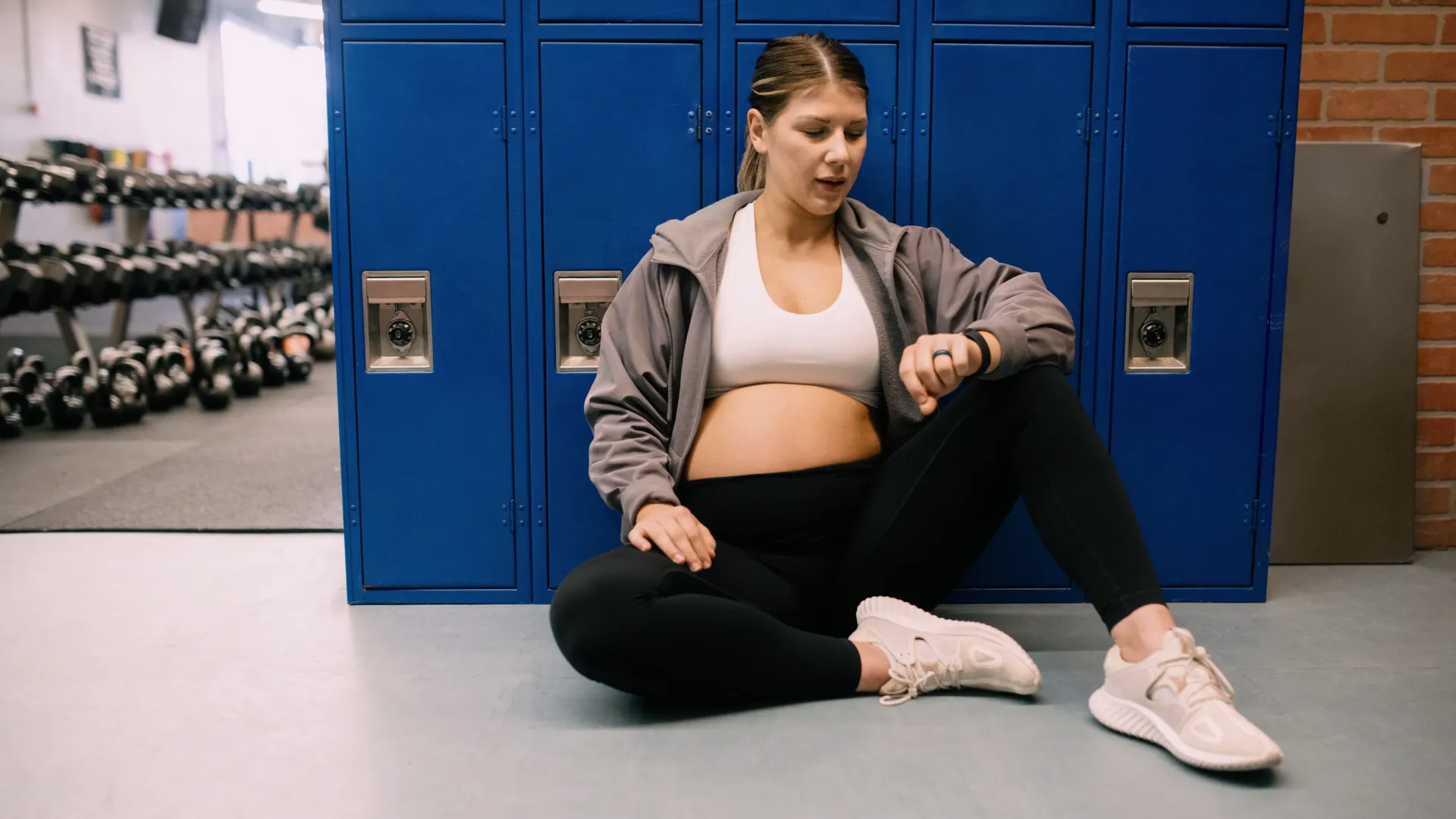
This is often the most comfortable window for training. It’s also when posture and balance start changing enough to matter.
Cleveland Clinic describes the end of month 4 as around avocado-sized.
Second trimester training priorities
- Maintain strength with stable patterns (squat, hinge, push, pull, carry)
- Keep your back and upper body strong (posture work pays off later)
- Begin modifying positions that no longer feel good
One specific note: the CDC advises that after the first trimester, try to avoid activities that require lying flat on your back. In real life, this often means switching to incline or side-lying options, especially if flat-on-back work makes you feel lightheaded or nauseated.
Third trimester (Weeks 28–delivery): keep function high, keep fatigue low
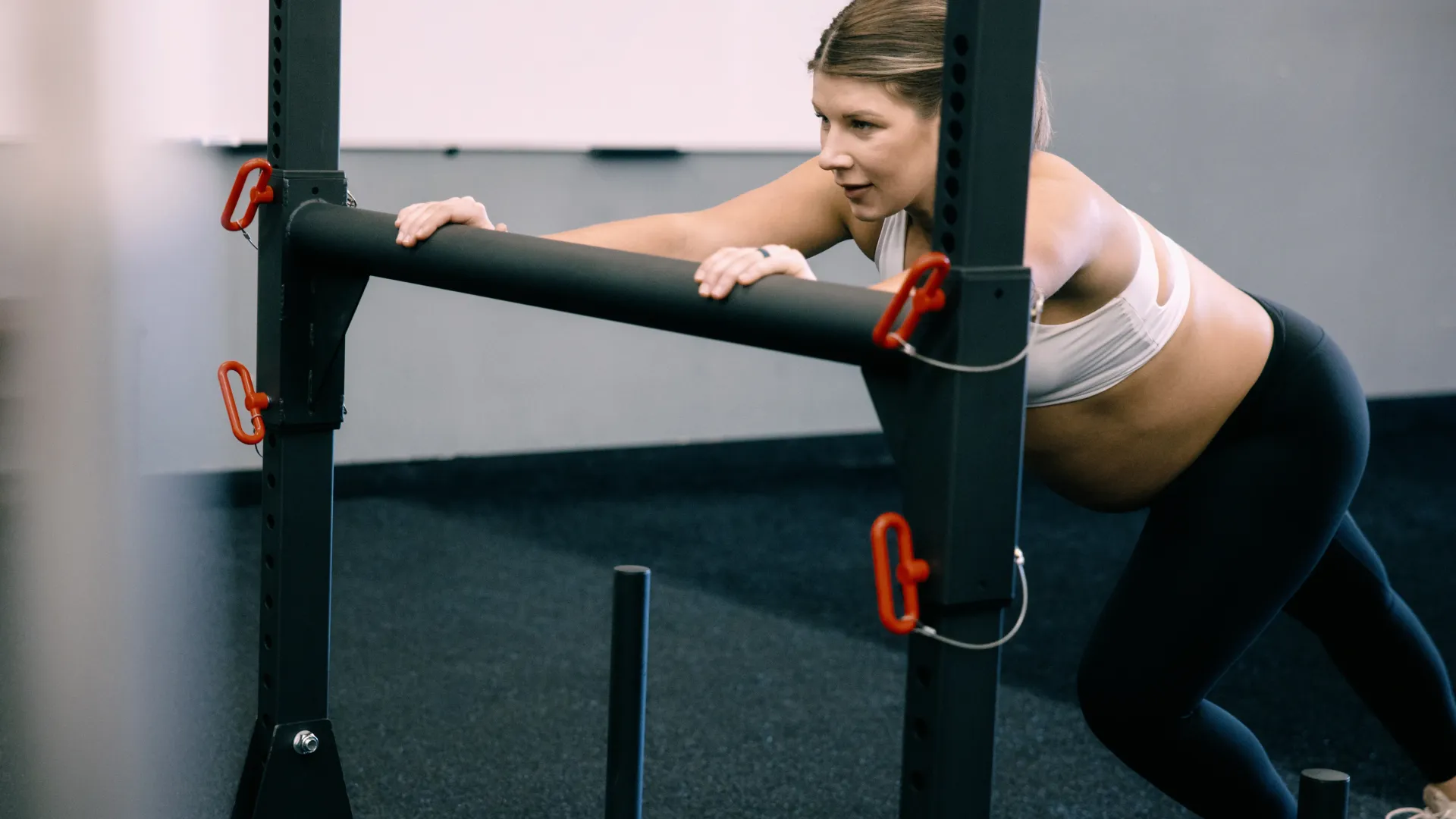
Late pregnancy is not the time to “push through everything.” It’s the time to stay strong with lower friction.
Third-trimester training priorities
- Fewer total exercises, more payoff per movement
- Shorter sets, longer rest
- More supported positions
- Less balance demand
- More comfort-based range of motion
You’re still training. You’re just training with precision.
Exercise selection without turning this into a giant list
You do not need 40 prenatal exercises. You need a few patterns, trained well, with smart swaps.
Squat pattern
What we want: legs and glutes working, torso controlled, breathing steady.
Smart swaps as pregnancy progresses:
- Box squat
- Goblet squat with a slightly wider stance
- Leg press with a comfortable setup (if it feels good)
Hinge pattern
What we want: glutes and hamstrings doing the work, spine neutral, no “grip fight.”
Smart swaps:
- Romanian deadlift with dumbbells
- Hip hinge to a target (like a bench)
- Cable pull-through
Push and pull
What we want: upper back and chest strength to support posture and daily life.
Smart swaps:
- Incline dumbbell press instead of flat barbell bench
- Supported rows instead of bent-over rows if your back gets cranky
- Cable work for smooth resistance
Carries
Carries are low-drama and high-value: posture, grip, trunk control, and real-world strength.
Smart swaps:
- Suitcase carry (one side)
- Farmer carry (both sides)
- Slow treadmill carry holds if space is limited
Core training
Prenatal core training is less about crunching and more about control.
Think:
- Anti-rotation presses
- Side-lying core control
- Breathing-led trunk work that does not create bulging or pelvic heaviness
Safety: the “avoid” list and the “stop now” list
Avoid higher-risk categories (especially as pregnancy progresses)
You’re not fragile. You’re just not trying to roll the dice.
- High-fall-risk activities
- Contact or collision risk
- Anything that spikes overheating quickly
Stop exercising and contact your provider if warning signs show up
This Mayo Clinic Health System post from 2021 discusses warning signs to stop exercising, such as vaginal bleeding, abdominal pain, regular painful contractions, leaking amniotic fluid, dizziness, headache, chest pain, or severe shortness of breath during exercise.
If you want a simple rule: if something feels medically “off,” you don’t negotiate with it.
FAQ: quick answers to common prenatal strength training questions
“How heavy is too heavy?”
Heavy is too heavy when you can’t maintain breath control, positions get sloppy, or you feel pelvic heaviness or pressure. Stay in a zone where effort is real but repeatable.
“Do I need to stop lifting in the third trimester?”
No. Many people benefit from continuing, with smarter exercise choices and less overall fatigue.
“Can do strength training while pregnant”
Often, yes, with the right progression and coaching. The CDC emphasizes that moderate-intensity activity is safe for healthy pregnant women, and you can build up gradually.
“Should I avoid lying on my back?”
The CDC’s guidance is to avoid activities that require lying flat on your back after the first trimester. Practically, that usually means choosing incline, side-lying, or supported variations.
Prenatal fitness in Pleasant Hill: how Royal Blue Fitness can help
If you’re looking for prenatal fitness in Pleasant Hill, you don’t need random workouts from the internet. You need a plan that matches your trimester, your symptoms, and your training background.
At Royal Blue Fitness, prenatal coaching starts with a Strength and Range of Motion Assessment, then we build a program around:
- Stable strength patterns that scale
- Breathing and pressure management
- Smart modifications as your body changes
- A clear safety framework so you feel confident, not cautious
If you want help building a pregnancy-safe strength plan that still feels like real training, reach out to Royal Blue Fitness for expert prenatal fitness in Pleasant Hill and book a consult. You bring the questions; we’ll bring the structure.
Here are our latest articles! Click to read more.