Postpartum Workout Plan for Recovery: 6 Core Rebuilding Moves We Use With Clients
If you’re postpartum and you miss feeling strong in your own body, you’re not asking for too much. You’re asking for a plan that respects healing and still moves you forward. A thoughtful approach to postpartum core strengthening helps you get there.
Many online postpartum workout plans for recovery are just lists. Lists can help, but they usually skip the two things that make postpartum training actually work: (1) quick screening, and (2) progression rules.
At Royal Blue Fitness, we keep the simplicity, then add structure and coaching. These are six core rebuilding moves we return to again and again because our experience shows they’re easy to learn, they scale well, and clients consistently tell us they feel better after doing them as part of our postpartum workout plan for recovery.
If you’re in Pleasant Hill (or nearby in the East Bay), this is the same foundation we use to help postpartum clients rebuild strength with confidence. We also integrate pelvic floor exercises postpartum as needed and coordinate care when symptoms call for it.
Who these postpartum recovery workouts are for
These workouts are a great fit if:
- You want a smart way to rebuild without guessing.
- You feel “weak,” “unstable,” or unsure how to restart core work.
- You want training that supports your body, not a plan that tries to “push through” symptoms.
They are not a fit for DIY if you are dealing with strong red flags. In that case, you deserve a real screen first, and we are happy to coordinate with a pelvic floor PT or your medical team when needed.
A quick note on timing
There’s no single universal timeline. The better approach is in phases:
- Re-connect: breathing, gentle core control, postpartum mobility exercises
- Rebuild capacity: more positions, better endurance, light strength
- Integrate strength: hinges, squats, carries, controlled rotation
- Return to impact (if you want it): jumping and running come later, not first
That “start where you are and progress based on symptoms and readiness” approach matches guidance from major medical organizations like ACOG’s Exercise After Pregnancy FAQ and the CDC’s postpartum activity overview.
Quick postpartum screening before you start (green lights and stop signs)
This is where we earn your trust: postpartum exercise should make you feel more capable, not more symptomatic.
Green lights
You’re generally in a “safe to start” lane when:
- You can breathe through reps, and you are not holding your breath to get through it.
- You feel muscle effort, not sharp pain.
- Symptoms stay stable or improve in the next 24 hours.
Stop signs (pause and get checked)
Stop the session and get medical guidance, or a pelvic floor PT screen, if you notice:
- Pelvic heaviness, pressure, or a bulging sensation
- Leaking that starts or increases during training
- Doming or coning along the midline that you cannot reduce by scaling down
- Worsening pain in the abdomen, pelvis, low back, or incision area
- Any postpartum warning sign that your provider has discussed with you
This “symptoms decide” approach lines up with Mayo Clinic’s pelvic floor guidance, which notes that postpartum pelvic floor dysfunction can include urinary incontinence, prolapse, pelvic girdle or low-back pain, and that pelvic floor physical therapy may help reduce symptoms.
Postpartum core training: What “core” actually means

Postpartum core is not just abs.
It’s a system that includes:
- Breathing mechanics and rib position
- Pelvic floor coordination
- Deep abdominal control
- Hips and glutes are doing their share
- Trunk stiffness when you carry, hinge, squat, and rotate
When clients feel “stuck,” it is usually because they are chasing ab fatigue instead of rebuilding coordination and pressure control. Early on, the goal is simple: you should feel supported, steady, and in control.
Postpartum workout progression rules (how we progress clients without guessing)
At RBF, we use rules. Rules remove anxiety.
Rule 1: Own the breath before you chase difficulty
If you have to hold your breath, strain, or bear down to finish reps, the move is too advanced for today.
Rule 2: Use symptom-based progression
If symptoms show up, increase, or linger, that is not failure. It’s feedback. Scale down and rebuild the foundation.
Rule 3: Progress one variable at a time
Progress in this order:
- Position and breathing
- Range of motion
- Reps and total time
- Load
- Speed and impact
The 6 postpartum recovery workouts we use with clients (our RBF picks)
These six show up constantly in our programming because they’re effective, they’re scalable, and clients tell us they feel confident doing them.
For each move: keep it easy enough that you can breathe and control your trunk shape. Quality wins.
1) 360 Breathing with Gentle Pelvic Floor Connection
Why we like it: This is the reset button. If you can control pressure, everything else gets safer.
How to do it
- Lie on your back, knees bent, feet flat.
- Inhale through your nose and let your ribs expand gently (front, sides, back).
- Exhale slowly and feel your ribs soften.
- Add a light “zip-up” feeling from the pelvic floor to the lower belly, without straining.
Do: 3–5 slow breaths, 2–4 rounds.
Make it easier: Shorter exhale, less intensity.
Make it harder: Add an overhead reach while keeping the breath smooth.
2) Supine Pelvic Tilts (Ribs-Down to Neutral)
Why we like it: Postpartum bodies often lose the “middle” position. This gives it back.
How to do it
- Stay on your back, knees bent.
- Exhale and gently tuck your pelvis (tailbone heavy).
- Inhale back to neutral, not a big arch.
Do: 6–10 reps, slow.
Common fix: If your neck or hip flexors take over, make the range smaller and slow down.
3) Heel Slides (Pressure-Control Version)
Why we like it: It builds deep-core coordination without the intensity of crunching or planking.
How to do it
- Start in the same position.
- Exhale gently and brace like you’re preparing to lift a laundry basket.
- Slide one heel away slowly, then return. Alternate sides.
Do: 5–8 per side.
Make it easier: Smaller slide range.
Make it harder: Add a light band around the feet, only if you stay symptom-free.
4) Glute Bridge (Exhale on Lift)
Why clients love it: It feels like real work, and it teaches the hips to support the trunk.
How to do it
- Feet hip-width, heels under knees.
- Exhale as you lift, keep ribs quiet.
- Pause for 1 second at the top, lower with control.
Do: 6–12 reps.
Make it easier: Smaller lift.
Make it harder: Add a longer pause, then later a light dumbbell if symptoms stay quiet.
5) Quadruped Rock-Back to Bird Dog Progression
Why we like it: It teaches stability in a joint-friendly position that sets you up for functional strength.
Rock-back
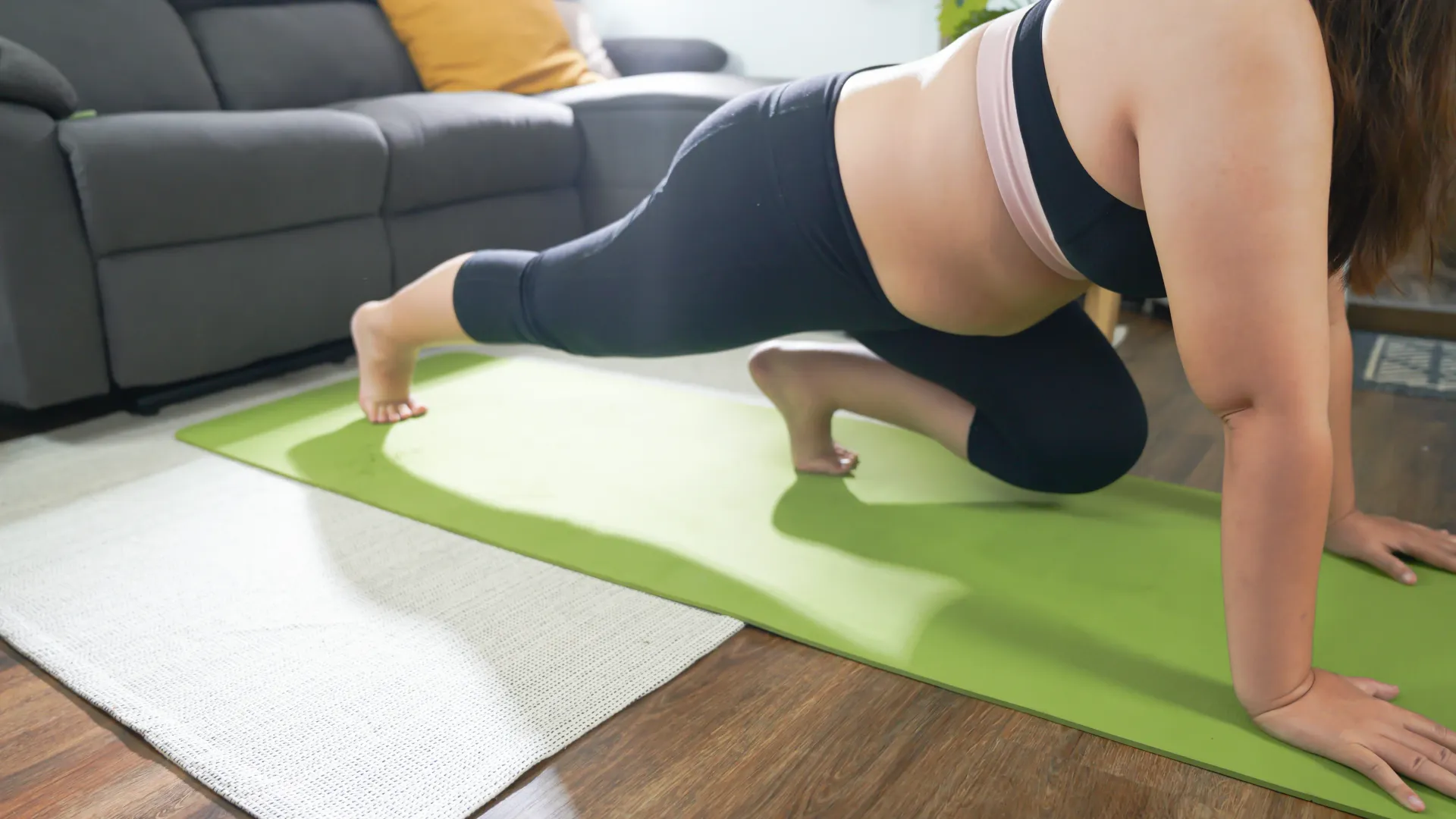
- Hands under shoulders, knees under hips.
- Exhale and rock hips toward heels, then return.
Do: 6–10 reps.
Progress to bird dog
- Exhale, brace, then reach one leg back (or one arm forward).
- Keep hips level and ribs quiet.
Do: 4–8 reps per side.
Watch for: Doming, rib flare, breath holding, or shifting side-to-side.
6) Half-Kneeling Pallof Press (Anti-Rotation Strength)
Why we like it: This is a real-world core strength for carrying, lifting, and twisting without feeling unstable.
How to do it
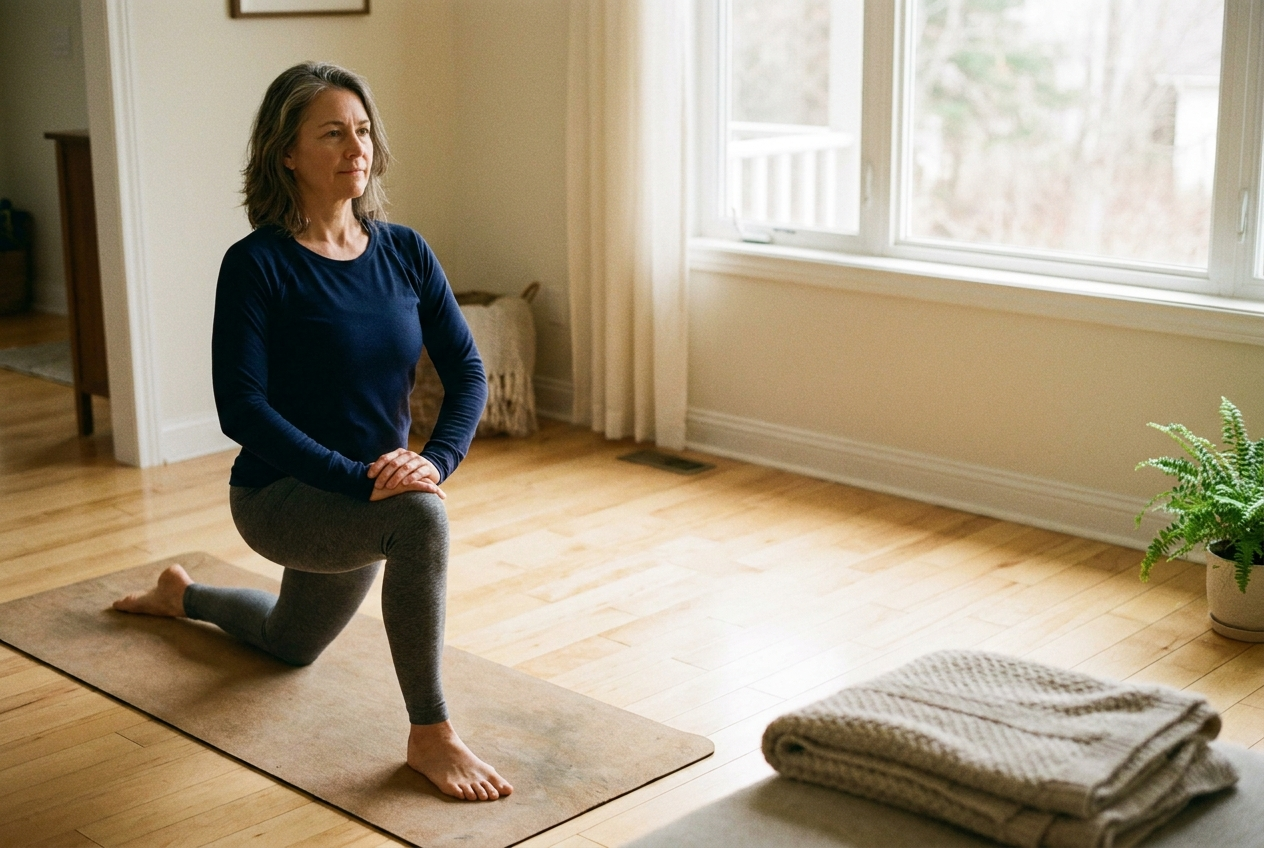
- Half-kneel tall (one knee down, one foot forward).
- Hold a band or cable at chest level.
- Exhale and press straight out, return slowly.
Do: 6–10 reps per side.
Make it easier: Tall-kneeling, lighter band.
Make it harder: Add a 2–3 second hold at full reach.
Simple 20-Minute Postpartum Recovery Workout Routine
You don’t need perfect. You need repeatable.
Option A: Re-connect day (10–15 minutes)
360 breathing: 2–4 rounds
Pelvic tilts: 6–10 reps
Heel slides: 5–8 per side
Option B: Build day (15–20 minutes)
Glute bridge: 2 sets of 8–12
Rock-backs or bird dog: 2 sets of 6–10
Pallof press: 2 sets of 6–10 per side
Frequency: 2–4 days per week. If sleep is chaotic, start with two sessions you can reliably hit.
Why these are our picks (supporting evidence, kept simple)
Our exercise choices come from coaching experience, but the “why” also lines up with the research and guidelines:
- Pelvic floor muscle training is commonly recommended and has evidence supporting benefits for urinary incontinence prevention and treatment in pregnancy and postpartum, including in a Cochrane review on pelvic floor muscle training.
- Postpartum exercise and rehabilitation strategies for pelvic floor disorders and diastasis recti are actively studied; the 2025 Canadian postpartum movement guideline reviewed seven systematic reviews and recommends gradual, symptom-based progression plus daily pelvic floor muscle training.
- Big-picture safety and return-to-activity guidance is summarized in ACOG’s Committee Opinion on physical activity during pregnancy and postpartum.
That’s why this plan prioritizes breath, control, and gradual progression. It is not flashy. It works.
How to Progress Your Postpartum Recovery Safely to the next level
Once these feel controlled and symptom-free, we usually start integrating:
- Carries (light at first)
- Hinges and squats (tempo and control before load)
- Step-ups and split squats
- Eventually, impact work if it’s a goal
If you want a simple “when to start” reference point, Mayo Clinic’s guide on exercise after pregnancy does a good job explaining why delivery type and complications change the timeline.
Postpartum recovery and personal Training in Pleasant Hill: how Royal Blue Fitness helps
If you’re Googling postpartum recovery Pleasant Hill, you’re probably looking for a plan you can trust.
Here’s what we do differently:
- We coach the details that matter postpartum: breathing, rib position, pressure control, and smart progressions.
- We make it feel doable, even if you’re tired, busy, and not sure where to start.
- We give you a plan that fits your body and your life, so you stop second-guessing.
If you want help, book a consultation at Royal Blue Fitness. We’ll map your next 4–8 weeks and build the simplest path back to feeling strong.
Mini FAQ
How often should I do postpartum recovery workouts?
Most people do best starting with 2 postpartum recovery workouts per week, then gradually building toward 3–4 sessions as recovery, sleep, and energy improve. Consistency matters more than intensity during postpartum recovery, especially in the early stages.
What if I have diastasis recti?
You can still follow a postpartum workout plan if you have diastasis recti. The key is choosing exercises you can control without doming or coning at the midline, then progressing gradually. Research supports targeted core rehabilitation, but symptoms vary from person to person, which is why symptom-based progression and individual response matter more than a one-size-fits-all approach.
Are postpartum mobility exercises enough, or do I need strength too?
Postpartum mobility exercises help you access positions, but strength training helps you own those positions. Most postpartum clients feel best when they combine both. Even light strength work plays an important role in rebuilding core stability and confidence after pregnancy.
How do I know if I’m bracing correctly?
A proper postpartum brace feels like gentle, 360-degree support around the trunk while still allowing you to breathe and talk comfortably. If you’re holding your breath, bearing down, or seeing bulging through the midline, that’s a sign to scale the exercise down and rebuild control before progressing.
When can I return to running or higher-impact workouts?
Returning to running or higher-impact workouts depends on symptoms, strength capacity, and how well your pelvic floor and trunk handle load. A movement screen and structured progression plan can help you return safely and avoid months of frustration or setbacks.
Here are our latest articles! Click to read more.