Pelvic Floor Exercises That Actually Work: Strength, Coordination, and Pressure-Control
If you have ever leaked a little during a run, a jump, a heavy lift, or even a sneeze, you are not alone. It is also not something you have to accept as your baseline.
Most of the time, this is a capacity and coordination problem: your pelvic floor is not matching the demand you are placing on it yet. That can be a strength issue, a timing issue, a breathing and pressure issue, or a “you are always clenched and never fully relax” issue. Targeted pelvic floor exercises help restore strength, coordination, and control, enabling your body to meet those demands more effectively. For many, pelvic floor exercises for urinary incontinence offer a practical first step to reduce leaks during workouts and daily life.
That is why “just do Kegels” is often incomplete advice. In this guide, you will learn what the pelvic floor actually does, how it works in conjunction with your breath and deep core, why leakage occurs during exercise, and five exercises that we use to build pelvic floor function, which transfers to real strength training.
Educational note: If you have pelvic pain, heaviness, bulging, or symptoms that worsen with training, it is worth getting assessed by a pelvic floor physical therapist or qualified pelvic health specialist.
What your pelvic floor actually is
Your pelvic floor is a layered group of muscles and connective tissue that forms the “floor” of your pelvis. The major muscular layer (often discussed as the pelvic diaphragm) includes the levator ani group and coccygeus. Together, these tissues support the pelvic organs, help maintain continence, and resist pressure spikes from above.
If you want a clear, labeled visual, OpenStax’s Figure 11.19: Muscles of the Pelvic Floor is one of the cleanest reference images available.
Two important mindset shifts:
- It is not one muscle. It is a coordinated system that must function smoothly, efficiently, and quickly under various conditions.
- It is not meant to be clenched all day. Like any muscle group, it needs a full range: contract and fully relax.
Why Pelvic Floor Coordination Matters More Than Kegels Alone
A lot of people can “do a Kegel” and still leak during exercise. That does not mean you failed. It usually means the pelvic floor is not coordinating well with breathing, trunk control, and the timing of effort.
Pelvic health clinicians often start with diaphragmatic breathing because your diaphragm and pelvic floor are designed to move together. When you learn to inhale without bracing and exhale with smooth effort, you build the foundation for better pressure-control in squats, hinges, carries, and impact.
Why Leaking During Exercise Happens
Leakage during effort is often described as stress urinary incontinence: leakage when internal pressure rises faster than your system can close and support. That pressure can spike during coughing, jumping, running, and heavy reps. Targeted pelvic floor exercises for urinary incontinence can improve your system's ability to respond to those spikes.
Importantly, this is not only a postpartum issue. A systematic review in the International Urogynecology Journal found urinary incontinence across female athletes and reported a higher prevalence in higher-impact activities, especially sports involving jumping, running, and rotation.
Common training triggers include:
- Jumping and running
- Heavy lifts, especially when you hold your breath to grind through a rep
- Sit-ups or aggressive “brace harder” strategies
- Coughing, laughing, or sneezing mid-workout
Why Kegels Alone May Not Fix Leaking
Kegels can be helpful when they are done correctly and when they are part of a larger plan. Both NIH NIDDK and Mayo Clinic emphasize finding the correct muscles and practicing clean technique.
They often fail for predictable reasons:
- You are not sure you are using the right muscles yet, so you compensate with glutes, abs, or inner thighs.
- You squeeze hard but do not fully relax between reps.
- You hold your breath, which can create the same pressure spike you are trying to control.
- You practice strength in isolation, but you never train timing during real movements.
One safety note: NIDDK mentions that stopping urine midstream can help you identify the muscles, but it should not become your training method. Treat it as a quick check, not a practice habit.
Pelvic Floor Exercises During Pregnancy and Postpartum
Pregnancy and postpartum can raise the demands on the pelvic floor, so these skills matter even more. The goal is not “bouncing back.” The goal is building a base that supports strength training, daily life, and a confident return to higher-impact work when your body is ready. For many, targeted pelvic floor exercises postpartum support a steady rebuild of coordination and gradual loading.
What it should feel like
A good pelvic floor contraction usually feels like a gentle lift and close, not a hard squeeze everywhere. Just as important, a good session includes a full release. If you are not sure what you are feeling, getting feedback can save a lot of guesswork.
If you want a simple, clear walk-through on finding the right muscles and practicing contractions, Harvard Health has a step-by-step Kegel guide that many people find easier to follow than generic “just squeeze” instructions.
The 5 moves we use (with better cues and better transfer)
These are pelvic floor exercises, but not in the “random workout list” way. These are movement patterns that teach your pelvic floor to work with breathing, pressure, and real strength training.
1) Diaphragmatic breathing with pelvic floor “drop and lift”
What it trains: coordination and the ability to relax, then contract on purpose.
How to do it:
- Lie on your back with knees bent, feet on the floor.
- Inhale through your nose and let your ribcage expand. Think “soften and widen” through the pelvic floor.
- Exhale slowly and think “gentle lift,” as if you are stopping gas.
- Aim for smooth, not intense.
Dose: 5–8 slow breaths, 1–2 rounds.
2) Pelvic tilt to neutral
What it trains: pelvis and ribcage control without gripping, plus awareness of “stacking” before loading.
How to do it:
- Same setup as breathing: on your back, knees bent.
- Gently tilt the pelvis so your low back flattens, then return to a neutral mid-point.
- Exhale on the effort, inhale on the return.
Dose: 6–10 controlled reps.
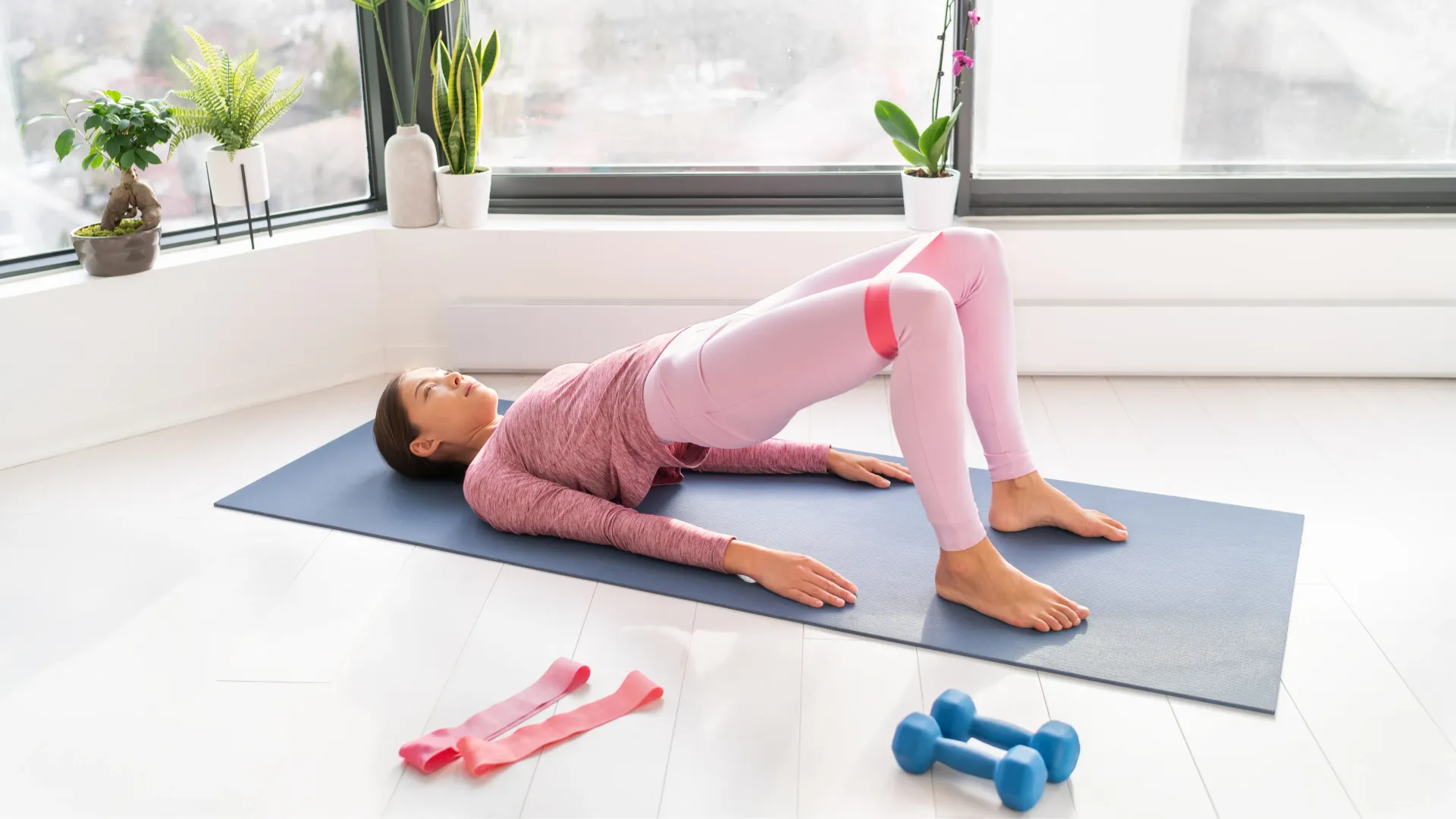
3) Glute bridge with exhale-on-effort
What it trains: pelvic floor timing with hip drive and pressure-control.
How to do it:
- Feet planted, ribs down, neck relaxed.
- Inhale at the bottom.
- Exhale as you lift your hips. Keep the lift smooth.
- Pause 1–2 seconds, then lower with control.
Dose: 2 sets of 6–10 reps.
4) Box squat or supported squat
What it trains: pelvic floor support during a real-world pattern: sit-to-stand, lifting, stairs, and daily life.
How to do it:
- Use a box or bench, so you control depth.
- Inhale on the way down.
- Exhale through the hardest part of the stand.
- Keep the effort smooth and repeatable.
If you leak here: raise the box, reduce load, slow the tempo, and clean up exhale timing.
Dose: 2–3 sets of 5–8 reps.
5) Bird-dog (slow, controlled)
What it trains: trunk stability while limbs move, without pressure spikes.
How to do it:
- Hands under shoulders, knees under hips.
- Exhale as you reach one leg back and the opposite arm forward.
- Move slowly; pause, then return with control.
- Keep ribs quiet and hips level.
Dose: 2 sets of 4–6 reps per side.
One skill that can help fast: “The Knack”
“The Knack” is a well-timed pelvic floor contraction right before a known trigger like a cough, sneeze, or jump. A study in the International Urogynecology Journal documented an immediate reduction in cough-related leakage for many participants when that timing strategy was used. Think “squeeze before you sneeze,” then fully relax after.
How long does it take to feel a difference
Most plans that improve symptoms are structured and consistent over weeks to months. In a Cochrane review, pelvic floor muscle training is described as a common first-line physical therapy approach for urinary incontinence in women, typically delivered as a program rather than a one-off tip.
A reasonable “on average” window to expect meaningful change is about 8–12 weeks of consistent work, with longer timelines when you are returning to higher loads and impact. Consistency matters more than perfection.
A practical expectation:
Weeks 1–2: better awareness and less clenching
Weeks 3–6: improved timing, fewer surprise leaks in daily life
Weeks 6–12: better tolerance for lifting, intervals, and higher-impact progressions
If you want more individual support, Women’s Health Private Coaching in Pleasant Hill, Royal Blue Fitness can help you safely incorporate pelvic floor exercises into real training.
FAQ
How often should I do pelvic floor exercises?
For skill work (breathing and coordination), a few minutes most days can help. For strength and transfer, 2–3 focused sessions per week are realistic and effective for most people.
Is leaking during exercise common?
It is common, but common is not the same as “you should live with it.” With the right plan, many people improve significantly.
How do I know if I am doing Kegels correctly?
If you are unsure, get coached. Feedback helps you confirm you are using the right muscles and relaxing fully between reps.
When should I get help?
If symptoms persist, worsen, or include pain or heaviness, a pelvic floor PT or pelvic health specialist can assess coordination and prescribe the right progression.
How we approach this at Royal Blue Fitness
At Royal Blue Fitness, we treat pelvic floor training the same way we treat everything else: skill first, then strength, then real-world performance. We do not hand you a half-baked program and call it a day. We coach the breathing, pressure-control, and progression so these moves actually transfer to your training.
If you want pelvic floor training in Pleasant Hill that helps prevent leaking during exercise, reach out. Prefer to talk it through? Call or message us, and we will map your next step.
If you want a simple reference sheet to practice alongside this article, the AHRQ pelvic floor therapy handout is a helpful starting point.
Here are our latest articles! Click to read more.