Free Weights vs Machines: Which Builds Real-Life Strength?
Standing in front of a rack of dumbbells on one side and a row of machines on the other, plenty of capable people quietly freeze. Are free weights the serious choice and machines a shortcut? Will one build strength you can actually use, while the other just makes you good at sitting in a machine?
The gym is full of confident opinions on this, and most of them are too absolute to be useful. The honest answer is more practical than folklore suggests, and it does not require picking a side for the rest of your life. What matters is matching the tool to your goal, your experience, and your body.
This guide compares the two based on the criteria that genuinely determine the outcome, then helps you choose with confidence rather than guesswork.
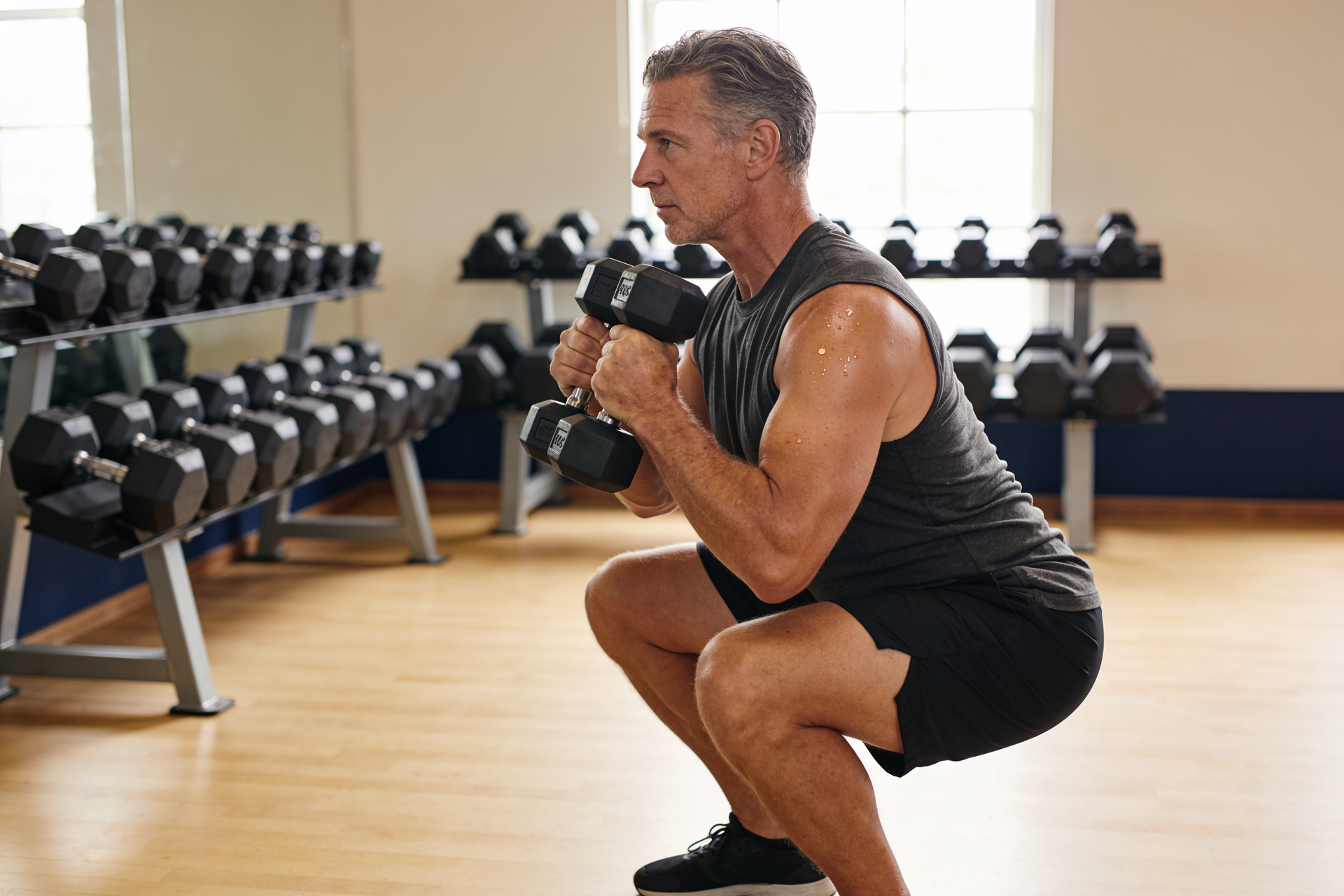
Real-life strength is the tiebreaker
Before comparing tools, it helps to define what you are training for, because the goal is the tiebreaker. Real-life strength is the ability to produce and control force in ways that carry over to daily living and to whatever you personally care about, whether that is lifting grandchildren, staying capable and independent as you age, or adding visible muscle.
Both free weights and machines can build it. They reach the goal by different routes, and the route that suits you depends on where you are starting and where you want to go.
The five criteria this guide compares
To keep the comparison fair, both tools are judged on five things that genuinely affect results:
Transfer: how well the strength carries over to everyday movement.- Skill demand: how much technique the tool requires before it pays off.
- Joint comfort: how the movement feels for your body, which matters more for some than others.
- Solo safety: how hard you can push when no one is there to spot you.
- Scalability: how easily you can keep adding challenges over months and years.
A tool can win decisively on one criterion and lose on another, which is exactly why blanket verdicts like “free weights are always better” fall apart on contact with a real person and a real goal.
Transfer, for example, is why a heavy farmer’s carry with dumbbells prepares you for hauling luggage through an airport in a way a seated machine rarely will. Solo safety, on the other hand, is why that same person, training alone in a garage, might sensibly choose a machine chest press over a heavy barbell bench with no one to spot them.
The criteria genuinely pull in different directions, and learning to weigh them for your own situation is the real skill.
The best tool depends on your goal and experience
A brand-new lifter rebuilding confidence has very different needs from an experienced lifter chasing a heavier squat. Someone training alone in a garage faces different constraints than someone with a coach and a fully stocked gym.
The reason there is no single right answer is that the five criteria matter in different proportions for different people. Transfer might be the top priority for an active person who wants strength for hiking and yard work, while solo safety might dominate for someone who trains alone and wants to push hard. Keep your own goal in mind as you read, because it decides which criteria carry the most weight for you.
Free weights: what they are and what they build
Free weights are dumbbells, barbells, kettlebells, and anything you move through space along a path that you control rather than one a machine dictates. Because nothing guides the movement, your body has to stabilize and steer the weight in every direction, not just push or pull it. That stabilizing demand is the entire point of free weights, and it shapes both their strengths and their tradeoffs.
Free weights at their best
Free weights require your stabilizing muscles to work alongside the prime movers, rather than letting a machine hold the path for you. A classic
muscle-activity study on the bench press recorded higher muscle activity with free weights in sixteen of twenty comparisons, with the gap largest at the lighter sixty percent load and concentrated in the shoulder stabilizers, where the anterior and medial deltoids fired roughly fifty and thirty percent harder than on the machine, though individual patterns varied. That is the kind of recruitment that helps when a real task is itself unstable, like hauling an awkward bag of mulch or catching yourself on a curb.
Free weights also let you train natural, full-range movement patterns the way your body actually moves, and they scale almost infinitely, since you can keep adding load for years without outgrowing the tool.
Picture standing up out of a low chair with a bag of groceries balanced in one arm. That is a free-weight problem your body solves with balance and coordination, not a movement any fixed machine path can fully rehearse. Free-weight training practices exactly that kind of coordinated, slightly unpredictable, real-world effort, which is why the strength it builds tends to show up outside the gym.
The tradeoffs to plan around
That same freedom raises the skill requirement, and this is the honest cost. Free weights take longer to learn well, and poor form under a loaded barbell carries more consequences, especially when you train alone with no one to help if a rep goes wrong. There is also a setup and decision cost, from selecting the right weights to learning how to bail out of a lift safely.
None of this makes free weights a bad choice. It simply explains why many people benefit from coaching, or from a patient, progressive on-ramp, when they commit to free-weight training rather than diving straight into heavy loads.
Machines: what they are and what they build
Machines guide the weight along a fixed or semi-fixed path, so the direction of the movement is largely handled for you. You supply the muscular effort, the machine supplies the stability and the groove. That arrangement is often dismissed as easier, but it creates a genuinely valuable and distinct set of strengths that free weights cannot match as cleanly.
Machines at their best
Because the path is guided, machines lower the skill barrier and let you direct your effort straight at the target muscle without having to first master a complex movement. That makes them excellent for learning a pattern, building confidence as a beginner, and isolating a specific muscle you want to develop.
They also let you push close to your true limit safely without a spotter, because on most machines, you can simply stop a set and rack the weight without getting pinned under it. For anyone training hard alone, that safer fail point is a real and underrated advantage. As
the American Council on Exercise notes, machines let you lift near-maximal loads with minimal risk of injury from falling weights, while overloading a barbell squat or bench press with no spotter can cause serious injury.
Consider a beginner who feels lost and self-conscious as they walk into a busy gym. A leg press lets them train their legs hard on the very first day, without spending weeks first learning to balance a loaded barbell on their back. That early sense of success and safety is often exactly what turns a nervous newcomer into someone who keeps coming back, and consistency is where real results actually come from.
The tradeoffs to plan around
The fixed path that makes machines so approachable also means your stabilizing muscles do less work, and the machine, rather than your body, decides the movement pattern. Machines are also engineered around average proportions, so a person who is very tall, very short, or simply built differently may not fit a given machine well, which can make the movement feel off.
For most goals, these tradeoffs are modest and easily managed, but they are precisely why free weights keep their place in a complete program built around transferable, whole-body strength.
Head to head on the criteria that matter
Put side by side on the five criteria, neither tool sweeps the comparison, and that is the single most useful finding here. Each wins where its design serves the goal and gives ground where it does not.
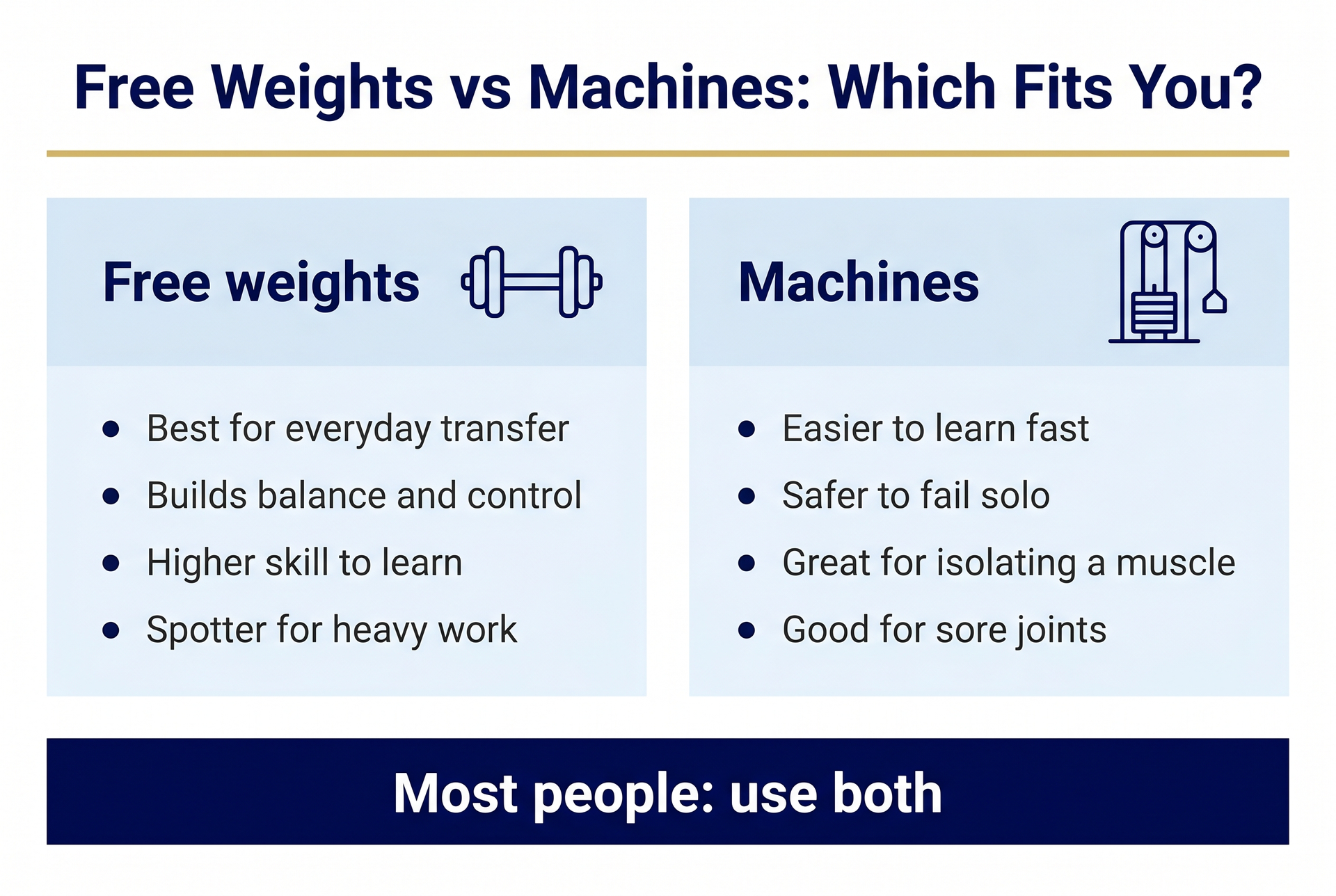
| Criterion | Free weights | Machines |
|---|---|---|
| Transfer to daily movement | Strong. You stabilize and steer the load, so strength carries to unpredictable real tasks. | Moderate. The guided path trains the muscle but less of the balance that real-life demands require. |
| Skill demand | Higher. The lifts take time to learn, and form matters more under load. | Lower. The path is handled for you, so you can train hard sooner. |
| Joint comfort | Variable. Adjustable by angle, grip, and range, but you manage it yourself. | Often comfortable. The fixed path limits how much a cranky joint has to stabilize. |
| Solo safety | Lower. Heavy work usually wants a spotter, safety pins, or a rep left in reserve. | Higher. You can stop most sets and rack the weight without getting pinned. |
| Scalability over time | Excellent. Add load for years without outgrowing the tool. | Good. Easy to load, though fit depends on your proportions. |
The smart way to read the matchup is through the lens of what you personally care about most, rather than looking for an overall champion that does not exist.
For building muscle and strength
For raw muscle growth, the research is reassuring and clear. When effort and progression are matched, a
2023 systematic review and meta-analysis of thirteen trials found no meaningful difference between free weights and machines for muscle growth, with the choice coming down to your goals and preferences.
For maximal strength in a specific lift, free weights have a real edge, because the skill of performing that lift is itself part of the strength you are measuring. But for the goal most people actually have, which is to add muscle and get stronger in general, what drives results is training hard and applying
progressive overload as you keep training.
The takeaway here is genuinely freeing. If your goal is to build muscle and feel stronger, you are allowed to pick the tools you actually enjoy and will use week after week, because your adherence and your progression will drive your results far more than the free-weights-versus-machines debate ever could. The best tool, in that sense, is the one that keeps you training.
For joints, control, and training alone
If you are managing sensitive joints or returning to training after a layoff, machines can let you load a muscle while limiting how much you have to stabilize, which many people find more comfortable and less intimidating. Free weights, by contrast, build the balance and control that transfer to the unpredictable demands of real life, which a fixed machine path cannot fully replicate.
For the specific case of training alone and pushing close to failure, machines offer a safer place to fail, while heavy free-weight work generally calls for a spotter, safety pins, or a disciplined habit of leaving a rep in reserve.
A middle path is common after a tweak or a return from time off. Many people lean on machines to keep training the area comfortably while it settles, then gradually reintroduce the free-weight versions of those movements as their confidence and capacity come back. The tools are not a one-time choice; they are something you adjust as your situation changes.
Choose this if: match the tool to you
The cleanest way to decide is to stop asking which tool is better in the abstract and start asking which one fits your situation right now. Run yourself through the two short profiles below honestly, and notice that most people recognize themselves at least partly in both, which is a hint about where this is heading.
Lean toward free weights if
You want strength that transfers to everyday movement and physical tasks.- You are willing to invest the time to learn the lifts properly.
- You have access to coaching, or you are comfortable progressing carefully on your own.
- You are chasing maximal strength in specific movements like the squat or deadlift.
Free weights reward the effort you put into the skill, and that skill is part of the payoff. Learning the major lifts with
qualified coaching can meaningfully shorten the learning curve and help you build good habits from the start.
Lean toward machines if
You are new and building confidence.- You train alone and want to push hard with a safer fail point.
- You are working around a cranky joint and want to limit how much you stabilize.
- You want to isolate and develop a specific muscle.
Machines lower the barrier to training hard, and lowering that barrier is often exactly what keeps a beginner coming back long enough to build the consistency that real progress depends on. There is nothing remedial about choosing the tool that helps you actually train.
The honest answer: most people benefit from both
The versus framing sells a rivalry that barely exists inside good programs. The most practical approach for the large majority of people is to use both tools deliberately, letting free weights build transferable, full-body strength and letting machines add safe volume, targeted isolation, and beginner confidence.
A
randomized comparison of free-weight and machine training over eight weeks found similar gains in muscle size and strength with either modality, and the broader strength field points the same direction again and again: the tool is a means to an end, and a thoughtful combination almost always beats loyalty to either camp. The lifters who argue hardest for one side are usually optimizing for a narrow goal that may not be yours.
A simple way to combine them in one week
Start with free weights while you are fresh. Anchor your sessions with a few free-weight movements early, while your energy, focus, and coordination are highest, since those lifts demand the most skill and reward fresh attention.
Finish with machines to add focused volume. Use machines later in the session to add targeted volume for the muscles you most want to develop, when you are already fatigued, and the lower coordination cost of a guided path is an advantage rather than a compromise.
In concrete terms, a session might open with a barbell or dumbbell lift for one of the big movement patterns, then move to two or three machines for the specific muscles you want to develop, for example, 3 to 4 hard sets on the main lift, then 2 to 3 sets on each machine, stopping a rep or two short of failure. You get skill and transfer while you are fresh and safe, targeted work to finish, all in one straightforward workout, without ever forcing the false choice the gym debate insists you make.
Frequently Asked Questions
Are free weights better than machines for building muscle?
Not necessarily. When you train with similar effort and progressively increase the load over time, both build muscle effectively, and the research does not crown a clear winner. Free weights hold an advantage for maximal strength in a specific lift because the skill of the lift is part of the result you are measuring. But for general muscle growth, the factors that actually decide your results are consistency, effort, and progression, not whether the weight was attached to a machine or a barbell.
Are machines a waste of time for serious lifters?
No, and treating them that way is a mistake. Even very experienced lifters use machines to add training volume safely, to isolate and bring up a lagging muscle, and to keep training a body part when a joint needs a break from heavy free-weight loading. Machines are specialized tools with specific strengths, not a beginner’s consolation prize. The genuine error is relying only on machines and never developing the stabilizing control and transferable strength that free weights build.
I train alone at home. Which should I prioritize?
If you train alone and want to push close to your limit, machines offer a safer fail point, because you are far less likely to get stuck under a load with no one to help. That said, a few well-chosen free-weight movements build the transferable, real-world strength that machines cannot fully provide, so a compact free-weight setup combined with careful, self-limiting progression often gives the solo home lifter the best of both worlds without needing a full machine circuit.
Which is safer if I have joint concerns?
Many people with sensitive joints find machines comfortable, because the guided path limits how much they have to stabilize and lets them work a muscle without aggravating a problem area. But this is highly individual, and free weights can often be adjusted by changing the angle, grip, or range to feel just as good. Comfort during a movement is not the same as a medical green light, so if a joint is genuinely painful rather than simply working hard, have it evaluated by a qualified provider before you load it heavily either way.
How do I know if my form is good enough for free weights?
Start light enough that you can perform full, controlled reps without straining to maintain position, and progress only when the movement stays clean. Filming a set from the side is one of the most useful things you can do, since it reveals drifts you cannot feel in the moment. If a lift consistently feels awkward or you are unsure whether your pattern is sound, a session or two with a qualified coach is a faster and safer path than guessing, and it pays off across every workout that follows.
Build strength that fits how you actually move
Free weights and machines are not rivals; they are different tools aimed at the same goal, and the best program for most people uses both. The real question was never which one wins in the abstract, but which combination fits your body, your experience, and what you are training for.
That last part is the one piece this article cannot answer for you, because it depends on where your strength and mobility actually stand right now. A
Strength and Range of Motion Assessment shows you what you are working with today, so the mix of tools you choose is matched to you rather than to gym folklore. If you are in Pleasant Hill or the wider East Bay and still unsure where your starting point sits, it is a sensible, low-pressure way to find out.
Here are our latest articles! Click to read more.