Zone 2 Training is Simple, Not Easy
You have probably heard someone talk about zone 2 cardio training recently.
It could be a podcast guest talking about mitochondria. It may have been an article promising better longevity if you stay in your fat-burning heart rate training zone a few times a week.
On paper, it sounds straightforward: move at a moderate pace, keep it going, and good things happen.
In real life, it is trickier. You have a busy schedule. Your brain gets bored. Your knees or back might not love the idea of jogging for an hour. And just knowing that zone 2 is good for you does not automatically translate into doing it consistently.
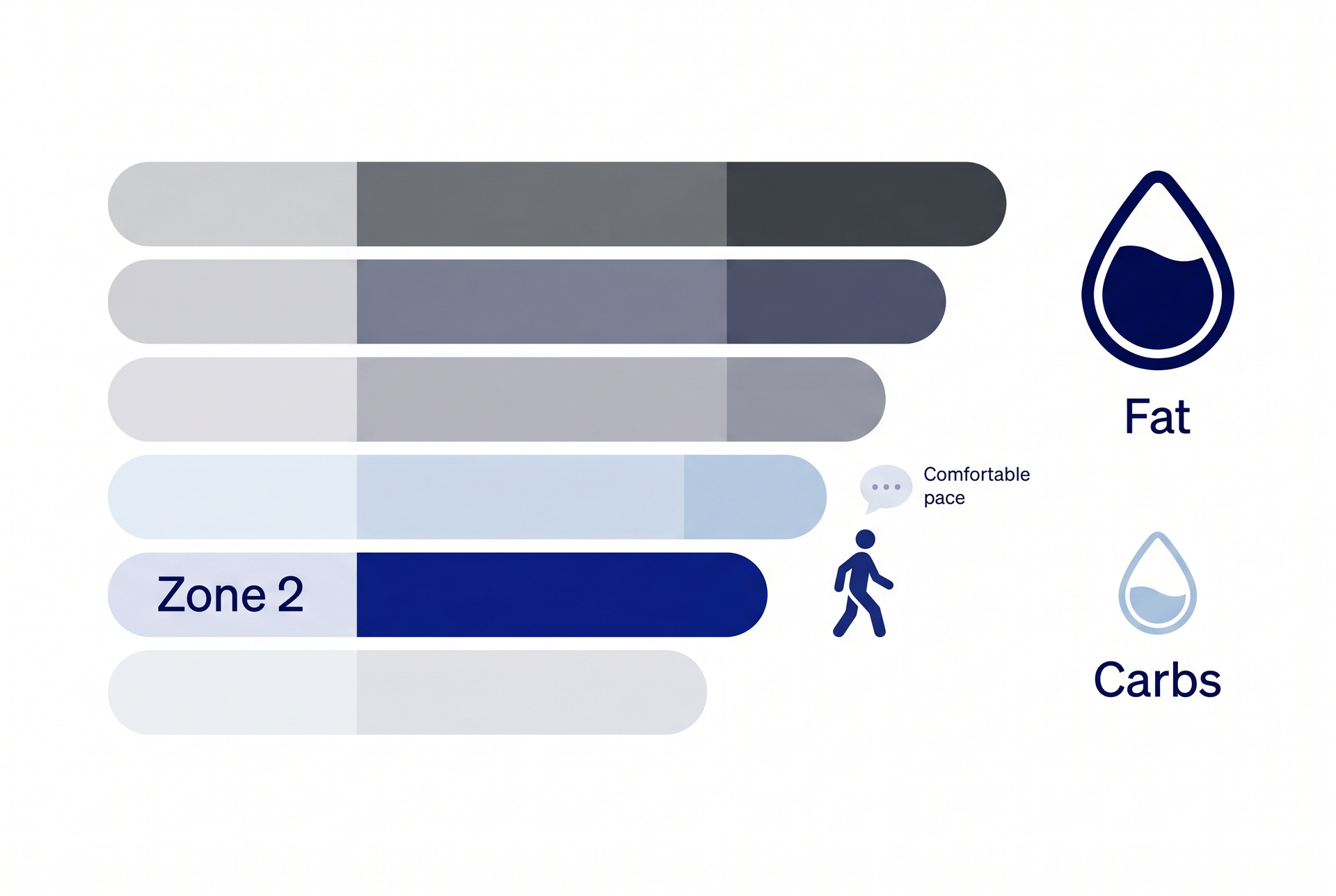
This article is not a graduate-level lecture on biochemistry. Instead, it is about how zone 2 actually feels, why it is hard to stick with, and how to make it work in your real life so you can use low-impact aerobic workouts as a tool for long-term health. The short answer up front: zone 2 is a steady, moderate effort at roughly 60 to 70 percent of your maximum heart rate, the kind of pace where you can still hold a light conversation but would not want to sing.

What people really mean by zone 2
When people talk about zone 2, they are usually describing a level of effort that is:
- Steady and moderate, not all-out
- Sustainable for 30 to 60 minutes or more
- Mostly aerobic, meaning your body is using oxygen efficiently to fuel you
A simple way to think about it:
- You can talk in full sentences.
- Your breathing is deeper, but you are not gasping.
- You feel like you could keep going, even if you would rather be done.
That is the essence of zone 2 cardio training, and it lines up with how clinicians describe it. Cleveland Clinic exercise physiologists put zone 2 at
60 to 70 percent of your maximum heart rate, an effort where you can still
carry on a light conversation but would not want to sing. You are working harder than a casual stroll, but nowhere near a sprint. For many adults, it shows up as a brisk walk, a comfortable cycling pace, or an easy swim that you could maintain for a while.
Some people like to use numbers. You might see charts that put zone 2 around 60 to 70 percent of your estimated max heart rate, or a 3 to 4 out of 10 on a personal effort scale. Those tools are fine as long as you remember they are estimates, not pass-or-fail scores. The talk test does the same job with no math at all.
The big picture: it should feel comfortably challenging, not brutal.
Why something so easy feels so hard
If zone 2 is supposed to be low-to-moderate effort, why do so many people struggle to stay consistent with it? It usually comes down to three friction points.
The time commitment is real
A lot of zone 2 recommendations involve 40, 50, or even 60 minutes in one session. On a normal workday, that can feel impossible. You might think:
- I barely have 30 minutes to myself.
- By the time I drive to the gym, warm up, and shower, the morning is gone.
Even if your body can handle the session, your calendar might not. That tension alone can keep people from starting.
The mental game wears you down
Zone 2 is not dramatic. There is no intense burn, no finish-line sprint, and sometimes not even that much sweat. You are just there, moving, breathing, watching numbers climb slowly. Common thoughts that pop up:
- Is this doing anything?
- This feels too easy to matter.
- I am already bored, and it has only been 8 minutes.
If you are used to high-intensity workouts that leave you exhausted at the end, zone 2 can feel strangely underwhelming, even though it is doing exactly what it is supposed to do.
The body you are working with has a history
For adults 40-plus, seniors, or anyone with a history of joint pain, the mental picture of zone 2 is often the real problem. They imagine:
- Endless jogging on a hard surface
- Ankles, knees, and back all complaining
- Being forced into no pain, no gain to get results
If that is what you are picturing when you hear fat-burning heart rate training, it makes sense that you would hesitate. Your body has its own story, and it is not interested in reliving old injuries.

A real zone 2 session, minute by minute
Let us walk through a realistic 40-minute zone 2 session so you know what to expect. We will use a brisk walk as an example, but the same general principles apply to a bike, an elliptical, or other low-impact aerobic workouts.
Minutes 0 to 5: warming up from everyday
At the very beginning, your body is still in regular-life mode.
- You might feel a little stiff, especially in the hips, knees, and low back.
- Your breathing is light.
- The pace feels easy, maybe even too easy.
The goal here is simply to transition from desk pace or sofa pace to exercise pace without shocking your system. Your heart rate will start creeping up, but it will not feel like a workout just yet.
Minutes 5 to 15: settling into the zone
As you keep going, your body starts to feel more coordinated, joints usually loosen up a bit, and breathing settles into a steady rhythm. This is where you nudge your pace to the point where you are working, but still very much in control. You should notice:
- You can talk, but you would not choose to lecture.
- Your attention is split between your surroundings and how your body feels.
- It feels sustainable, even if part of you is counting down to the end.
At this stage, many people think, this feels fine, why did I make such a big deal out of starting?
Minutes 15 to 30: the negotiation phase
This middle section is where the mental game really starts. Physically, you are usually still okay. You are not out of breath, and your muscles feel like they are working, not burning. Mentally, though, the inner voice wakes up:
- You are busy. You could stop at 20 minutes and call it a win.
- Does this really matter? You did not even go that hard.
- You could just do a harder, shorter session another day.
This is completely normal. You are not weak for having these thoughts. You are just human.
This is also precisely where the steady effort earns its keep. At a moderate, conversational pace, your body leans on fat as its main fuel: a review of fat-metabolism research found that
lipids are the predominant fuel source during exercise below roughly 65 percent of VO2max, with fat oxidation peaking somewhere in the 45 to 65 percent range before carbohydrate takes over at higher intensities. Staying in that window, even when your brain wants to check out, is what lets you accumulate real aerobic time rather than a few hard minutes.
Minutes 30 to 40: the second wind
If you make it past that negotiation phase, something often shifts. You realize:
- Actually, I am okay.
- Tired? Yes. Falling apart? Not even close.
- There is real pride in having stuck this out.
Your body has adapted to the pace. You might still be eager for the session to end, but there is a sense of momentum. This is the feeling most people are chasing when they talk about building an aerobic base. That base is not vague motivation: this steady, fat-fueled, submaximal effort is exactly the intensity that develops the mitochondrial machinery aerobic fitness is built on. In a
Sports Medicine study, San Millan and Brooks measured fat burning, carbohydrate burning, and blood lactate across professional endurance athletes and less-fit adults during a graded ride to exhaustion, and the contrast was stark. The athletes oxidized far more fat at the same moderate intensities, with peak fat oxidation near 0.66 grams per minute versus about 0.38 in moderately active adults and just 0.12 in adults with metabolic syndrome, and they held blood lactate markedly lower throughout. Across every group, fat oxidation and lactate moved in almost perfect opposition (correlations around negative 0.97), which the researchers read as a direct window into mitochondrial oxidative capacity: the better trained the aerobic system, the more it ran on fat and the less lactate it spilled at these submaximal efforts, while less-fit adults shifted off fat to sugar far sooner. The same Cleveland Clinic physiologists note that steady aerobic work
strengthens the heart muscle to pump more blood per beat, improves mitochondrial function, and adds capillaries around your muscles, and because it places less strain on joints and tendons than hard training, it carries a lower injury risk. That capacity comes from time in the zone, not from sprinting for 20 seconds and quitting at the first mental dip.
Training your mind to stay in the zone
If you recognize yourself in that negotiation phase, you are not alone. The good news is, you can train your mind the same way you train your body. Here are a few practical tools.
Use tiny checkpoints, not giant goals
Instead of saying, I have to do 45 minutes, try:
- Let me get to 10 minutes and reassess.
- Then, let me get to 20 minutes and reassess.
- Then, let me get to 30 minutes and reassess.
You are still doing the full session, but your brain is only asked to commit to manageable chunks. That feels much less overwhelming when you are staring at the clock.
Decide your stop rule before you start
A simple rule might be: if I hit my planned time and I still feel okay, I can stop with zero guilt. Or: if I hit my minimum time and I truly feel off, I can stop without calling it a failure. Having that rule in place ahead of time helps you sort real signals from simple boredom. Your decision to stop or keep going becomes intentional rather than impulsive.
Give your brain something to do
Zone 2 is a perfect time for:
- Listening to a favorite podcast or audiobook
- Calling a friend for a catch-up walk
- Watching a show on a tablet while you pedal
You are not cheating by distracting yourself. You are pairing a steady physical effort with something that makes the time pass more easily. That is smart programming for your nervous system.
Reframe boring as training the foundation
It is tempting to think, if I am not exhausted, this is pointless. Try a different frame:
- High-intensity work is like remodeling a room.
- Zone 2 is like reinforcing the foundation and updating the wiring.
You might not see dramatic changes in a single session, but you are upgrading the systems that keep everything running. That matters a lot for adults 40-plus who want to feel good walking, traveling, playing with grandkids, or taking on new hobbies for decades, not just the next 6 weeks.
I do not have an hour: making zone 2 fit real life
The gold standard often sounds like one long session several times per week. In a perfect world, that is great. In the real world, you can get a lot of benefit from a more flexible approach. Here are a few ways to think about it.
Think in weekly minutes, not perfect sessions
Instead of obsessing over a 60-minute block, think about total minutes per week at a zone 2 feel. The public-health targets are written this way on purpose. ACSM notes that
substantial health benefits come from 150 to 300 minutes per week of moderate-intensity activity, and the CDC is explicit that you do not have to do it all at once: you can
spread the activity across the week and break it into smaller chunks. For example:
- Three 30-minute sessions
- Four 20 to 25-minute sessions
- Two longer sessions on the weekend and shorter ones during the week
You are still giving your heart, lungs, and muscles plenty of time in that moderate zone. You are just spreading it out in a way that respects your schedule.
At a glance: your weekly zone 2 target
| Weekly target | How it should feel | How to split it |
|---|---|---|
| 150 to 300 minutes per week of moderate effort (ACSM); more sits at the higher-benefit end | Conversational: full sentences yes, singing no. About 60 to 70 percent of max heart rate, a 3 to 4 out of 10 effort | No need to do it all at once (CDC). Spread it across the week, for example three 30-minute sessions, four 20 to 25-minute sessions, or two longer weekend efforts plus shorter weekday ones |
Stack it onto existing habits
Look for places where you are already moving or could easily add it:
- Arrive at the gym 20 minutes earlier and walk before your strength session.
- Turn part of your lunch break into a brisk outdoor walk.
- Use evenings for low-impact aerobic workouts on a bike or treadmill at home, while you listen to something you enjoy.
You are not rebuilding your life around zone 2. You are weaving it into what is already there.
Accept imperfect but consistent
You will have weeks where things go sideways. Travel, illness, holidays, childcare, or work emergencies will happen. Instead of dropping to zero when you cannot do the ideal, aim for:
- Shorter sessions at the same feel
- A couple of micro sessions on days that are truly packed
Small, consistent effort keeps your base from disappearing. It is a calmer, more sustainable way to live than the all-or-nothing cycle of being on the wagon or off the wagon.
My knees hate running: making zone 2 body-friendly
If you have a joint pain history, past injuries, or you simply do not like running, you can still get everything you need from zone 2. The key is to focus on the intensity, not the specific exercise. A few examples:
- Brisk walking on flat ground or modest hills
- Treadmill walking with a slight incline at a pace that feels stable
- Cycling or a recumbent bike where your knees feel supported
- Elliptical or stepper if your joints tolerate the pattern
- Pool walking or gentle deep-water jogging for very cranky joints
All of these can keep you in that I can talk, but I am working space. They are all valid forms of fat-burning heart rate training, especially for adults who want to protect their joints while building a stronger cardiovascular base. What matters most is:
- Your body feels secure and stable.
- You can stay in the zone long enough to get the benefits.
- You are not dealing with sharp pain, alarming joint sensations, or flare-ups that linger for days.
If you find yourself guessing or constantly worrying about whether an exercise is safe for your knees, back, or hips, that is usually a sign you would benefit from coaching and a more personalized plan.
How zone 2 fits into a bigger picture, not a solo act
Zone 2 is powerful, but it is not the whole story. For long-term health and independence, especially for adults 40-plus and seniors, you also need:
- Strength training to maintain muscle, protect joints, and make everyday tasks easier
- Mobility and balance work so you move confidently and reduce fall risk
- Smart progression so you do not jump from zero to hero overnight and burn out
At Royal Blue Fitness, zone 2 is one ingredient inside a structured program, not a standalone obsession. We care less about whether your smartwatch puts you in the exact textbook zone, and more about whether:
- You feel better walking up stairs
- Your blood pressure, energy, and stamina are improving
- Your joints feel more supported by strong muscles
- You are staying consistent without constantly restarting
That is the real win.
You do not have to figure this out alone
If you are curious about zone 2 but unsure where to start, it is completely normal to feel stuck between too scientific and too vague. You do not need to become your own exercise physiologist. At Royal Blue Fitness, we can help you:
- Translate zone 2 cardio training into clear, simple sessions that fit your schedule
- Choose low-impact aerobic workouts that respect your joints and injury history
- Blend your cardio, strength training, and mobility so they support each other instead of competing
- Build the mental and emotional skills to stay consistent, not just excited for two weeks
If you want guidance and support instead of guesswork, the next step is simple.
Book a consultation with Royal Blue Fitness. We will help you find your conversational pace, set checkpoints and a stop rule so the negotiation phase in the middle of a session stops talking you out of it, and choose low-impact options that respect your joints, so zone 2 becomes a pace you can actually find and hold week after week.
Simple does not always mean easy. You do not have to do the hard parts by yourself.
Frequently Asked Questions
How do I know if I am actually in zone 2?
The easiest check is the talk test: at a true zone 2 effort you can hold a conversation in full sentences, but you would not want to sing. If you prefer numbers, it lands around 60 to 70 percent of your estimated maximum heart rate. A wearable can help, but your own breathing and the ability to keep talking are reliable, no-math signals that you are in the right window.
How much zone 2 should I do each week?
Aim for the standard moderate-activity target rather than a perfect single session. Public-health guidance points to 150 to 300 minutes of moderate-intensity activity per week, and you can break that into whatever fits your life, such as three 30-minute walks or four 20-minute sessions. Spreading it out counts just as much as one long block, so consistency matters more than any single workout.
Does zone 2 burn fat?
At a moderate, conversational pace your body relies mostly on fat for fuel, since fat oxidation is highest at lower-to-moderate intensities and drops off as effort climbs. That does not make zone 2 a magic weight-loss button, and total results still depend on overall activity, strength work, sleep, and nutrition. Think of it as building an efficient aerobic engine, not as a shortcut.
Is zone 2 safe if I have bad knees or past injuries?
Usually yes, because zone 2 is about intensity, not a specific movement. You can reach it on a recumbent bike, an elliptical, a treadmill at a slight incline, or even pool walking, all of which spare cranky joints. The signs to respect are sharp pain, alarming joint sensations, or flare-ups that linger for days. If you are constantly unsure whether something is safe, that is a good reason to get a personalized plan and coaching.
Is zone 2 enough on its own?
No single ingredient is. Zone 2 builds your aerobic base, but lasting strength, joint protection, and fall prevention also need resistance training and mobility or balance work. For adults 40-plus especially, the best results come from blending steady cardio with strength and smart progression, so the pieces support each other instead of competing for your limited time.
Here are our latest articles! Click to read more.