Heat-Safe Exercise With High Blood Pressure: Questions to Ask Before You Push Harder
Here is our honest opinion, and the rest of this article is built to back it up: when you have high blood pressure and the weather turns hot, the smartest thing you can do is push your questions harder before you push your workout harder. That is not caution for its own sake. It is the move we would make ourselves, because heat plus blood pressure is the combination where a confident guess tends to go wrong quietly.
The short version of what we recommend: get your personal limits from your healthcare team first, then let a coach organize strength, pacing, and consistency around those limits. The medical calls belong with medical providers. The training calls are where we can genuinely help, and most of the time there is a smart way to keep making progress without rolling the dice in the heat.
From here we walk the real decision the way we walk it with clients. For each beat we tell you what we would consider, then bring the evidence behind why we do it. We also walk the borderline cases, because the honest answer to should I push harder is almost always it depends, and on what.
One number is worth knowing up front. The
CDC defines high blood pressure as readings consistently at or above 130/80 mm Hg, and it often carries no symptoms at all. That is the whole reason we lead with questions: in the heat you cannot feel your way to a safe intensity, so you plan for it instead.
Our starting stance: keep training, change the math when it is hot
We do not want anyone with high blood pressure scared away from exercise. Our recommendation is to keep moving, because the reward is real and it compounds. What we change is the math around the workout when heat enters the picture, not the decision to train at all.
Here is the evidence behind that stance. Regular exercise can
lower blood pressure by about 4 to 10 mm Hg systolic and 5 to 8 mm Hg diastolic, and Mayo Clinic notes those benefits take roughly one to three months of consistency to show up. That is a meaningful return, and it is earned by sessions you can repeat, not by single hard efforts in a hot room.
So the risk versus reward call, in our view, is straightforward. The reward comes from consistency over months. The risk in heat comes from one unpredictable session. We protect the reward by making each session predictable, which is why we run every choice through three filters: what your provider has told you, how your body is responding today, and whether the environment is adding stress. If any filter is unclear, we take the conservative option, every time.
What this article is, and what it is not
We will give you a clear point of view on the training approach. We will not tell you whether your blood pressure, medication, history, or symptoms make a specific workout safe, because no article can do that honestly. Read this as preparation for a better conversation with your provider, and as a window into how a conservative coach actually thinks. The opinions here are about training decisions. The medical decisions stay with your medical team.
Start from your provider's limits, not from a generic rule
Our recommendation: before you change anything about a hot-weather session, get your own guardrails. Ask whether you have personal heat limits, intensity limits, or symptom rules. Ask whether outdoor exercise, heavy lifting, intervals, or long sessions should change when it is hot. Ask which warning signs should end a session immediately.
The evidence we lean on here is the
CDC's heat-and-health guidance, which recommends staying cool, staying hydrated, knowing the symptoms, and working with your doctor to build a heat action plan when a health condition is in the picture. For someone managing blood pressure, that plan is the foundation we build on. What this question reveals is simple but decisive: whether you arrive with clear guardrails, or whether step one is getting them.
Treat medication as a question for your provider, never for us
Our position is firm: we do not touch medication decisions, and neither should a fitness article. Some medications affect hydration, temperature regulation, or how lightheaded you feel in heat, and that genuinely changes how a session should look. But the right answer is personal, so we route it to your provider or pharmacist every time.
The evidence backs the routing. The
CDC is explicit that many medicines can make you dehydrated or overheated on hot days, and that you should not change them until you talk to your doctor. Mayo Clinic adds that
blood pressure medicines can affect heart rate and how your body reacts to exercise. If you recently started training more, that is worth raising directly. This matters most right after a medication change, or when you feel off in the heat, which is exactly when a coach should never be the one improvising.
Change the environment first, because it is the cheapest fix
If we could only change one thing, we would change the environment before the exercise. It is the cheapest way to lower the cost of a workout. Cooler times of day, indoor training, shade, air conditioning, longer rest, and easy access to water all cut the total stress of a session without touching the work itself.
This lines up with the same
CDC heat guidance: stay cool, stay hydrated, and plan around the hottest hours. So when the heat index is high, the air quality is poor, or you already feel drained, our recommendation is to move indoors. We see that as the more mature training decision, not a softer one. The goal is not to beat the weather. It is to keep training consistent and appropriate, which is what actually moves the numbers over months.
Judge effort by your body, not by the number on the bar
Our recommendation is to measure intensity by how the work feels, not only by the load or the pace. In heat, the same weight feels harder, because your body is cooling itself and meeting the workout at the same time. Breathing, perceived effort, recovery between sets, and whether you can still speak in full sentences all give honest feedback.
So in practice we start lower than the client wants and progress only once the response is stable. That usually means fewer sets, more rest, shorter sessions, lower workout density, and smooth breathing rather than straining. We treat that conservative setting as a starting point you earn your way up from, never a ceiling you are stuck at. The evidence for going slower is the same blood-pressure benefit from Mayo Clinic above: it rewards repeatable consistency, and overcooking a hot session is how consistency breaks.
Know the warning signs that mean stop today
Our rule is blunt because the stakes are. Stop the workout if you feel dizzy, faint, confused, nauseated, unusually short of breath, weak, chilled despite the heat, or simply not like yourself. Chest symptoms, a severe headache, fainting, or neurological symptoms are medical concerns, not training data to push through.
The evidence is clear and worth taking literally. The
CDC lists muscle cramping, heavy sweating, shortness of breath, dizziness, headache, weakness, and nausea as overheating symptoms to take seriously.
MedlinePlus makes the key point bluntly: even a person in good shape can suffer heat illness if warning signs are ignored, and it advises calling for emergency help for confusion, fainting, or a high fever. Our take: heat illness is not a toughness test, and a stopped session is a smart session, not a failed one.
Decide what you will change first, before you arrive
Our recommendation is to make the shrink decision in advance, in a fixed order, so the in-the-moment guesswork that leads people to either overdo it or skip training entirely disappears. When a session needs to get smaller, change the most controllable variables first.
- Move it: shift the session indoors or to a cooler hour.
- Lower it: reduce intensity and add rest between sets.
- Shorten it: cut total volume and drop any finishers.
- Simplify it: choose lower-complexity movements you can control.
Keep the goal, lower the cost of the heat. If symptoms, blood-pressure readings, medication questions, or health history make the call unclear, that is the moment to ask your healthcare team before pushing. A coach can translate guidance into a plan, but the clinical decision comes first.
Ask how breathing and straining apply to you specifically
Here is one we deliberately will not answer for you. Breath-holding can make a lift feel more forceful, but whether it is appropriate for someone managing blood pressure is a medical question, not a fitness rule we hand out. Our recommendation is to ask your provider what breathing and intensity guidelines fit your situation.
What we will commit to on the coaching side: we keep every lift from turning into a strain test by default. Lighter starting loads, smoother breathing, longer rest, and better technique make a session more controllable while still building real strength over time. Strength does not require holding your breath. It requires consistency you can repeat, which is the same theme running through every question here.
Track the information that actually changes the plan
Our recommendation is to track more than whether you finished. For high blood pressure in heat, the useful signals, depending on your provider's guidance, are perceived effort, heat exposure, hydration, symptoms, sleep, and medication timing. Those are the inputs that tell us whether to progress, hold, or pull back.
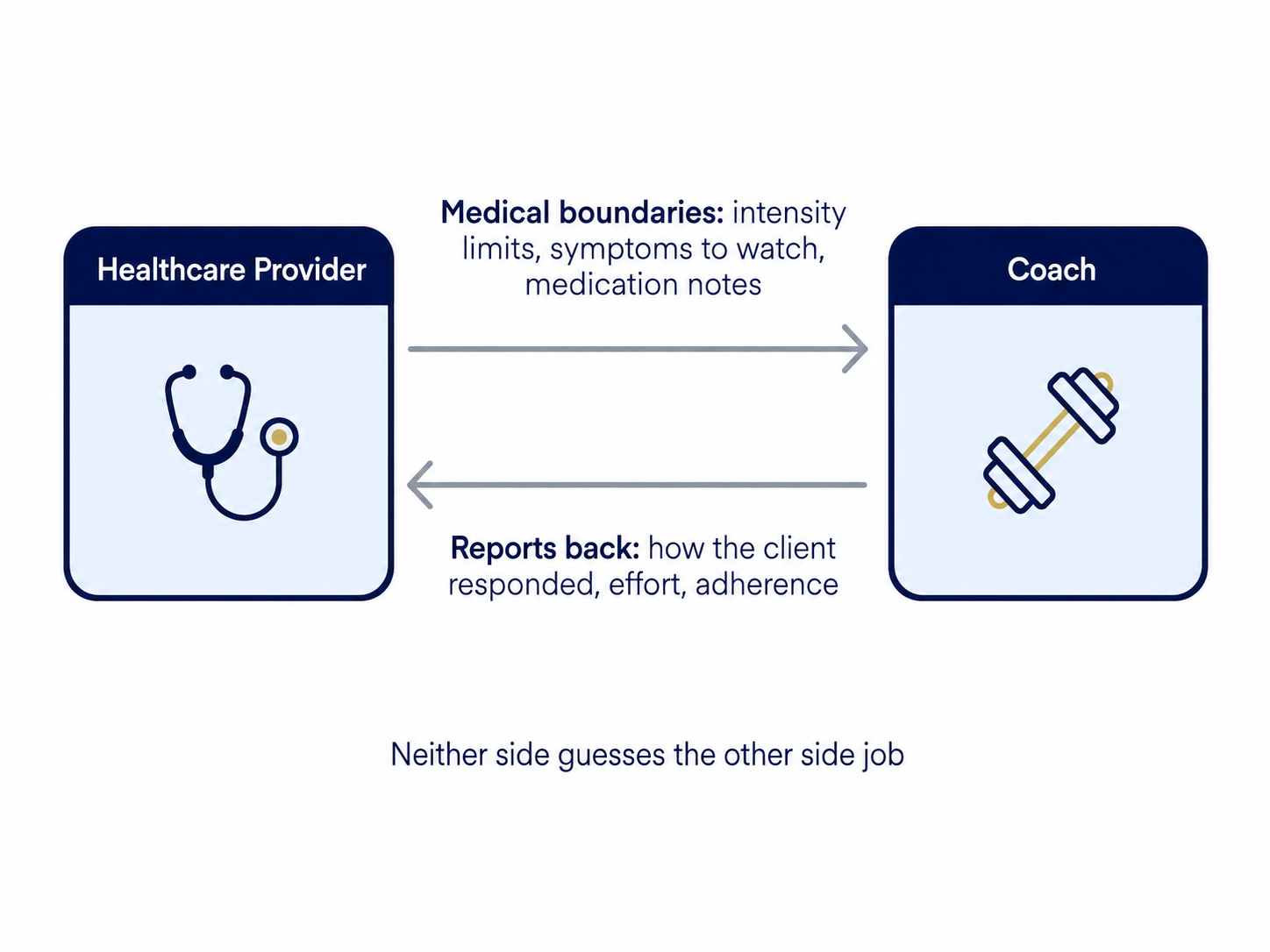
If your provider asked you to monitor blood pressure or avoid certain intensities, that guidance should shape the plan, not sit in a drawer. We turn those boundaries into training decisions and keep a simple record of how you responded. That record is the bridge back to your provider: it makes your next appointment start with real information instead of a shrug. This is the two-way translation we coach on. Your provider sets the medical boundaries, we turn them into concrete training choices, then report back what we saw so the next decision is better informed. Neither side guesses at the other side's job.
A conservative heat-safe session is structured, not weak
We want to retire a myth here. A conservative session is not a useless one. It is a session with enough structure to train hard at the things that matter without inviting unnecessary risk. It might begin indoors, use a longer warm-up, keep the first sets easy, avoid breath-holding, build in rest, and stop before fatigue makes form or symptoms unpredictable.
To make that concrete, here is the kind of sketch we might start from. Treat it as an illustration only, not a prescription, and never a substitute for your provider's guidance.
Warm up indoors: easy movement and mobility in a cool room, no rush, until breathing and heart rate settle.- Two or three easy strength moves: supported or machine-based exercises with generous rest, smooth breathing, and a load that feels comfortably manageable.
- An easy finish: a relaxed walk or light bike, kept conversational rather than hard.
- Stop early if anything feels off: the warning signs above outrank the plan, always.

That sketch is a starting shape, not your session. The real version is decided by your provider's guidance and by how your body responds on the day. For strength, that often means machines, supported dumbbell work, cable work, or simple bodyweight patterns rather than high-density circuits or heavy compound lifts in a hot room. For conditioning, it often means an easier indoor walk or bike rather than a hard outdoor interval. The person decides the details. The principle holds: reduce heat cost first, keep intensity conservative, and progress only when the response is stable.
The borderline cases, and how we would call them
Most of the real questions live in the gray zone, so here is how we lean when the answer is not obvious. None of these override your provider. They are how we would reason while staying inside the training lane.
If your blood pressure is well controlled and the day is only moderately warm, we would still train indoors or in the cool hours, but we would let you progress at a normal, patient pace. The reward is there and the risk is manageable, so we keep building.
If your medication was recently changed, or you simply feel off in the heat, we would hold intensity steady rather than progress, and we would lean on the warning-sign rules harder than usual. When something is uncertain, our bias is to gather one more good week of stable sessions before adding load.
If you have had symptoms in heat before, that history changes the call for us. We would move the whole session indoors, shorten it, and treat any recurrence as a reason to stop and check in with your provider, not as something to train around quietly.
And if the guidance you bring is vague, our honest recommendation is to go get a sharper version before pushing. A coach can only build safely on guidance that is specific enough to translate, which is the next point.
Where we stop, and where we can genuinely help
We will say plainly where our lane ends. Royal Blue Fitness does not diagnose high blood pressure, manage medication, clear medical risk, or tell clients to ignore symptoms. We also do not use friendly fitness language to make medical decisions sound simpler than they are. When a decision belongs to a clinician or pharmacist, we route it there.
What we can do, and do well, is build a fitness plan around your guidance: strength work, mobility, pacing, recovery, habit structure, and a training environment that makes consistency realistic. For the right client, that support makes exercise feel safer, clearer, and less all-or-nothing, which matters most when the weather is already adding stress.
Bring your provider a specific question, not a broad one
Our recommendation for the conversation itself: skip the broad version. Many people ask their provider, can I exercise, and that is too broad to answer well. A better conversation gives context, including the type of exercise you want, where you will do it, how hot it may be, the intensity you are aiming for, and whether you have had symptoms in heat before.
Useful questions to bring include:
- Are there intensity limits I should follow?
- Which signs should stop a workout immediately?
- Do my medications change my heat tolerance?
- Should I avoid outdoor workouts during heat waves?
- Do I need to check my blood pressure before or after exercise?
Give your coach guidance that is clear enough to use
On the flip side, a coach can only act on guidance that is specific enough to translate. If your provider says avoid high intensity, we need to know what that means for you. If your provider says monitor symptoms, we need to know which symptoms matter most. The clearer the input, the safer and more useful the plan.
With that in hand, the plan we would build includes conservative starting points, clear stop rules, longer rest, controlled breathing, indoor options, and progression only when your response is stable. That is the second half of the two-way translation: medical boundaries in, trainable decisions out.
Our coaching philosophy: keep improving, safely
If we zoom all the way out, this is the belief underneath every recommendation above. The goal is to keep getting better, and to do it safely. It is genuinely nuanced, and we respect that, which is why we ask so many questions before changing a single thing.
From our coaching perspective, there is almost always a viable path forward that keeps safety first. No single answer is the only answer, and the right call shifts with your control, your medication, the day's heat, and how you feel. That is not a dodge. It is the honest shape of the problem, and it is exactly why a thoughtful coach paired with good medical guidance beats a one-size-fits-all rule.
Train conservatively, with the right guidance in place
Royal Blue Fitness handles the fitness side: building a strength plan, scaling intensity, improving movement options, tracking your response, and creating a heat-aware structure you can actually keep. We do not manage blood pressure, prescribe medication changes, or clear medical risk.
If you have appropriate medical guidance and still feel unsure how to train through the heat,
book a Strength and Range of Motion Assessment. It gives us a conservative starting point, and from there coaching can help you stay consistent without turning summer into a guessing game.
FAQ
What questions should I ask before exercising with high blood pressure in the heat?
Ask your healthcare provider whether you have personal heat limits, intensity limits, medication considerations, symptom stop rules, or blood-pressure monitoring guidelines that should change your plan. Bring details about the type of exercise, the environment, and the intensity you want. When blood pressure and heat are both in play, our view is that a conservative decision is not a lack of effort; it is what makes training sustainable.
Should I lower my exercise intensity in hot weather?
Often, yes, and that is the call we would usually make. Heat makes the same workout feel harder, so reducing intensity, adding rest, shortening the session, or moving indoors can be the smart move, especially with high blood pressure or heat-sensitive medications. Treat the lower setting as a starting point you can progress from once your response stays stable.
What symptoms mean I should stop my workout?
Stop for dizziness, faintness, nausea, unusual shortness of breath, weakness, confusion, chest symptoms, a severe headache, or anything that feels wrong. Seek medical help if symptoms are severe, unusual, or do not resolve. We treat warning signs as information to act on immediately, never a challenge to push through.
How do medications affect heat tolerance during exercise?
Some medications can affect hydration, dizziness, or temperature regulation, which changes how heat feels and how your body responds. Ask your provider or pharmacist how yours interact with hot-weather exercise, and never change a medication based on workout advice. This is one we always route to a clinician, because only they can tell you what is safe for your specific prescriptions.
Can Royal Blue Fitness help me exercise with high blood pressure?
Yes, on the fitness side and after appropriate medical guidance: conservative strength planning, movement assessment, pacing, progression, and coaching. Medical management, medication decisions, and exercise clearance stay with your healthcare team. We build the plan around their boundaries rather than around guesswork.
What should I bring to a trainer after talking with my healthcare team?
Bring any guidance about intensity limits, symptoms to watch, medication considerations, blood-pressure monitoring, and activities to avoid. A coach can use that to build a conservative plan and to track how you respond, so your next medical appointment starts with real information instead of a shrug.
Here are our latest articles! Click to read more.