Pregnancy Mobility Training for the 2nd and 3rd Trimesters: Move Better, Lift Safer, Feel Strong
If you are in your second or third trimester and your workouts suddenly feel different, you are not imagining it. This is the phase where your body changes fast, your bump starts taking up space, and movements that felt smooth a month ago can feel cramped, wobbly, or just plain awkward.
Here is the good news: you do not have to stop training. You just need smarter training, the kind that bends with your body instead of fighting it.
In this guide, you will learn how to approach pregnancy mobility training and strength work in the second and third trimesters, including when to modify supine or prone positions, how to adjust hinges and squats as your bump grows, and what to do when your baby shifts and you suddenly feel pressure in your bladder or low back. Think of this as the more nuanced, real-world weeks 13 and beyond version of prenatal training, at the point where general advice no longer fits your changing body.
Before you begin: get your provider's green light
This article is general education and fitness coaching, not medical clearance. For most uncomplicated pregnancies, exercise is encouraged with smart modifications, but your pregnancy is yours alone, so get your OB or medical provider's okay to keep training, especially if you have a complication, a higher-risk pregnancy, or any restriction your care team has already given you. Once you are cleared, the modifications below focus on training well within that clearance, and the warning signs that mean stop and call your team are spelled out in the safety section further down. Your provider has the final vote.
The second and third trimester, and why the timing changes your training
Quick definitions
The second trimester runs from weeks 13 to 27. A helpful week-by-week overview is the Mayo Clinic's pregnancy week-by-week overview.
The third trimester runs from week 28 to birth. Cleveland Clinic's overview of
the third trimester uses this same framework.
Those dates matter because the training variables change as pregnancy progresses: body shape, balance, breathing mechanics, fatigue, joint feel, and how much pressure your pelvic floor has to manage under load.
The biggest training shifts after week 13
In the second and third trimesters, you are usually dealing with some mix of:
- More bump, less space: your center of mass shifts and some positions simply stop fitting.
- Different balance: single-leg work can feel less stable.
- Different breathing mechanics: your rib cage expands, so pressure management becomes more of a concern.
- A pelvis that wants stability, not stretching contests: things can feel looser, which is exactly why strength and control matter.
You are not fragile. You are adapting, and your training should adapt with you.
Common workout sensations, and what they usually mean
The lift you owned last month suddenly feels foreign
Some changes show up as a movement that used to feel automatic and now feels strange. A few common examples:
- Your hinge feels like you cannot get close to the weight anymore.
- Squats feel crowded, or your stance naturally widens.
- Your low back feels more switched on when you are standing still, not just when you lift.
- Getting into position under load takes longer, and that is normal.
The fix is rarely to stop. The fix is almost always to change your setup, adjust your range of motion, and choose the right variation for the body you have today.
Planning for your changing body through each trimester
As pregnancy progresses, we account for the whole picture rather than any one symptom. Your posture shifts, the hormone relaxin loosens your ligaments and joints, and your center of gravity moves forward as the bump grows. At the same time, your baby’s changing position can press on the nerves around your lumbar spine, which is one reason low-back or nerve-related discomfort can show up under load that felt fine a few weeks earlier.
Because of all of that, our adjustments go beyond simply avoiding certain positions. We change how you lift. We widen your stance to make room for the bump and improve your base of support, we reduce the loads when recovery and pressure management call for it, and we prioritize strict, controlled form over chasing a maximal number on the bar.
We also avoid overstretching on purpose. Relaxin already increases joint laxity, so chasing end-range mobility can do more harm than good right now. None of this is guesswork: we know the physiology, we expect these changes, and we adjust your training intelligently through every trimester. Symptoms that feel sharp, one-sided, or persistent still belong with your provider or a pelvic floor physical therapist, and we coordinate around their guidance.
What to do in the moment:
- Pause.
- Take a slow inhale through your nose, then a long exhale like you are fogging a mirror.
- Change something small first: stance width, range of motion, tempo, or support.
- If it still feels off, switch the exercise.
And if you are working with a coach, say something the moment it happens. You know your body and your baby best, and the best prenatal training is built on that real-time feedback.
Safety guardrails, without the fear-mongering
For most uncomplicated pregnancies, exercise is considered safe and encouraged, with smart modifications as your body changes. That is the core message of the American College of Obstetricians and Gynecologists (ACOG) guidance on prenatal physical activity, which encourages women with uncomplicated pregnancies to keep doing both aerobic and strength-conditioning work before, during, and after pregnancy. That said, your body gets the final vote.
Effort is okay, warning signs are not
Stop exercising and call your medical team if you notice any of these warning signs:
- Dizziness or feeling faint.
- Leaking fluid.
- Vaginal bleeding.
- Regular painful contractions.
- Significant pain.
- Significant shortness of breath.
- A noticeable decrease in your baby's movements. How often your baby moves can vary, but if you go longer than usual without feeling movement, stop and contact your provider.
UCSF Health summarizes most of these stop-and-call signs clearly in its
exercise during pregnancy patient guide, and Cleveland Clinic adds reduced fetal movement to the list of symptoms worth a same-day call to your
pregnancy care provider. When in doubt, make the call. That is what your care team is there for.
Intensity that works in real life
Instead of chasing numbers on the bar, use tools that actually fit pregnancy:
- RPE: most working sets should feel like you could do 2 to 3 more reps if you had to.
- Talk test: you should be able to speak in short sentences while you work.
- Form first: if your form changes dramatically under fatigue, that load is too heavy for today.
- Breathe through the effort: avoid holding your breath or bracing so hard you cannot breathe. Exhale on the effort instead. Long breath-holding under load (the Valsalva maneuver) spikes internal pressure, which is exactly what you want to manage down in pregnancy, not crank up.
If you want a simple, reputable overview of safe activities and how to scale intensity,
Johns Hopkins Medicine's exercise during pregnancy guide is a solid reference, and it specifically flags breath-holding during exertion as something to avoid.
Supine and prone training: when to modify, and what to do instead
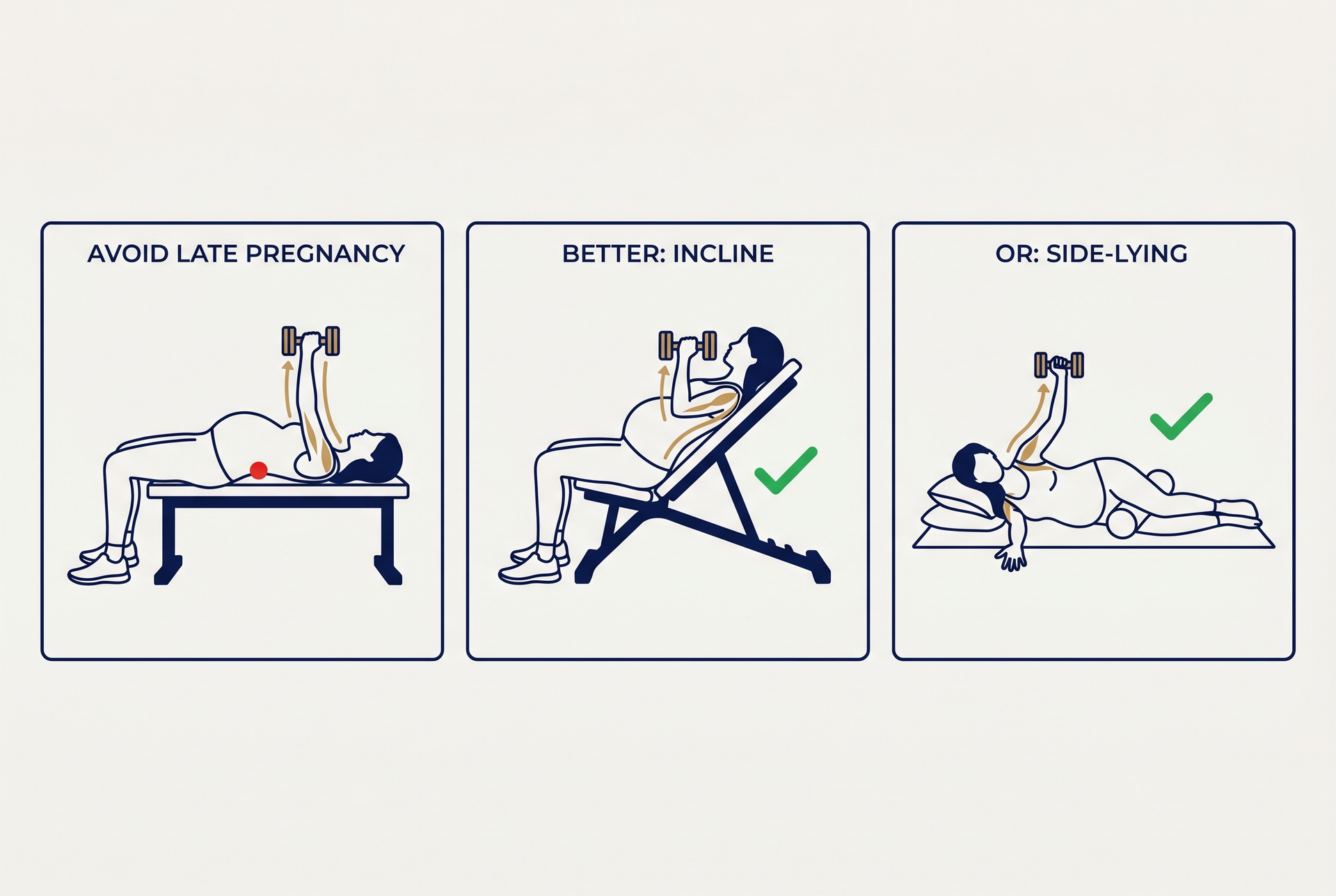
Supine work, or lying flat on your back
A practical guideline used by many clinicians is to avoid lying flat on your back for more than a few minutes later in pregnancy, especially if it makes you feel dizzy. The NHS guidance on exercising in pregnancy explains why this position can reduce blood return and cause low blood pressure in some people, particularly after about week 16.
Here is the coaching version:
- If you feel fine on your back for a brief while, that is one thing.
- If you feel dizzy, nauseated, breathless, or off while lying flat, modify immediately.
Simple swaps that keep your training strong:
- Incline bench press instead of flat bench.
- Supported chest press machine instead of flat dumbbell press.
- Side-lying positions for mobility and breathing drills.
- Tall-kneeling or standing presses instead of supine pressing.
Prone work, or lying on your stomach
Prone work often becomes uncomfortable or impractical as the bump grows. This is less about a strict rule and more about the simple fact that it no longer fits. When the position stops working, change the position, not the goal.
Swaps that usually feel great:
- Quadruped positions on hands and knees for core control and mobility.
- Standing hinge and row patterns.
- Side-lying thoracic mobility instead of prone spinal work.
Modifying lifts when the bump is in the way, without losing strength
This is where the second and third trimesters get specific. Your movement patterns can stay the same, but your version of them changes.
Hip hinge modifications for RDLs, deadlifts, and good mornings
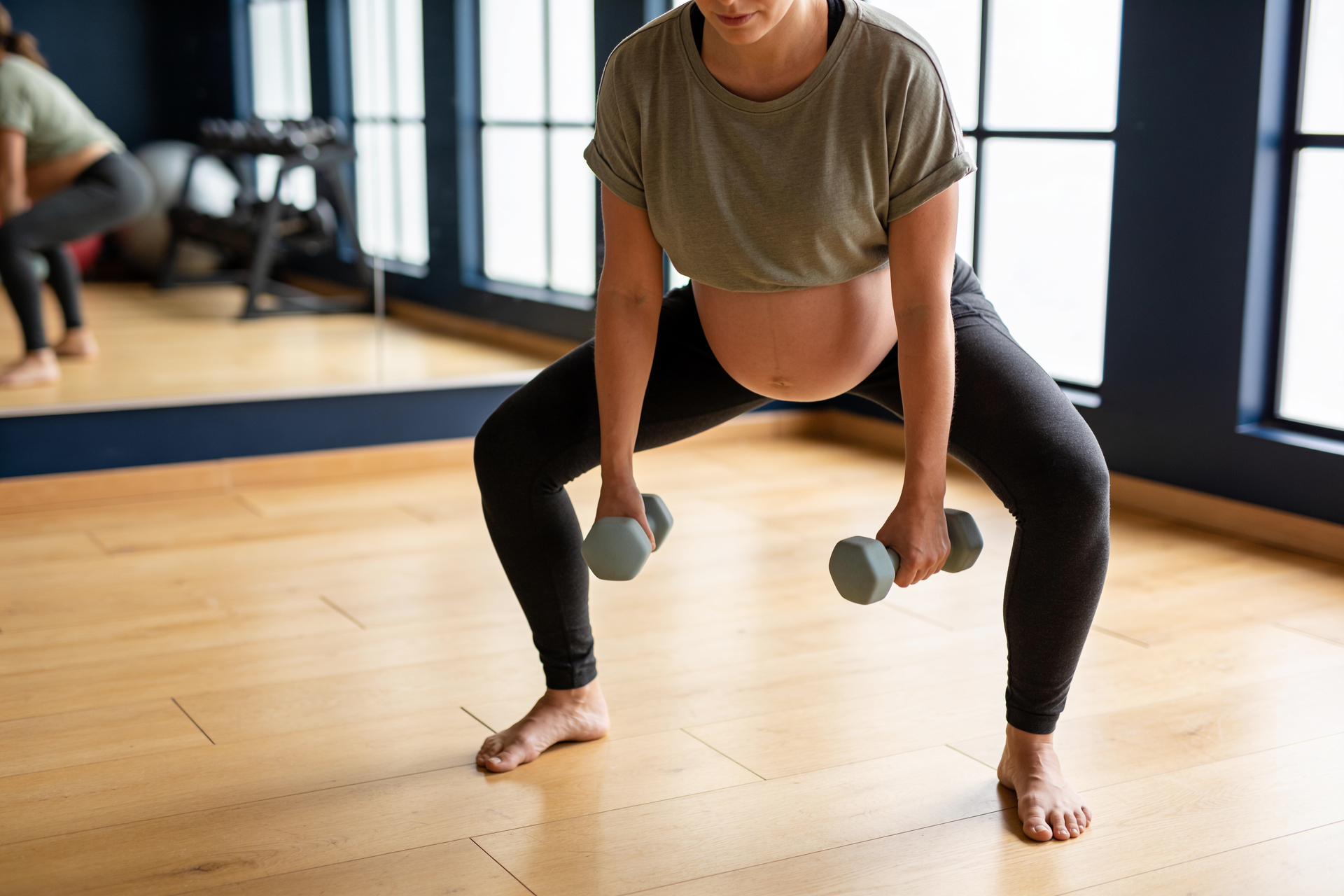
Close-stance hinges and barbell RDLs can get awkward fast, because there is literally a baby in the path of the bar. Your best hinge options as the bump grows:
- Dumbbell RDL with weights at your sides: more space than a bar in front.
- Slightly wider stance hinge: gives the bump room.
- Block pulls or rack pulls: reduced range, still heavy enough to matter.
- Cable pull-through: excellent when your back is tired and you want a clean hinge.
Coaching cue that matters: keep the hinge about your hips moving back, not your torso reaching down. If you are reaching around your bump, it is time to change the setup.
Squat and lunge modifications
Squats often feel better with a wider stance and a slightly more upright torso. Pregnancy-friendly squat options:
- Goblet squat, where the counterbalance helps you stay upright.
- Box squat for a consistent depth.
- Landmine squat, if you have access to one.
- Supported squat holding a rack for balance.
Lunge options that tend to work well:
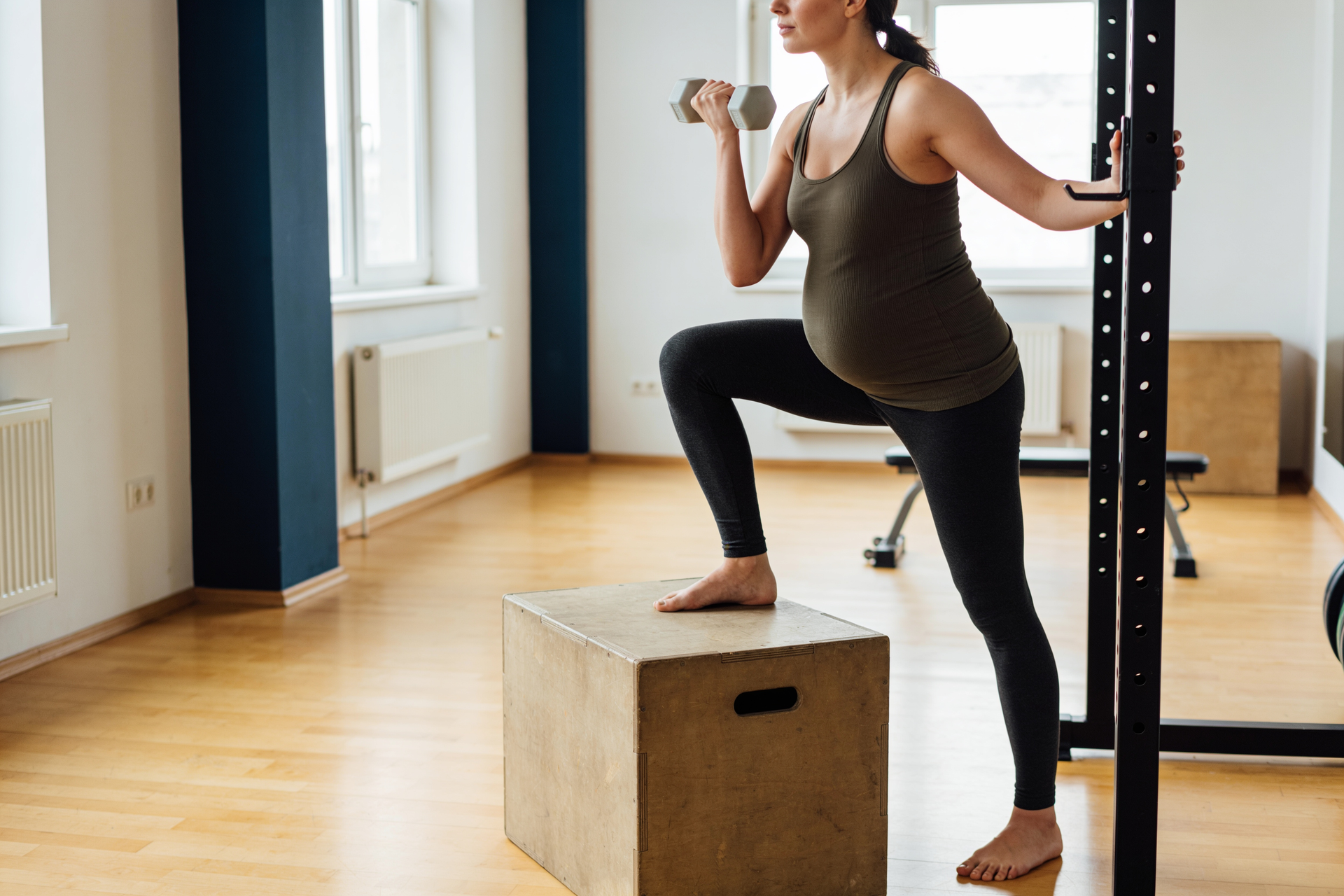
- Supported split squats, where light support is smart, not a cop-out.
- Step-ups with a nearby rail or rack.
- Reverse lunges with a shorter range, if pelvic comfort allows.
If pelvic discomfort shows up, the goal is usually to shorten the stride, reduce depth, add support, and emphasize control.
Upper-body training: keep it strong, keep it posture-friendly
Upper back strength matters even more as your rib cage expands and your posture adapts. Make these your staples:
- Rows, whether cable, dumbbell, or chest-supported.
- Lat pulldowns or band pulldowns.
- Incline or standing pressing.
- Carries.
The mobility priorities that matter most in the 2nd and 3rd trimester
You are not doing mobility to get looser. You are doing mobility to keep joints moving comfortably, reduce day-to-day stiffness, and support strong, controlled lifting mechanics.
Hips: rotation and adductors
Well-moving hips reduce the urge to steal motion from your low back. Start here:
- 90/90 hip switches, or elevated 90/90 with a cushion under your hips if needed.
- Adductor rock-backs, widening the knees as the belly grows.
- Supported hip flexor mobility with short holds and easy breathing.
If you feel pinching in the front of the hip, reduce the range, elevate your hips, slow down, and keep your ribs stacked over your pelvis.
Thoracic spine and ribs: rotation without twisting your low back
As your torso changes, many people start rotating through the lower back instead of the upper back. Where to begin:
- Side-lying open books.
- Half-kneeling thoracic rotations with a hand on the wall and a small range.
- Thread-the-needle, with a modified range if your wrists are sensitive.
Your goal is smooth rotation with relaxed breathing, not forcing the end range.
Lateral trunk and low back: make room, do not crank
Rib expansion and the bump can make your QL and low back feel like they are constantly working. What tends to help:
- Wall-supported side-bend breathing.
- A lat-focused stretch paired with a gentle exhale.
- Child's pose variations with support from pillows or a bench.
If a drill creates more pelvic pressure, it is not the right drill for today.
Ankles and feet: the underrated third-trimester difference-maker
Swelling, an altered gait, and balance changes can leave your ankles and feet feeling stiff and cranky. Try these:
- Calf mobility with both a bent and a straight knee.
- Foot tripod work across the big toe, little toe, and heel.
- Supported balance holds, kept short and frequent.
This quietly improves how you walk, how you squat, and how your hips and back feel.
Mobility alone is not the answer: pair it with strength and control
The best pregnancy movement training is a pairing: mobility to keep your options open, and strength to keep the whole system stable.
If you like seeing the research, a large
British Journal of Sports Medicine systematic review and meta-analysis on resistance training in pregnancy pooled 50 studies and roughly 47,000 participants and linked resistance training to lower odds of gestational hypertension and gestational diabetes. A separate meta-analysis in
Frontiers in Physiology looked at aerobic, strength, and combined training effects on blood pressure in pregnancy and found combined training had the most consistent effect. The honest caveat in both: most programs studied mixed strength with aerobic work, so the research is a green light for training, not a precise dose prescription, which is exactly where coaching fills the gap.
The mobility-plus-strength pairing method
Here are pairings we love because they keep things simple:
- Hip rotation mobility (90/90 or elevated 90/90). Pair with a supported split squat isometric hold, 15 to 25 seconds per side.
- Adductor rock-back mobility. Pair with a side-lying adductor lift, slow reps and a small range.
- Thoracic open books. Pair with a chest-supported row or cable row, 8 to 12 controlled reps.
- Side-bend breathing. Pair with a suitcase carry hold, 20 to 40 seconds per side.
Carries are a secret weapon in late pregnancy. They train posture, breathing control, and real-world stability without ever asking you to lie down, and they make daily life feel easier.
Core and pressure control, without obsessing over bracing harder
In the second and third trimesters, core training becomes less about tight abs and more about pressure management. A simple cue that works:
- Inhale: expand the ribs gently.
- Exhale: feel the ribs come down, keep the pelvis neutral, and stay in control.
If you notice doming or coning along your midline, treat it as a signal to reduce load, range, or intensity. It is feedback, not failure.
Sample protocols you can actually follow
8 to 10-minute daily pregnancy mobility reset
Do 1 to 2 rounds at an easy pace:
- Adductor rock-backs: 6 to 8 reps.
- Side-lying open books: 5 reps per side.
- Wall-supported side-bend breathing: 3 slow breaths per side.
- Calf mobility with a bent knee: 6 reps per side.
If you want to add one strength element, finish with two suitcase carry holds, 20 to 30 seconds per side.
20-minute prenatal mobility and strength session
Block A, mobility, about 6 minutes:
- 90/90, elevated if needed: 60 seconds total.
- Open books: 5 per side.
- Supported hip flexor mobility: 30 seconds per side.
Block B, strength pairings, 10 to 12 minutes:
- Supported split squat isometric hold: 2 rounds, 15 to 25 seconds per side.
- Chest-supported row: 2 rounds, 8 to 12 reps.
- Suitcase carry hold: 2 rounds, 20 to 40 seconds per side.
Finish, 2 to 3 minutes: an easy incline walk or a gentle breathing reset.
35 to 45-minute strength session template with bump-friendly swaps
- Warm-up, 8 to 10 minutes: the daily mobility reset above.
- Main lift, 10 to 12 minutes: dumbbell RDL at your sides or a block pull, 3 sets of 6 to 10.
- Upper-body pull, 8 to 10 minutes: cable row or chest-supported row, 3 sets of 8 to 12.
- Lower-body unilateral, 8 to 10 minutes: supported step-ups or split squats, 2 to 3 sets of 6 to 10 per side.
- Carry finisher, 4 to 6 minutes: suitcase carries or holds, alternating sides.
Keep your rest generous. Pregnancy workouts should feel strong, not rushed.
When to ease off heavy training, and how to transition in the final weeks
There is no universal week when heavy becomes unsafe for everyone. What changes is your recovery capacity, your pressure management, and your comfort with certain positions.
Define heavy correctly: heavy is a feeling, not a number
This is the rule we come back to with every pregnant client: in pregnancy, heavy is a feeling, not a number. The number on the dumbbell matters far less than how the rep actually feels. A weight has crossed into heavy when:
- Your form breaks down.
- You have to brace so hard you cannot breathe smoothly.
- Symptoms spike during or after the set.
- You do not recover well for 24 to 48 hours afterward.
If any of that is happening, you are already in the time-to-transition zone, no matter what the load says.
A smart timeline that fits real bodies
Most people do well with a gradual shift in the last 4 to 6 weeks, depending on symptoms and medical guidance:
- Keep strength training, but lower the intensity slightly.
- Shorten your sessions.
- Add more support-based variations.
- Prioritize carries, step-ups, rows, and controlled hinges.
You are not backing off. You are changing goals, from building strength to maintaining capability and keeping your system calm heading into birth.
What to do if pelvic pressure increases late in pregnancy
If you feel increased pelvic heaviness or pressure during lifting:
- Reduce the load.
- Shorten the range.
- Choose more supported positions.
- Emphasize your exhale timing.
- Shift toward more carries and incline walking.
If symptoms persist, consider adding a pelvic floor physical therapist to your team. A good coach and a good pelvic floor PT complement each other, and neither replaces your medical provider.
Frequently Asked Questions
When should I stop lying on my back during pregnancy workouts?
If lying flat makes you feel dizzy, nauseated, or short of breath, modify right away. Many people switch to incline or side-lying variations as pregnancy progresses, especially when supine positions are prolonged or it is later than about week 16. There is no need to white-knuckle a position that makes you feel off.
What if I feel sudden bladder pressure mid-set?
Pause, breathe, adjust your stance or range, and switch exercises if needed. Sudden pressure is common when the baby shifts and presses on your bladder. The best approach is symptom-led programming and real-time communication with your coach, so the plan bends to what your body is telling you that day rather than forcing through a position that suddenly feels wrong.
Is it normal to feel more low-back tightness in the third trimester?
Yes, it is very common. You are carrying more load, your posture is adapting, and your trunk muscles are working differently to keep you upright. Mobility paired with strength, especially hinges, rows, and carries, usually helps more than stretching alone, because the goal is a low back that is supported and stable, not one that is stretched looser. If the tightness turns into sharp or one-sided pain, loop in your provider or a pelvic floor PT.
Can I keep deadlifting and squatting in the third trimester?
Many people can keep their hinge and squat patterns, but the variations often change. Dumbbells at your sides, a wider stance, a reduced range, and more support make these patterns more comfortable and sustainable, and they keep you strong without forcing your body into positions that no longer fit.
Should I avoid holding my breath when I lift while pregnant?
Yes. Avoid long breath-holding and very hard bracing under load. Exhale on the effort instead. Holding your breath through a heavy rep raises internal pressure, which is the opposite of what you want when you are already managing more pressure through your trunk and pelvic floor.
Prenatal mobility and strength training in Pleasant Hill at Royal Blue Fitness
If you are pregnant and want training that feels safe, empowering, and tailored to your body week to week, this is exactly what we do at Royal Blue Fitness in Pleasant Hill.
The hardest part of training through the second and third trimester is that the right answer keeps moving. The bump grows, the baby shifts, and what felt fine last week feels wrong today. That is the gap a coach is built to close. Our
Strength and Range of Motion Assessment uses VALD force-plate and dynamometer testing to give us an objective read on what your body already does well and what feels limited or sensitive right now, so the modifications stay matched to your actual measurements and symptoms instead of generic trimester rules.
You bring the feedback. We bring the structure, the modifications, and the coaching that help you stay strong through pregnancy and feel more prepared for birth and postpartum. When you are ready,
book your assessment and we will build your second and third trimester plan around the body you have today.
Here are our latest articles! Click to read more.