What Is Progressive Overload? A Plain-English Guide for Real Strength Progress
Progressive overload is one of those phrases the strength world repeats constantly and rarely stops to define, usually said as though everyone in the room already knows exactly what it means. The good news is that the idea behind it is genuinely simple. Once it clicks, it becomes the single most useful lens you own for understanding why some training produces results and some quietly goes nowhere.
The trouble is that the term gets thrown around loosely, leaving a lot of people nodding along without a clear definition to work from. This guide defines progressive overload in plain language, shows where people get it wrong, and hands you the practical ways to put it to work in your own training.

Progressive overload, defined in plain English
Progressive overload is the principle that to keep getting stronger or building muscle, you have to gradually increase the demand you place on your body over time.
The logic is straightforward. Your body adapts to the stress you give it, becoming better suited to handle exactly what you ask of it. If the stress never changes, your body has no reason to keep changing, so it settles at whatever level your current training requires and parks there.
To keep progressing, you make training a little harder in a controlled, deliberate way on a recurring basis. That gradual, intentional increase in demand is the entire concept. As
the National Institute on Aging puts it, gradual increases in the amount of weight, the number of sets or repetitions, or how often you train will result in stronger muscles. Progressive overload is simply the name for keeping that demand meaningful as your body adapts to it.
Why it is the engine behind every strength gain
Progressive overload matters because it is the engine behind nearly all long-term progress, and understanding it explains things that otherwise feel mysterious. It is why the workout that transformed you a year ago now does almost nothing: your body has fully adapted to it, and the demand no longer registers as a challenge. It is also why an ordinary, unglamorous routine can keep delivering results for years, as long as the demand keeps creeping upward in small steps.
This is not a fringe idea. As UC Davis Health molecular exercise physiologist
Professor Keith Baar describes the same loop: record what you lifted, and next session do a little more, either another repetition or a slightly heavier weight. The principle holds whether your goal is everyday capability, visible muscle, or raw strength. Grasp this one idea and you suddenly understand both why your training stalled and what to do about it.
Picture two people running the same beginner routine for a year. The one who nudges the weight up a little whenever a set starts to feel easy keeps gaining. The one who repeats the identical workout settles into a plateau within a few months.
Same exercises, same time in the gym, same effort on paper. The only difference is whether the demand kept rising, and that one difference is the whole ballgame.
The misunderstanding that trips people up
For such a simple principle, progressive overload is constantly misunderstood, and the misunderstandings cause real frustration and the occasional real injury. People tend to fall into one of two traps. Either they treat overload as a single narrow tactic, or they assume it means grinding harder in every session until something finally breaks.
Both readings miss the heart of the idea, and both reliably lead somewhere you do not want to go: a stall or a burnout.
It is not just "add weight"
The most common mistake by far is believing progressive overload means adding weight to the bar every single time you train. Adding weight is certainly one way to increase demand, but it is not the only way, and chasing it relentlessly is exactly how people get hurt or hit a wall.
Overload simply means increasing the demand, and demand has several dials you can turn, not just one. Treating weight as the only lever, as
the National Strength and Conditioning Association makes clear, ignores most of the levers it lists, since it defines progression as systematically modifying frequency, intensity, and exercise difficulty over time. Lean on load alone and plateaus arrive far sooner than they otherwise would. The bar cannot go up forever. Your training can keep getting harder in other ways for a very long time.
The six levers you can actually pull
Because overload means increasing demand rather than just adding weight, you have several levers at your disposal. Good training rotates through them instead of forcing a single one until it stalls. Think of these six as the dials on the mixing board:
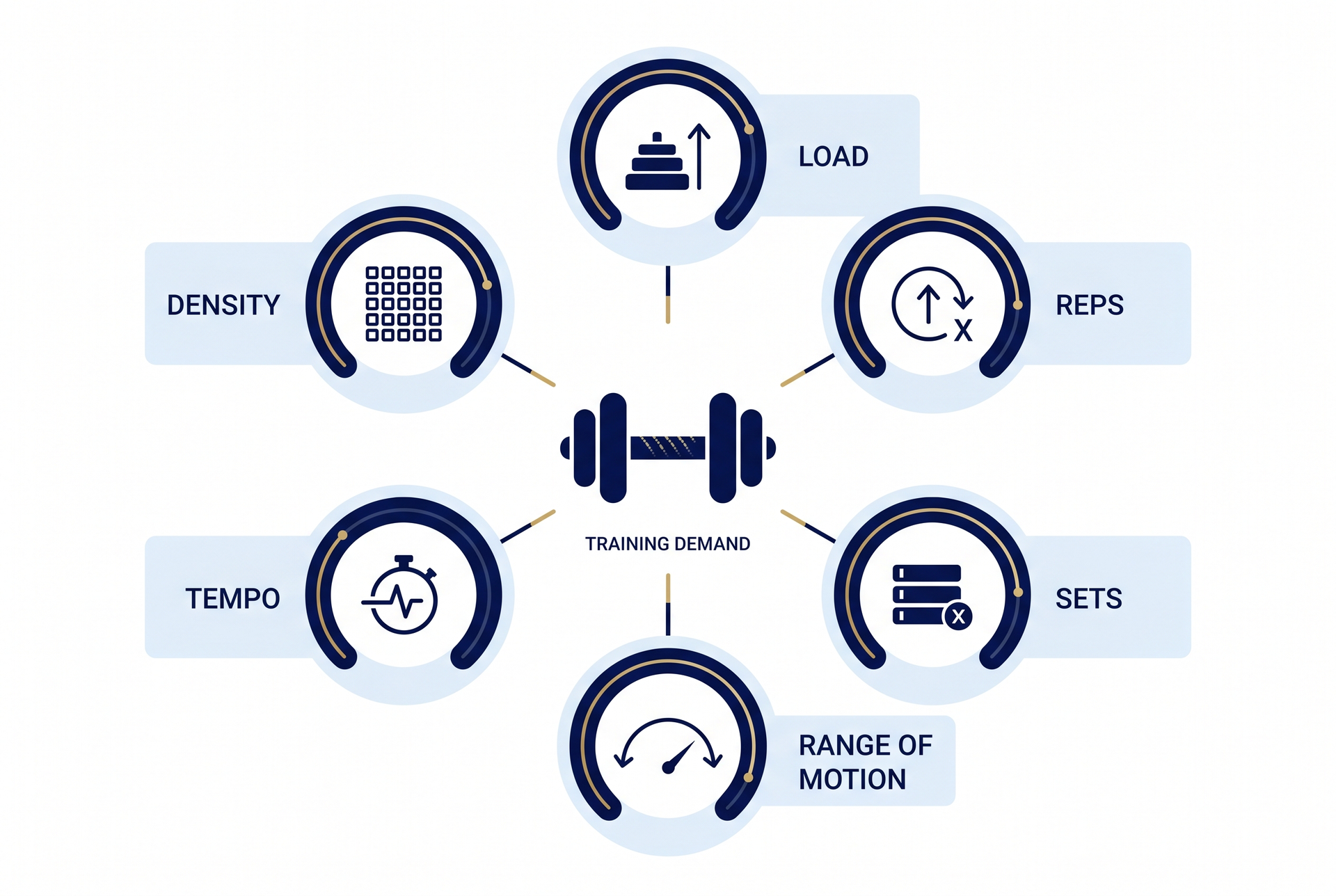
| Lever | How you turn the dial |
|---|---|
| Load | Add weight to the movement. |
| Reps | Do more repetitions at the same weight. |
| Sets | Add a set to raise your total work. |
| Range of Motion | Move through a fuller, controlled range so the muscle works harder on every rep. |
| Tempo | Slow the movement down to increase the time the muscle spends under tension. |
| Density | Do the same work in less time by trimming your rest. |
Knowing your options is what lets you keep progressing year after year, long after simply loading more plates becomes unrealistic.
Load, reps, and sets: the obvious dials
The most familiar levers are the obvious ones, and they are a fine place to start. You can add weight to a movement, add reps at the same weight, or add a set to increase the total amount of work you do. Each of these raises the demand on the muscle.
A reasonable approach, supported by
a 2022 study in PeerJ that compared adding load against adding reps over eight weeks and found both worked, is to move whichever lever best fits your current goal and recovery, and to change it in small, trackable steps rather than dramatic leaps. A common, reliable method is to add reps each week until you reach the top of your target range, then add a small amount of weight and begin the range again, so progress is steady and never a guess.
For instance, if your plan calls for sets of eight to twelve reps, you might start at eight reps with a given weight, build up to twelve over a few weeks, then add the smallest increment available and drop back to eight at the new load. The weight went up, but only after you earned it with reps first, which keeps each jump small enough to actually handle. We tell clients the same thing in plainer words: earn the next plate, do not just reach for it.
Range, tempo, and density: the quiet dials
The subtler levers matter just as much, and they are what experienced lifters lean on when the obvious ones run dry. You can improve your range of motion so the muscle does more work on every rep, slow the movement down to increase time under tension, or compress the same amount of work into less time to raise the overall density of a session.
On the first two, the evidence is reassuringly specific. As
a narrative review of resistance-training technique concludes, range of motion is the main technique variable for muscle growth, with training at longer muscle lengths especially worthwhile, while repetition tempo can vary by preference as long as each rep takes somewhere between two and eight seconds. Density, trimming your rest to do the same work faster, is the third quiet lever and a useful one, though it is best dialed up gently. Together these forms of overload keep progress going once simply adding weight stops being realistic, which becomes the norm after the rapid gains of your first months. Mastering them is what separates lifters who keep improving from those who stall and assume they have maxed out.
Here is a concrete example. If you have been doing a partial squat, working toward a fuller, controlled depth increases the demand without touching the weight at all, because the muscle now does more work through a longer path on every single rep. The bar did not get heavier. The exercise unquestionably got harder.
What a few months of overload actually looks like
In practice, progressive overload is undramatic, almost boring, which is exactly why it works. It looks like adding a few pounds to a lift when the current weight starts to feel easy, slipping in an extra rep here and there, and steadily tightening your range and control from week to week.
No single session feels like a breakthrough. But stretched across three or four months, those small, repeated increases stack into strength and muscle you can genuinely see and feel. Major medical guidance, like
Mayo Clinic's strength-training guidance, frames it the same way: when an exercise gets easy, gradually increase the resistance, and stick with it long enough and your strength keeps climbing no matter where you started. The body rewards consistency far more than it rewards the occasional all-out effort that leaves you too sore to train again for a week.
Imagine logging your main lifts each week through that stretch. In month one, you add a rep here and there. By month two, a couple of your weights have quietly crept up.
By month three, you glance back and realize the load you now use just to warm up was your hardest set when you started. None of it felt remarkable in the moment, which is precisely how real, durable progress tends to feel. It sneaks up on you.
Two close cousins: the deload and the plateau
Progressive overload does not climb in a straight line forever, which is where two closely related ideas come in and start to make sense.
A deload is a planned lighter stretch that lets your body catch up and fully absorb the work you have done, so you can keep progressing afterward rather than slowly digging a fatigue hole. A plateau is the stall that signals it is time to either change which lever you are pulling or back off and recover.
Both concepts click into place once you understand overload. Each is simply part of the natural rhythm of pushing demand upward over time and then giving your body the room it needs to adapt. Push, absorb, push again. If you want them unpacked properly, our companion piece on how strength actually improves over time walks through the full progression framework, while this guide keeps to the plain definition.
Frequently Asked Questions
How quickly should I progress?
Slowly and steadily, which is faster in the long run than it sounds. Make small increases, a little more weight, a rep or two, or an added set, only when your current effort starts to feel manageable rather than maximal. Trying to add load in every single session almost always leads to stalled progress or strain, because your body cannot adapt that fast. Trackable, gradual change you can sustain for months is what actually builds strength, and writing it down keeps you honest about whether the demand is truly rising.
Does it work for beginners and experienced lifters alike?
Yes, though it looks quite different at each stage. Beginners can often add weight or reps frequently, sometimes session to session, because their bodies adapt rapidly to a brand new stimulus. As you gain training experience, that pace naturally slows, and you lean more heavily on the subtler levers like range of motion, tempo, and total weekly volume. The underlying principle never changes at any level. What changes is the pace of progress and the specific tools you reach for to keep the demand climbing.
Can I overload without adding weight?
Absolutely, and learning how is essential, because at some point adding weight every week simply stops being realistic for anyone. You can add reps or sets, improve your range of motion so each rep does more work, slow your tempo to increase time under tension, or do the same work in less rest time. Rotating through these options keeps progress going when the number on the bar refuses to budge, and it is exactly how experienced lifters keep improving for years.
Is more always better?
No, and this is a common and costly misunderstanding. Progressive overload means gradually increasing demand, not maximizing it every session. Push too hard, too fast, and you outrun your body's ability to recover and adapt, which produces fatigue and stalls rather than gains. The goal is the smallest meaningful increase you can recover from and consistently repeat. Planned lighter periods and adequate recovery are part of the system, not a break from it.
Put the principle to work
Progressive overload is not jargon. It is the simple, powerful idea that gradual, deliberate increases in demand are what keep you getting stronger over time. Understanding it turns training from guesswork into something you can actually steer, because you finally know what to change and why.
The principle starts from where you are, which raises the obvious question: where is that, exactly? A
Strength and Range of Motion Assessment gives you honest starting numbers for strength and range of motion, so you can apply progressive overload precisely instead of guessing which lever to pull first. If you train around Pleasant Hill or the East Bay, it is a practical way to find the point you are steering from.
Here are our latest articles! Click to read more.

Strength for Independence After 50: Training for Stairs, Carrying, Travel, and Getting Off the Floor