Virtual Coaching With Royal Blue Fitness: How Our App Keeps You Progressing

Most of our clients train with us in person, and that is by design. Standing next to a coach is still the best way to learn a lift, get a hand on your form, and feel pushed on the days you would rather coast. Virtual coaching is not here to replace that. It is here for the weeks when life gets in the way, when a work trip, an injury, a move, or a packed stretch of family logistics would otherwise hand you an easy excuse to stop training.
Here is the honest part. At most gyms, when you cannot make it in, training simply stops. The best of them email you a written script and hope for the best; most do not even do that. We built virtual coaching so you never fall into that gap. It is the closest thing to in-person one-on-one when you cannot be in the room, because it keeps a real, live human in the loop instead of leaving you alone with a PDF.
This guide walks through what virtual coaching actually is, how we flex it to almost any situation, and which tools inside the Royal Blue Fitness app keep you moving forward during your busiest, most disrupted weeks.
One note before we start. If you are managing an active injury, a recent surgery, or a flare that is getting worse, talk with your physician or physical therapist and get cleared before you begin or restart remote training. We are glad to coordinate with them, but clearance for an active medical issue comes first.
What virtual coaching actually is for us
Virtual coaching is personal training delivered remotely through video, the app, and messaging rather than in person at the studio. The label is not the interesting part. What matters is that a real coach is still doing the real work, just reaching you through a screen instead of across the gym floor. A good virtual coach still does the core work:
Assesses your movement, history, and current limits- Designs a plan around your goals, equipment, and schedule
- Adjusts the program as your life and body change
- Keeps you accountable with check-ins and honest progress tracking
The difference from in-person is delivery, not depth. Your workouts, feedback, and communication live in a shared digital space rather than a physical room. For an in-person client who suddenly cannot get in, that shared space keeps the thread of training unbroken: you do not lose your plan, your history, or your coach for two weeks, you just train a different way for a while.
We treat that bridge seriously. The people who reach out to us have often tried the do-it-alone version, a generic app or a stack of saved videos, and found it quietly fell apart the first time their routine did. A live human who notices when you go quiet is the part an app alone cannot replace, and it is the part we protect when we take you remote.
The real selling point: we flex to almost any situation
If one thing separates our virtual coaching from a downloadable workout, it is this: we do not have a single remote format and ask you to fit it. We have a ladder of options, and we meet you on whichever rung your week actually allows. When one rung is not realistic, we drop to the next without dropping you.
Live virtual sessions when the clock cooperates
When your schedule and ours line up, we coach you live over video in real time, watching your form, calling cues, and adjusting on the fly. This is the rung closest to standing in the studio together, and the default whenever time zones and calendars allow. You get the same back-and-forth you would in person, just through a camera.
Custom pre-recorded sessions when time zones get in the way
Sometimes a live session is simply impossible. You move overseas for work, or your only window is the one hour nobody is awake on both ends. Instead of handing you a generic plan, we build custom sessions for you and send them, recorded for your exact equipment, your current limits, and the specific things we are working on. It is a workout made for you, on your clock, not a one-size template.
Reverse review: you record, we coach after
The third rung flips the direction. You film your own workout, send us the clips, and we send back real feedback: what looked solid, what to change, what to load next time. This async loop keeps a coach's eyes on your training even when no shared live window exists. It is slower than a live call, but a world apart from training with nobody watching.
The point of the ladder is not any single rung; it is that there is always a next one. Travel, relocation, an odd schedule, a stretch of low motivation: each has a rung that keeps you progressing instead of pausing.
Why virtual coaching holds up when life does not
Virtual coaching is not about doing it alone with an app. It works because it removes the barriers that usually derail training before it ever builds momentum, and because it keeps the human connection that makes a plan stick.
Beat the scheduling barrier
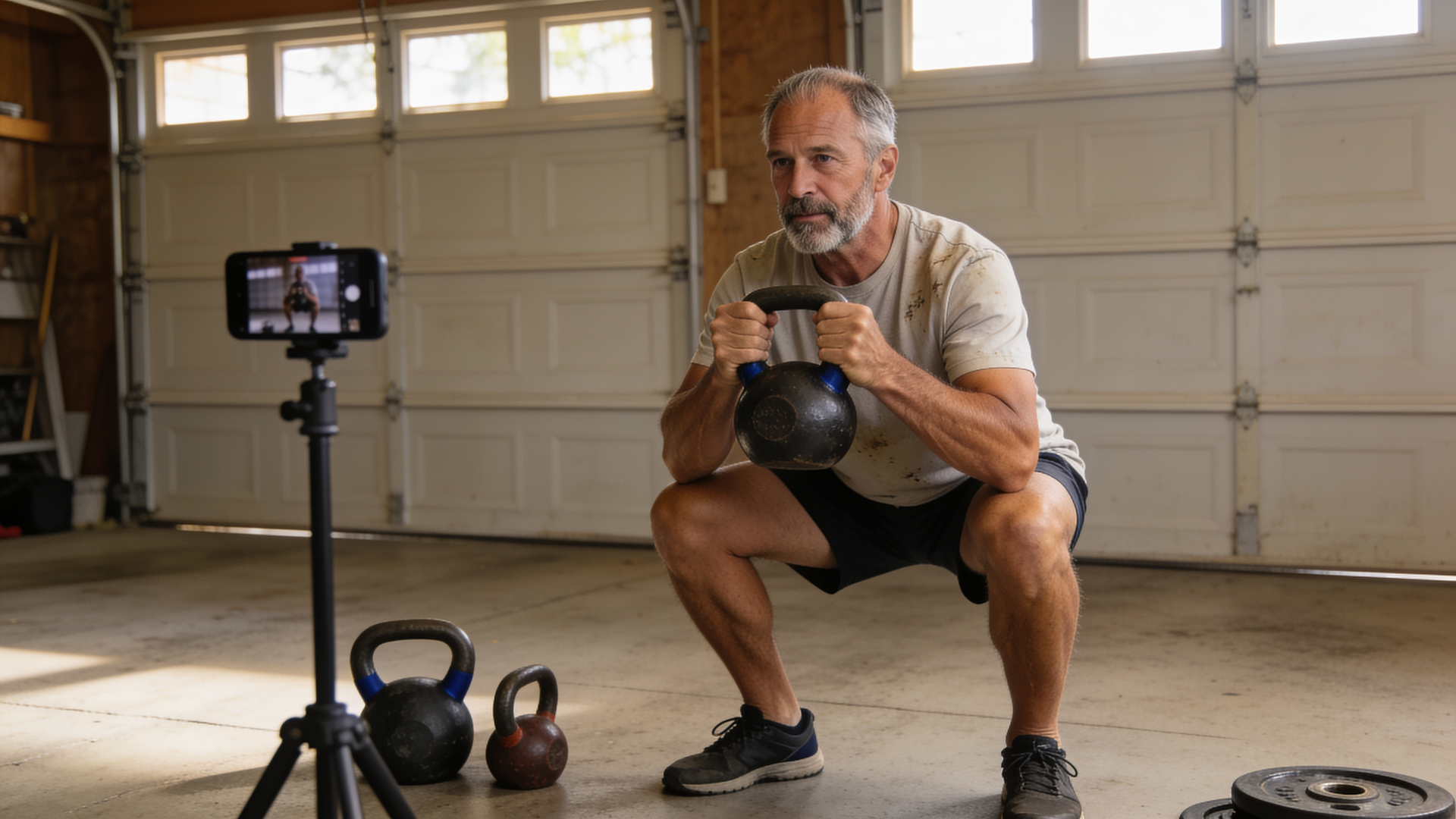
Traffic, late meetings, and family logistics do not have to kill your workout. With virtual coaching you can train at home, in your garage, or in a basic apartment gym, start early or late, and break a longer workout into shorter blocks when the day falls apart. Your coach builds the plan around your week instead of expecting your life to fit gym hours.
You get the right coach, not just the closest one
When training is virtual, you are not limited to trainers within a short drive. That means you can keep working with a coach who:
Understands joint pain, past injuries, and post-physical-therapy needs- Emphasizes functional strength and mobility over a random workout of the day
- Knows how to progress and regress movements without flaring things up. If a deep squat is not available today, we might move you to a box squat at a comfortable height and lower the box as your range returns, rather than forcing the full depth or skipping the pattern
That last point is where a coach earns their keep. The skill is not pushing harder; it is knowing the in-between versions of a movement so you keep training the pattern at a level your body can handle today.
Accountability stays built in
A good coach does not disappear after sending you a program. With our virtual coaching you should expect regular check-ins, clear expectations for what gets done each week, and a message when you miss sessions rather than silence. That mix of flexibility and accountability is what actually builds long-term consistency, and it is exactly what the do-it-yourself app cannot provide.
How our virtual coaching works, step by step
We treat virtual clients the same way we treat in-person clients. There is no lite version. The only thing that changes is how the coaching reaches you.
Week one: what to expect
Your first week is about setup, not guesswork. You film a short assessment for us, we build your first training block from what we see, and your calendar is populated with workouts before your first real session. By the time you start training, the plan is already waiting for you, not being made up day by day.
Your remote assessment, done right
We start by learning your goals and time frame, your injury history and any current pain, the equipment you can access, and the time you can realistically commit each week. Then we run our Strength and Range of Motion Assessment, adapted for remote delivery, using video, simple movement screens, and guided self-tests so we can see how you actually move. If you can visit the studio, we blend this with in-person tools; if you are fully remote, we adapt the same assessment to be safe, simple, and doable in your own space.
Programming built for your life, not your calendar
Based on that assessment, your coach builds a structured plan inside the Royal Blue Fitness app. Your program reflects how many days a week you can train, how much time you have, your current strength, mobility, and conditioning, and any joint sensitivities or red-flag movements we flagged. We keep the structure clear so you always know what is on deck today, instead of a vague push to do more.
Ongoing adjustments as life happens
Travel, flare-ups, and stressful weeks are part of normal life, so your coach keeps the plan moving with you. We tweak sessions when your sleep or stress is off, swap movements when something does not feel right, and progress your training when you are ready. You are never stuck with a static program that stops making sense after week two.
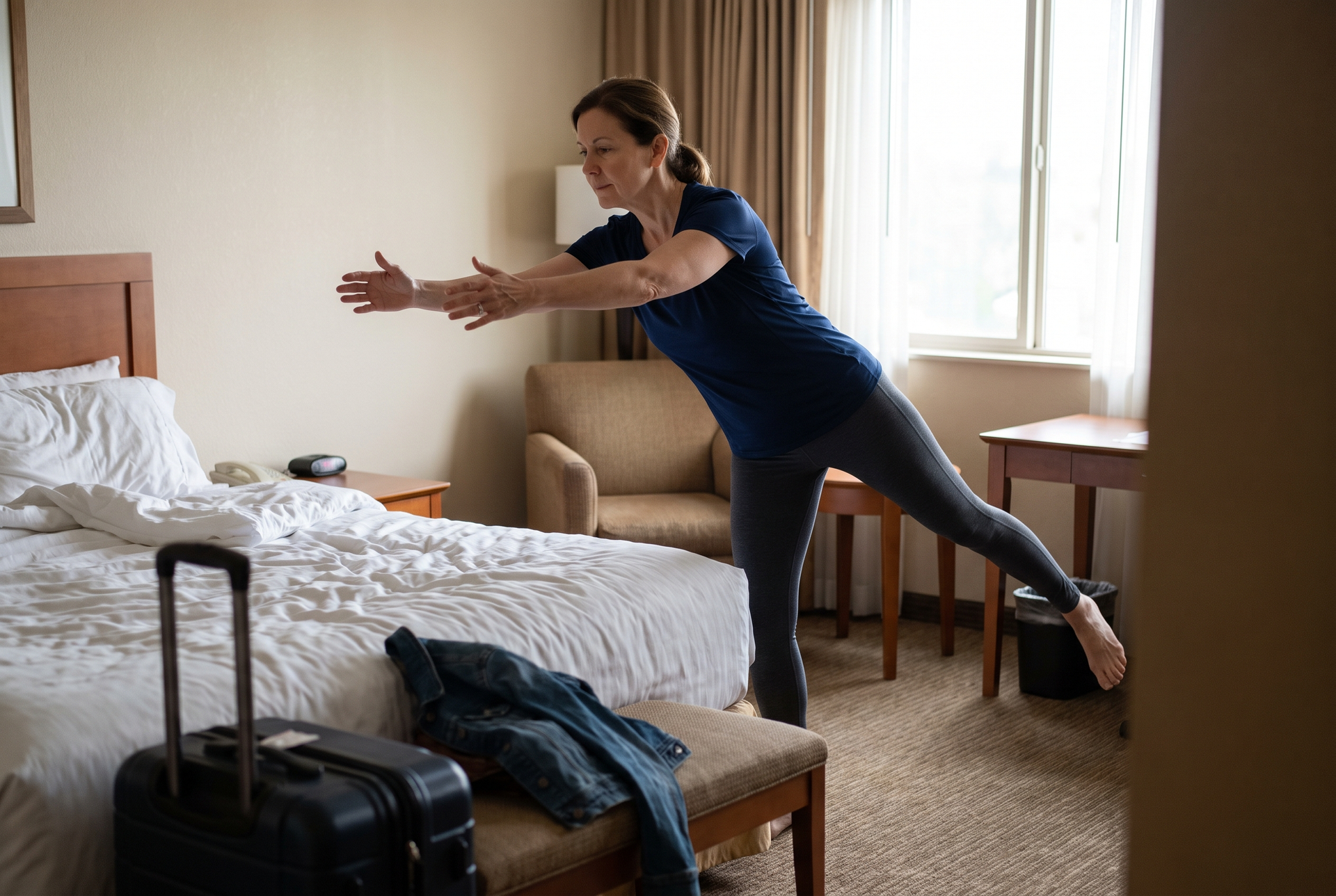
Here is what that looks like in practice. One client messaged us from a hotel on a work trip, with no barbell and a cranky lower back from a long flight. Inside the app we swapped her loaded deadlift for a hip-hinge pattern she could load with her suitcase, dropped the volume for two days, and left a short video cue on bracing. By the time she flew home, she had trained four times instead of writing off the week, and we picked the original plan back up without losing ground. That is the whole idea: in-person is her normal, and virtual kept the week from becoming a hole in her training.
Making a remote assessment genuinely useful
The most common worry we hear about virtual coaching is that a coach cannot really see you through a screen. That is fair, and it is exactly why our assessment is built around it rather than ignoring it. A rushed video call is not an assessment. A structured one, with the right camera angles and movements, tells us most of what we need to start safely.
During the Strength and Range of Motion Assessment we ask you to film a short set of everyday and foundational movements so we can watch how you actually move, not how you describe it:
A sit-to-stand from a chair, filmed from the side, to read hip and knee mechanics and how hard the movement is for you- A slow squat to a comfortable depth, to see ankle, knee, and hip range plus any shift to one side
- A few reaches overhead and behind the back, to gauge shoulder mobility before we load anything overhead
- A simple single-leg balance hold, because balance quietly drives a lot of how we sequence early sessions
From there we look for the same things we would in the studio: which patterns are strong, which are limited, and which feel unstable. That gives your coach a real starting map, not a guess, and it gives us a baseline we can re-film in a few weeks to show you concrete change.
Inside the Royal Blue Fitness app: your coaching home base
The app is where your virtual training actually lives, and it is the same place your in-person plan lives, which is what makes switching between the two seamless. Here is what you get when you log in.
A clear workout calendar and programming
You see your training laid out on a calendar view, with daily workouts assigned and easy to tap into, exercise-by-exercise instructions and rep schemes, and notes from your coach on what to focus on that day. No guessing, and no scrolling through random videos trying to build your own plan.
Exercise demos and form coaching
Each exercise includes video demonstrations so you understand the setup and tempo, written cues that match how we coach in person, and space to upload your own short clips for feedback. If something feels off, you can send a video and get real coaching instead of hoping your form is safe. This is the same upload-and-review loop that powers the reverse-review rung of our ladder.
Progress tracking and metrics
The app lets us track sets, reps, and loads across sessions, exercise substitutions and pain notes, and conditioning benchmarks such as time, distance, or heart rate where they are relevant. Over time this gives you a clear picture of progress, even on the weeks when the scale is not moving dramatically.
Here is how we actually read that data as coaches. We are not chasing a single number on a single day. We watch the trend across all of it together, your loads, your pain notes, your sleep and stress comments, your conditioning marks, and where the whole picture is heading over weeks. One heavy session or one flat day tells us little. The slope across everything is what tells us when to push, when to hold, and when to back off.
Messaging, reminders, and check-ins
You can message your coach directly in the app. We use that thread to confirm you understand each week's plan, check in when we notice missed sessions, and celebrate the wins along the way. You also get reminders and notifications so workouts do not quietly disappear from your day.
In-person and virtual are strongest together
It would be easy to frame this as in-person versus virtual, but that is the wrong contest. Each has real strengths and real limits alone. In person, a coach can put a hand on your back, spot a heavy lift, and read the room in a way no camera fully captures. Virtual gives you reach, flexibility, and a plan that travels with you anywhere.
In our experience the best results come from the two working together, not from picking one. The clients who thrive use in-person as their foundation and lean on virtual when life pulls them away, so the work never stops and the momentum never resets. The plan, the history, and the coach stay constant; only the delivery flexes. That is the version of training that survives a busy quarter, a long trip, or a tough season.
Choosing the setup that fits your life
Virtual coaching through our app is a strong fit when you want professional planning but your schedule or location makes regular in-person training hard, when you prefer or need to train at home or while traveling, when you have joint sensitivity or post-rehab needs and want coaches who respect that, or when you simply need clear structure and gentle accountability that can flex with your life.
If you are local to Pleasant Hill or the East Bay, the strongest option is usually a blend: in-person as your base, virtual to cover the weeks you cannot get in. Here is a simple way to see which setup fits right now:
| Setup | Best if | How it works |
|---|---|---|
| Fully virtual | You live outside the area, travel often, or have no realistic way to train in person | Your full plan, demos, feedback, and check-ins all live in the app, on whichever rung of the ladder fits your week |
| Hybrid (recommended locally) | You are local to Pleasant Hill or the East Bay | In-studio sessions as your base, with app-based training covering travel, busy stretches, and the weeks you cannot get in |
| Temporary virtual | You normally train in person but are sidelined by travel, a move, or a non-acute injury | We keep your existing plan running remotely until you are back in the studio, with no restart |
When virtual is not the right first step
We would rather tell you the truth than sell you the wrong thing. Fully virtual coaching is not the best starting point for everyone, and there are a few situations where we will steer you toward hybrid or in-person work instead.
You need hands-on rehab right now. If you are in the acute stage of an injury or post-surgery rehab that still needs hands-on care, that is a job for your physical therapist first, and we will pick up once you are cleared- You want hands-on spotting to learn the basics. If you are brand new to lifting and want a coach physically spotting heavy barbell work as you learn, a hybrid or in-person start is often smoother
- You strongly prefer in-person contact. If filming a couple of short clips and tapping through an app sounds like more friction than help, an in-person option may simply suit you better
None of these are permanent. Plenty of clients begin in person, get comfortable, and lean on virtual later when travel or a schedule change makes it practical. The setup is meant to bend to your life, not box you in.
Ready to see if virtual coaching fits you?
If you want a structured, pain-smart training plan and a coach who actually knows your story, virtual coaching can be a powerful way to keep moving forward without adding more stress to your life, whether it is your main setup or your safety net for the weeks you cannot get in.
When you are ready,
book a consultation and ask about our virtual coaching options. We will talk through your goals, schedule, and training history, then help you decide whether a fully virtual, hybrid, or in-person approach makes the most sense for you right now.
Frequently Asked Questions
Is virtual coaching as effective as in-person training?
In our experience, for most general strength, mobility, and conditioning goals, it can be. The plan, the assessment, and the coaching standards are the same; only the delivery changes. The biggest driver of results is consistency over months, and many people are simply more consistent when training fits their home and schedule. In-person still has an edge for heavy barbell work that benefits from hands-on spotting and for certain hands-on rehab needs, which is exactly why we lean on a hybrid setup for local clients rather than treating it as one or the other.
Do most of your clients train virtually?
No. Most of our clients train with us in person, and we think that is the strongest foundation. Virtual exists to support them when life interrupts, a work trip, a move, an injury that keeps them out of the studio, or a stretch where getting in just is not possible. For people outside the area, fully virtual is a great standalone option, but for locals it usually works best as a flexible complement to in-person training.
What if our schedules or time zones never line up for a live session?
Then we drop to the next rung of our flexibility ladder. If a live video session is not workable, we build custom pre-recorded sessions for your equipment and goals and send them to you. And if even that is tricky, you can record your own workouts and we review the clips and send feedback afterward. The format flexes; the coaching does not stop.
What equipment do I need to start?
Less than most people expect. We design your plan around what you already have, whether that is a full garage gym, a couple of adjustable dumbbells and a band, or just your body weight and a sturdy chair. During the assessment we note your equipment, then build the program to fit it. As you progress, we will suggest a small, specific addition or two rather than a long shopping list.
How do you keep my form safe if you are not in the room?
Every exercise in the app includes a demo and written cues, and you can upload short clips of yourself so we can review your technique and send feedback. We also start conservatively, choose movements that are forgiving to learn, and progress load only once your form holds up. If something does not look or feel right, we change it before it becomes a problem.
I am dealing with pain or coming back from an injury. Can I still do virtual coaching?
Often yes, once you have been cleared. If you are managing an active injury, a recent surgery, or a flare that is worsening, see your physician or physical therapist first. With clearance, we coordinate with your provider when helpful, respect any restrictions they set, and build around the movements that aggravate things while we strengthen what supports the area.
Can I switch between in-person and virtual when my schedule changes?
Yes, and many local clients do exactly that. Life is not static, so your coaching does not have to be either. If you normally train in person and need to go remote for a trip or a move, or you start virtual and later want occasional in-studio sessions, we shift the balance without restarting your program. Your plan, history, and progress all live in one place, so the transition is a setting change, not a fresh start.
Do I need to be tech-savvy to use the app?
No. If you can send a text and tap through a few buttons, you can use it. The calendar shows the day ahead, each exercise has a demo you tap to play, and logging a set is a couple of taps. We walk you through setup during onboarding, and if anything is confusing you can message us and we will sort it out. The technology should fade into the background so you can focus on training.
Here are our latest articles! Click to read more.