Tracking Progress With Purpose: How Royal Blue Fitness Uses Smart Data to Guide Your Training
Six weeks in, the doubt arrives almost on schedule. You have been showing up for your functional strength training, three days most weeks, doing the work, and somewhere in there, a small question starts to circle: Is any of this actually doing anything?
The usual ways of answering it all lie a little. The mirror is moody, kinder some mornings than others for no reason you can name.
The scale is worse, drifting up and down on water, salt, and last night's dinner, while your effort holds steady. And "I think I feel stronger" is hard to bank on when you are tired, busy, and not quite sure you trust your own read.
So the question goes unanswered, and unanswered is how good plans quietly die: not because they stopped working, but because no one could prove they were. The fix is not more willpower.
It is better evidence, a handful of honest numbers that neither flatter you nor panic you, and a coach who knows what to do with them. That is what purpose-driven tracking looks like at Royal Blue Fitness.

The Problem With Functional Strength Training by Feel Alone
Feel matters. A good coach never ignores it, and neither should you. But feeling alone is a famously noisy signal.
On a Tuesday after a bad night's sleep, a moderate workout can feel brutal. On a Saturday when you are rested and caffeinated, a genuinely hard session can feel easy. Use those sensations as your only scoreboard, and you will constantly mistake your mood for your progress, backing off when you should push and pushing when you should recover, never quite sure which.
The deeper trap is memory. Ask anyone how much they lifted two months ago, and you will get a shrug or a guess.
Human memory smooths and flatters, quietly editing the record so that today always feels roughly like normal. Real progress is often gradual enough to hide inside that smoothing: you can add meaningful strength over eight weeks and barely notice, because each session felt about the same as the last.
Numbers fix both problems. They do not replace how you feel; they give it a reference point, so you can tell the difference between a hard day and a true plateau, between real change and a story you are telling yourself.
The Scale Is the Wrong Scoreboard
If one number derails more training plans than any other, it is body weight.
The scale is not useless, but it is a blunt instrument pointed at the wrong target. As MedlinePlus puts it plainly, your weight cannot tell you the whole story, because the figure it reports lumps together muscle, bone, fat, and water and cannot separate them.
Drink a large glass of water, and you are two pounds heavier in a minute. Add muscle while losing fat over a month, which is exactly what good training does, and the scale may not move at all even as your body changes underneath it.
For someone training for strength and function, weight is close to irrelevant as a measure of progress and actively misleading as a motivator. Watching it bounce day to day invites a discouragement that has nothing to do with how the work is going.
We are not chasing a lighter version of you. We are building a stronger, more capable one, and that goal needs a scoreboard that can actually see strength.
That is where the next three layers come in.
The Three Layers of Progress Data RBF Tracks
Good coaching does not run on a single number. It runs on a small, deliberate set of signals that, read together, tell the truth about your training. We track three layers, each catching what the others miss:
- Objective numbers from assessment. Force production, range of motion, and how balanced your left and right sides are, measured the same way each time.
- Everyday training data, in the RBF app. What you lifted, how consistently you trained, and how the load has climbed across weeks and months.
- Subjective signals only you can report. How a session felt, whether a movement was smooth or grindy, whether an old achy spot spoke up.
Objective Strength and Mobility Numbers From Assessment
The foundation is a hard measurement, taken the same way each time, so the comparison stays fair. At Royal Blue Fitness, we use force-testing tools from VALD, the DynaMo and ForceFrame systems, which measure the actual force your muscles produce in pounds or kilograms, the range of motion in a joint, and the balance of strength from your left side to your right.
Instead of "your legs seem stronger," you get a number, plus a side-to-side comparison that can flag an imbalance worth addressing before it becomes a problem.
These tools capture more than a single maximum. How quickly you can produce force, what scientists call the rate of force development, matters enormously for real life, because catching yourself on a stumble or standing up quickly is about fast force, not just maximal force.
Why measure strength at all? Because it is one of the most meaningful markers of health we have.
A large study in The Lancet found that grip strength predicted health outcomes across populations even more strongly than blood pressure. Strength is not vanity.
It is closer to a vital sign, a number worth watching over the years.
Everyday Training Data From the RBF App
Assessments are snapshots, taken every so often. Between them, the day-to-day record lives in the RBF app, our coaching platform.
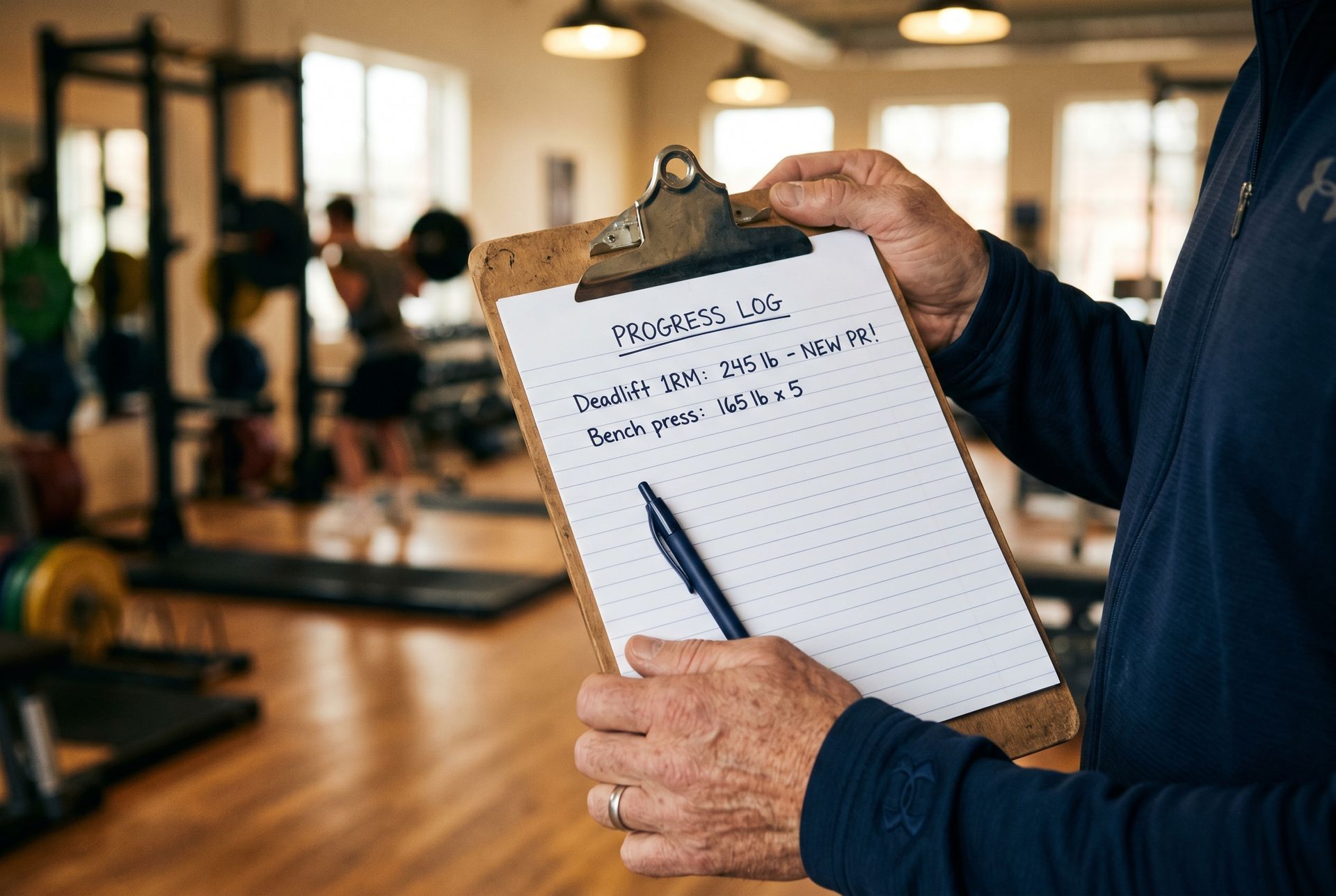
This is the layer most people never keep on their own, and it is quietly the most useful. The app stores your training history: what you did, how much you lifted, how many sessions you actually completed, and how the load has increased over weeks and months.
When the question is whether you are progressing, the clearest answer often lies here. The squat that was challenging at one weight in March is a warm-up by May, and the log shows it in black and white.
Consistency shows up here too, and consistency is the single best predictor of results. Four sessions one week and zero the next tells a different story than three steady sessions every week, even when the totals match. Seeing the pattern lets your coach shape the plan around your real life instead of an idealized one, and lets you watch the effort add up even when any single week feels unremarkable.
The Subjective Signals Numbers Miss
Numbers are powerful, and they are also incomplete. How a session felt, whether a movement was smooth or grindy, whether an old achy spot spoke up, whether you walked out taller than you walked in: none of that shows up on a force plate, and all of it matters.
The most useful way to capture this is a simple effort rating. Coaches borrow a tool called the rating of perceived exertion, a quick scale of how hard a set or session felt, to turn a vague sensation into something trackable.
An honest "that was an easy six out of ten" next to the same weight you ground out at a nine last month is real progress the bare numbers might miss.
This layer is also where safety lives. Pain, unusual fatigue, a movement that suddenly feels wrong: these are signals a good coach takes seriously, and a spreadsheet cannot read. Tracking how training feels keeps the data honest and keeps you, the human, at the center of it rather than the other way around.
From Numbers to Decisions, Not Dashboards
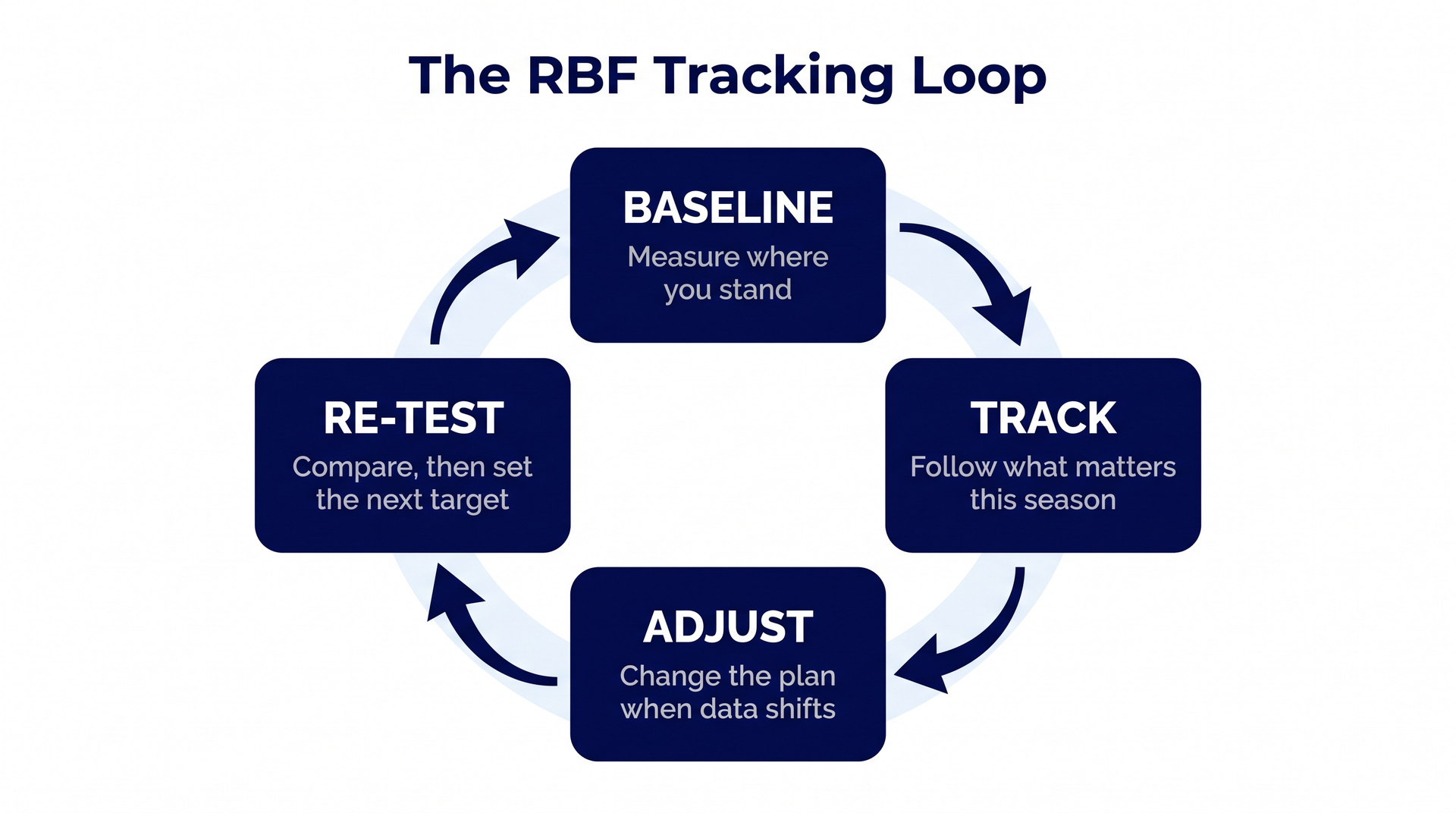
Data is only worth collecting if it changes what you do. The goal is never a prettier dashboard or more charts to admire. It is a short, repeatable loop that turns what you measure into your next, better training decision. We call it the RBF Baseline, Track, Adjust, Re-test loop, and here is how it runs:
- Baseline. Start with a clear, repeatable picture of where you stand today.
- Track. Follow only the metrics that matter this season, and let the rest record quietly in the background.
- Adjust. Change the plan when the numbers and how you feel start disagreeing with the goal.
- Re-test. Lay the new numbers beside the old, then set the next target and begin again.
Start With a Baseline
Everything starts with a clear picture of where you are right now. Your first Strength and Range of Motion Assessment captures that baseline: what you can do, where you move well, where you are limited, and how your two sides compare.
A baseline does two jobs. It points the plan at what actually needs work, so you are not guessing or copying someone else's program, and it becomes the reference every future check measures against.
Without it, "better" is an opinion. With it, "better" is a number you can return to.
None of this is a medical test or a diagnosis. It is a fitness evaluation, a starting map for any functional strength & mobility training.
Track Only the Metrics That Matter This Season
Here is where many data-driven plans go wrong: they measure everything and drown. More numbers do not mean more progress. They usually mean more noise and more anxiety.
So each training block focuses on a small handful of metrics tied to what you are working toward right now. Rebuilding after a layoff might mean watching consistency and range of motion while ignoring maximal strength for a while.
A strength block might track the load on two or three key lifts and little else. The rest of the data keeps recording quietly in the background, available when it becomes relevant, without cluttering your attention or your week.
The art of useful measurement is knowing what to ignore for now.
Adjust the Plan When the Data Shifts
Data earns its keep at the crossroads, the moments when something needs to change and you would otherwise be guessing.
When the numbers and your effort ratings agree that a lift is climbing steadily, that is the green light to progress: a little more weight, a harder variation, another set. When a metric stalls for a few weeks while your perceived effort climbs, that is information too, usually a sign to deload, change the exercise, or look at recovery, sleep, and stress outside the gym.
The plan is not carved in stone on day one and endured for twelve weeks. It is a living thing that responds to what your body is actually reporting, week by week.
That responsiveness is most of what good coaching is.
Re-Test, Then Set the Next Target
Every so often, the snapshot gets retaken. You repeat the key parts of the assessment, measure the same way as before, and lay the new numbers beside the old ones. A practical rhythm is to re-test every couple of months: often enough that the six-week doubt gets an honest answer, not so often that normal week-to-week variation sets off false alarms.
This is the satisfying part, the moment the gradual, invisible work becomes visible. The peak force that reads one number in winter reads a higher one in spring.
The range that was tight has opened up. The gap between your strong and weak sides has narrowed.
Then, with fresh numbers in hand, you set the next target and the loop begins again. Progress stops being a hope and becomes a record you are actively writing, one re-test at a time.
Who This Approach Fits Best
This way of training is not for everyone, and being honest about that is part of the point. It fits a particular kind of person especially well.
It suits adults who are tired of guessing and want proof that their effort is paying off. It suits people in their forties, fifties, and beyond who care less about how they look and more about staying strong, mobile, and capable for the long haul.
It fits anyone returning from an injury or training around an achy joint, where measuring left versus right and tracking range of motion turns a nervous comeback into a managed one. And it fits the quietly competitive, the people who are motivated by watching a number climb.
If you have ever wished someone would just show you, plainly, whether you are getting better, this is built for you.
Data Is Not Always the First Step
It would be easy, in an article about measurement, to imply that everyone needs numbers immediately. That is not true, and pretending otherwise would be a disservice.
If you are dealing with pain that has not been evaluated, a fresh injury, or a medical condition that affects exercise, the first step is a conversation with the right professional, a physician or a physical therapist, not a force test. We are coaches, and our assessment is a fitness evaluation, not a diagnosis or a substitute for medical care.
Some people also simply need to build a movement habit first, and bolting on a tracking system too early just adds pressure to something that should feel approachable. Data serves the training; when data gets in the way of starting, starting comes first.
Keeping Data in Its Place
There is a version of progress tracking that curdles into obsession, and it is worth naming so you can steer around it. When every meal, step, and milligram becomes a number to optimize, training stops being a source of energy and becomes another source of stress. That is the opposite of the goal.
The numbers are a tool, not a verdict on your worth. A plateau is information, not a personal failing.
A bad week is weather, not climate. We hold the data loosely on purpose, checking in often enough to steer and rarely enough to stay sane.
It helps to remember why any of this matters in the first place. The benefits of movement, as the CDC describes them, show up as feeling better, functioning better, and sleeping better long before they show up as a personal record. If the data ever starts crowding out those felt benefits, that is your signal to step back from the spreadsheet and simply train.

What Makes the RBF Approach Different
Plenty of gyms will hand you a workout. Fewer can tell you, with evidence, whether it is working, and fewer still keep the data in service of you rather than the other way around.
The Royal Blue Fitness difference is the combination: real measurement tools, a coaching platform that holds your history, and coaches who read all three layers together and run them through the Baseline, Track, Adjust, Re-test loop to build a plan that fits your joints, your goals, and your week. It is assessment-informed, so the plan targets your actual needs.
It is joint-friendly and strength-first, built for capability that lasts rather than a short-term look. And it is deliberately un-obsessive, designed to hand you clarity and confidence, not one more app to feel guilty about.
The numbers exist to make the coaching better and your decisions easier. That is the whole point.
See Your Starting Numbers
Your functional strength training in Pleasant Hill would start with one simple step: finding out where you stand today.
Not a number on a bathroom scale, but a real picture of your strength, your range of motion, and how your two sides compare, captured in a way you can return to and beat. That is what a Strength and Range of Motion Assessment gives you: a clear baseline and a plan built on it.
No obsession required and no transformation promised, just an honest starting point and a smarter way to train from here. When you are ready to stop guessing and start seeing your progress, come find your starting numbers.
Tracking Progress: Quick Answers
What does Royal Blue Fitness actually measure?
Three layers, read together. First, objective numbers from your assessment: how much force your muscles produce, your range of motion, and how balanced your left and right sides are.
Second, everyday training data in the RBF app: what you lifted, how consistently you trained, and how your load has progressed over time. Third, the subjective signals only you can report, like how hard a session felt and how a movement responded.
No single layer tells the whole story, which is exactly why we use all three rather than leaning on any one of them.
If the scale is not the goal, how do I know I am progressing?
By the things that actually reflect training. Are you lifting more than you were a month ago?
Has your range of motion improved? Are you training more consistently?
Do everyday tasks like stairs, groceries, and getting up off the floor feel easier? Those signals track real strength and function, which the scale simply cannot see.
Progress for a strength-focused plan looks like doing more, moving better, and feeling more capable, not a smaller number at weigh-in.
How often is progress re-tested?
Often enough to steer, not so often that normal week-to-week variation sets off false alarms. For most people, a re-test every couple of months strikes that balance, with the everyday training data filling in the picture between formal checks. The exact rhythm depends on your goals and where you are starting, so your coach sets it with you rather than imposing a fixed schedule on everyone.
Do I need a smartwatch or wearable to track progress?
No. This approach runs on your assessment results, your training log in the RBF app, and a coach who reads them, none of which requires a wearable.
Devices can be a fun extra if you enjoy them, but they are not the system, and plenty of people make excellent progress without one. The meaningful data comes from how you train and test over time, not from a gadget on your wrist.
What happens if my numbers stall?
A plateau is information, not failure. It usually means something needs to change: the exercise, the load, the volume, or recovery factors like sleep and stress outside the gym.
Your coach treats a stall as a prompt to adjust the plan, which is exactly what the data is for. Plateaus are a normal part of every long training journey, and they are far easier to move past when you can actually see them happening instead of guessing in the dark.
Here are our latest articles! Click to read more.