Rotation vs Anti-Rotation: The Missing Piece in Functional Fitness for Back Confidence and Everyday Strength
If you grew up believing core training meant crunches and sit-ups, you are in good company. For decades that was the message, and on the surface it made sense: you feel your abs working, so they must be getting stronger.
There is a more useful way to think about your midsection, though, built around how your trunk actually works during real movement. It comes down to two skills, rotation and anti-rotation, and training the pair tends to do far more for everyday strength and back confidence than another round of crunches ever will.
This guide explains why the two work together, gives you three beginner moves to build them, and keeps safety front and center the whole way.
The old lens treats your core as one bending muscle
The crunch-focused view treats your core as a single muscle whose only job is to bend you forward, over and over. It is true that the abs flex the spine. The problem is that this picture is incomplete.
In daily life, your trunk spends very little time deliberately curling up and a great deal of time doing something else: keeping you steady while your arms and legs move, and controlling how your body twists and turns. A routine built only on crunches trains one small slice of what your midsection really does.
The crunch became the default because it is easy to teach, easy to feel, and easy to count. But ease of measurement is not the same as usefulness. A strong trunk rarely announces itself. More often it shows up as the absence of a problem: you carry the bag and nothing tweaks, you turn to look behind you and it feels like nothing.
The Scale Is the Wrong Scoreboard
If one number derails more training plans than any other, it is body weight.
The scale is not useless, but it is a blunt instrument pointed at the wrong target. As MedlinePlus puts it plainly, your weight cannot tell you the whole story, because the figure it reports lumps together muscle, bone, fat, and water and cannot separate them.
Drink a large glass of water, and you are two pounds heavier in a minute. Add muscle while losing fat over a month, which is exactly what good training does, and the scale may not move at all even as your body changes underneath it.
For someone training for strength and function, weight is close to irrelevant as a measure of progress and actively misleading as a motivator. Watching it bounce day to day invites a discouragement that has nothing to do with how the work is going.
We are not chasing a lighter version of you. We are building a stronger, more capable one, and that goal needs a scoreboard that can actually see strength.
That is where the next three layers come in.
A better lens is a control center that turns and stays steady
At Royal Blue Fitness, we find it far more useful to picture your trunk as a control center than as a single bending muscle. Its real job is to manage force: allow movement where you want it, prevent movement where you do not, and keep the loads traveling through your body under control.
Seen that way, two skills do most of the work, and they are simply descriptions of things you already do all day.
Rotation is controlled turning
Rotation is your trunk's ability to turn smoothly and with control. Think of reaching behind you for a seatbelt, swinging a golf club, or turning to set a bag on the counter. Healthy rotation means your torso can twist through a comfortable range without strain.
People sometimes get nervous about rotating after hearing that twisting is dangerous. The concern is really with sudden, forceful, or heavily loaded twisting at the edge of your range, not the gentle turning you do reaching for a seatbelt. Controlled rotation within a comfortable range is normal, healthy human movement.
Anti-rotation is resisting a twist
Anti-rotation is the equal and opposite skill: staying square when something tries to turn you. Carrying a heavy bag in one hand, holding a railing as you step to the side, or steadying yourself when someone bumps into you all ask your trunk to resist a force pulling it off center.
This quiet, stabilizing strength is what most core training overlooks, and for daily life it is often the more valuable of the two. The National Institute on Aging notes that muscle-strengthening makes everyday tasks easier, such as
getting up from a chair, climbing stairs, and carrying groceries. Those are exactly the moments anti-rotation supports.
Together they are your gas and your brakes
Rotation and anti-rotation are two halves of one system. A trunk that can turn but cannot stay steady is exposed under one-sided loads. A trunk that can brace but cannot turn comfortably tends to feel stiff and guarded.
You can think of rotation as the gas and anti-rotation as the brakes. A capable body has both and knows when to use each. Crunches, by comparison, train neither one, which is why thinking in pairs gives you a fuller picture of trunk strength than counting sit-ups ever could.
You use both all day without noticing
These are not abstract gym concepts. You use rotation and anti-rotation dozens of times a day, usually without a thought, and that is exactly why they are worth training on purpose.
Everyday turning, from seatbelts to dishwashers
You rotate when you reach across your body, turn to talk to someone behind you, load a dishwasher, or swing a tool. Comfortable turning makes those moments feel easy and unremarkable.
When turning is limited or guarded, the same moments feel awkward, and people often respond by twisting from the wrong places or avoiding the movement altogether. Neither helps. Gentle, regular practice of comfortable rotation is how you keep those everyday turns feeling natural.
Staying square under a one-sided load
Anti-rotation shows up every time you carry something on one side, climb stairs, or catch your balance. It is invisible when it works and very noticeable when it is missing.
When anti-rotation is strong, you simply carry the bag and stay upright. When it is weak, the same load makes you lean, shuffle, or brace in a way that feels effortful and a little precarious. Building it is one of the most direct ways to make heavy, one-sided daily tasks feel manageable again.
One-sided loads fill an ordinary day
Much of daily life is lopsided. You carry a bag in one hand, hold a child on one hip, reach with one arm, and step one foot at a time. Each is a small anti-rotation challenge, a moment where your trunk has to keep you balanced against an uneven load.
Once you start noticing these one-sided moments, you see them everywhere, which is the simplest argument for training anti-rotation on purpose rather than hoping it takes care of itself.
Carrying a suitcase up a flight of stairs shows the pair working together. Anti-rotation keeps you square so the bag does not pull you sideways on each step, and rotation lets you turn smoothly at the landing without your lower back doing all the work. Train both, and the whole task feels lighter.
A quick self-check points your training
You do not need a formal assessment to get a rough sense of where you stand, just a little honest attention to how movement feels.
- If turning to reach or look behind you feels stiff or uneasy, your rotation may be worth gentle attention.
- If carrying something on one side or steadying yourself feels shaky, your anti-rotation may need work.
Most people find one skill clearly less comfortable than the other, and that imbalance is a fine place to begin. This is direction for your training, not a diagnosis. If anything feels painful rather than merely challenging, that is a reason to check in with a professional, not to push harder.
Three beginner moves build trunk control safely
Here is the encouraging part: building rotation and anti-rotation does not require anything intense or risky. The three moves below cover both skills and start gently. A light resistance band and a single weight are all you need.
| Move | What it trains | How to start |
|---|---|---|
| Controlled band rotation | Comfortable, controlled turning (rotation) | Anchor a light band at chest height. Stand side on, hold it at your chest with both hands, and turn slowly away from the anchor through a comfortable range, then return with control. Keep the range modest and your breathing easy. |
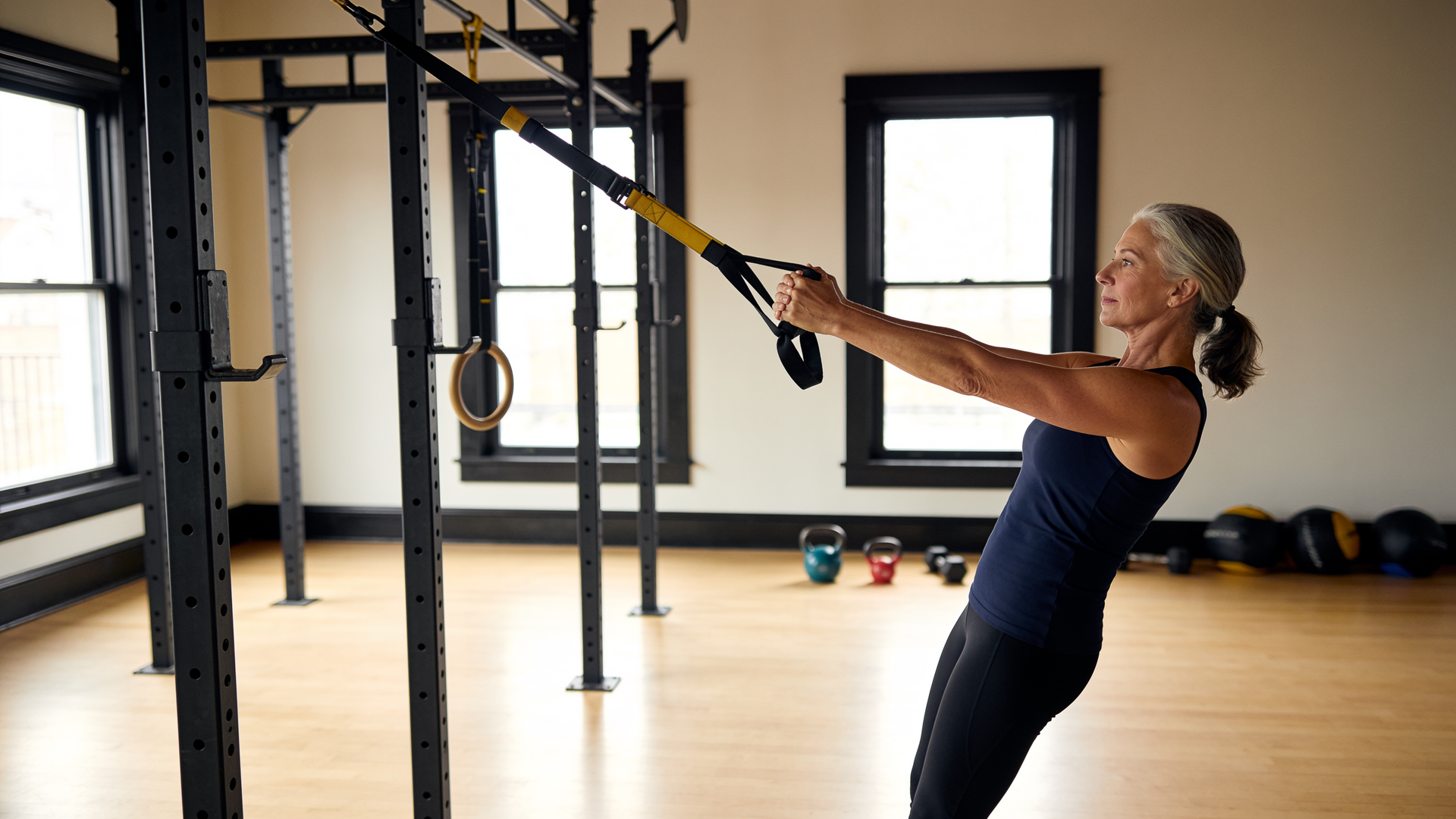
| Pallof press hold | Resisting a twist (anti-rotation) | Keep the same band at chest height. Standing side on, press both hands straight out in front of your chest. The band pulls you toward the anchor, and your job is to stay square and not let it turn you. Hold for a few easy breaths, return, and repeat. |
| Suitcase carry | Staying tall under a one-sided load (anti-rotation) | Hold one moderate weight in one hand. Stand tall, brace gently, and walk a short distance without leaning toward or away from the weight. Switch hands and repeat. Stop before your form tips. |
Notice that two of the three train anti-rotation. That is on purpose, because staying square under a one-sided load is the skill most people are missing and the one that carries over most directly to real life.

A simple way to begin: do all three twice a week on two non-consecutive days, so your trunk gets a recovery day in between. Start with one set of each and build toward two or three as the movement stays clean. For the band rotation, aim for eight to twelve slow reps to each side; for the Pallof press hold and the suitcase carry, work up to two or three holds of three to five easy breaths, or about ten to twenty steady steps per side for the carry. The National Institute on Aging suggests that one set of eight to twelve repetitions is effective, with two or three sets doing more, performed only to the point where one more clean rep would be hard.
Progress in one order: range first, then time, then load. The simple rule we use with clients is to add a little only when your last set looks as steady as your first and you still have one clean rep in reserve. Across a first month that often means weeks one and two grooving each pattern light or unweighted, then weeks three and four nudging up either the range or the weight, never both in the same week.
Start with control, not intensity
Begin with slow, deliberate reps and modest range. The aim is quality of control, not how hard or fast you can move. A good sign you are at the right level is that the movement looks steady from the first rep to the last.
Keep breathing through every rep and hold. If you catch yourself holding your breath just to finish, that is a sign to ease back rather than push on.
Progress in small steps. The National Institute on Aging points out that
gradual increases in weight, sets, or repetitions are what build stronger muscles, and that overdoing it can leave you sore or strained. If you are new to this, start without added weight until the movement feels easy, then add a little at a time.
A sensitive back calls for care, not avoidance
If you have a history of back pain or your back feels sensitive, this is the moment for extra care, not avoidance. Movement is generally good for backs, and many people grow more confident with gentle, controlled trunk work over time.
Everyone is different, though, and an article cannot tell you what is right for your body. The American Physical Therapy Association's guide notes that physical therapists help people with low back pain
restore movement, reduce pain, and learn safe lifting and loading. If you have ongoing pain, a recent injury, or any concern, talk with a qualified professional before starting, and stop any movement that causes pain rather than working through it.
Royal Blue Fitness starts with an assessment, not a routine
At Royal Blue Fitness, trunk training starts with where you are, not a fixed routine. Every client begins with a Strength and Range of Motion Assessment, so coaching is built around how you actually rotate, how steadily you resist a twist, and how your back feels through everyday patterns.

One client came to us after he threw his back out swinging an axe while working in his garden. It was a textbook real-life moment: a loaded twist, bent forward, under a one-sided load. At his assessment, bending forward was limited and uncomfortable, and his strength scores sat around the 18th percentile for his age and gender, with clear weakness down the legs.
We did not rush him. Over about six months of patient, progressive coaching, his strength climbed to roughly the 58th percentile, and he was back to working in his own backyard. Full confidence took longer, closer to another year before the on and off flare-ups settled for good, and we stayed with him the whole way.
We share that for honesty, not as a promise. Recovery timelines vary from person to person, and training is not a treatment for back pain or any medical condition. What stays constant is the approach: control first, respect for your history, and progress that meets your back where it is. The American College of Sports Medicine notes that resistance training improves
physical function such as balance and stair climbing, the very abilities that make daily life feel easier.
Common questions about core and back confidence
Are crunches bad for my back?
Not necessarily, but they are a narrow slice of core training and not the most useful one for most people. Rather than repeatedly bending your spine, you will usually get more everyday benefit from training your trunk to stay stable and to control rotation. If crunches bother your back specifically, that is a good reason to set them aside.
What is an anti-rotation exercise?
They are movements where your trunk resists a turning force instead of creating one. The everyday version is carrying a weight on one side while staying tall and square. In training, a Pallof press hold or a suitcase carry builds that quiet stability. The defining feature is that you are working to keep your torso still, not to move it. A useful test of a true anti-rotation move is simple: if you are working to stay still rather than trying to move, you are training the right thing.
Can core training help with back confidence?
Many people find that building trunk control helps them feel steadier and more confident in daily movement. That said, training is not a treatment for back pain or any medical condition, and results vary from person to person. If you are dealing with ongoing pain, work with a qualified professional to find what is right for you.
Should I avoid rotation if my back feels sensitive?
Not automatically. Gentle, controlled rotation through a comfortable range is a normal part of healthy movement, and avoiding it entirely can sometimes make a back feel more guarded. The keyword is gentle: start small and controlled, avoid forceful twisting, and if rotation causes pain, stop and check in with a professional.
How is this different from regular ab workouts?
Regular ab workouts usually focus on flexing the spine, like crunches. A rotation and anti-rotation approach focuses on how your trunk controls and resists movement, which is much closer to how you use your midsection in daily life. The goal shifts from how many reps you can do to how well your trunk supports you while the rest of you moves.
How long before I notice a difference?
It varies from person to person, so treat any timeline as a rough guide, not a promise. Many people feel a little steadier within a few weeks of consistent, gentle practice, while bigger gains in everyday confidence build over months. Progress is rarely a straight line, and that is normal. If pain is part of the picture, work with a qualified professional.
Build real trunk confidence
The crunch was never the whole story. Your midsection is a control center that decides how much you turn and how steady you stay, and training both abilities, rotation and anti-rotation, does far more for everyday strength and back confidence than endless sit-ups.
Start gently, put control ahead of intensity, and respect any history your back carries. If you would like a starting point built around how your own body moves, a
Strength and Range of Motion Assessment looks at your trunk control and movement so any training is matched to you rather than to a generic routine.
Here are our latest articles! Click to read more.