Summer Exercise and High Blood Pressure: A Decision Framework for Safer Training
Summer is supposed to make training easier. Longer days, warmer mornings, the beach and the trail right there waiting. But if you are managing high blood pressure, summer can quietly turn a steady habit into a daily guessing game. Is it too hot to train today? Is your usual intensity still smart when the heat is pushing your heart harder? Most advice stops at "be careful," which is true and almost useless when you are standing in your kitchen at 7 a.m. trying to decide what to do.
Here is the stance we coach: in almost every summer, the right answer is not to stop training and it is not to push through on willpower. It is to decide on purpose. This is a coaching framework, not medical advice, and it is meant to sit alongside the care you get from your provider, not replace it. What it gives you is a simple, repeatable model you can run before any summer session, so you stop guessing based on discomfort or motivation and start choosing based on clear criteria. The model is four quick checks, run in order: environment, intensity, recovery, and your stop signals, and together they point you to one of three calls, train as planned, adjust, or skip today. The whole piece is really about weighing risk against reward, one morning at a time.
Heat and blood pressure: why summer raises the training stakes
When you exercise, your heart works harder, and your blood vessels dilate to deliver more blood to your muscles and skin. Add heat, and your body asks even more of that same system: it has to cool you down while also fueling the work. Blood is routed to the skin to shed heat, your heart rate climbs to keep up, and you lose fluid through sweat, which thins your margin for error.
For most people, this is just a hard workout. When you already manage high blood pressure, the math is different. The National Heart, Lung, and Blood Institute describes high blood pressure as a condition in which the force of blood against your artery walls stays too high over time, so the cardiovascular system works against greater resistance day to day. Stack a hot environment and hard effort on top of that baseline, and the demand can add up faster than it would for someone with normal pressure.
That is also why heat illness is a real consideration, not a footnote. The CDC's guidance for athletes in the heat notes that people who exercise on hot days are more likely to become dehydrated and develop heat-related illness, and it advises starting slow, picking up the pace gradually, scheduling sessions for the cooler parts of the day, and stopping all activity if you feel faint or weak. None of this means you cannot train in summer. It means the decision deserves a real method instead of a gut feeling.
The coaching lane and the medical lane
Before the framework, one honest boundary. There is a coaching lane and a medical lane, and knowing which one you are in keeps you safe.
The coaching lane is everything in this article: how to read the conditions, how to scale intensity, how to adjust strength and cardio, and when to call it a day. A good framework helps you make smart training choices most of the time.
The medical lane belongs to your provider: your specific blood pressure numbers, your medications and how they interact with heat and exercise, whether a symptom is normal effort or a warning sign, and any clearance to start or change a program. This framework never answers those questions, and any time a session pushes you toward one of them, that is your signal to stop training and check in with your provider. Treat that as the rule, not the exception.
The four-check summer adjustment framework
Here is the model. Before any summer session, you run four checks in order. Each one has a clear thing to look for and a clear action. The point is not to pass or fail; it is to decide: train as planned, adjust, or skip today and move the session.
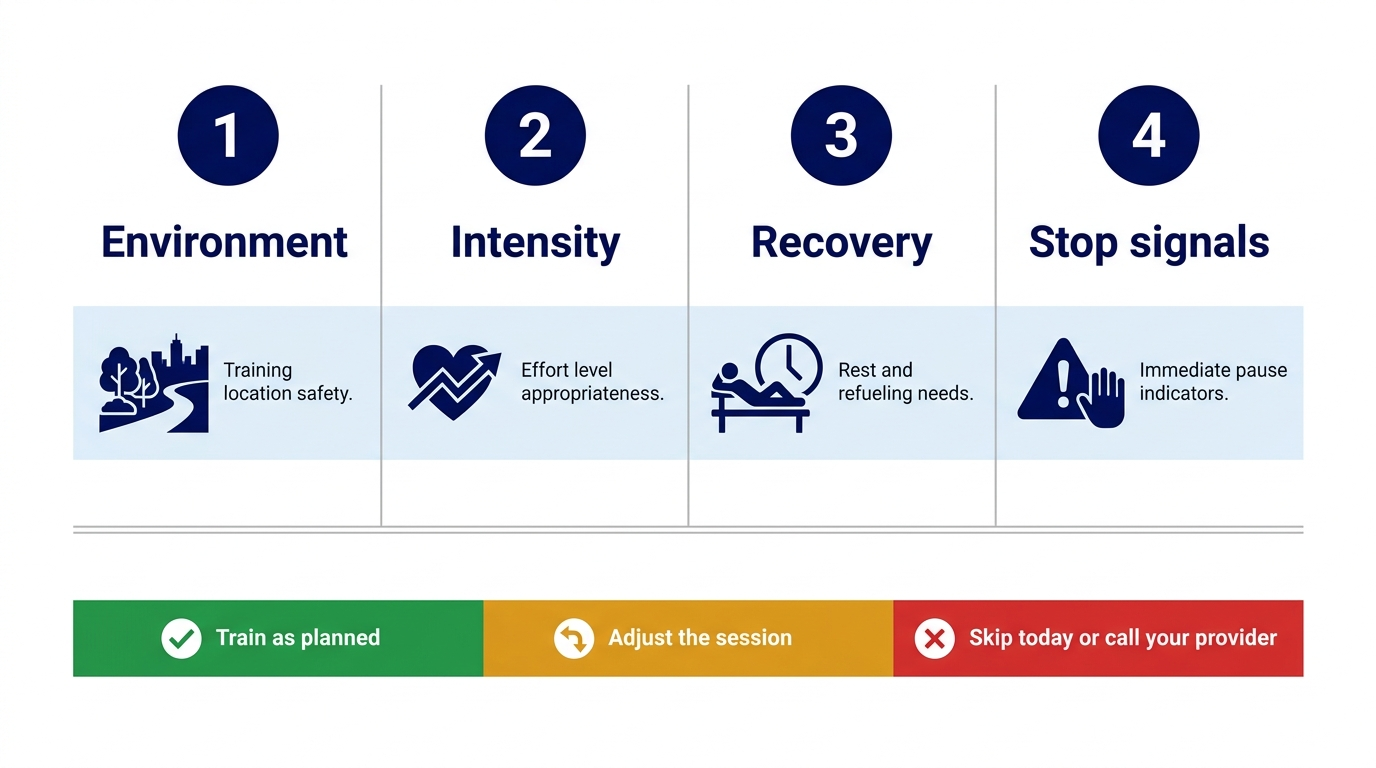
| Check | The question | What are you looking for |
|---|---|---|
| 1. Environment | Is it manageable right now? | Heat, humidity, time of day, shade, and water access |
| 2. Intensity | Is the plan low enough? | Effort you could hold a conversation through, not max effort |
| 3. Recovery | Are you ready to absorb it? | Sleep, hydration, prior training load, recent medication changes |
| 4. Stop signals | Do you know your exits? | The specific symptoms that end a session today |
Check 1: is the environment manageable?
Start with the conditions, because they set the ceiling for everything else. Heat and humidity together are what matter, not the temperature alone, since high humidity blocks the sweat evaporation your body relies on to cool itself. The National Weather Service heat safety guidance explains how the heat index combines temperature and humidity into a single "feels like" number, and that as it climbs, the risk of heat-related strain rises with it.
In practice: train in the cooler bookends of the day, early morning or evening, not midday. Pick shade over open sun. Have water on hand before you start, not as an afterthought. If the conditions are genuinely extreme, that is not a day to tough it out outdoors. Move the session indoors or shift it to tomorrow. The environment check can end the decision right here, and that is a feature, not a failure.
Check 2: is the planned intensity low enough?
Heat already raises your heart rate at any given effort, so summer is not the season for personal records or grinding, maximal work. The safer default is moderate effort: a pace or load you could sustain while holding a short conversation. Mayo Clinic's guidance on exercise and high blood pressure points out that regular, moderate activity strengthens the heart and can help bring blood pressure down over time, and that the smart approach is to start slow and build gradually rather than push hard, which matters even more when heat is already in the mix.
If your plan called for hard intervals or a heavy lifting day and the conditions are warm, that is the moment to dial intensity back a notch rather than push through. Lower the effort, and you keep training while staying well under the line.
Check 3: are you ready to absorb it?
Two identical workouts can land completely differently depending on what you brought to them. Short sleep, a skipped breakfast, yesterday's hard session still in your legs, or a recent change to your medication all change how today will feel. Recovery is the check people skip most, because it is invisible until it is not.
A quick, honest scan works: Did you sleep? Are you hydrated already before the session? Is this the third hard day in a row? Has anything about your medication changed recently? If several answers point the wrong way, treat today as an easy day regardless of what the plan said.
Check 4: do you know your stop signals?
The last check happens before you start, not during. Decide in advance exactly what ends a session, so you are not negotiating with yourself mid-workout when your judgment is already taxed by heat and effort.
Stop the session and contact your provider if you feel chest tightness or pressure, unusual or severe shortness of breath, dizziness or lightheadedness, a pounding or irregular heartbeat, a sudden headache, or any vision changes. These are not "push through it" sensations. In the moment, the right move is always to stop, cool down, and call your provider rather than wait and see.
The four checks in a decision table
Run the checks, then read your result. The framework resolves to one of three outcomes.
| If your checks look like this | Your decision |
|---|---|
| Conditions manageable, intensity moderate, recovery solid, stop signals clear | Train as planned |
| One or two checks are borderline | Adjust: lower intensity, shorten the session, move indoors, or change the time |
| Conditions are extreme, recovery is poor, or any stop signal is already present | Skip today and reschedule, or contact your provider if symptoms are present |
Your one-page summer decision card
Print this and keep it where you decide, the kitchen counter, your gym bag, your phone notes. Run the four checks top to bottom, then read the outcome row.
| Check | What to look for | Looks clear | Borderline or off |
|---|---|---|---|
| 1. Environment | Heat index, humidity, time of day, shade, water access | Cool enough, shade and water ready | Hot or exposed: move indoors or to a cooler hour |
| 2. Intensity | Effort you could hold a conversation through, not max effort | Plan is already moderate | Hard intervals or heavy day: drop a notch |
| 3. Recovery | Sleep, hydration, prior load, recent medication changes | Rested, hydrated, fresh legs | Short sleep or third hard day: make it easy |
| 4. Stop signals | The symptoms that end the session today, decided in advance | None present, exits known | Any warning sign present: stop and call your provider |
| Your call: all clear means train as planned. One or two borderline means adjust (lower intensity, shorten, move indoors, change the time). Conditions extreme, recovery poor, or any stop signal present means skip and reschedule, or contact your provider if symptoms are present. |
|---|
A worked example: how this plays out on a hot Tuesday morning
Say it is 8 a.m. on a Tuesday in July, and your plan calls for a 40-minute run with hard finishing intervals. You run the framework. Check 1: the heat index is already climbing, and there is little shade along your usual route, so the conditions are borderline. Check 2: hard intervals are high intensity, which is not a great match for a borderline-hot day. Check 3: you slept fine, and you are hydrated, so recovery is solid. Check 4: you know your stop signals and feel completely normal right now.
You have two borderline checks, environment and the planned intensity, so the framework points to "adjust" rather than "train as planned" or "skip." A reasonable adjustment: keep the session, but drop the hard intervals, run the first 25 minutes at an easy conversational pace on the shadiest part of your route, carry water, and finish before the heat peaks. You trained, stayed well inside the line, and made the call based on criteria rather than on how motivated you felt. That is the whole point of the model.
Applying the framework to strength training
Strength work is one of the most valuable things you can do, and it does not have to disappear in summer. As Cleveland Clinic notes in its guidance on exercises that help lower blood pressure, cardio and strength training together strengthen your heart so it can pump more blood with less effort, which supports better blood pressure over time. It just changes shape in the heat. The framework still runs first, and then a few specific adjustments keep the session in the safe zone.
Manage the breathing. Avoid breath-holding during effort, sometimes called the Valsalva maneuver, because it causes sharp, temporary pressure spikes. The American Heart Association's guidance on getting active with high blood pressure specifically warns that holding your breath can raise blood pressure and recommends breathing regularly throughout your warmup, workout, and cooldown. The simple fix is to exhale on the hard part of every rep and never hold your breath under load.
Trade load for control. Lighter weights for slightly higher reps, performed smoothly, let you keep training without the maximal straining that pushes pressure up. Leave a couple of reps in reserve rather than grinding to failure.
Rest longer and stay cool. Heat plus short rest periods stacks cardiovascular demand quickly. Lengthen your rest between sets so your heart rate settles, and train in the coolest space available. If your only option is a hot garage gym at noon, that is an environment-check problem, and moving the session is the right answer.
Favor supported and seated variations on hard days. When recovery is thin or the heat is high, supported and seated movements let you keep the training stimulus while reducing the balance and total-body demand that compound strain.
Applying the framework to outdoor cardio
Outdoor cardio is where heat hits hardest, because you are exposed for the whole session, and there is nowhere to hide from the conditions. The framework's environment check carries the most weight here.
Use the heat index, not the thermometer, to make the call, and lean on the cooler parts of the day. Choose shaded routes and loops that keep you near water and home, rather than a long out-and-back that leaves you stranded far away if you need to stop. Let effort, not pace, lead the session: in the heat, your usual pace will feel harder, so slow down and hold a conversational effort instead of chasing a number on your watch.
Build in walk breaks without treating them as failure, hydrate before you feel thirsty, and shorten the session when conditions are marginal. A cooler, shorter, well-hydrated cardio session beats a heroic one that ends with you overheated and dizzy a mile from your door.
Inside an RBF session: what we monitor and what stops training
A good coach runs a version of this framework for you, in real time, so you are not carrying the whole decision alone.
In a session, we watch the controllable training variables, including effort level, rest length, total volume, the room temperature and airflow, and how you are responding set to set rather than just what the plan said on paper. We adjust live: if the day is hot or your recovery looks thin, the session gets lighter, shorter, or cooler before it becomes a problem.
We also follow the same stop rules you do, and we do so firmly. If chest tightness, unusual breathlessness, dizziness, an irregular heartbeat, or any of the warning signs show up, the session stops, and the next step is with your provider, not a modified set. That is not us being cautious for show. It is the honest line between coaching and medical care, and respecting it is part of training with a condition rather than around it. If you want the day-to-day heat habits that sit underneath this decision, our companion article on heat-safe exercise with high blood pressure walks through hydration, timing, and clothing in more detail.
Where this framework ends
It is worth being clear about what this model is not, because honesty here is part of keeping you safe.
It is not medical clearance. It cannot tell you whether you personally are ready to exercise, what your blood pressure targets are, or how your specific medications change your response to heat and effort. It is not a substitute for taking your medication as prescribed or for keeping your provider appointments. And it is not a fixed set of rules that overrides how you actually feel on a given day. Your symptoms always outrank the plan.
What it is: a repeatable way to make a smart training decision on most summer days, so you can keep moving without guessing and without quietly raising your risk. From our coaching perspective, there is almost always a viable solution that keeps safety first, no single answer is the only one, and used alongside your medical care, that is genuinely powerful.
Ready to build a summer plan that works with your health?
The framework helps you make the daily call. But if one check is where you keep getting stuck, whether intensity is your sticking point and you are never sure how hard is too hard in the heat, or recovery is the one you keep guessing at, that is exactly where knowing your real starting point changes things. A plan built around your actual capacity beats one built on assumptions every time.
At Royal Blue Fitness, that starts with a
Strength and Range of Motion Assessment. We map your current strength, mobility, and balance, so whichever check trips you up, the assessment sets the starting point that resolves it: it shows the intensity that is genuinely moderate for you, and the recovery and load your body can absorb right now, then builds a summer plan around it that respects your conditions, works with your medical care, and fits the life you actually want to live. You bring the goals and the honest picture of your health. We bring the structure, the adjustments, and a coach who runs the framework with you so you are never guessing alone.
Frequently Asked Questions
Does exercising in summer heat raise blood pressure more than usual?
Heat and exertion together ask more of your cardiovascular system than either does alone, because your body is cooling you and fueling the work at the same time. Blood gets routed to your skin to release heat while your heart rate climbs to power the movement, and the fluid you lose through sweat narrows your margin. For someone managing high blood pressure, that combined demand is exactly why the environment and intensity checks come first. It does not mean you cannot train in summer. It means you train with the conditions in mind and scale the effort to match the day rather than the calendar.
Should I stop all summer exercise because of my blood pressure?
For most people, no. The goal is adjustment, not elimination. Staying active is valuable for your overall health, and the four-check framework is designed to help you keep training on days it makes sense and scale back or skip on days it does not. In practice, "adjustment" might mean an early-morning shaded walk instead of a midday run, lighter weights with longer rest instead of a heavy session, or simply moving the workout indoors. Your provider is the right person to confirm what is appropriate for you specifically, especially when you are starting out or changing your routine.
What symptoms mean I should stop exercising immediately?
Stop the session and contact your provider if you experience chest tightness or pressure, unusual or severe shortness of breath, dizziness or lightheadedness, a pounding or irregular heartbeat, a sudden headache, or vision changes. These are warning signs, not an effort you should push through. The right sequence is simple: stop moving, get to a cooler place, hydrate, and reach out to your provider rather than waiting to see if it passes. Deciding on these exits before you start, as Check 4, is what keeps the decision easy in a moment when heat and fatigue make clear thinking harder.
Can regular exercise actually help manage blood pressure over time?
It is more than helpful: for mildly to moderately elevated blood pressure, physical activity is recommended as a first-line part of treatment, not just a nice extra. In its scientific statement Physical Activity as a Critical Component of First-Line Treatment for Elevated Blood Pressure, the American Heart Association notes that for patients with mildly or moderately elevated blood pressure, lifestyle-only approaches are the first line of therapy, and that increasing physical activity has extensive benefits among those changes. The statement points to roughly 90 to 150 minutes a week of moderate-to-vigorous aerobic exercise plus dynamic resistance training (about six exercises, three sets of ten), and reports that aerobic training lowers systolic pressure by about 4 mm Hg on average, with combined aerobic and resistance work also showing a significant effect. A separately readable network meta-analysis of 391 randomised controlled trials, published in the British Journal of Sports Medicine reaches the same direction, finding modest but consistent reductions in systolic pressure from exercise that, among people with high blood pressure, look broadly similar in size to commonly used blood-pressure medications. The pattern that matters is consistent and moderate, most weeks, rather than occasional maximal efforts. Summer does not change that goal; it just changes how you reach it: you keep the consistency by adjusting intensity and timing to the heat. Used this way, exercise is genuine treatment for your blood pressure, though it works alongside your medical care, not as a reason to change your medication on your own.
How does dehydration affect blood pressure during summer workouts?
Sweating in the heat pulls fluid out of you, and going into or through a workout under-hydrated adds stress to a cardiovascular system that is already working hard. That is why hydration is built into the first check, not left as an afterthought. A practical habit: drink before you feel thirsty, since thirst lags behind actual need, and keep water within reach for the whole session rather than rationing it. On hot days, a shorter, well-hydrated workout will always serve you better than a longer one you finish overheated and depleted.
Here are our latest articles! Click to read more.