How Often Should You Strength Train? A Practical Guide for Adults 40 Plus
Here is the short answer: most adults over 40 build strength well by training their major muscle groups two to three times per week, on non-consecutive days. That single sentence covers the large majority of people, and if it is all you take away, you will not go far wrong.
But "how often" is one of those questions where the honest answer is "it depends," and what it depends on, your experience, your goals, your recovery, and your real schedule, is what turns a generic number into a plan that actually fits your life. This guide gives you the direct answer first, then the factors that move it, so you can land on a frequency you will actually keep.
One quick framing before the details: this is practical, guidance-grounded education on frequency, not medical advice, and it assumes nothing about your clearance to exercise. If you have a health condition or any concern about starting, make that a conversation with your medical provider first.
With that said, the question of frequency itself has a refreshingly clear answer for most people.

The direct answer for most adults 40 plus
For most adults over 40, two to three full-body or well-distributed strength sessions per week are the sweet spot. That frequency is enough to build and maintain meaningful strength; it leaves room for recovery between sessions, and it is realistic to sustain alongside a busy life.
The CDC's physical activity guidance recommends muscle-strengthening activity working all the major muscle groups on two or more days per week, and its own sample weekly schedules place two weight-training days alongside walking, which fits adults in their 40s, 50s, and beyond.
Two days is a genuinely effective floor. Three days give you a bit more room to progress and distribute the work. You do not need more than that to get strong, and for many people, trying to do more is what causes them to quit.
It is worth pausing on why two to three works so well, rather than just asserting it. Strength is built when you challenge a muscle and then let it recover and adapt, and that recovery takes time. Training a muscle group two or three times a week, with rest in between, hits a natural rhythm: often enough to keep sending the signal to get stronger, and spaced enough to let the adaptation actually happen.
Pile the sessions too close together, and you interrupt the very recovery that makes them work in the first place.
The right number is not one-size-fits-all
That two-to-three range is the answer for most people, but "most people" is not you specifically, and a few real factors shift where in that range you should land, or occasionally outside it. Understanding them is what lets you personalize the number instead of guessing. Three factors do most of the work: your experience and recovery, your goals, and your schedule.
Experience and recovery
Where you are in your training journey changes how often you should train and how much recovery you need between sessions. A beginner often progresses beautifully with two well-structured full-body sessions a week because the stimulus is new, the body responds quickly, and recovery capacity matters more when every session is challenging.
Recovery is the quiet half of the equation here, since strength is built between sessions, not during them.
UCLA Health advises training two or three times a week on non-consecutive days specifically because your muscles need time to rest in between resistance sessions, which is when they adapt and get stronger.

As you gain experience, you can often handle and benefit from a third day, but more experience does not automatically mean more frequently. A practical way to gauge your own recovery is to notice how you feel as you walk into each session.
If you arrive feeling recovered and ready to work, your frequency is well matched to your recovery. If you consistently feel beaten up and flat before you have even started, that is a sign to add a rest day rather than a training day, regardless of how experienced you are.
Your recovery, not the calendar, sets your real ceiling.
Your goals
What you are training for also nudges the number. If your goal is general strength, health, and staying capable as you age, two to three days a week is plenty and arguably ideal.
If you are specifically chasing greater muscle size or more advanced strength, you may benefit from three or occasionally four sessions, structured so that each muscle group still gets enough recovery, often by splitting the body across days. A
meta-analysis of resistance training in healthy adults averaging about 70 years old found that two sessions a week already produced large strength gains in this age group, and adding a third day did not reliably beat it; training frequency itself was not a significant predictor of how much strength people gained. The practical read is to match your frequency to your goal rather than chase more days: a third session can help you fit in more quality work, but it is the work and the recovery, not the day count, that drive the result.
For the reader who simply wants to feel strong, move well, and protect their independence, the lower end of the range delivers the vast majority of the benefit. This is genuinely good news for the busy reader.
The gap between two days and three is much smaller than the gap between zero days and two, so you capture the lion's share of the benefit simply by showing up consistently twice a week. Higher frequencies are a way to chase the final increments of progress, not a requirement for the strength and everyday capability most people actually want.
Your schedule and life
The most important factor is often the least discussed: the frequency you can actually keep. A perfectly optimized four-day plan you abandon after a month is worse than a two-day plan you hold for years, because consistency over time is what builds and maintains strength. In our coaching experience, the average adult's week is far more compressed than any training plan assumes, which is exactly why an honest look at your real schedule matters more than an ideal on paper.
Pick a frequency that survives a busy week, a tiring stretch, and the ordinary chaos of real life, because that is the one that will still be standing in a year. The
federal Physical Activity Guidelines for Americans set the muscle-strengthening target at all major muscle groups on two or more days per week, a deliberately achievable floor. In practice, the barrier for most people is rarely knowledge; it is fitting the training into real life.
That is exactly why the realistic two-day plan beats the ambitious five-day one: the best frequency on paper means nothing if your week cannot actually hold it. Build for the week you have, not the week you wish you had.
The official guidelines, briefly
It helps to know that the two-to-three range is not a gym myth but the consensus reflected in public health guidance. The national Physical Activity Guidelines recommend that adults do muscle-strengthening activities involving all major muscle groups, the legs, hips, back, chest, core, shoulders, and arms, on two or more days per week, in addition to regular aerobic activity.
Health resources from
the National Institute on Aging echo this, with one of its featured researchers advising adults to get strength training in the mix one to two times per week as part of healthy aging. These are floors framed for general health, and many people choose to train three days for a bit more progress, but the headline is reassuring: the effective dose is far more achievable than the fitness industry often implies.
It is worth letting that sink in if you have ever felt that getting strong requires living at the gym. The official, evidence-based target is to work your major muscle groups two days a week. Everything beyond that is optional refinement for specific goals.
The bar for capturing the core health and strength benefits is set at a height that almost anyone can clear with a little planning and a couple of hours a week.
By goal: a quick guide
Different goals fit different frequencies. Use this as a starting point, then adjust based on your recovery and your week:
| Your goal | Sessions per week | What it looks like |
|---|---|---|
| General health and staying capable | 2 | Two full-body sessions on non-consecutive days |
| Building and maintaining strength | 2 to 3 | Full-body sessions, or a light upper and lower split |
| More muscle or faster progress | 3 to 4 | Body split across days so each area still recovers |
| Returning after a long break | 2 | Two manageable full-body sessions, building gradually |
Notice that no row calls for training every day, and that the highest frequency is reserved for specific, more advanced goals. The same meta-analysis of resistance training in healthy adults averaging about 70 years old found that the biggest strength gains came from doing two to three quality sets per exercise for seven to nine challenging reps, at a moderate-to-hard effort, rather than from any particular number of training days. In other words, once each muscle group gets enough good work, two thorough days and three moderate days can land in a similar place, so you have real room to choose what fits your life.
A sample two-day week
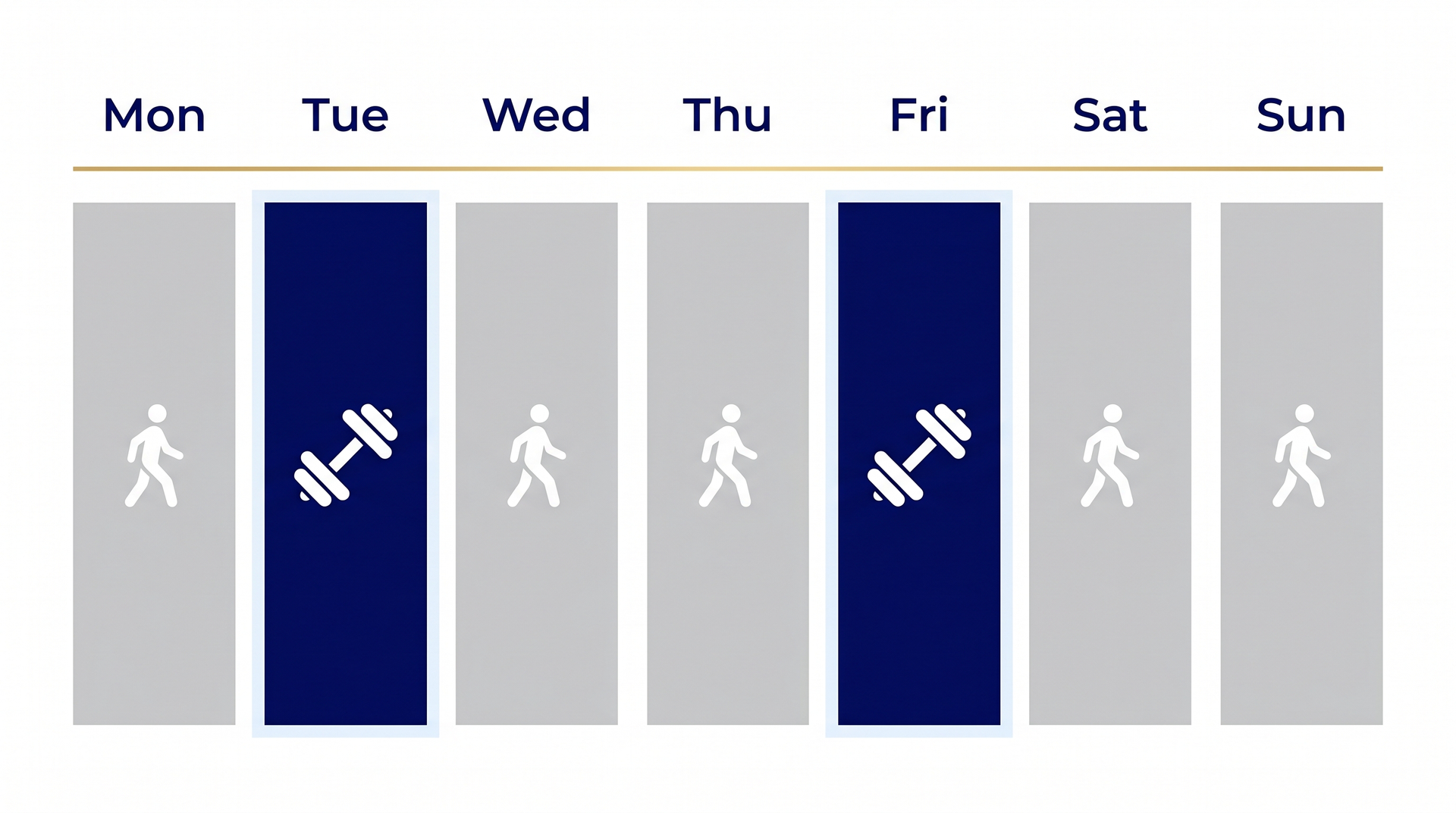
To make the two-day plan concrete, here is one simple way it can sit in a real week, with the strength days kept on non-consecutive days and the rest of the week left light:
| Mon | Tue | Wed | Thu | Fri | Sat | Sun |
|---|---|---|---|---|---|---|
| Strength | Easy walk or rest | Rest | Strength | Rest | Walk or activity you enjoy | Rest |
Two strength days with rest in between, easy movement on the other days, and nothing that needs to happen daily. Shift the days to fit your schedule and, if you are building toward three, add one more strength day with a rest day on either side of it.
Quality over frequency
Here is the point that matters more than the exact number: how often you train matters far less than what you do when you train and whether you keep doing it. Two focused, progressive sessions a week beat five aimless ones that never get harder. The people who get strong are not the ones who train the most days; they are the ones who train with intent and consistency over months and years.
If you are choosing between adding a fourth day and improving your existing sessions, improving the sessions almost always wins. A useful test, when you are tempted to add a day, is to ask honestly whether your current sessions are already as good as they could be. Are you challenging yourself on each set?
Are you progressing the work over time? Are you hitting all the major movement patterns? If the answer to any of those is no, a fourth day will mostly add more mediocre training to your week.
Fix the two or three days you already have first, and you may find you never needed the extra one.
Inside a good session
A productive strength session does not have to be long or complicated, but it should include a few things. It works the major muscle groups through compound movements like squatting, hinging, pushing, pulling, and carrying. It challenges you, meaning the last couple of reps of a set are genuinely hard.
And it progresses over time, gradually getting a little more demanding as you get stronger, which is the principle that actually drives results.
UCLA Health describes resistance training as making your muscles contract against an external force so they get stronger and gain endurance, which is the simple core of an effective session. Get those elements right twice a week, and you are doing more than most.
Frequently Asked Questions
Are two days a week really enough to get stronger?
Yes. For most adults over 40, two well-structured full-body sessions a week are enough to build and maintain meaningful strength, and national guidelines treat two days as the effective baseline. The keys are that the sessions work all your major muscle groups, challenge you, and progress over time. Two focused, consistent days will take you remarkably far, and they are far easier to sustain than a more ambitious plan you cannot keep.
Can I strength train every day?
You can train most days if you structure it so the same muscles aren't worked hard back-to-back, usually by splitting your body across different days. But for most people over 40, training every day is unnecessary and can shortchange recovery, which is when your body actually gets stronger. Two to three quality days with rest in between deliver the vast majority of the benefit with far less risk of burnout. More days are not better; better days are better.
How many rest days do I need between strength sessions?
A common and effective approach is to leave at least a day between sessions that work the same muscle groups, since muscles need recovery time to adapt and grow stronger. If you train your whole body two or three times a week, spacing those sessions on non-consecutive days handles this naturally. You can do light activity like walking on the days in between. If you feel persistently run down rather than refreshed, that is a sign you may need more recovery, not more training.
Does training frequency need to change as I age?
Not dramatically for most people. The two-to-three days-a-week recommendation applies well across the adult lifespan, including mature adults. What may change is how much recovery you want between sessions and how you structure the work, and that is highly individual. The bigger shift with age is usually toward valuing consistency and recovery, not toward training less often. If you have specific health considerations, those are worth discussing with your medical provider.
What if I can only train once a week?
One quality session a week is far better than none, and it will help you build or maintain some strength, so if that is what your life allows right now, do it and do it well. That said, a single weekly session makes progress slower because you are providing the strength-building stimulus less often. If you can find a way to add even a short second session, the jump from one day to two is one of the most valuable upgrades you can make. Start where you can, and build from there.
Is more frequent training better for building muscle?
Up to a point and for specific goals, a higher frequency, like three to four days, can help, mainly by letting you do more total quality work across the week with adequate recovery for each muscle group. But beyond what you can recover from, more frequency stops helping and starts costing you through fatigue. For most people, the total amount of good work you do over the week matters more than how many days you spread it across, so two or three productive days remain an excellent choice.
Set a frequency you can actually keep
The honest answer to how often you should strength train is two to three times a week for most adults over 40, adjusted up or down based on your experience, your goals, your recovery, and the week you actually have. But two things the day count can never capture decide whether it works: the quality of each session and your ability to keep showing up. The real question is not how many days, but what those days should hold for your body, and that is what a generic guide cannot tell you. A
Strength and Range of Motion Assessment gives you a clear read on where your strength stands today, so whatever you have chosen, a two-day plan or a three-day one, those sessions are built around you instead of a rule of thumb. If you are deciding how to spend limited training time in or around Pleasant Hill or the East Bay, it is a solid place to start.
Here are our latest articles! Click to read more.