Pregnancy Back Pain Relief Exercises: A Full-Spectrum Plan Before, During, and After Baby
Back pain during pregnancy can feel like it came out of nowhere. One week you are fine, the next week your low back feels tight getting out of the car, your hips ache rolling in bed, or a simple grocery bag suddenly feels heavier than it should.
Here is the good news: most pregnancy back pain is predictable. It follows patterns, and patterns have solutions. The goal is not to push through or quit moving. The goal is to identify what you are dealing with and use the right plan for the right stage, whether you want to prevent it, calm a flare-up, train through it safely, or rebuild after baby.
Why pregnancy changes your back: the simple mechanics behind the pain
Pregnancy changes your stack, meaning how your ribcage sits over your pelvis. As your center of gravity shifts forward, it is common to flare the ribs up, tip the pelvis forward, and ask your low back to do more work all day. That can create a steady ache or a sharp pinching feeling with standing, walking, or getting up from a chair. Mayo Clinic's overview of pregnancy back pain explains these normal body changes and why they often show up as back pain.
Some days also feel worse simply because your baby's position, your fatigue, and your daily load change. If yesterday was fine and today feels cranky, that does not mean you broke something. It usually means your body needs a better plan for today's inputs.
Pregnancy back pain vs pelvic girdle pain
Not all back pain in pregnancy is actually your low back. A lot of people feel pain around the sacroiliac joints (the dimples on the back of your pelvis) or the pubic symphysis (front of pelvis). That category is often referred to as pelvic girdle pain. RCOG's patient guidance on pelvic girdle pain in pregnancy lists common triggers like walking, stairs, standing on one leg (getting dressed or getting into a car), and turning in bed. This distinction matters because the best exercise choices and training modifications depend on what is being irritated.
Red flags: when back pain is not a training problem
Most pregnancy back pain responds well to smart movement, but some symptoms should be handled by your OB or healthcare team first. Use this as a safety filter:
- Vaginal bleeding, fever, or burning with urination
- Rhythmic cramping, contractions, or pain that comes in waves
- New numbness, weakness, or progressive symptoms down the leg
- Severe pain that is not easing with rest or position changes
- Any symptom that feels alarming or different from normal soreness
Johns Hopkins Medicine notes that pregnancy back pain can sometimes signal more serious problems and recommends contacting your healthcare provider if symptoms are severe or last longer than about two weeks.
How to identify your type of pain in 3 minutes
You are not diagnosing yourself here. You are sorting your next best move.
1) Location clues
| Where it hurts | Often points to |
|---|---|
| Center low back (belt line) | Often posture-load and fatigue-driven |
| One-sided back pocket or SI area | Often pelvic girdle irritation |
| Front of pelvis (pubic bone) | Often pelvic girdle irritation |
| Upper back between shoulder blades | Often ribcage position plus prolonged sitting, computer work, or later postpartum feeding posture |
2) Trigger clues
| Trigger | What to work on |
|---|---|
| Standing or walking sets it off | Stacking, glute endurance, breaks, stride control |
| Rolling in bed hurts | Pelvic girdle strategies and log-roll mechanics |
| Hinging or lifting hurts | Hinge pattern, stance, load, and hand support |
| Sitting hurts | Ribcage flare, pelvis position, and bracing habits |
3) What helps clues
| What helps | What it suggests |
|---|---|
| Feels better after gentle movement | Your body wants more motion and better mechanics |
| Feels better with compression during activity | Common with pelvic girdle pain |
| Feels better when you reduce asymmetry | Points toward pelvic girdle sensitivity |
The rules that apply at every stage: train safely without making it worse
These are your guardrails, whether you are preventing pain or rebuilding after it.
Rule 1: Find your neutral enough
You are not chasing perfect posture. You are finding a repeatable position where ribs are not flared up, and your pelvis is not dumped forward. Most people feel immediate relief when they stop hanging on the low back for stability.
Rule 2: Swap intensity for control during flare-ups
If pain is up, use:
- Smaller range of motion
- Slower tempo
- More support (hands elevated, light counterbalance, split stance)
- Lighter loads
You can still train. You just train smarter.
Rule 3: Respect asymmetry
Pregnancy and postpartum life are asymmetry machines: toddler on one hip, laundry basket on one side, car seat twist, one-armed feeding. When pain shows up, reduce extra asymmetry in training and daily movement.
Rule 4: Breathe to manage pressure, not to brace harder
A lot of people respond to discomfort by bracing harder. That often increases pressure, stiffens the ribs, and makes the low back do even more. Think: smooth exhale, ribs soften down, pelvis feels supported.
ACOG's guidance on physical activity during pregnancy and the postpartum period supports staying active for most uncomplicated pregnancies, with modifications as needed for normal pregnancy-related changes.
Before back pain starts: a prep plan that prevents most flare-ups
If you are early in pregnancy or simply not hurting yet, this is high-return work.
Strength anchors (2 to 4 days per week)
- Squat pattern: supported goblet squat, box squat
- Hinge pattern: light Romanian deadlift, hip hinge to wall, supported hinge
- Row pattern: cable row, dumbbell row with one hand supported
- Carry pattern: farmer carry, or suitcase carry, short distances, tall posture
Mobility that actually matters
Skip aggressive stretching. Go for:
- Gentle hip flexor length (short holds, no deep back bend)
- Thoracic mobility (supported rotations)
- Controlled pelvic tilts and ribcage stacking drills
Daily-life setup that pays off later
The NHS guidance on pelvic pain in pregnancy includes practical posture and movement tips to reduce strain, such as bending your knees and keeping the load close when lifting and carrying.
Pregnancy back pain relief exercises for an acute flare-up
If you are in the this is new, and it is loud phase, the goal is simple: calm symptoms, keep you moving, stop the spiral.
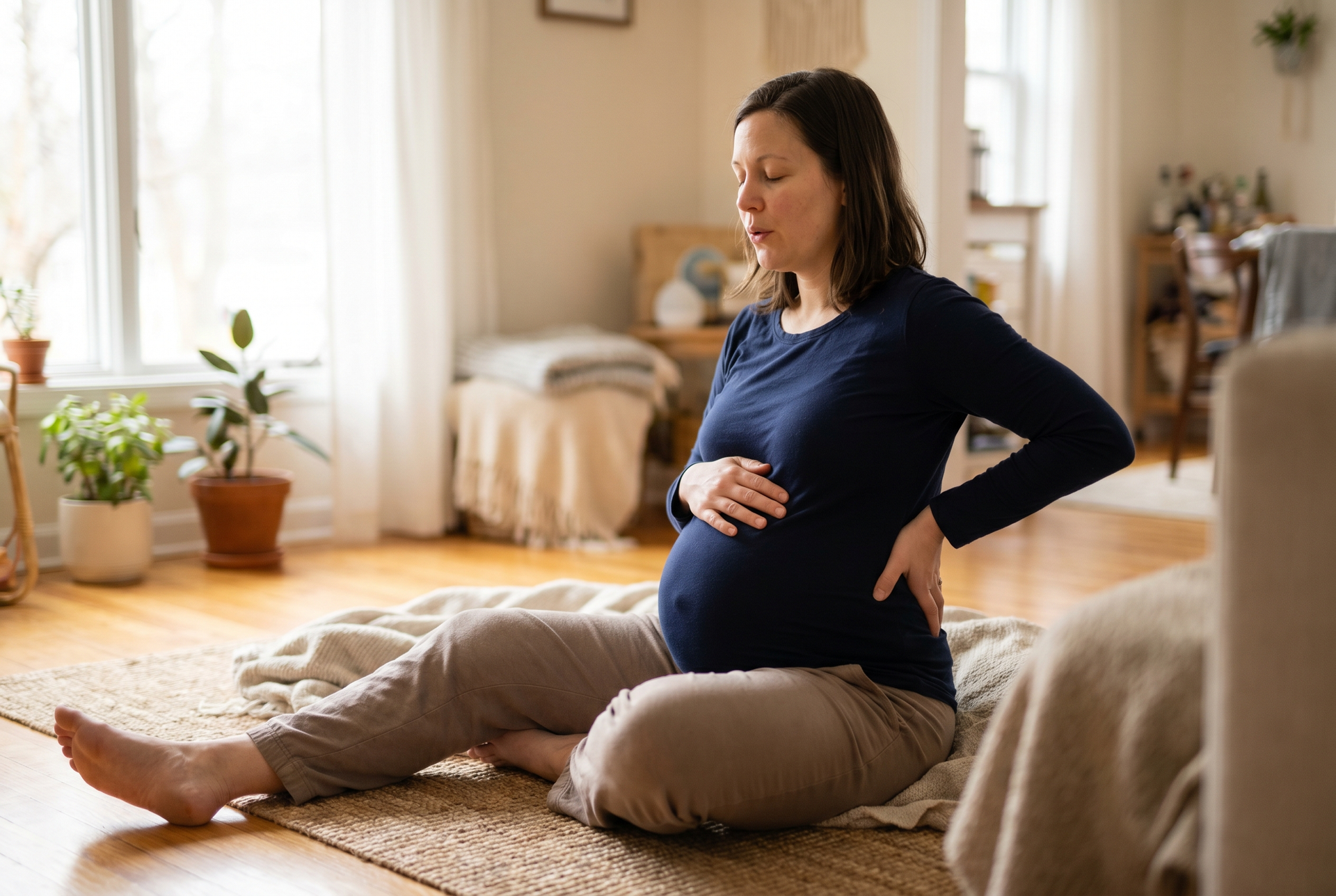
The first 24 to 72 hours
- Reduce the top 1 to 2 provocative movements (often deep hinging, long walks, twisting while carrying)
- Change positions frequently (avoid long sitting or long standing)
- Take short, easy walks if walking feels better afterward
Relief menu: choose 3 to 5 options
Pick what reduces symptoms in the moment.
- Stack reset breathing (30 to 60 seconds): exhale, ribs soften down, pelvis feels supported
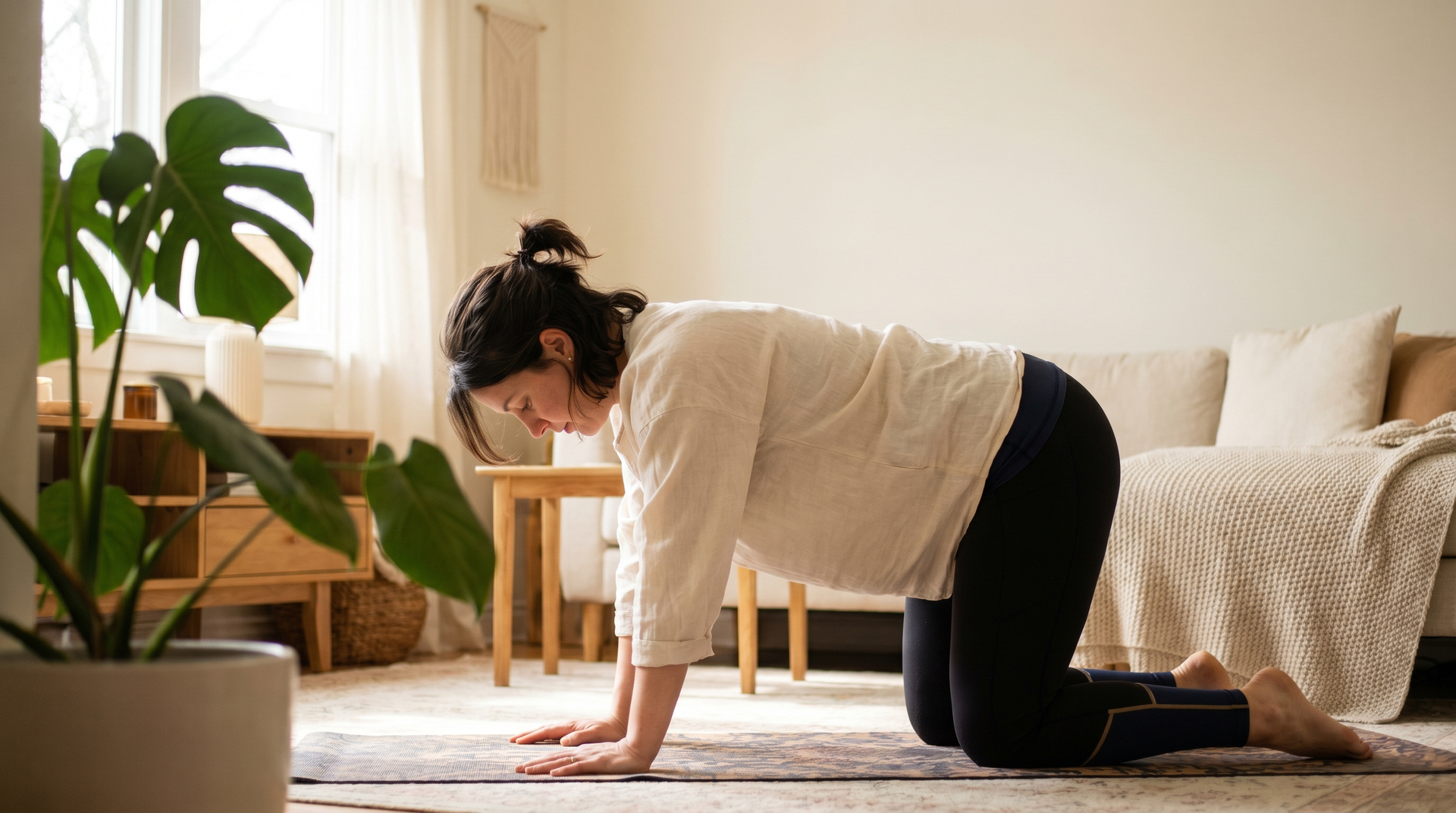
- Supported quadruped rock-backs: small range, slow reps
- Standing hip hinge with hands on a counter: feel glutes, not low back
- Short stride marching: slow, tall posture, light core engagement
- Side-lying top-leg abduction: glute med work without pelvic shear
- Gentle supported thoracic rotation: take pressure off the low back by improving rib movement
This matches the principle behind most major pregnancy back pain guidance: posture, activity, and a small set of practical strategies tend to beat doing nothing for most people.
Training modifications that keep you progressing
If you lift, you do not have to quit. You do have to modify.
- Swap unsupported hinges for supported hinges
- Use box squats instead of deep free squats
- Use split-stance patterns if symmetrical stance feels cranky, or the opposite if split stance triggers pelvic girdle pain
- Keep effort moderate; stop 2 to 4 reps before true fatigue
If it keeps coming back: chronic or recurring pregnancy back pain
Recurring pain usually means your capacity is being exceeded by daily demands. That does not mean your body is failing. It means your plan needs better levers.
Cochrane's evidence summary on treatments for low back and pelvic pain in pregnancy reviews multiple interventions and supports the idea that care should be tailored to your symptoms rather than forcing one universal fix.
A systematic review and meta-analysis in the British Journal of Sports Medicine found that prenatal exercise does not prevent every case of low back or pelvic girdle pain, which is a useful reality check: the aim is to manage and reduce symptoms, not to guarantee you avoid them entirely.
The build-back plan (2 to 4 weeks)
Focus on capacity, not hero workouts.
- Glute strength: hinge, bridge variations, step-ups as tolerated
- Anti-rotation trunk strength: Pallof press variations, suitcase carry
- Upper back endurance: rows, band pull-aparts, supported reverse fly
- Walking dosage: shorter and more frequent beats long and painful
Support belts: when they help, how to use them
Some people feel meaningful relief with a belt during standing or walking; others do not. Use a belt like a tool, not a crutch:
- Trial it during the activity that triggers pain
- If it reduces symptoms and helps you stay active, it can be worth it
- Keep strengthening as the foundation
After baby: postpartum back pain workouts that rebuild your base
Postpartum back pain is often a blend of recovery, sleep posture, repetitive lifting, and time spent in flexed feeding positions.
The CDC's pregnancy and postpartum activity guidance notes that moderate-intensity physical activity is generally safe for healthy pregnant and postpartum women and can support mood and well-being in the first year after delivery. ACOG also encourages a gradual return to activity, tailored to delivery and symptoms.
Why it lingers (the common reasons)
- Feeding posture and prolonged hunching
- Car seat and stroller lifting with awkward angles
- Baby-wearing without trunk endurance
- Deconditioning after months of modified movement
AAOS OrthoInfo's tips for new parents align with what we coach in the gym: bring the baby close, avoid twisting under load, and rethink how you lift and carry the car seat.
Phase 1: restore strength with the simplest patterns (2 to 3 days per week)
- Box squat or sit-to-stand
- Supported hinge (hands elevated, light load)
- Row (band or cable)
- Carry (short, tall, controlled)
- Pressure-control core (breathing plus gentle coordination)
Keep sessions short. Consistency wins here.

Phase 2: progress when your back feels stable again
- Increase load slowly
- Increase range second
- Add complexity last (single-leg, overhead, faster tempo)
When pelvic floor PT or postpartum rehab support is a smart add-on
Consider a specialist if you have pelvic heaviness, leaking that persists as you return to impact or heavier lifting, or pain that does not improve with smart exercise and daily-life changes. University of Michigan Health's Healthy Healing After Delivery Program is one example of multidisciplinary postpartum-specific rehab support.
Sample weekly structure: train through back pain without guessing
Use this as a template, not a rulebook.
Template A: flare-up week
Day 1 (20 to 30 minutes): stack reset breathing, supported hinge, box squat, row, short carry
Day 2: easy walk intervals (5 to 10 minute chunks), relief menu
Day 3 (20 to 30 minutes): glute bridge, Pallof press, row, light step-ups if tolerated
Template B: building week
Day 1: squat pattern plus row plus carry
Day 2: hinge pattern plus upper back plus trunk anti-rotation
Day 3: full-body lighter-but-longer day (moderate effort, clean reps)
Frequently Asked Questions
Should I stop lifting if my back hurts?
Not automatically. If the pain is sharp, escalating, or accompanied by red flags, stop and talk with your provider. Otherwise, most people do best with modifications: less load, more support, a smaller range, and a slower tempo.
What if walking makes it worse?
That is common with pelvic girdle pain. Try shorter walks, shorter strides, more breaks, and supportive footwear. If rolling in bed and one-leg movements also trigger symptoms, pelvic girdle strategies and an individualized assessment can help.
Is yoga enough for pregnancy back pain?
Yoga can help, especially with breathing and gentle mobility. Strength and load tolerance matter too. Most back pain improves fastest when you combine relief drills with progressive strengthening.
When can I exercise postpartum?
It depends on delivery, symptoms, and medical guidance, but a gradual return to activity is commonly encouraged for healthy postpartum women. Start with simple patterns, keep effort moderate, and build week to week.
Pregnancy and postpartum coaching in Pleasant Hill: build a plan that fits your real life
If you want help sorting out what kind of pain you are dealing with and what to do next, this is where coaching matters. At Royal Blue Fitness, you do not get generic pregnancy-safe workouts. You get coached movement patterns, smarter breathing and pressure strategy, and the right modifications so you can keep training and feel more like yourself.
In the assessment, we are mostly watching how you manage pressure: whether the ribs stay stacked over the pelvis as you breathe and load, whether you can exhale into a hinge without bracing the low back, and how much load a pattern tolerates before symptoms climb. Those three readings, which sort your movement rather than diagnose anything, are what tell us which stage-appropriate version of each exercise to start you on.
If you are local to Pleasant Hill, a strong first step is a
Strength and Range of Motion Assessment so we can identify your triggers, your best patterns, and your current limiting factor. From there, we build a stage-appropriate plan: prevention, flare-up management, progression, and postpartum rebuilding.
Here are our latest articles! Click to read more.