Joint-Friendly Summer Training: Heat-Safe Workouts to Stay Strong With Fewer Flare-Ups

Your knee, your hip, your shoulder: whichever joint tends to speak up, it has a way of getting louder in summer. You want to keep training, but every twinge raises the same question: Am I building strength, or am I about to set myself back a week?
So you hover between two bad options: push through and risk a flare-up, or stop and lose the ground you have worked for. You do not have to choose between those two. There is a way to read what your joints are telling you in the heat and choose heat-safe workouts they can handle, so you stay strong with fewer flare-ups.
Why Summer Makes Joints More Reactive
Joints are not just hinges; they are living tissue that responds to how much you move and how well you recover. Movement is part of what keeps them healthy. The Arthritis Foundation explains that activity helps the joint produce synovial fluid, the lubricant that keeps joints agile, and that stronger surrounding muscles take the load off the joint itself. So the goal in summer is never to shut movement down.
At Royal Blue Fitness, that principle shapes the first coaching decision: keep movement in the plan, then adjust the version until the joint can tolerate it today.
What changes in the heat is the margin around that movement. Hot weather thins out your recovery: sleep is shorter, hydration slips, and you are often on your feet and sweating more during the day. A joint that felt fine on a well-rested spring afternoon can feel reactive on a poor-sleep, under-hydrated July morning, even with the same workout on paper. The joint did not suddenly get worse. The conditions around it did. Reading summer this way takes the fear out of it: A noisier joint in the heat can be a recovery and tolerance signal, not automatically a sign that something is damaged.
Reading Your Joints: Irritation, Flare, or Stop
Most of the fear around training with sensitive joints comes from not knowing which signal you are getting. These four are worth learning to tell apart because each one points to a different action, and most of them are not a reason to quit.
Use this table as a coaching decision guide, not a diagnosis tool. It helps you decide whether to continue, adjust, soften the session, or stop and check with a clinician.
| Signal | What it feels like | What to do |
|---|---|---|
| Normal Effort | Working muscles and a mild ache that eases as you warm up and fades within a day | Train as planned; this is the ordinary cost of getting stronger |
| Irritation | A specific joint feels cranky, stiff, or warm during or right after a set | Scale the load, range, or tempo and keep moving in a range that feels controlled |
| Flare | More soreness, stiffness, or mild swelling that lingers but settles with gentler movement | Shorten and soften the session; favor range-of-motion and low-impact work |
| Stop | Sharp or catching pain, the joint giving way or locking, fast swelling, numbness, or heat-illness signs | End the session and check with a clinician before loading that joint again |
Normal Training Discomfort vs Joint Irritation
The first skill is telling honest effort from a joint complaint. Normal training discomfort is spread through the muscle, shows up fairly evenly on both sides, and eases as you warm up. Joint irritation is specific: it points to one spot, often feels stiff or warm, and tends to get worse, not better, as the set goes on.
NIAMS describes the familiar markers of an irritated joint, including pain when you use the joint, stiffness, and swelling, with osteoarthritis stiffness usually easing within about thirty minutes of moving. If a sensation is muscular, general, and fading, keep going. If it is joint-specific, sharp, or building, that is your cue to adjust before you push another rep.
A Flare You Can Work Around
A flare is not an automatic stop sign. It is a louder, longer version of irritation: more soreness or stiffness that lingers into the next day but still calms down with gentle movement. The instinct is to rest completely, which often backfires by further stiffening the joint.
Mayo Clinic notes that even during a flare, it helps to keep the body moving, often by doing only range-of-motion work that day, rather than stopping entirely. A workable flare means you trade your planned session for something smaller and smoother: easy mobility, a short walk, controlled low-load reps. You are still training. You are just meeting the joint where it is today.
We use that as a practical reference point during coaching. A flare changes the purpose of the session. Instead of chasing the planned workout, the priority becomes finding the smallest useful dose of movement the joint can tolerate. If symptoms look sharper, unstable, neurological, or unusual, that leaves the fitness lane and gets routed back to a clinician.
Signals That Mean Stop
Some signals move the session out of adjustment mode and into stop mode. Stop if you feel sharp or catching pain, if the joint gives way or locks, if swelling comes on fast, or if you notice numbness, tingling, or a joint that is hot and visibly swollen.
Layer the heat signals on top of these: dizziness, nausea, a pounding heart that will not settle, or clammy skin in the heat, all end the session too. None of these are toughness tests. If a stop signal shows up, get out of the heat, settle the joint, and check with a clinician before you load it again. If the signal is sharp, unstable, swollen, neurological, or paired with heat-illness symptoms, the safest training decision is to stop instead of trying to salvage the workout. A conservative call is always the right one, especially if you are managing arthritis, a post-rehab joint, or any diagnosed condition.
Strength Is Still the Goal, Not Rest
It is easy to assume that sensitive joints mean less lifting and more rest. The opposite is usually true. The American College of Rheumatology emphasizes that the right kind of exercise is genuinely important for people with arthritis, because strong muscles support and unload the joint, while inactivity lets the surrounding muscles weaken and leaves the joint less protected.
So strength is not what threatens your joints in summer; it is what protects them. The work of safe fitness for joint pain is not to remove the strength; it is to keep the strength while removing the parts of a session that overload a reactive joint on a hot day. Hold onto that, because fear of damage is what pushes people to quit, and quitting is what actually lets the joint get weaker over the season. Your job is to stay strong in a way the joint can tolerate, not to trade strength for rest.
The Mistake of Training Through Every Flare
If under-training is one failure, grinding through every flare is the other. Reading your joints does not mean ignoring them. The people who get hurt in summer are often the most disciplined ones, the ones who treat every signal as something to override.
There is a real difference between adjusting and ignoring. Adjusting means you felt the signal, respected it, and changed a variable to keep training safely. Ignoring means you felt the same signal and added load anyway because the program said so. The first builds a joint that trusts movement. The second teaches the joint that training means pain, and eventually it forces the rest you were trying to avoid. When in doubt in the heat, adjust down. A scaled session still preserves the habit, keeps strength in the plan, and reduces the chance that one reactive workout turns into a longer shutdown.
Choosing Joint-Friendly Strength in the Heat
This section is the heart of the method: not a fixed list of safe exercises, but a way of choosing the version of each movement your joints can perform today. Three dials do most of the work.

Match the Movement to Today's Tolerance
Keep the goal of the exercise; change the shape of it to fit the joint. A movement that bites on a reactive day often feels fine in a slightly different position, range, or setup. Swap the version, not the muscle group:
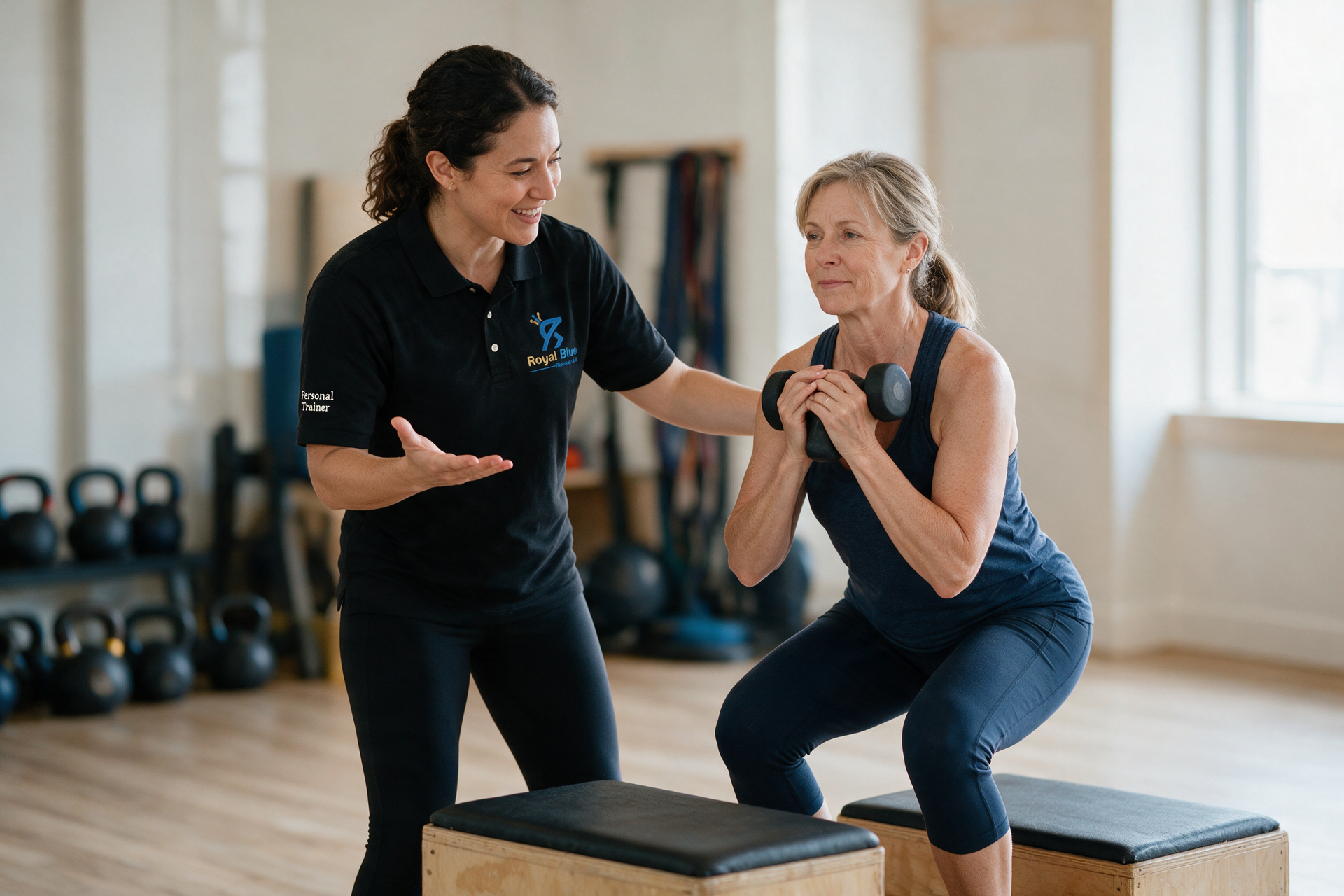
- If a deep squat bites, squat to a comfortable box height or move to a leg press you control.
- If lunges aggravate a knee, hold split squats in a pain-free range or use a steady step-up.
- If overhead pressing pinches a shoulder, press to a lower height or switch to an incline angle.
- If gripping irritates a wrist or elbow, use straps, neutral handles, or a machine variation.
None of these are downgrades. They are the same training goal expressed in a way the joint accepts on a hot, reactive day.
Load, Range, and Tempo Are Your Dials
Before you drop an exercise, turn the dials. Lighter load, a shorter range, and a slower tempo each lower joint stress while keeping the movement intact, and you can adjust one without sacrificing the others.
Harvard Health’s arthritis exercise guidance does not name our three coaching dials directly, but it does support the principles behind them: choose times when stiffness and pain are less likely to be at their worst, use warmth before movement when appropriate, warm up gradually, progress slowly, and stay inside a comfortable range. At Royal Blue Fitness, we translate that into three practical training adjustments during a joint-sensitive summer session: reduce the load, shorten the range, or slow the tempo before removing the movement entirely.
Lower-Impact Options When Joints Are Loud
On the loudest days, change the surface and the impact, not the intent. Lower-impact work can still carry real training value when it keeps the muscles and patterns you care about working while sparing the joint from impact it cannot handle that day. It means you keep training the muscles and patterns you care about while sparing the joint from the pounding.
The Arthritis Foundation points out that
walking and water-based exercise are especially well suited to sensitive joints, and water has a summer bonus: it keeps you cool while it unloads the joint. A cool-water session, a controlled machine circuit, or banded work can carry your strength through a flare week without asking the joint to absorb impact it cannot handle right now.
Building a Joint-Friendly Summer Week
A strong summer plan respects both variables at the same time: the temperature outside and the joint tolerance you have that day. The simplest structure is to anchor your harder strength work in the coolest windows and let the reactive days be lighter, not skipped.
Borrow the heat-safety basics that outdoor-work guidance has settled on. OSHA frames heat protection around water, rest, and shade, plus gradually building tolerance to the heat over a week or so. Translated to training: hydrate before you are thirsty, build in real rest between hard sessions, train in cooler or shaded conditions, and ease back into intensity after a hot stretch instead of jumping straight back to your spring numbers. A practical week might place two strength sessions in cool morning windows, one or two low-impact or mobility days for reactive joints, and at least one full recovery day, with the loads adjusted by how the joints are reading that morning rather than by the calendar.
OSHA’s guidance is written for occupational heat exposure, not personal training programs, so we do not treat it as a workout prescription. We use the same core safety logic: water, rest, shade, cooling, and gradual heat tolerance to shape conservative summer training decisions. For a joint-sensitive client, that can mean shorter work blocks, longer rest, cooler training windows, indoor substitutions, or backing off intensity after several hot days in a row.
A Flare-Response Plan You Set in Advance
Decide what a flare means before you are standing in one. When a joint flares mid-summer, your judgment is the first thing to go, so the plan should already exist.
Keep it simple and write it down. Mild irritation means scaling the load, range, or tempo and finishing a shorter session. A workable flare means trading the planned work for mobility, low-impact movement, or a short walk, and protecting your sleep and hydration that day. A stop signal, the sharp pain, the giving way, the fast swelling, or any heat-illness sign means to end the session, cool down, and contact a clinician before training that joint again. Having those three responses ready turns a scary moment into a calm decision you've already made. That is the difference between a flare that costs you an afternoon and one that costs you the month.
The Royal Blue Fitness Approach for Joint-Sensitive Clients
Most joint-sensitive setbacks in summer are not bad luck; they are a plan that never accounted for the joint or the heat in the first place. That is the gap we work in. Coaching for joint-sensitive clients starts by understanding how your specific joints behave under load, where your tolerance sits today, and which movements you can own without flaring, and then building a summer plan around that reality rather than a generic template.
It is collaborative and conservative by design. We make workout adjustments for summer as the season and your joints change; we keep strength in the plan rather than retreating to endless rest, and we route anything that looks medical back to your provider rather than guessing. The aim is simple: keep you training, keep you strong, and keep the flares rare enough that summer stops feeling like a risk.
Adjust Before the Shutdown: Start With an Assessment
You do not have to spend another summer bracing for the next flare. You can read your joints, choose the version of training they tolerate, and build a week that respects both the heat and the joints. The fastest way to make that personal is to know where you actually stand. A Strength and Range of Motion Assessment maps your strength, your range, and your current tolerance, so we can build a joint-smart summer plan with heat-safe workouts instead of guessing. If recurring setbacks keep stealing your momentum, that is the place to start before focusing on your strength training in Pleasant Hill, before the next flare forces the decision for you.
Joint-Friendly Summer Training: Quick Answers
What time of day is best for joint-friendly summer workouts?
Usually, the cooler windows are used early morning or later evening, or indoors in air conditioning during high heat. Cooler conditions mean less heat stress on your recovery and joints that tend to feel looser once you have warmed up. The best time is the one that lets you train and still recover well, so if mornings leave you stiff, a cooled indoor session later in the day can work just as well. What matters is avoiding the hottest part of the day for your harder efforts.
Should I stop training if my joints flare in the heat?
Not always. Mild irritation usually calls for scaling the load, range, or tempo and continuing in a comfortable range. A workable flare calls for a shorter, gentler session built around mobility and low-impact movement. You should stop and check with a clinician if you have sharp or catching pain, a joint that gives way or locks, fast swelling, numbness, or any signs of heat illness. The goal is to adjust intelligently far more often than you fully stop.
Are low-impact workouts always better in summer?
Not automatically. Low-impact options like water work, walking, and controlled machine training are excellent for sparing reactive joints, but a long or fast low-impact session in extreme heat can still overload your recovery. The smarter approach is to match both the impact and the heat to the day: lower the impact when the joint is loud, and lower the duration or intensity when the heat is high. Low-impact is a tool, not a free pass.
How do hydration and recovery affect joint-friendly training?
They change how much your joints can tolerate on a given day. Short sleep, low hydration, and the extra daily load of a hot week all shrink your recovery margin, which can make a joint feel reactive even when your training has not changed. Hydration and rest will not cure joint pain or replace medical care, but they meaningfully support your tolerance, which is why a joint-friendly summer plan treats sleep, fluids, and rest days as part of the training, not extras.
How can Royal Blue Fitness help if summer keeps causing setbacks?
We start with an assessment that maps your strength, range, control, and current tolerance, then build a plan that keeps you strong while working around your specific joints and the heat. As the season and your joints change, we adjust the plan with you, and we route anything that looks medical back to your provider. We cannot promise a flare-free summer or any specific outcome, but a plan built around how your joints actually behave beats guessing your way through another hot season.
Here are our latest articles! Click to read more.