Heat-Safe Strength Training: How to Adjust Summer Strength Training Without Losing Progress

You loaded the bar with the same weight you moved easily in April, and somewhere around the third set, your heart was pounding, your shirt was soaked, and the reps felt borrowed from someone stronger. Nothing about the workout changed. The weather did. When the heat climbs, a lot of people decide they have only two options: tough it out and feel wrecked, or skip the summer strength training and feel guilty about it for the rest of the day.
There is a better way to think about it. Heat is not a reason to quit, nor is it a test of willpower. It is a variable you can adjust the same way you already adjust sets, reps, and rest.
Heat Is Part of the Training Load, Not Background Noise
The temperature is not just the weather on a hot day. It is part of the workload your body has to manage. When it is hot, your body is doing the lifting and cooling itself at the same time, and both jobs pull from the same limited supply of blood flow, fluid, and attention. The CDC's guidance on heat and your health explains that hot conditions raise the risk of heat-related illness, and that the risk climbs with high temperature, humidity, sun exposure, and physical exertion.
At Royal Blue Fitness, we do not treat summer heat as a side note. Temperature, humidity, sun exposure, and physical exertion all change how expensive a workout becomes, so they belong in the same conversation as load, volume, rest, and exercise selection.
For training, that means a session you would have called moderate in spring can quietly become hard in July, even though not a single number on the program has changed. Treating heat as background noise is how people end up dizzy, flat, or sidelined for a week. Treating it as a real, measurable cost is how you keep training through the season. Once you see heat as a load, summer stops being a willpower problem and becomes a programming problem, and a programming problem is something you already know how to solve.
Why the Same Workout Costs More When It Is Hot
There is a real, physical reason a familiar session feels heavier in the heat, and it is worth understanding before you start changing things. Two systems are competing for the same resources, and when you can tell which one is straining, every later decision gets easier to make.
Heat Adds a Second Job on Top of the Lift
Your muscles need blood to move weight. Your skin needs blood to shed heat. In a hot room, your body has to supply both at once, so your heart rate climbs faster, your rest periods feel shorter than the clock says, and the same set leaves you breathing harder at the top. University of Colorado sports medicine explains how the body cools itself mainly by sweating, and how that cooling system gets overwhelmed when you exert yourself in hot, humid weather, and sweat cannot evaporate fast enough to keep up.
None of that means you are weak or that you have lost fitness. It means a real share of your effort is going toward temperature control instead of toward the barbell. When you expect that tax in advance, a lighter-feeling day stops being discouraging and starts being useful information about the conditions, rather than a verdict on you.
Recovery Shifts Before Strength Does
The first thing heat changes is not your top set. It is how well you bounce back between sessions. Sleep gets shorter and lighter on hot nights, appetite often dips, hydration quietly slips, and you may be walking and sweating far more during the day without ever logging any of it as training stress. ACSM’s guidance on exercising in hot environments gives this a practical training meaning: when heat exposure changes suddenly, reduce intensity or session length first, give the body time to acclimatize gradually, and use steady hydration as part of the recovery plan rather than treating it as an afterthought.
In practice, that means we look at the recovery picture before we assume the program is broken. A hot week may call for shorter sessions, more rest between sets, or a few acclimatization days before we ask the body to perform at its normal pace.
So when a session feels off, look hard at the days around it before you blame the program itself. Your strength is almost always still there. Your recovery is usually what moved, and recovery is the thing summer erodes first and most quietly.
The Heat-Safe Adjustment Ladder: Change the Smallest Variable First
When a workout feels too expensive in the heat, you do not need to tear it apart and start over. You need to change the smallest thing that fixes the problem, and then stop. The ladder below is an order of operations: start at the top rung, make that one change, and only climb down to the next rung if the problem is still there. Most days, you will fix things on the first or second rung and never reach the bottom.
- Timing. Move the session into the coolest window before changing anything else.
- Environment. Shift to shade, airflow, or air conditioning.
- Density. Add rest and cut the circuits before you touch the weight.
- Load. Lighten the bar only when the day truly calls for it.
- Exercise selection. Swap the movements themselves on the hardest days.
At Royal Blue Fitness, we use this kind of ladder because it protects the training goal while still respecting the body’s signal. If a client’s form still looks clean but their heart rate is not settling, we usually adjust density first by adding rest or breaking up circuits. If movement quality changes, balance feels off, or symptoms appear, then that becomes a stop-or-refer decision rather than a programming tweak.
Start With Timing
The cheapest change you can make is when you train, not what you train. A session at 7 a.m. and the exact same session at 3 p.m. are two different workouts in the summer, even though the program on paper is identical.
The CDC’s heat guidance for athletes advises
limiting outdoor activity during the hottest part of the day, scheduling workouts earlier or later when temperatures are cooler, and pacing activity instead of starting hard and trying to push through. Moving your hardest work into the coolest window of the day often solves the entire problem without touching a single set, rep, or pound. A lifter who dreads an afternoon session in a hot garage frequently finds the same workout feels almost normal at sunrise. Try this rung first, every single time, because it costs you nothing in training quality and buys you the most relief.
Then Change Where You Train
If better timing alone is not enough, change where you train. The same effort costs far more in direct sun on reflective pavement than it does indoors with air conditioning, under shade, or in front of a fan with good airflow.
The American Heart Association’s warm-weather workout guidance points to the coolest parts of the day, shaded routes, and steady hydration before, during, and after activity. We use that same logic when deciding whether outdoor conditioning should move indoors, whether a sun-exposed session should shift to shade, or whether the safest version of the workout is the one with better airflow.
Sometimes the fix is as small as moving from the driveway into the garage, or from a sun-baked track to a shaded loop along the water. Moving a strength session indoors during a heat wave is not quitting on the outdoors or going soft. It is protecting the session so that it still happens at all, which is the only version of the workout that builds anything.
Loosen Density Before You Touch the Load
This is the rung most people skip entirely, and it is the most useful one in the whole ladder. Density is how much work you pack into a stretch of time: short rest periods, supersets, circuits, racing the clock on a finisher. In the heat, density is usually what is hurting you, not the weight on the bar.
Before you strip plates off, add thirty to ninety seconds of rest between sets, break a superset back into straight sets, or cut the conditioning piece at the end. You keep lifting the loads that actually drive strength, while lowering the metabolic and heat cost of getting through the session. Spacing the work out also gives your cooling system time to catch up between efforts, which is exactly what it needs when the room itself is working against you. Reach for this rung before you reach for lighter weights, because it protects the stimulus while cutting the strain.
Lighten the Load Only When the Body Says So
Lighter weights are a real and valuable tool, but they sit further down the ladder than most people put them. Drop the load when timing, environment, and density are already handled and the session still feels unsafe or sloppy, or when your body is plainly telling you to back off.
This is where rate of perceived exertion earns its place: on a brutal day, the same level of effort will simply move less weight than it did last month, and matching the load to the day in front of you is smart, not soft. Picture two identical training days a week apart, one mild and one sweltering. The same effort that handled your working weight easily on the mild day might only support eighty percent of it in the heat, and chasing the original number would just buy you a worse session and a worse recovery.
A lighter day chosen on purpose protects the weeks of training around it. Ego lifting in a heat wave protects nothing.
Swap the Movements on the Hardest Days
On the very worst days, change the movements themselves. Swap a long, technical barbell complex for a few controlled machine sets that let you brace and breathe, trade sprint intervals for a shaded walk, or choose exercise in hot weather that keeps you stable and grounded instead of chasing your breath around the floor.
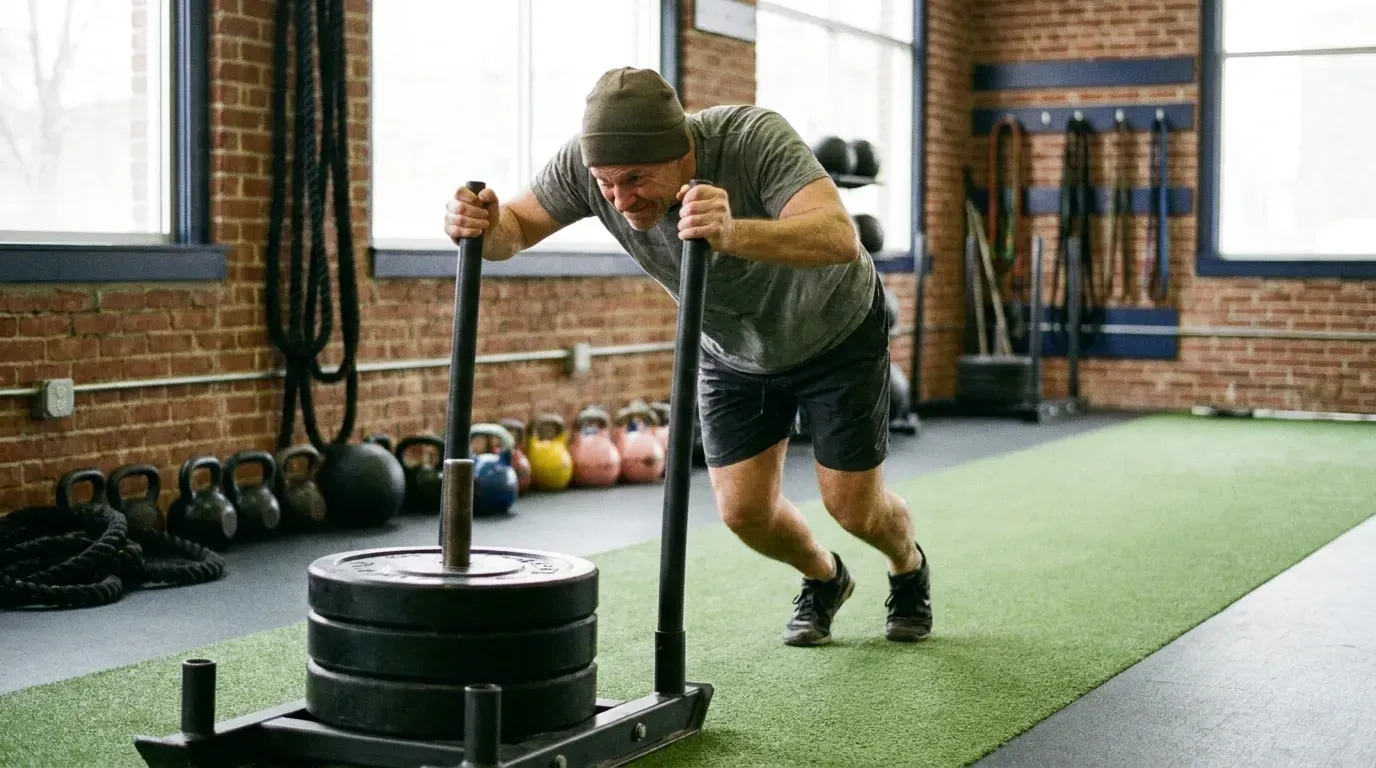
A goblet squat to a box can stand in for heavy back squats, and a steady sled push or loaded carry can replace a sweaty interval block. The goal is never to make the workout easy or to dodge effort. It is to pick the version of the workout your body can absorb today and still repeat tomorrow. A session you can recover from is worth far more than a heroic one that costs you the next three days.
Maintain, Modify, or Skip: A Three-Way Decision
Every hot training day really comes down to one of three honest choices, and naming them out loud keeps you from defaulting to all-or-nothing thinking, where the only options feel like a perfect session or no session at all. Before you warm up, look at the conditions, check how recovered you actually feel, and decide which of the three you are working with today.
| Choice | When it fits | What you do |
|---|---|---|
| Maintain | Indoors and cool, or a genuinely mild window. The conditions are not fighting you. | Run the program as written and judge it on its own merits. |
| Modify | Warmer than ideal but not dangerous, which is most summer days, and knee load | Climb the ladder: timing, then environment, then density, then load. |
| Skip or recover | Poor sleep, an already run-down week, extreme heat, or early warning signs. | Swap for a walk, mobility, or full rest, and protect the next ten sessions. |
The ladder tells you how to change a workout. This decision tells you whether to.
Maintain When the Environment Is Controlled
If you are training indoors in a cool space, or outdoors in a genuinely mild window, you may not need to change anything at all. A controlled environment removes most of the heat cost, so you can run the program exactly as written. The cue is simple: if the room or the morning air is not actually fighting you, do not go inventing a problem. The only mistake is maintaining out of pure habit on a day when the weather has obviously and dramatically changed.
Modify When Heat Raises the Cost
Most summer days live right here. The conditions are warmer than ideal but not dangerous, and the right move is to climb the ladder one rung at a time. Modifying is the workhorse of a heat-safe plan, because it keeps you consistent without ever pretending the heat is not real.
The cue is that the session feels meaningfully harder than the same work felt in spring, even though the numbers match. You are still training hard and still making progress. You are simply being deliberate about which single variable to spend on today.
Skip or Recover When the Signal Is Stronger
Sometimes the honest answer is to not train at all, or to swap the planned session for easy recovery. If you slept badly, you are already run-down from the week, the heat is genuinely extreme, or your body is sending early warning signs, then a hard session is a withdrawal you cannot afford to make. Trading it for a short walk, ten minutes of mobility, or a true rest day is not falling behind. Skipping one session to protect the next ten is the plan working exactly as it was designed to, not a failure of discipline.
What a Heat-Adjusted Week Can Look Like
The ladder and the three-way decision are far easier to trust once you see them play out across an ordinary summer week, where no two days ask quite the same thing of you. Here are three days you will probably recognize, and what each one calls for.
A Manageable Warm Day
It is 78 degrees and breezy at 7 a.m. You train the session exactly as written, simply moving it earlier to stay ahead of the afternoon heat. Timing did all of the work, and nothing else needed to change. This is the maintain-or-light-modify day, and the good news is that most of your week can look like this if you are willing to protect your mornings and get the important work done before the day heats up.
A Heat-Wave Day
It is 99 degrees with heavy humidity and an air quality alert on your phone. You move the strength session indoors to the air conditioning, keep your working loads exactly where they were, and stretch the rest periods so your heart rate settles all the way down between sets. The outdoor conditioning you had planned becomes a short, easy evening walk once the sun is down, or it simply disappears from the week with no guilt attached. You modified the environment and the density, kept the part that actually builds strength, and shed the part that was only adding heat and risk.
A High-Fatigue Day
The temperature outside is perfectly fine, but you slept five hours, you traveled yesterday, and your legs feel hollow walking up the stairs. This is not a heat problem at all. It is a recovery problem wearing a summer disguise, and it is easy to misread in July when you are already primed to blame the weather. You drop to a lighter technique day or take full recovery, because stacking a hard session on top of an empty tank is how small problems quietly turn into injuries. Reading the day in front of you honestly will always matter more than reading the thermometer.
Warning Signs That End the Session
Some signals are not invitations to adjust. They are instructions to stop, and a heat-safe plan names them clearly before you ever feel them, because in the moment, your own judgment is the first thing the heat takes from you. Stop the session, get to a cool place, and rehydrate if you notice heavy sweating that suddenly stops, cold or clammy skin in the heat, dizziness or lightheadedness, a headache, nausea, muscle cramps that will not release, or a heart rate that stays high even after you rest.
MedlinePlus advises contacting a provider if signs of heat exhaustion do not improve within an hour of getting out of the heat and drinking fluids, and treating confusion, fainting, or a very high body temperature as an emergency that needs immediate care.
These are medical signals, not toughness signals, and no workout on earth is worth pushing through them. And if you live with a heart condition, take a medication that affects how your body handles heat, or manage any chronic condition, set that threshold lower for yourself and talk with your provider about what summer strength training should look like in your situation.
In our setting, those signs are not coached around. They end the session because heat symptoms change the goal from “finish the workout” to “protect the person.”
Summer Consistency Is the Real Win
The goal for the hottest stretch of the year is not a personal record. It is an unbroken habit. Strength is built over months and seasons, not over single sessions, so the real summer win is continuing to show up in a form your body can actually sustain week after week. The federal physical activity guidelines call for at least 150 minutes of moderate activity a week plus two days of muscle-strengthening work, and they make one point worth remembering on a brutal July afternoon: some activity is better than none, and the benefits start accumulating before you ever hit the full targets.
A summer of slightly lighter, smarter, well-timed sessions keeps your strength, your routine, and your sense of yourself as someone who trains completely intact. That is not a holding pattern you are stuck in. That is winning the season, and walking into the fall ready to build again.
Build a Heat-Safe Workout Plan Around Your Starting Point
You do not have to choose between suffering through your summer strength training and skipping it. You need a reliable way to read the day, make the right workout adjustments for summer, and focus on the variable that matters most. Now you have one: see heat as part of the load, climb the adjustment ladder from timing down to exercise selection, and decide honestly each day whether to maintain, modify, or skip.
The piece most people are still missing is a clear starting point, an honest picture of their strength and movement before the heat muddies the signal. That is what a Strength and Range of Motion Assessment gives you. It shows us your baseline, so we can build a summer plan that bends with the heat instead of breaking your progress along the way. When you are ready to stop guessing your way through the hot weeks, reach out to Royal Blue Fitness for your summer strength training in Pleasant Hill.
What is the first thing to change about strength training when it gets hot?
Start with timing, not the workout. Moving your session into the cooler morning or evening hours often fixes the problem on its own, before you touch a single set, rep, or pound. If better timing alone does not do it, change your environment next, then the density of the work, and only then the load. Spending on the cheapest variable first keeps the training that actually builds strength fully intact, which is the whole goal.
Do I need to lift lighter in summer?
Not automatically. Lighter loads are a tool, but they sit near the bottom of the list, not the top. On most hot days, adding rest between sets and easing the density of the session protects you more than stripping weight off the bar, because density is usually what is driving the heat cost. Drop the load when the session still feels unsafe after you have handled timing, environment, and rest, or when your body is clearly telling you to.
Is indoor training better during a heat wave?
Often, yes. Moving a strength session into air conditioning during extreme heat lets you keep your loads and train safely while your cooling system gets a break, which matters even more if you manage a chronic condition or take a medication that affects how you handle heat. Think of it as protecting the session, not abandoning your routine. The outdoor work can come back when the conditions do.
What heat symptoms mean I should stop training?
Stop and cool down if you feel dizzy, nauseated, or confused, if you develop a headache, if your skin turns cold and clammy in the heat, or if your heart rate stays high after you rest. These are signs of heat-related illness, not weakness, and they call for getting out of the heat, rehydrating, and seeking medical help if they do not ease within about an hour. Muscle cramps that show up during hard work in the heat are often the earliest warning of all, so treat them as a cue to back off rather than a thing to push through. Confusion, fainting, or a very high body temperature are emergencies. When in doubt, end the session, because that is always the safe choice.
Can I still build strength during the hottest weeks?
Yes, with realistic expectations. The summer goal leans toward consistency and maintenance rather than personal records, and that is a genuine win, because holding your strength through a hard season sets up the progress that comes when the weather finally breaks. Smart, well-timed, slightly adjusted sessions keep you moving forward. No one can promise specific results, but a sustainable summer will always beat a heroic week followed by three lost ones.
Here are our latest articles! Click to read more.