Hard Work vs Smart Progression: Why Effort Alone Does Not Build Strength

Hard work matters. The problem is not effort. The problem is effort without a clear progression strategy. Many people train with real discipline, sweat through hard workouts, feel sore, and still wonder why their strength is not moving the way they expected.
That frustration is real, and it can feel unfair to work hard and get so little back. But strength does not grow from exhaustion alone. It grows when the body gets an appropriate signal, has enough recovery to adapt to that signal, and gets a next step that is challenging without being random.
The
Mayo Clinic strength training guidance describes strength training as a process that uses resistance and then gradual increases in weight or resistance once a level becomes easy. Royal Blue Fitness uses that same principle in plain coaching language: effort has to be dosed, observed, and progressed, not just survived.
Hard work matters, but it needs direction
Effort is the reason training changes the body at all. A workout that never challenges you gives the body little reason to adapt, so some genuine difficulty is not optional. The catch is that effort by itself does not tell you what to change next.
A hard workout can mean a dozen different things: heavy weight, high reps, short rest, complex exercises, sloppy pacing, or simply too much total stress packed into one week. Without something to measure, soreness starts to feel like proof of progress even when the plan is only manufacturing fatigue.
Smart progression does not remove intensity. It gives intensity a job. The questions become simple and answerable: what are we asking the body to build, and how will we actually know whether the dose was right?
The RBF Effort-to-Adaptation Loop
At Royal Blue Fitness we run every program through the same four-part loop. We call it the Effort-to-Adaptation Loop, and it is the lens behind every plan we write, because it is the simplest honest way to separate productive training from busy, random effort. Each part answers a question the next part depends on.
| Part of the loop | The question it answers |
|---|---|
| Signal | What stimulus did the workout actually create? |
| Recovery | Did the body have what it needed to respond to that stimulus? |
| Progression | What is the single planned change for next time? |
| Feedback | Did the change produce the result we were after? |
Take someone trying to build leg strength. If most of their session is spent gassed from conditioning circuits, the real signal was conditioning, not strength, and the squat never moves no matter how brutal the day felt. The loop is how we keep that quiet mismatch from happening week after week.
Signal is the stimulus, not the difficulty
The signal is what the workout actually asked the body to do: produce more force, hold more control, move through more range, last longer, or coordinate better. A session can be exhausting and still send the wrong signal for the goal you care about.
A better plan names the main signal before the first set. If the goal is strength, the session protects movement quality and loading above everything else. If the goal is conditioning, it can tolerate more breathing demand and shorter rest. If the goal is movement quality, the plan leaves enough attention and control for the body to actually learn the pattern.
Recovery is where the adaptation actually happens
Recovery is not laziness, and it is not the reward for hard work. It is the window where adaptation physically takes place. If the body never gets enough time, food, sleep, or lower-stress days, more effort only adds noise on top of the work it has not finished absorbing.
This is why the same workout can be productive one week and too much the next. Work stress, sleep, travel, lingering soreness, pain, and the previous few sessions all change the true load you are carrying. A smart plan watches those variables instead of pretending the body lives outside the rest of your life.
Sports medicine draws the same line. A review of overtraining syndrome in the journal Sports Psychiatry describes a continuum: brief functional overreaching, where performance dips for up to about two weeks and then rebounds, can be productive, but if heavy load keeps outrunning recovery for three to four weeks or more, that dip stops rebounding and slides into non-functional overreaching and, eventually, overtraining syndrome. The same review frames recovery as three real ingredients, sleep and rest, hydration and nutrition, and mental recovery, not as time off you have to earn.
This is also where we push back on the old "no pain, no gain" belief. Effort is not the enemy, and maximum effort has its place, but setbacks from too much stress, a strained soft-tissue injury, or the flat, heavy fatigue that comes from chronically high volume, set you back further than they ever move you forward. The smarter approach is to break training into blocks. In coaching athletics we call it periodization, but really it is just structuring training in blocks of months and weeks: a stretch to build, a lighter stretch to absorb, then build again. That structure is exactly what tells you whether you are dosing effort well or quietly doing too much.
Signs you may be doing too much
If you are not sure where you fall, the same overtraining review points to a recognizable cluster of warning signs. A few in isolation are normal training noise. Several together, especially when they persist, are a signal to pull back and reassess the dose:
- Performance that stalls or drifts downward even though you are training hard
- Persistent heavy fatigue, or workouts that feel harder than the weight on the bar should
- Muscles that stay unusually sore or stiff well past the normal window
- Mood or sleep that is off, more irritable, flatter, or harder to fall and stay asleep
- A resting heart rate that runs higher than your usual baseline
- Frequent small flare-ups, overuse niggles, or more minor illnesses than normal
None of this replaces medical advice. If symptoms are severe, keep getting worse, or feel unusual, that belongs with a qualified healthcare provider rather than another hard week. But for most people, this list is an early, honest read on whether effort has tipped past what recovery can absorb, and a cue to repeat or regress instead of pushing again.
Progression is one planned change, not everything at once
Progression is the deliberate adjustment that moves training forward. It can be more load, more reps, more range, slower tempo, cleaner control, shorter rest, more weekly work, or a harder variation. It does not always mean adding weight, and it should never mean changing everything.
Progression has to be specific enough to learn from. If everything changes at once, you cannot tell what worked; if nothing changes, the body stops getting a clear challenge. The
2026 resistance training guidelines from the American College of Sports Medicine make a related point from a review of more than thirty thousand participants: load and volume should be tailored to the goal and adjusted over time rather than pushed blindly, and for most adults consistency matters more than chasing a complicated program.
Feedback is what keeps the plan honest
Feedback is the part most home programs skip. Did performance actually improve? Did the technique stay organized under load? Did recovery hold up between sessions? Did the next workout feel better, worse, or the same?
This is where coaching turns effort into information. A good coach does more than celebrate a hard day. A good coach reads what the work produced and uses it to choose the next step, which is exactly what a workout log of how tired you felt can never do on its own.
More effort can quietly create less progress
More effort backfires when it strips away the conditions adaptation needs. It usually shows up as a familiar pattern: recurring soreness, performance that bounces around for no clear reason, frequent small flare-ups, technique that falls apart under fatigue, or a cycle of pushing hard for two weeks and then vanishing for two.
None of that means the person is weak or undisciplined. It means the plan is not managing the dose. The body may simply need a repeat week, a planned deload, fewer exercises, a smarter exercise order, more recovery between the hard days, or a lower-risk way to progress the same movement.
The
CDC adult activity recommendations call for regular movement plus muscle-strengthening work on at least two days a week, but regular was never meant to read as reckless. The goal is a repeatable plan that quietly compounds, not a heroic week you cannot run back.
One of the most common patterns we see in a first assessment is the lifter who is sore after almost every session yet has not added meaningful strength in months. The training is not too easy. It is too scattered, with the dose changing so often that the body never gets a clear, repeatable signal to adapt to. The fix is rarely more effort.
Fatigue and soreness do not belong on the scoreboard
Many hard-working exercisers grade a workout by how much it took out of them. A smarter plan also asks what the workout actually built, because those are two different questions.
Fatigue tells you the body was challenged. It does not tell you whether the challenge was useful, well-timed, or repeatable. A workout can be flattening and still miss its goal, and it can be calm and focused while quietly being one of your most productive sessions of the month.
Soreness behaves the same way. It tends to show up whenever training changes, which makes it a poor long-term measure of progress. When soreness becomes the target, the plan starts chasing novelty instead of skill, load tolerance, and repeatable progression. The more useful question is not how wrecked you feel, but whether the work is becoming more predictable: more weight at the same clean technique, more control through the same range, or better recovery after the same session.
Training hard without training randomly
Hard and random are not the same thing, and the difference is mostly structure. A few habits keep the effort pointed at something.
Give each hard day a single clear purpose
A hard day should have one reason to exist: a heavy strength day, a higher-volume day, or a conditioning day. When every day is hard in the same undefined way, the plan loses contrast and recovery becomes almost impossible to manage.
Repeat a pattern long enough to actually measure it
A program needs enough repetition to reveal whether it is working. Constant exercise novelty feels interesting, but it makes progress impossible to read. Repeating a movement pattern with small, intelligent adjustments almost always beats starting over every week.
Change one major variable at a time
If load, reps, tempo, rest, exercise selection, and frequency all move together, the plan becomes unreadable and so does your progress. A smarter progression changes one or two variables, then watches how the body responds before touching anything else.
Respect the warning signs and route them out
If pain is getting worse, numbness or weakness appears, or symptoms simply feel unusual, that is not a cue to push through. Those questions belong with a qualified healthcare provider. Fitness coaching can support strength, movement quality, and progression, but it does not diagnose or treat medical conditions, and a good coach will say so.
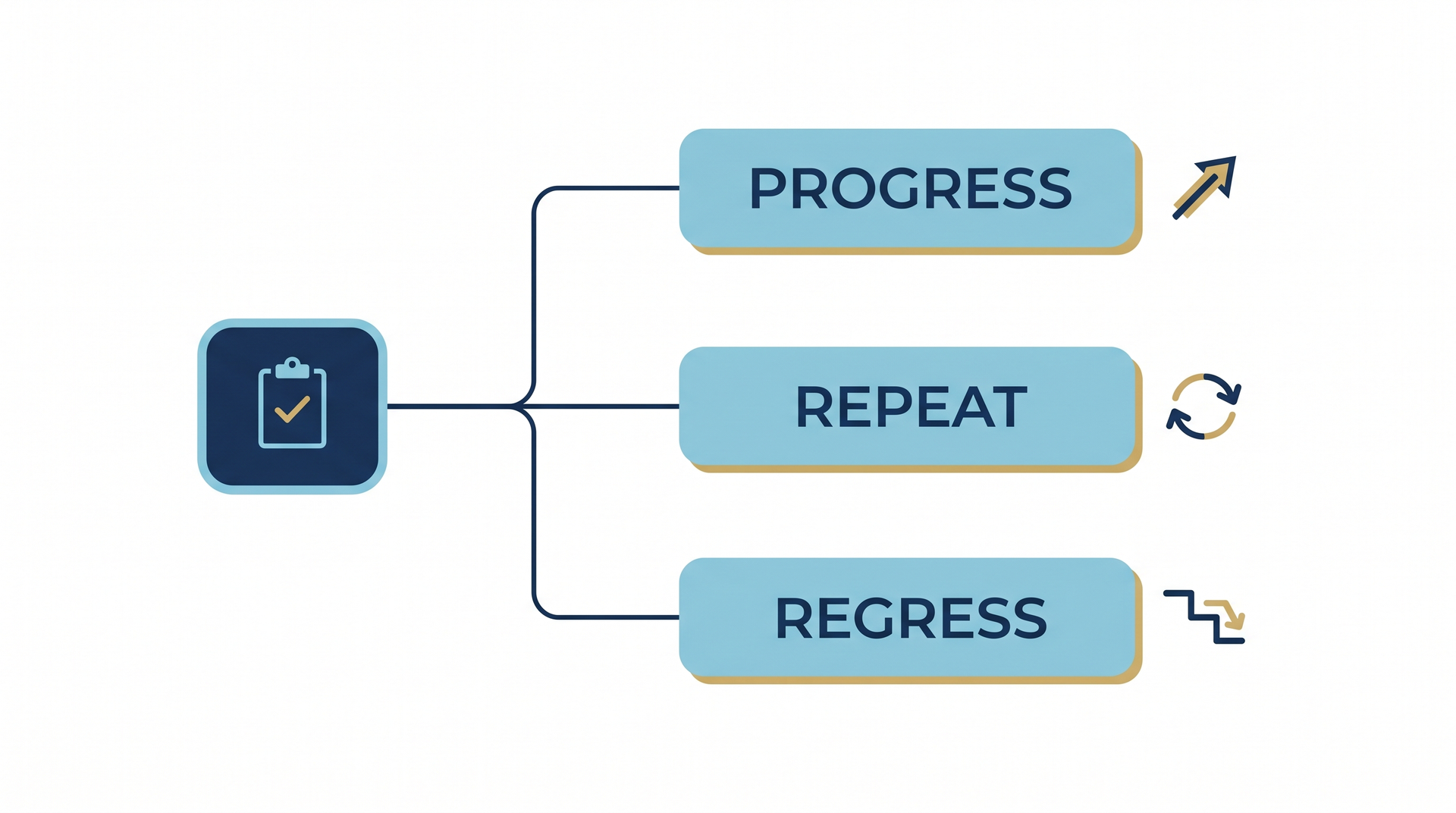
The Progress, Repeat, or Regress decision
A practical plan needs decision rules, not just good intentions. The table below turns the Effort-to-Adaptation Loop into a simple read on what to do next, based on what the last block of training is telling you.
| What you are seeing | The smart next move |
|---|---|
| Clean technique, steady recovery, and the load feels manageable | Progress: add load, a set, range, a harder variation, or less rest, matched to the goal |
| The movement is almost there but not consistent, or recovery is only okay | Repeat: hold the level and build skill before adding any challenge |
| Technique breaks down, recovery is poor, or symptoms are increasing | Regress: less range, less load, more support, or fewer sets, and keep training |
This is how we protect ambition and patience at the same time. It does not tell anyone to avoid hard work. It tells you when hard work is ready to become more demanding, and when the smartest move is to let the body absorb what it has already done. In our programs, the assessment is what sets the starting line: the Strength and Range of Motion Assessment shows us whether a given movement should begin at Progress, Repeat, or Regress, so the first month is built on evidence instead of guesswork.
Progress when the signal is clear
Progress when you can repeat the movement with control, recover reasonably, and explain what changed. That might mean a little more load, an added set, a harder variation, more range, or shorter rest. The change should always point back at the goal, not just at making the day harder.
Repeat when the signal is mixed
Repeating a workout is not a failure. It is often the missing piece. When a movement is almost ready but not automatic, the body usually needs more practice at the same level before more challenge does any good. A repeat block gives you and your coach a much clearer read.
Regress when the signal is a warning
Regression is not quitting either. It is how you keep training when the current version is simply too much: less range, less load, more support, fewer sets, or a simpler variation of the same pattern. Smart regression keeps the work going instead of forcing an all-or-nothing choice between grinding and stopping.
What the loop looks like across one month
Picture a straightforward month. In week one, you add a small amount of load to your main lift while holding the other exercises steady, and your technique stays clean. In week two, you repeat those exact numbers because the movement is not quite automatic yet, and by the end of the week it feels noticeably smoother.
In week three, you add another small jump in load plus one extra set on the lift that feels strongest, while a crankier pattern stays exactly where it is. In week four, you intentionally pull the volume back, keep the same movements, and let the body absorb the work before the next build begins.
None of that is inconsistency. That is coaching. Notice that the plan is reading something at every step: load, reps, range, technique, recovery, and response. If the only record were how tired you felt, not one of those decisions could be made with any real confidence.
How Royal Blue Fitness turns effort into progress
Royal Blue Fitness starts by clarifying what you are actually trying to build. Strength for daily life is not the same as power for sport, confidence after a setback, or general conditioning. Once the goal is clear, an assessment helps pin down where your body is starting from today.
From there, the plan gives your effort a direction. Exercises are chosen because they serve the goal. Load is progressed because the body shows readiness, not because the calendar flipped. Recovery is built into the week because adaptation needs the room. Feedback shapes the next block because the plan should learn from you, not force you into a template.
Hard work is still very much part of the equation. It just belongs inside a smarter system. When signal, recovery, progression, and feedback work together, strength stops feeling mysterious and starts becoming measurable. The most useful definition of toughness is not doing more at every opportunity. It is choosing the next challenge your body can actually turn into progress.
Frequently Asked Questions
Why does effort alone not build strength?
Because effort is only the stimulus, not the result. Strength also depends on recovery, progression, technique, consistency, and honest feedback, and a workout can feel brutally hard while still missing the goal it was supposed to serve. The fix is almost never less work. It is work with a direction, where each session has a clear job and you can actually tell whether the body responded to it or just got tired.
What exactly is smart progression?
It is changing the right training variable at the right time: load, reps, range, tempo, rest, exercise difficulty, or weekly volume, matched to the person and the goal. It is not cautious for its own sake. Done well, it protects your hard work by making sure each new challenge is productive, recoverable, and clear enough to learn from.
How do recovery and consistency affect strength?
Recovery is what lets the body adapt to the work you have already done, and consistency is what gives the plan enough repeated exposure to build real skill and capacity. Without recovery, hard sessions pile up as fatigue. Without consistency, they stay scattered events. You do not need every session to be maximal. You need enough quality work, repeated often, with enough recovery for it to add up.
When should I work harder versus progress more carefully?
Push harder when technique, recovery, and your response to training are all stable and trending in the right direction. Progress more carefully when soreness lingers, performance drops, pain increases, or life stress is already high. Careful progression is not about avoiding challenge. It is about choosing the kind of challenge your body can absorb right now, so the effort turns into strength instead of another setback.
Is soreness a good sign that a workout worked?
Not on its own. Soreness mostly tells you that something in the training changed, which is why a brand-new program can leave you sore even when it is poorly designed. It does not measure whether you got stronger. A far better sign is that the work is becoming more repeatable: the same lift moving with cleaner technique, more control through the same range, or easier recovery after the same session. Chase those signs, and let soreness be a side effect rather than the target.
Train hard with a plan that actually progresses
If you are working hard but not seeing strength progress, the missing piece is usually direction, not effort. A
Strength and Range of Motion Assessment gives us a clear starting point, so we can place each movement at Progress, Repeat, or Regress and turn your hard work into smarter progression, clearer feedback, and training that actually adds up over time.
Here are our latest articles! Click to read more.