Functional Training for Beginners: How to Start with Squat, Hinge, Push, Pull, Carry, and Rotation
Starting functional training for beginners can feel intimidating, and that is a completely reasonable response. The internet is full of people flipping tires, balancing on wobble boards, and swinging heavy kettlebells, and it is easy to assume that is the price of entry.
It is not. Starting well is quieter and simpler than it looks: a few basic movement patterns, light or no load, and a focus on moving well before moving heavy.
This guide gives you a safe, beginner-friendly way to start the six patterns without getting buried in advanced programming or hurting yourself trying to keep up with people who have trained for years.
Focus on movement quality first, not intensity
Your initial task is to practice each pattern with control within a comfortable range, so the movement feels stable and repeatable. That is the foundation everything else is built on, and rushing past it is the single most common way beginners get discouraged or sore. Slow down here, and the rest of your progress speeds up later.
Here is what you can safely skip at the start: heavy loads, complex equipment, soreness as a goal, and any move you have to brace yourself just to survive. Beginners make the fastest, safest progress by keeping early sessions easy enough to comfortably do a little more, then adding small amounts over time.
National physical activity guidance from Health.gov recommends muscle-strengthening activity at least twice a week, which is a realistic target to build toward, not a starting line you must clear on day one. The goal in your first month is not to be impressive.
It is to build a habit your body trusts and your schedule can absorb.
Form comes before weight. Harvard Health's guidance on a safe strength program puts it simply: focus on form, not weight, start with little or no load, and give the same muscles at least 48 hours to recover between sessions. Clean technique learned early is what lets you add load safely later.

The six movement patterns, one at a time
You can begin every pattern below with just your body weight. For each one, the aim is the same: move through a comfortable range with control, then progress slowly.
You do not need all six in one session at first. Even two or three patterns, done well, are a real start.
Think of these as skills you are learning, not tests you are passing.
Start with the squat
Practice sitting back into a chair and standing up without using your hands. Keep your weight in your whole foot and let your knees travel out over your toes rather than caving inward.
This rehearses every down-and-up moment in your day. If standing without hands is hard, that is useful information, not a failure: start from a higher surface or rest your fingertips on something stable.
A good target is moving smoothly for a set of eight to twelve without grabbing anything for support. When chair squats feel easy, lower to a slightly lower seat or hold a light weight at your chest to add a little challenge.
Keep your chest up and imagine spreading your feet across the floor, which helps your knees track in line rather than collapsing inward.
Add the hinge
Stand tall, then push your hips back like you are closing a drawer with your backside, keeping a long spine and a soft bend in the knees. The hinge is how you lift from around knee height without straining your lower back.
Slide your hands down the front of your thighs as your hips move back, then squeeze your glutes to stand tall again. Keep the range small at first, and only fold as far as you can without rounding your back.
If you practice only one movement from this list, make it the hinge. A mirror or a phone propped to the side helps here, because the difference between a clean hinge and a rounded back is easy to feel only once you have seen it.
This one pattern protects your back for decades, so give it time.
Learn the push
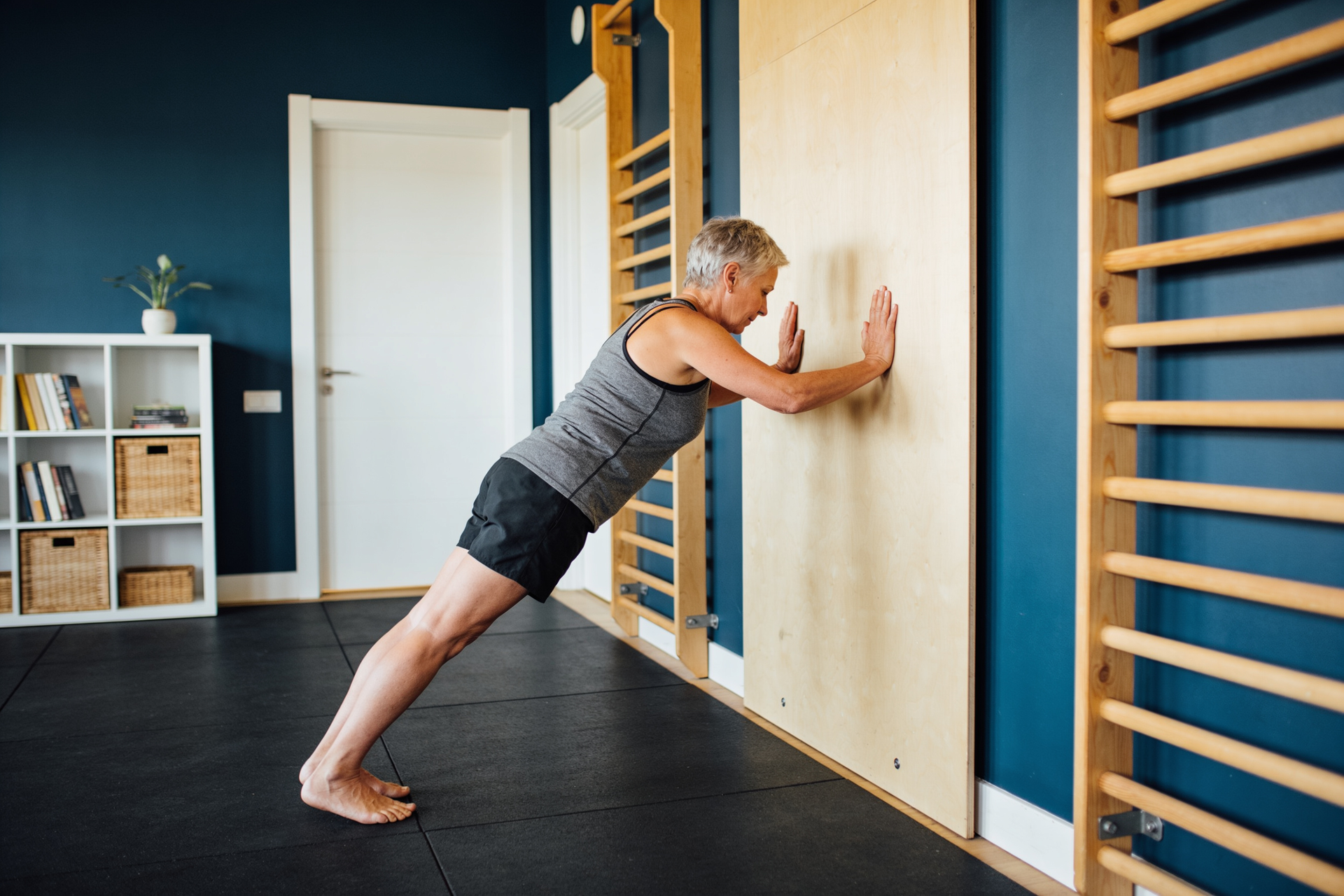
Pushing means pressing something away from your body. A wall push-up is a perfect start: place your hands on a wall, lower your chest toward it, then press back, keeping your body in one straight line and your ribs down rather than flared.
When that feels easy, progress to an elevated surface like a sturdy counter before you ever attempt a push-up from the floor. An elevated push-up done with control builds the real thing faster than a floor push-up done with a sagging back.
Lower yourself slowly, pause for a beat, and press back with control, and you will feel the difference within a couple of weeks.
Train the pull
Pulling is bringing weight toward you, and it is often the weakest pattern for beginners because daily life pushes far more than it pulls. Start by pulling a resistance band or a towel anchored to a door toward your ribs, squeezing your shoulder blades gently together and keeping your shoulders down away from your ears.
Give this pattern extra attention. Most beginners are noticeably push-dominant, and evening that out helps your posture as much as your strength.
If you have no equipment, even slow rows with a couple of light household weights build the habit, and if your shoulders tend to round forward by the end of a long day, strengthening your pull is one of the most direct fixes.
Pick up a carry
Pick up two manageable weights, water bottles, grocery bags, or light dumbbells, stand tall, and walk. That is the entire exercise.
Keep your shoulders back, your ribs stacked over your hips, and breathe normally instead of holding your breath. Carries build grip, posture, and balance all at once, and they are nearly impossible to do with bad technique, which makes them one of the most beginner-friendly things you can do.
Walk a comfortable distance, set the weights down, rest, and repeat for a few rounds. A simple way to progress is to walk a little farther before setting the weights down, or to pick up slightly heavier objects once your grip is comfortable.
Introduce rotation
Stand tall and gently turn your torso side to side to feel the movement, then practice the more useful skill: resisting rotation. Hold a lightweight at your chest and stay square and steady while you take a few slow steps or shift your feet.
Early rotation work is about control, not speed or force, and you should never crank or twist hard against resistance when you are new to it. That quiet stability is what keeps your back comfortable when you reach across the car or turn quickly to catch something.
Train it gently and consistently rather than chasing big, forceful twists, which is where many people end up irritating their backs.
Putting the patterns into a simple weekly start
A complicated program is not the goal, and it can actually get in your way. A simple, effective start is to run gently through the patterns twice a week, with at least a day of rest between sessions.
Pick three or four patterns for your first few weeks, then add the rest as you get comfortable. Sessions can be short; twenty to thirty minutes is plenty at the start, and they should leave you feeling worked but not wrecked.
A round might consist of chair squats, hinges, wall push-ups, and a short carry, repeated two or three times with rest as needed.
A useful gauge: you should finish feeling like you could have done one more set if you really had to. Consistency across weeks matters far more than intensity in any single session, a point the American College of Sports Medicine's 2026 resistance training guidelines reinforce: the biggest returns come from consistent participation in a sensible program, and the best program is the one you will actually keep doing.
Common beginner mistakes to avoid
The most common mistake is starting too heavy too soon, chasing the loads you see other people using. Their starting point is not yours, and copying it is how beginners end up sore, frustrated, or hurt.
The second mistake is treating soreness as proof that a session worked. Some new sensations are normal when you start; sharp pain, twinges, or soreness that lingers for days is a signal to ease back, not a badge to chase.
A large research review of progressive resistance training supports the gradual, progressive approach, linking steady strength work to improved performance in everyday tasks such as standing from a chair and climbing stairs. The key word is progressive, not light: you start manageable and add a little over time.
A third mistake is skipping the pull pattern because it feels awkward, which leaves most beginners stuck in a push-dominant posture. A fourth is piling on too much variety too soon.
You do not need ten exercises; you need to get genuinely comfortable with six patterns. Master the basics first, and the fancier variations will be there waiting when you are actually ready for them.
The people who look impressive in videos have almost all spent unglamorous months on the same plain patterns you are starting with now.
Progress one small variable at a time
Once a movement feels easy and controlled for your current sets, you can do slightly more: a few more repetitions, a little more range, a slightly lower surface, or a modest amount of added weight. Change one thing, not three, so you always know what actually made the difference.
Two short sessions a week are plenty to build from, and consistency over months matters far more than any single heroic workout. If a pattern stalls or starts to bother you, hold steady or scale back rather than pushing through it.
Plateaus are normal and often just mean your body needs another week at the current level. Patience here is not a lack of progress; it is the progress, because the strength you build slowly is the strength that stays.
Where a coach or assessment earns its place
You can absolutely start your own functional strength training in Pleasant Hill, and plenty of people do well that way. A coach or an assessment becomes worth it when you want to be sure a pattern is safe for your body, when something consistently feels off and you cannot tell why, when you are returning after an injury or a long break, or when you simply want a plan built around you instead of a generic template.
Good coaching is not about making movements harder or more impressive. It is about matching the right starting point and progression to your body, your history, and your goals, so you spend your effort where it actually pays off.
A good coach often has you do less than you expected at first, not more, because they are protecting the long game.
Beginner functional training questions
How many days a week should a beginner do functional training?
Two days a week is a strong, sustainable start. It fits the general guidance to strengthen your muscles at least twice weekly and leaves room to recover between sessions.
If two feels like too much at first, start with one consistent day and build from there once it feels routine. Showing up regularly beats an ambitious schedule you cannot keep.
Do I need a gym or equipment to start?
No. Every one of the six patterns has a bodyweight version, and household items like water jugs or grocery bags work well for carries and light loading.
A chair and a wall cover the squat and the push. Equipment helps later as you get stronger, but it is not required to begin today.
How do I know if my form is good enough?
A good rule of thumb: you can move through the range with control, you are not holding your breath or bracing just to survive the repetition, and the movement feels stable rather than shaky or sharp. If you are unsure, filming a set from the side or having it checked during an assessment quickly removes the guesswork.
How long until I see results?
Sooner than many people expect, and partly for a reassuring reason: early strength gains come largely from your nervous system learning to coordinate the movement, which research on training adaptations shows happens in the first weeks before much muscle size changes. Beyond that early progress, research from the Harvard T.H. Chan School of Public Health
Is it normal for one side to feel weaker than the other?
Yes, very. Almost everyone has a stronger and a weaker side.
Carries and single-arm or single-leg variations gently even things out over time. If one side is sharply painful rather than simply weaker, that is worth getting looked at before you load it further.
Your first few weeks
You do not need to be fearless or already fit to start functional training. You need a chair, a little space, two light weights, and permission to begin gently.
Practice the six movement patterns with control, add small amounts over time, protect your pull pattern from getting neglected, and let consistency do the heavy lifting. Nobody starts strong, and the people who end up strong are simply the ones who keep showing up after the novelty wears off.
If you want to start with confidence that each pattern is right for your body, a Strength and Range of Motion Assessment is a calm, no-pressure way to get a starting point built around you.
Here are our latest articles! Click to read more.