Hip Pain When Walking: How Strength, Stride, and Stability Work Together
The first block feels fine. So does the second. Somewhere around the third, the hip starts to talk, and by the time you head home, it is a real ache.
Walking is supposed to be the easy movement, the one you do without thinking, but after hip pain, it can quietly become the thing you brace against. The good news is that walking tolerance is built, not just hoped for. Treat what follows as coaching to use between visits with the provider who knows your hip, not a replacement for their read on it, and it will show how the pieces fit together.
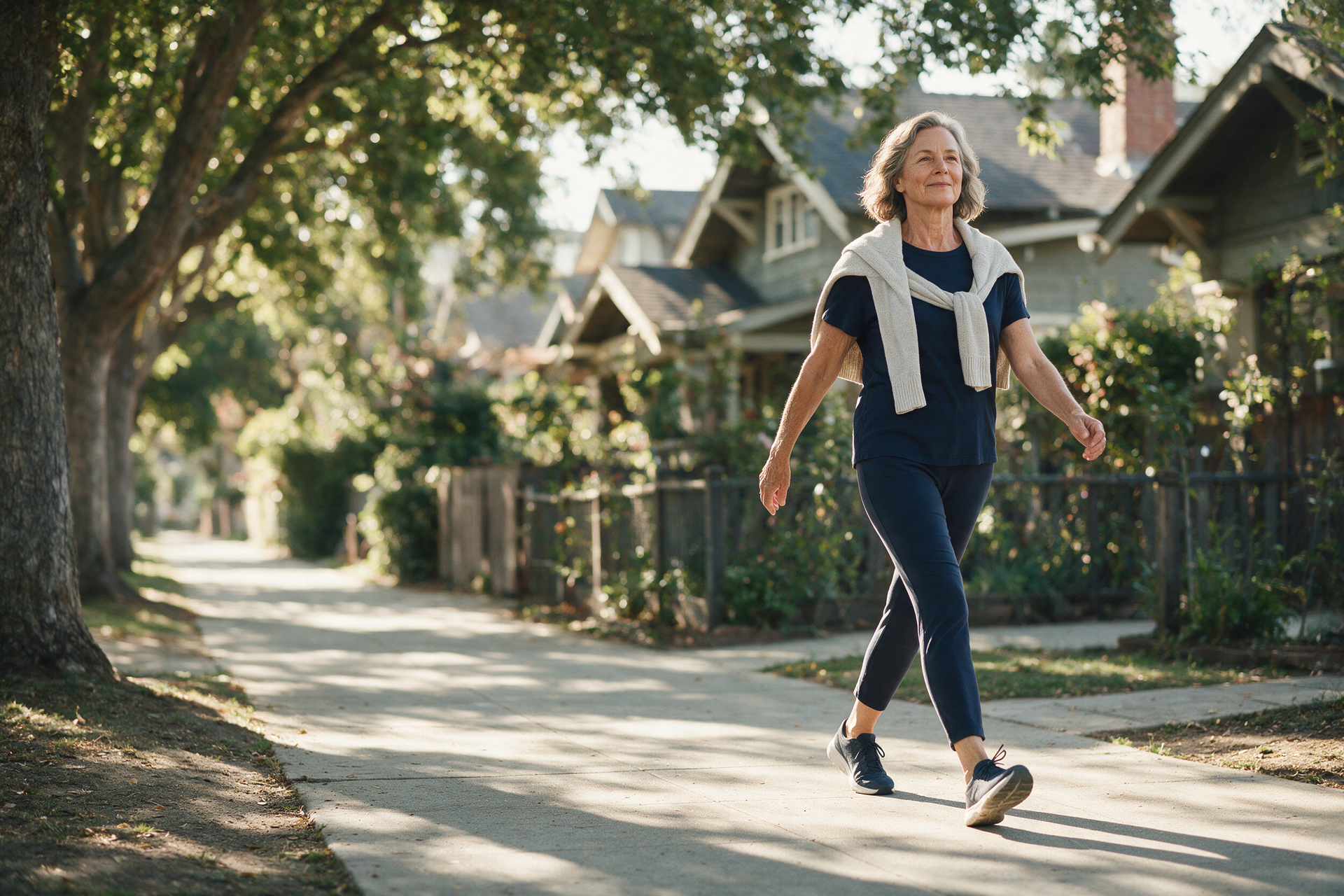
This is for hips that ache once the walk gets long
Think of this as the distance chapter in a longer recovery story, with calming symptoms and rebuilding basic hip strength as the chapters that come before it. If you are still early in recovery, still settling symptoms, or still working on the basics with a provider, start there. Come back to this piece when the hip is calm at rest and on short distances, but longer walks still find their limit. That is the specific gap we are closing here: not whether you can walk, but how far and how comfortably.
Walking can aggravate a recovering hip
Walking looks gentle, and over a few steps, it is. The trouble is that walking is not just a few steps. It is the same demand repeated hundreds of times, and a hip that is still rebuilding can handle that demand for a while before it adds up.
What your hip does on every single step
Every time you step onto one leg, that hip briefly carries your whole body and has to keep your pelvis from dropping toward the other side. The muscles on the outside of the hip do that stabilizing work, holding your pelvis level while one foot is off the ground. During walking, your body spends most of the cycle balanced on a single leg, switching from one to the other with every stride. The load is real: single-leg stance makes up the majority of the gait cycle, and because the abductors' leverage is short, the hip joint can carry up to about four times your body weight in those moments.
So a walk is not one task. It is hundreds of single-leg balancing acts in a row, each asking your hip to produce force and control it. That is why distance matters in a way a quick errand does not reveal.
Distance, hills, and pace change the demand
A short walk samples your hip. A long one tests it. The longer you go, the more those repeated single-leg moments accumulate, and small inefficiencies that were invisible early start to cost you. Hills add load on the climb and braking on the descent, while a faster pace gives each muscle less time to recover between steps.
This is why the same hip can feel completely fine to the mailbox and cranky by the end of a shopping trip. Nothing changed about the hip between block one and block three except how many times you asked it to do its job. It is the same reason a light bag feels weightless at the store and heavy by the time you reach the car: the load never changed, the repetitions did.
It can feel fine at first, then flare later
Fatigue is the hinge. While the supporting muscles are fresh, they keep your pelvis level and your mechanics clean. As they tire, your form drifts, other tissues pick up the slack, and the hip that was quiet starts to complain. That delayed flare is not a sign of damage so much as a signal that you reached the end of your current endurance, and endurance is exactly what builds with the right training. The goal is not to fear the flare but to push the point where it shows up a little further out each week.
The three things that build walking tolerance
Comfortable walking is not one quality but three, working as a team:
- Strength provides the force each step needs.
- Stride decides how that force is applied.
- Stability keeps the whole thing controlled.
Strengthen one and ignore the others, and the hip stays vulnerable, which is why the rest of this guide treats them together.
Strength: the muscles that support each step
The muscles around your hip are the engine of walking, and strengthening them lets the joint share the load rather than absorb it. Stronger hip muscles keep the joint stable, relieve pain, and protect against further trouble, which is why a conditioning program targets the glutes, the muscles on the outside of the hip, and the surrounding support. When the engine is strong, each step costs less, and the hundreds of steps in a long walk add up to far less fatigue. The stronger the hip, the further you can go before you reach its limit.
Stride: how mechanics change the load
How you walk changes what your hip has to handle. Stride length, cadence, and where your weight lands all shift the load on the joint, sometimes for better and sometimes for worse. A stride that is too long or a tendency to lurch to one side can quietly pile stress onto a recovering hip with every step. You do not need a perfect, textbook gait, but small mechanical habits scale up fast over distance. A half-inch of extra reach in your stride is nothing once and a great deal over five thousand steps, which is why mechanics that feel minor can decide how your hip feels at the end of a long day.
Stability: keeping the pelvis controlled
Stability is the quiet partner. It is the hip's ability to keep your pelvis level and your trunk upright as you balance on one leg, step after step, with the glutes and deep core doing the stabilizing work. When that control is there, walking looks effortless. When it is missing, your body improvises, and the improvisation is usually what hurts.
Strength, stride, and stability work as a team
The three rarely fail in isolation. A weakness in one usually shows up as a problem in another, which is why chasing a single fix often disappoints. Reading which one is the weak link helps you spend your effort where it counts.
Weak strength shows up as fatigue or a limp
When the supporting muscles cannot keep the pelvis level, the result is visible: the pelvis drops toward the unsupported side and you lean or limp to compensate. Weak hip muscles, especially the ones on the outside of the hip, are the most common reason for this pattern, and the standard answer is to strengthen them. Left alone, that uneven walk spreads stress to the knees and ankles too, so the fatigue rarely stays in just one place.
Stride changes can overload the hip
Sometimes the strength is adequate, but the mechanics are not. A protective habit picked up during the painful weeks, a longer stride to keep pace, or favoring one side can each load the hip in ways it does not love. Here the fix is less about building muscle and more about smoothing how you move, often with simple cues and gradual practice.
Sometimes stability is the missing piece
And sometimes you are strong enough, and your stride is reasonable, but control breaks down as you tire. The pelvis starts to wobble late in a walk, balance feels less sure on uneven ground, and the hip works overtime to stay centered. That is a stability and endurance gap, and it responds to balance work and single-leg control rather than heavier lifting. You could already be strong enough; what you are missing is the staying power to keep that strength organized late in a walk.
Building walking tolerance after hip pain
Rebuilding distance is less about walking more and more on a sore hip and more about giving it the strength, mechanics, and control to make each step cheaper. Build the capacity first, then let the distance follow.
Strength foundations to prioritize
Start with the muscles that stabilize the hip on one leg: the glutes and the muscles on the outside of the hip. Simple, controlled work builds the base that walking draws on:
- Side-lying leg raises for the muscles on the outside of the hip: a slow set of 8 to 12 per side is a fine start.
- Bridges for the glutes and the back of the hip: 2 to 3 sets of 8 to 10 with a brief pause at the top.
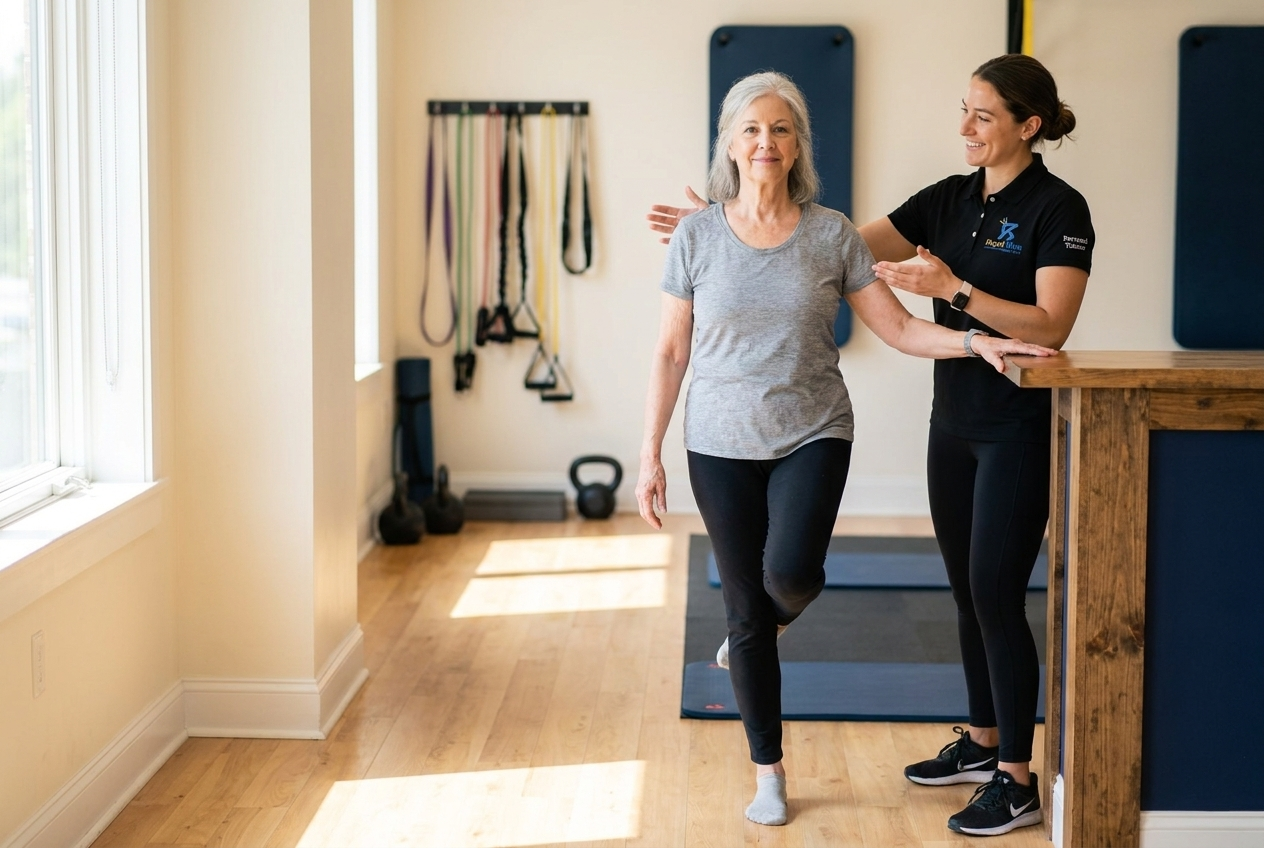
- Supported single-leg stances to train balance under load: 15 to 20 seconds per side, near a counter.
Progress gradually, keep the movements clean, and choose the specific exercises your provider has cleared for your hip.
Simple stride and gait considerations
You do not need to overhaul how you walk, just nudge the habits that cost you:
- Shorten the reach: a comfortable, slightly shorter stride rather than over-reaching.
- Keep a steady cadence instead of speeding up and lurching.
- Watch your weight placement: notice if you consistently shift to one side.
Walking on even ground while you rebuild, then reintroducing variety, lets you practice good mechanics before adding challenge.
Stability and balance support
Balance work is the bridge between strength and smooth walking. A little balance practice several times a week teaches the hip to stay centered as you tire:
- Single-leg stance near a counter for support, building toward 20 to 30 seconds per side.
- Slow, deliberate weight shifts from one foot to the other.
- Controlled step-ups onto a low, stable step: a set of 5 to 8 per side, slow on the way down.
It pays off in the back half of every walk, which is exactly where tolerance breaks down. The first mile is rarely the problem; it is the steadiness of the last one that decides how the day feels.
Real-life scenarios
The point of all this is the ordinary walk, so it helps to picture where tolerance actually gets tested.
The long errand or travel day
A day at the mall, the airport, or a museum is not one walk; it is a marathon of starts, stops, and standing in line. The fix is not to avoid these days but to prepare for them and pace them: build your endurance ahead of time, plan a few sit-down breaks before the hip demands one, and treat the day as a series of manageable stretches rather than one long haul. Planning a sit-down break partway through is not a setback; it is sensible pacing that carries you comfortably through the rest.
Hills and uneven terrain
Slopes and uneven ground ask more of every part of the system at once: more strength on the climb, more braking on the descent, and more stability where the footing is unpredictable. Reintroduce them gradually after flat-ground walking feels solid, and shorten your stride on the way down to ease the load. A gentle incline is good training once your hip is ready for it, not a place to start.
Where walking guidance stops, and when to see someone
This is a guide for building everyday walking tolerance in a hip that is past acute care, not a diagnosis or a treatment plan. Sharp pain, a hip that gives way or locks, swelling, night pain, or symptoms that are clearly getting worse are reasons to check with a provider rather than push through. Use this for the ordinary fatigue-and-distance puzzle, and hand anything on that warning list to your provider first.
Your next step toward comfortable walking
If short walks still bother you or your symptoms are unsettled, circle back to the basics of hip strength after pain before chasing distance. If short walks are fine and only the long ones find your limit, the strength, stride, and stability work above is your path forward.
If you would rather not piece this together alone, Royal Blue Fitness can pinpoint where your walking breaks down and build the strength, stride, and stability progression around your hip. That starts with a Strength and Range of Motion Assessment, worked in coordination with your providers.
Book yours online and we will start with how you actually walk.
Frequently Asked Questions
Why does my hip hurt only on longer walks?
Because a long walk is the same single-leg demand repeated hundreds of times, and a recovering hip can manage it until the supporting muscles fatigue. As they tire, your mechanics drift, and the hip picks up stress it handled cleanly when fresh. That delayed ache usually points to an endurance and strength gap rather than damage, and endurance is exactly what builds with consistent training.
Should I keep walking through hip pain?
Mild discomfort that settles soon after you stop is usually fine to work near, and gentle walking often helps a recovering hip. Sharp pain, a limp you cannot smooth out, swelling, or symptoms that climb as you go are signals to stop and reassess instead of pushing. A good rule is to walk to comfortable fatigue, not into rising pain, and to check the next-day response before adding distance.
Will strengthening reduce hip pain when walking?
Often, yes. Exercise therapy has been shown to reduce pain and improve function in hip osteoarthritis, one of the more common sources of hip pain, and stronger hip muscles help the joint share load and keep your pelvis controlled step after step. Strengthening the glutes and the muscles on the outside of the hip is the most common answer to the kind of pelvic-drop limp that makes walking hurt. It is not instant, but consistent strength work tends to buy you noticeably more comfortable distance over a few weeks.
Do walking poles or different shoes help?
They can, as useful support rather than a cure. Poles share some load and improve stability, which can extend a comfortable walk, and supportive, well-fitting shoes give your stride a steadier base. Think of them as tools that buy you room while you rebuild strength and control, not replacements for that work. Choose what genuinely helps you move more comfortably and keep building the underlying capacity.
How far should I walk while recovering?
Far enough to challenge the hip a little, not so far that it flares. A practical approach is to find the distance you can do comfortably, stay near it for a while, and add small increments as your response stays quiet the next day. Let the morning after guide your progression rather than a fixed step count, and back off a notch if a longer walk leaves the hip grumpy. Distance that climbs slowly and stays comfortable beats an ambitious walk that costs you the next two days, because progress you can repeat is the only progress that adds up.
Here are our latest articles! Click to read more.