Strength Training Classes Near Pleasant Hill: What to Look For Before You Join
A strength class can look impressive and still be a poor match for your body. Loud music, heavy weights, sweat, and next-day soreness do not prove a class is building usable strength. The better question is whether the class runs on a system: a way to learn your starting point, coach your technique, progress the plan, and adjust when your body pushes back.
If you are comparing strength training classes near Pleasant Hill, treat this article as a decision checklist. The point is not to label each class good or bad. The point is to notice whether the format can support your real needs. For some people a class is perfect. For others, private or partner training builds the foundation first.
Public-health guidance is consistent that adults need both aerobic and muscle-strengthening activity. The
HHS Move Your Way Activity Planner sets the weekly baseline at moderate-intensity activity plus muscle-strengthening work on at least two days. That baseline does not make every strength option equally useful, though. The class still has to fit the person walking in.

Checklist item 1: it learns your baseline before adding load
A good class has some way to learn who just walked in. That does not require a full private assessment every time, but it should be more than a waiver, a smile, and a quick demo. Look for a coach who knows whether you are new to lifting, returning after a long break, managing a cranky joint, or training toward a specific goal.
A baseline is not only a safety step. It tells the coach which cueing, range, exercise variation, and loading make sense for you. Watch for what happens before the weights get heavier. A strong answer sounds practical:
- The coach watches you move before loading you
- Recent training history and injuries get asked about
- You start with a manageable variation and earn your way up
A weak answer sounds like "everyone does the same workout, keep up."
Checklist item 2: progression is planned, not random
Progression does not always mean more weight every week. It can mean cleaner control, more repeatable reps, a deeper comfortable range, a slower tempo, more total volume, or more confidence with the same movement. The American College of Sports Medicine progression model is built around variables like load, volume, exercise selection, rest, frequency, and movement speed, because strength comes from repeated signals that gradually get harder while recovery keeps up, not from novelty.
Here is what planned progression can look like on a single movement across a month:
- Week 1: goblet squat, two sets of eight, controlled tempo
- Week 2: same load, add two reps per set
- Week 3: same reps, sit a little deeper with control
- Week 4: add a small amount of load, then repeat the cycle
When you try a class, listen for that logic. Does the coach explain why a movement is in the workout? Are there levels? Does the same pattern show up often enough for you to improve? If the class changes everything every time, it becomes hard to tell whether you are getting stronger or just surviving new workouts.
Checklist item 3: coaching is visible during the session
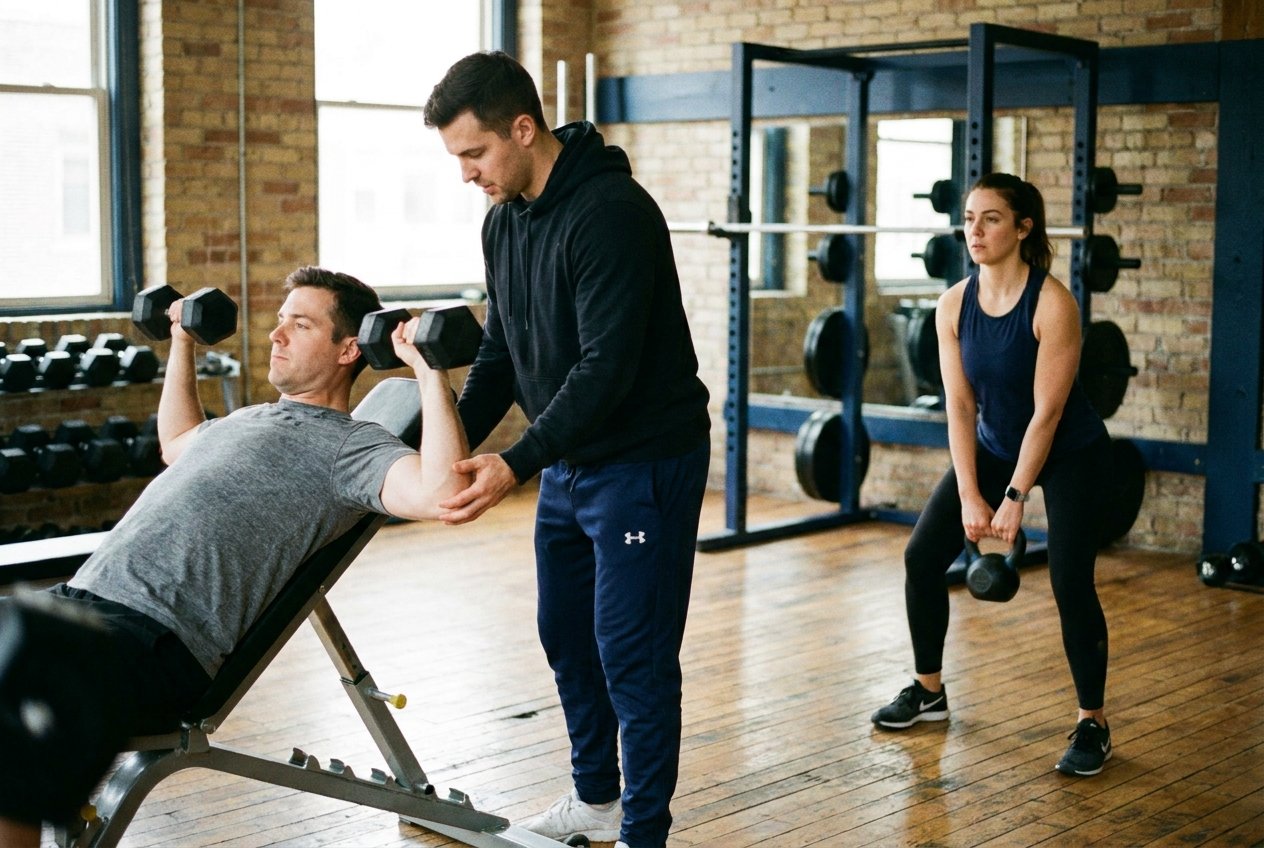
Good coaching shows up in the room. The coach scans positions, adjusts setups, swaps an exercise when needed, and offers one useful cue at a time instead of burying you in corrections. In small-group training the coach-to-client ratio matters, because strength work is technical and someone has to notice the difference between a normal challenge and a pattern that needs to change.
Credentials support the decision without replacing it. The
US Registry of Exercise Professionals verifies fitness professionals against recognized standards, which gives you one quick screening question before joining: who is coaching, and what are they trained to notice?
Pay attention to how a coach handles a struggle. A thoughtful one makes the exercise more successful without making you feel singled out, by lowering the weight, shortening the range, changing the stance, adding support, or switching to a cleaner variation. If the only answer is "push harder," the class may not be built for long-term strength.
Checklist item 4: modifications are built in, not improvised
Real bodies do not arrive with identical shoulders, hips, knees, backs, and recovery. A useful class expects that variation and treats modifications as the route, not a failure. For adults 65 and up, the CDC older-adult activity guidance emphasizes weekly aerobic, muscle-strengthening, and balance work, a reminder that a class should leave room for balance and function, not only intensity.
Safe does not mean easy. A supported squat can still be hard. A reduced-range deadlift still builds strength. A controlled-tempo row can beat a heavier rep done in a poor position. The right modification keeps the training honest while matching the movement to the person, and the options should exist before the workout starts, not get improvised after someone already feels lost.

Checklist item 5: recovery and consistency are respected
A class can be well coached and still be too aggressive if it ignores recovery. Strength improves when the body can absorb the signal, so sleep, stress, work demands, travel, and weekly frequency all matter. The practical theme in current strength guidance is simple: consistency and appropriate effort beat complexity. You do not need the most punishing plan; you need one you can repeat, recover from, and build on.
Ask a few questions before committing:
- How often is the class meant to be attended?
- Are the sessions designed to complement each other across the week?
- What should you do on a week when you feel unusually sore or run down?
Strong answers make room for real life. Weak answers make every day feel like a test.
Checklist item 6: it fits your local routine
Near Pleasant Hill, the best class is not the one with the loudest marketing. It is the one you can attend consistently without turning fitness into another stressful commute. Location, parking, class size, timing, and accountability all decide whether a plan survives past the first month. The Pleasant Hill Recreation and Park District lists adult classes, aquatics, and registration resources, which is a reminder that schedule and location are real factors, even though convenience alone does not prove the class is the right fit.
Price deserves the same context. A cheaper class is not cheaper if you never get enough coaching to progress, and a pricier one is not automatically better. Compare what you are actually paying for: supervision, assessment, progression, modifications, accountability, and confidence.
Green flags and red flags
Once you know what to look for, most classes sort themselves quickly. Use this as a quick scan during a trial session.
| Green flags | Red flags |
|---|---|
| Warm-up that prepares the day's movements | One-size-fits-all loading for the whole room |
| Individual setup and weight choices | Shame-based or "just push harder" motivation |
| Key patterns taught more than once | Everything changes every session |
| Progress tracked beyond attendance | Soreness treated as proof it worked |
| People training at different levels calmly | No clear regressions when something hurts |
| Success measured by control, depth, and confidence | Coach cannot explain why the workout is built that way |
How to test a class, and what the first month should tell you
A trial class should answer more than whether the room feels friendly. Watch the first ten minutes: does the coach learn your name and starting point, ask about history or limitations, and explain what the session is meant to build? During the workout, notice how corrections are handled. The best coaching sounds calm and specific, like "slow the lowering phase," "use this lighter weight today," or "pause at the bottom," and it helps you succeed rather than singling you out.
The first month tells you whether there is a real system behind the energy. You do not need dramatic results in four weeks, but you should be able to explain what you are practicing, what is being tracked, and why the next session makes sense. Look for small signs of order:
- The main lifts repeat often enough for you to improve
- The coach remembers what you used last time
- Modifications stay consistent rather than random
- You know whether the goal is strength, control, conditioning, balance, or a mix
Recovery is part of that read. A good class should leave you challenged but not wrecked for days. Notice how your body responds over the next 24 to 48 hours. Reasonable soreness is normal after a new stimulus, but irritated joints or a wipeout that lasts days is information, and a good coach helps you adjust before it becomes a reason to quit.
When private or partner training makes more sense
A class is a great fit when you already move well enough to follow the group plan and only need light individualization. Private or partner training is often the better first step when pain varies week to week, when you are coming back from injury, when balance or confidence is a real concern, or when your goals are very specific.
In our own Strength and Range of Motion Assessment, the limiter we most often see in people deciding between a class and private coaching is not motivation. It is a movement or joint issue they cannot self-monitor in a busy room, like a hip that shifts under load or an overhead position that is not ready yet. That is the kind of thing one-on-one coaching resolves quickly, after which a class becomes a great place to keep building.
The decision is rarely class versus training forever. It can be a sequence: start with a
Strength and Range of Motion Assessment, build a baseline through private coaching, then move into a small-group format once the plan is clear. At Royal Blue Fitness, our four-phase system, assess, build fundamentals, integrate, and progress, is designed to match that path to the person rather than throw you into a workout built for no one in particular.
Frequently Asked Questions
What should I look for in a strength training class?
Look for assessment, visible coaching, planned progression, built-in modifications, and a class size that lets the coach see how you move. A good class builds strength over time rather than just making you tired that day.
How do I know if a class is safe for me?
It is more likely to fit when the coach asks about your history, starts you at the right level, offers modifications, and explains what to do when something feels wrong. If you have medical restrictions, new symptoms, or changing pain, get medical guidance before relying on a group class as your main plan.
Is small-group training better than random workouts?
It is better when it uses a real progression system. Random workouts create effort but make progress hard to track, while a good class repeats the important patterns often enough for you to improve.
How often should I attend?
Many adults progress with two well-designed sessions per week when the plan is consistent and recoverable. More is not automatically better, since the right frequency depends on your history, recovery, goals, and the rest of your week.
What should I ask before joining?
Ask how the class handles beginners, injuries, modifications, progression, coaching ratio, missed sessions, and recovery. The answers should be specific enough to reveal a system behind the workout.
What if I am dealing with shoulder, knee, hip, back, or post-rehab concerns?
Ask the coach directly how those are handled, and what the class is not designed to do. A coach who can explain who should start with private training, who needs medical clearance, and who fits the class is giving you the honesty that makes the decision easy.
Ready for a strength plan that fits your body?
Start with a
Strength and Range of Motion Assessment when you want to know whether a class, private coaching, or partner training is the right next step. It turns "which class should I try?" into a clear plan you can follow and re-test.
Here are our latest articles! Click to read more.