Fitness for Busy Adults on the Go: Staying Strong on the Road
Busy adults on the go do not usually fail because they are lazy. They lose rhythm because the environment keeps changing. One week has normal training times, familiar equipment, and predictable meals. The next week has flights, meetings, family obligations, hotel rooms, traffic, and work spilling into the time that normally belongs to movement.
That is why the answer is not just more discipline. You need a fitness system that can travel with you. It has to be simple enough to use when your schedule is messy, but strong enough to protect the qualities that matter most: strength, mobility, walking tolerance, energy, and confidence. The CDC recommends that adults get
both aerobic activity and muscle-strengthening work each week, and it makes an important point for busy people: that activity can be spread across the week and broken into smaller chunks.
Your routine does not have to be perfect to keep working
A perfect routine is fragile. It depends on the same location, gym access, schedule, and energy level. A portable routine is stronger because it gives you options.
The goal on the road is not to hit a personal record every time you move. The first goal is to keep the thread connected. When you can still train, walk, stretch, carry, or reset during a disruptive week, you return home with momentum instead of guilt.
The frustration here is specific: you can be consistent when life is stable, but your schedule is not built around stability. That means the plan has to remove shame from the equation. A missed gym day during travel is not a character flaw. It is a planning problem, and planning problems can be solved with flexible options.
A portable plan also protects identity. Even after you move on from a hard week, you still feel like a person who trains. That matters because consistency is not only physical. It is behavioral. It is the pattern of proving that your health does not disappear just because the calendar gets loud.
What does staying strong on the road really mean
Staying strong does not mean recreating your full gym program in a hotel room. It means protecting the movement patterns and habits that make you feel capable in real life.
For most busy adults, the road fitness target is simple: keep your legs working, keep your hips and spine moving, keep your upper body engaged, keep walking volume alive, and avoid letting stiffness become the loudest part of the trip.
| Priority | Why it matters |
|---|---|
| Squat and step strength | Supports stairs, chairs, luggage, and daily movement |
| Hinge and hip control | Helps manage sitting stiffness and back comfort |
| Push and pull strength | Keeps upper body strength from disappearing during travel |
| Core and carry work | Supports posture, luggage handling, and trunk control |
| Walking volume | Keeps conditioning alive without requiring a gym |
| Mobility resets | Prevents long-sitting stiffness from building all week |
Build the plan around movement patterns, not equipment
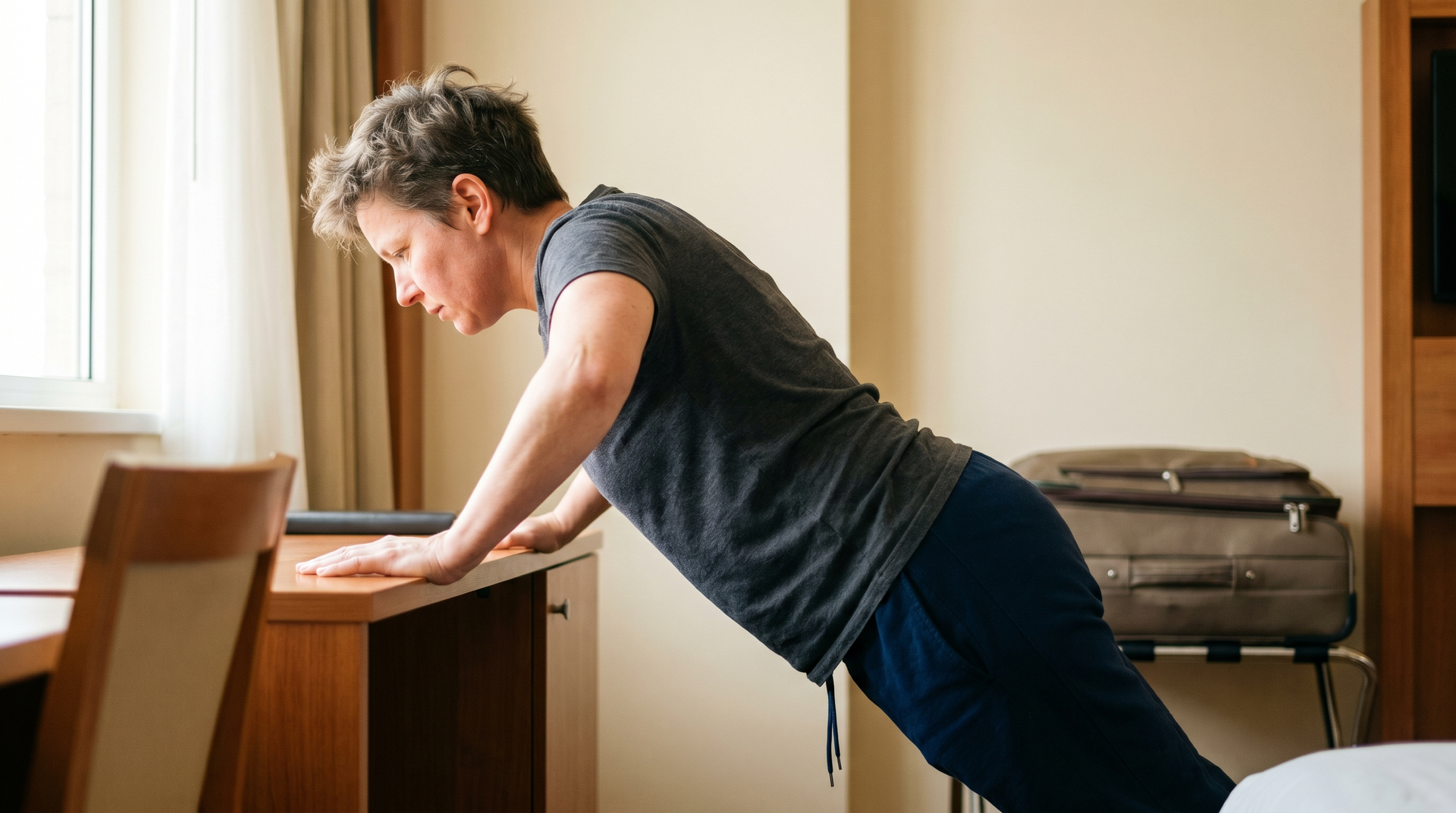
Equipment changes. Movement patterns travel. A chair can support sit-to-stands or incline push-ups. A backpack can become a light load for rows, carries, squats, or hinges. Stairs can become a conditioning tool. A resistance band can create pulling work almost anywhere.
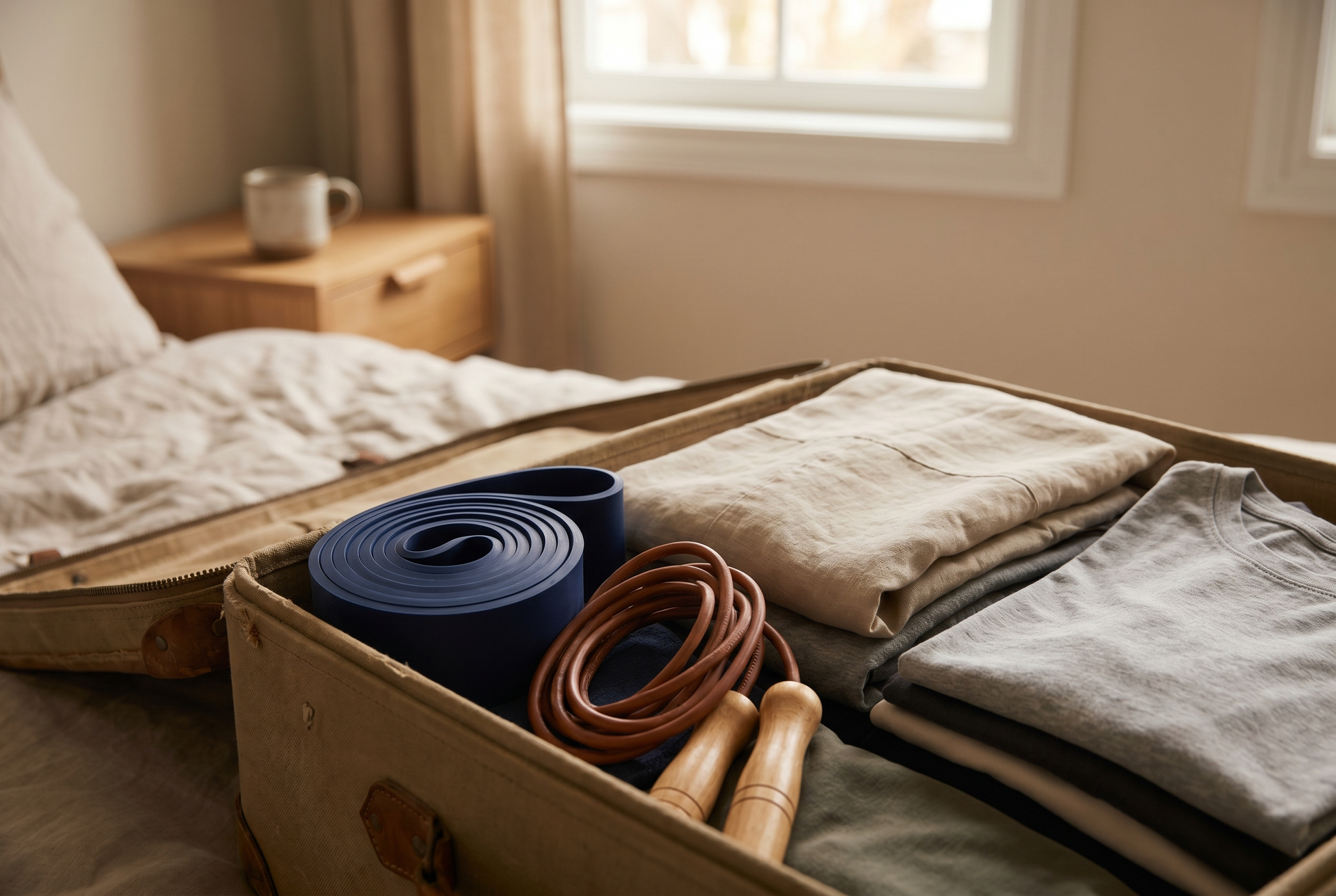
This is why we tend to think in patterns first. Squat. Hinge. Push. Pull. Carry. Rotate. Walk. If your routine touches those patterns across the week, you can maintain more than you think.
This movement-pattern lens keeps the plan from relying on a single tool. If you cannot pull from a cable machine, you can row with a band or backpack. If you cannot squat with weights, you can use a tempo sit-to-stand. If you cannot carry dumbbells, you can carry luggage or a loaded backpack. The tool changes, but the training category stays alive.
That is also why the road version does not need to feel like a downgrade. It is not the full program, but it keeps the nervous system, joints, and muscles engaged with the same skills you use at home. That makes the return to normal training smoother.
Choose the workout that matches the day
Busy adults often treat every missed workout as a debt that has to be repaid with interest. That is how a travel day turns into a punishment session. A better question is: what does this day need?
On a good-energy day, do a short strength session. On a low-energy day, walk and move. On an arrival day, reset before you train. On a long workday, use movement snacks. The workout should fit the day well enough that you can repeat it.
| Day type | Best training choice |
|---|---|
| Good-energy day | 20 to 35 minutes of strength maintenance |
| Low-energy day | Walk, mobility, and light core work |
| Travel day | Short movement snacks before and after sitting |
| Arrival day | Hydration, daylight, walking, and easy mobility |
| Busy workday | 10 to 20 minutes of functional strength |
A simple road fitness week
A realistic travel week does not need to be complicated. Two short strength sessions, two walking or conditioning sessions, and daily mobility can keep your body from feeling like it vanished from your normal life.
The mistake is assuming the week only counts if it looks like your home routine. It counts if it protects momentum. It counts if it keeps you moving. It counts if it helps you return home ready to continue instead of restart.
For example, a travel-heavy week might include a 20-minute strength session on Monday, a long walk on Tuesday, a 10-minute mobility reset after a flight on Wednesday, a short bodyweight circuit on Friday, and a longer outdoor walk over the weekend. That is not random. It protects strength, conditioning, mobility, and habit rhythm with enough flexibility to survive the trip.
The weekly floor matters more than the perfect week. When you know the smallest version that still counts, you stop negotiating with yourself every day. National activity guidance makes the same point in its own way:
the activity you can sustain across the week is what delivers the benefit, so you simply choose the best option available and keep moving.
Common mistakes busy adults make on the road
The first mistake is waiting for the perfect gym. The second is skipping everything because the full workout is not available. The third is going too hard after days of sitting. The fourth is treating stiffness as something to ignore until it becomes pain.
A stronger approach is to lower the barrier without lowering the standard. You still train. You just use the version that fits the week.
How Royal Blue Fitness helps routines survive real life
At Royal Blue Fitness, the goal is not a plan that only works during perfect weeks. A good plan should survive work stress, travel, family demands, fatigue, and the occasional messy calendar. That starts with knowing your baseline strength, range of motion, mobility limits, and recovery patterns.
If your routine falls apart every time life changes, the problem may not be a lack of motivation. It may be that your plan has no flexible version. Knowing your baseline is what lets us identify what to protect when you are busy, on the road, or rebuilding consistency.
In the assessment, we are looking for the two or three patterns that fade fastest when your weeks get chaotic, often a hinge that stiffens after long sitting or a carry that slips when you are tired, and we build your travel floor around protecting exactly those. The travel floor is the smallest version of your week that still counts, so a messy stretch defends your hard-won patterns instead of erasing them.
This is where assessment is practical rather than formal. If your hips always tighten when you travel, if your back always complains after sitting, or if you lose strength quickly when your week changes, those patterns give us information. We can build a plan that prioritizes the movements your body most needs to maintain.
The goal is not to make every week look the same. It is to make your body more resilient across different weeks. That is a different kind of consistency, and it fits the reality of busy adults far better than an all-or-nothing calendar.
Frequently Asked Questions
Can you stay strong without a gym?
Yes. You may not build every quality at the same pace, but you can maintain strength, mobility, and conditioning with bodyweight work, walking, bands, backpacks, and smart exercise selection.
What is the minimum useful workout?
Ten to 20 minutes can be useful when it includes a brief warm-up, two to four strength patterns, and a short walk or mobility finish.
Should you train hard when traveling?
Sometimes, but not every travel day deserves intensity. Match the workout to your sleep, energy, stiffness, and schedule.
Build a road plan around your real baseline
If your routine keeps collapsing the moment life changes, the fix usually is not more willpower; it is a plan with a flexible version built in. A
Strength and Range of Motion Assessment gives us that baseline: which patterns to protect, where your mobility limits are, and how to keep you moving through a messy week. For anyone training around Pleasant Hill or the East Bay who travels or runs a packed schedule, it is a straightforward first step toward consistency that survives real life.
Here are our latest articles! Click to read more.