Machines Are Not Cheating: When Strength Machines Are the Smarter Choice
Walk into almost any gym and you will eventually absorb the message, sometimes said out loud, more often just implied by where the serious-looking people train: machines are the easy option, and free weights are where the real work happens.
If you have ever felt vaguely guilty for using the leg press or the chest press, as though your workout did not quite count, that belief is doing you a disservice. Machines are not cheating, and they are not a lesser tier of training. They are a different tool with real strengths, and for some people and some goals, they are genuinely the smarter choice.
This article unpacks where the belief comes from, what machines actually train, and when reaching for one is the wise move rather than a compromise. You will not find any guilt here, and you will not find a verdict that one tool is simply superior. By the end, the leg press should feel like a deliberate choice rather than a quiet confession.
Why does this belief feel true
The idea that machines are easy mode did not appear from nowhere, and it is worth respecting before correcting it. Free weights demand balance, coordination, and full-body control, so they look and feel harder, and that visible difficulty gets equated with effectiveness.
There is a cultural layer too: the strongest-looking people in many gyms gravitate toward barbells, so the barbell area carries a kind of status that the machine section does not. The belief feels true because machines genuinely remove one specific demand, the need to stabilize the weight yourself.
What it gets wrong is assuming that removing the stability demand removes the work. It does not.
Think of the difference between hiking a rugged trail and climbing a stair machine at the gym. The trail demands balance and coordination; the stair machine does not, so it feels harder and looks more impressive. But your legs are doing real, hard work in both cases.
The stair machine simply strips out the balancing while keeping the effort, and no one would seriously argue that your legs got a free ride. Machines do the same thing for resistance training: they remove a layer of difficulty without removing the part that actually builds strength.
What machines actually train
Strip away the gym hierarchy and look at what is physically happening, and the picture changes. When you press, pull, or push against a machine, your muscles still have to produce force against resistance, which is the fundamental driver of getting stronger.
The machine guides the path of the movement, but it does not lift the weight for you. Your muscles do.
Understanding this is the key to letting go of the guilt, because the thing that builds strength, working hard against meaningful resistance, is fully present on a machine.
It helps to separate two things that often get blurred together: the difficulty of controlling a movement and the difficulty of the work itself. Machines reduce the first while preserving the second.
That is not a shortcut around effort; it is a redirection of your effort, away from balancing and steering the weight and toward simply moving it hard. For a great many goals, that redirection is exactly what you want, because it lets you pour your energy into the muscle rather than into not tipping over.
Guided load is still real load
The single most important point is this: a guided load is still a real load. A 2023 systematic review and meta-analysis comparing machine and free-weight training found no meaningful difference between them for muscle growth or strength, with strength gains tending to be specific to whichever tool you train.
Your muscles do not know whether the resistance is hanging from a barbell or running through a cable and a pulley. When researchers had men and women
train for weeks on either machines or free weights, both groups gained the same amount of muscle.
The guidance the machine provides changes the experience, not the fundamental stimulus. The
National Strength and Conditioning Association lists machines as a standard category of resistance-training equipment, not a lesser substitute.
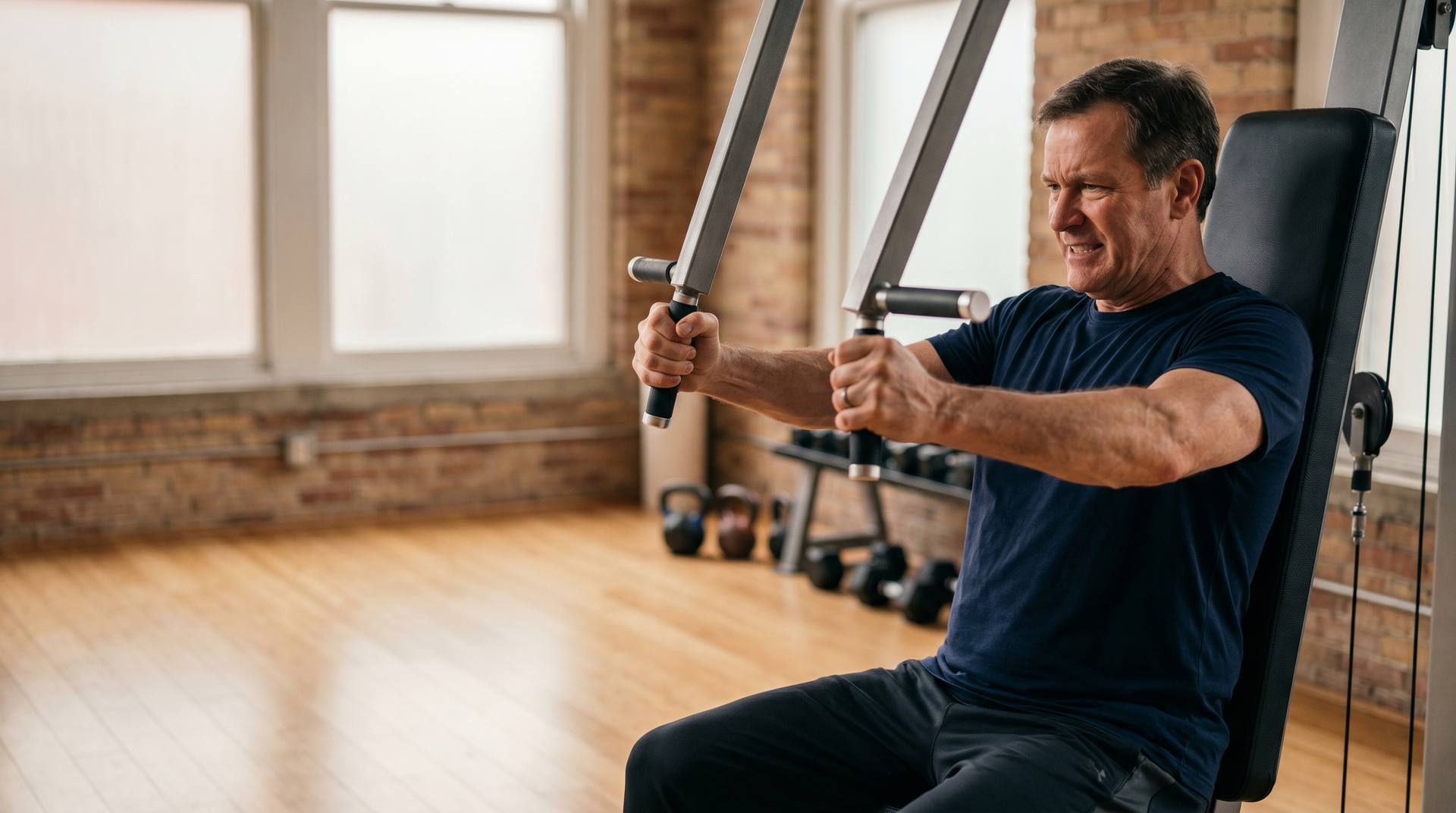
This is worth sitting with if you have ever felt your machine workout did not really count. A challenging set on a chest-press machine, taken close to the point where one more rep would be genuinely hard, delivers a real growth stimulus to your chest, shoulders, and triceps.
The plates moved, the muscles worked near their limit, and the adaptation that follows does not care in the slightest that a frame guided the path. Effort and progression are what your body responds to, and both are fully available on a machine.
Where machines genuinely shine
Once you stop seeing machines as a compromise, their real advantages come into focus, and they are substantial. There are specific situations where a machine is not just acceptable but actively the better tool, and recognizing those situations is what separates smart training from gym superstition.
Learning movements and building confidence
For anyone new to strength training, machines lower the barrier in a way that genuinely helps. By guiding the movement path, a machine lets you focus on generating effort and feeling the target muscle work without first having to master the balance and coordination that a free-weight version demands. The American Council on Exercise notes that machines are generally safer and easier to use, an advantage for beginners learning a specific movement.
That early confidence is not a small thing. It is often what keeps a beginner training long enough to progress to anything else.
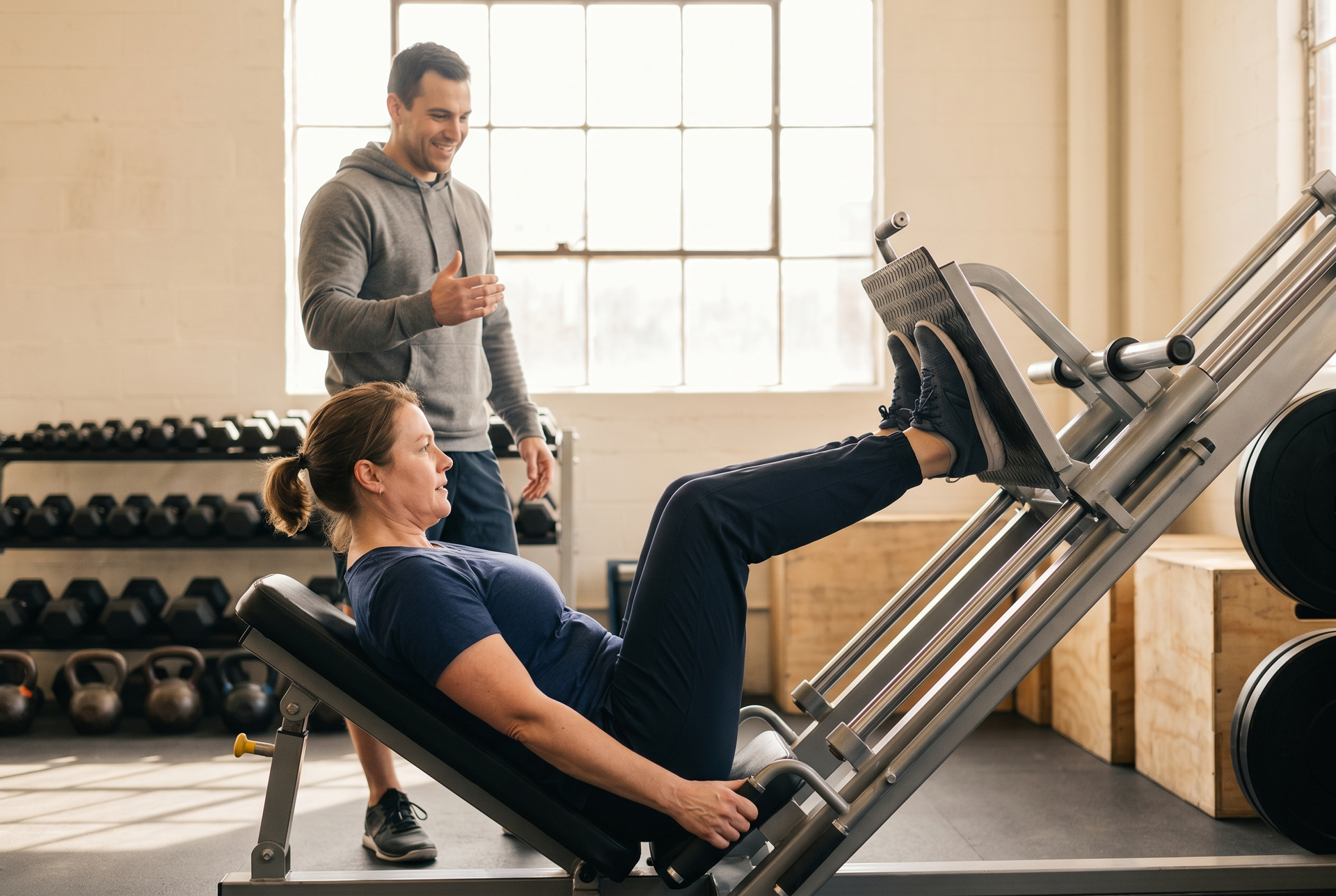
Picture someone intimidated by the squat rack who can nonetheless sit down at a leg press and train their legs hard from day one. That person is not avoiding the work; they are accessing it.
The base of strength and confidence they build on machines is frequently the very thing that makes free-weight movements approachable a few months later, rather than an intimidating wall they never get over. Starting where you can succeed is a feature, not a failure.
Training solo and pushing safely
If you train alone, machines offer a safety advantage that free weights cannot easily match. On most machines, you can push close to your limit and simply stop when you are done, without the risk of being pinned under a barbell with no one to help. This means you can train hard, even to the edge of your capacity, with a wide margin of safety.
That safer fail point lets a solo lifter chase real effort without the gamble heavy free weights can involve when no spotter is present.
For a home gym or a solo session, this quietly changes what hard training can look like. You can take a machine set right up to the edge of your capacity and simply stop, with no bar to bail and no one needed to rescue you.
That ability to safely approach genuine effort on your own is not a minor convenience. For many people, it is the difference between actually training hard and unconsciously holding back out of self-preservation.
After injury or with specific limitations
For people returning from an injury or working around a specific limitation, machines can allow training a muscle while controlling how much the area has to stabilize, which some find more comfortable. This is exactly where the non-judgment matters most.
That said, this article is general education, not rehabilitation guidance. If you are recovering from an injury or managing a medical condition, your physical therapist or medical provider is the right person to advise you on what is appropriate for you. The point here is simply that machines are a valid option, not that they replace professional care.
The broader takeaway is that having more tools, not fewer, gives you more ways to keep training around whatever your body is dealing with on a given day. A tool that lets you work within your current limits is not a downgrade. It is what keeps you moving forward instead of stopping altogether.
How we choose at Royal Blue Fitness
Here is where the principle becomes practical. In our Strength and Range of Motion Assessment, we look at how each joint tolerates load and where control tends to break down under fatigue. That read decides where a machine earns its place in your program.
If a shoulder flares on a free-weight press, or a knee a few weeks out of rehab needs a fixed, predictable path, we will often start that pattern on a machine and keep free-weight versions for the movements you already own. As your assessment numbers improve, we migrate pattern by pattern toward free weights where it makes sense for your goals. The machine is frequently the on-ramp, not the destination, and for some clients it stays in the plan for good because it is simply the best fit for that joint.
Where machines fall short (and how to fill the gap)
Honesty cuts both ways, so it is worth naming what machines do not do as well. Because the machine handles stability for you, your stabilizing muscles and your balance get less of a workout, and the movement pattern is set by the machine rather than by your own body.
Free weights and bodyweight movements develop the coordinated, real-world strength that transfers to unpredictable daily tasks, which a fixed path cannot fully replicate.
University strength staff make the same point, noting that machines do not develop the stabilizing structures that support the major joints the way free movement does.
The practical fix is not to abandon machines but to combine them with free-weight or bodyweight work over time, so you get both the focused, safe loading machines provide and the transferable control that free movement builds. A simple way to hold it in mind: machines are excellent at letting you work a muscle hard, and less able to teach your body to coordinate and balance under load.
Both qualities matter for a genuinely capable body. So the gap is real, but the answer is addition rather than avoidance.
The better principle: tools, not tiers
Here is the principle worth replacing the myth with: strength training tools are not ranked in tiers; they are different instruments for different jobs. A machine is not a beginner's version of a barbell any more than a screwdriver is a beginner's version of a hammer. Each does something the other does not do as well.
The strongest, most sustainable approach for most people uses whatever tool best fits the goal, the moment, and the body in front of it. A
randomized trial in novice trainees found similar gains in strength and everyday function no matter which they used, echoing the American College of Sports Medicine's guidance to choose equipment based on your goals and experience. Sometimes that is a barbell, sometimes a dumbbell, and sometimes, genuinely, a machine.
Choosing the right tool for the job is not cheating. It is exactly what skilled training looks like.
The lifters who keep progressing for years tend to hold all of this loosely. They reach for a barbell when transferable, whole-body strength is the goal, for a machine when safety-focused loading or learning a movement is the goal, and they feel no need to justify either choice to anyone.
The question was never whether a given tool is respectable enough. It is only ever whether it is the right tool for the job in front of you today.
Frequently Asked Questions
Can I build real muscle using only machines?
Yes. If you train with genuine effort and progressively increase the demand over time, you build muscle and strength effectively. Many people make excellent progress on a machine-based program, especially when starting out, training alone, or working around a limitation. The factors that drive results, effort, consistency, and progression are all fully available on machines. Adding free-weight movements later brings additional benefits, but they are not required for real progress.
Are free weights better than machines?
Neither is universally better, because they do different things. Free weights build more stabilizing strength and transferable control, while machines lower the skill barrier and let you train hard safely on your own. The best answer for most people is to use both, choosing the tool that fits the goal and the moment. Framing one as superior misses the point that they are complementary, not competing.
Is it okay to use machines if I am recovering from an injury?
Machines can be a comfortable option for some people in this situation, but the right answer depends entirely on your specific circumstances, and that is a question for your physical therapist or medical provider, not a general article. This guide is education, not rehabilitation advice. If you have been cleared to train and are looking for tools that let you work within your limits, machines are worth discussing with the professional guiding your recovery.
Will machines make me look like a beginner?
The only people keeping score on which equipment you use are not paying attention to their own training. Using machines reflects smart tool selection, not inexperience. Plenty of strong, experienced lifters use machines deliberately to add safe volume, isolate specific muscles, or train around a cranky joint. Your results come from how hard and how consistently you train, not from which corner of the gym you train in.
Should beginners start with machines or free weights?
Either can work, and many beginners benefit from a mix. Machines are excellent for building early confidence and learning to use muscles safely, while a few foundational free-weight or bodyweight movements help develop balance and control. A sensible beginning often uses machines to build effort and confidence while gradually introducing free movement, rather than treating it as an all-or-nothing choice.
Do machines or free weights burn more calories?
The difference in calories burned between a machine and a free-weight version of the same exercise is small and not a meaningful basis for choosing between them. What actually drives your results is how hard you train and how consistently you progress, not a minor difference in energy cost during the set. Choose the tool that lets you train hard and safely for your situation, and let effort and consistency, rather than a calorie estimate, do the real work.
Use every tool that moves you forward
The belief that machines are cheating costs people confidence, and sometimes costs them the very tool that would serve them best. Machines are not easy mode, and they are not a lesser tier. They are a legitimate, often smart choice for learning, for training hard alone, and for working within your body's current needs. The skill is in matching the tool to the job.
Matching the tool to the job, though, starts with an honest read of what your body is ready for, which is hard to judge from inside the same gym-floor assumptions this article set out to undo. That read is what a
Strength and Range of Motion Assessment provides: a clear picture of where your strength and movement stand today, so the tools in your program are chosen for your body rather than by gym folklore. For anyone around Pleasant Hill or the East Bay returning to training after a layoff or an injury, it is an especially useful place to begin. The leg press was never the confession the gym made it out to be.
Here are our latest articles! Click to read more.