Golfer's Elbow Keeps Coming Back Because It Is Not Just an Elbow Problem
You know the cycle. The inside of your elbow starts to ache, so you rest it, stretch the forearm, maybe add a brace, and after a couple of weeks, it settles down. You feel ready, so you head back to the range or string together a few rounds, and within days, the same nagging pain on the inner elbow is back.
Rest, stretch, brace, relapse, repeat. Maybe the brace even worked for a month, which made the next flare more confusing because what had helped last time suddenly didn't.
It is a frustrating loop, and most golfers read it as proof that their elbow is fragile or that they did something wrong. The more useful read is different. Recurring golfer's elbow is rarely just an elbow that will not heal.
It is usually a mismatch between what the arm is being asked to do and what it can currently handle, and the elbow is the part that ends up paying the price.
This article is not a diagnosis, and persistent or severe symptoms warrant a consultation with a qualified professional. From a coaching perspective, the goal is to explain why the pain keeps returning and what actually changes the pattern.
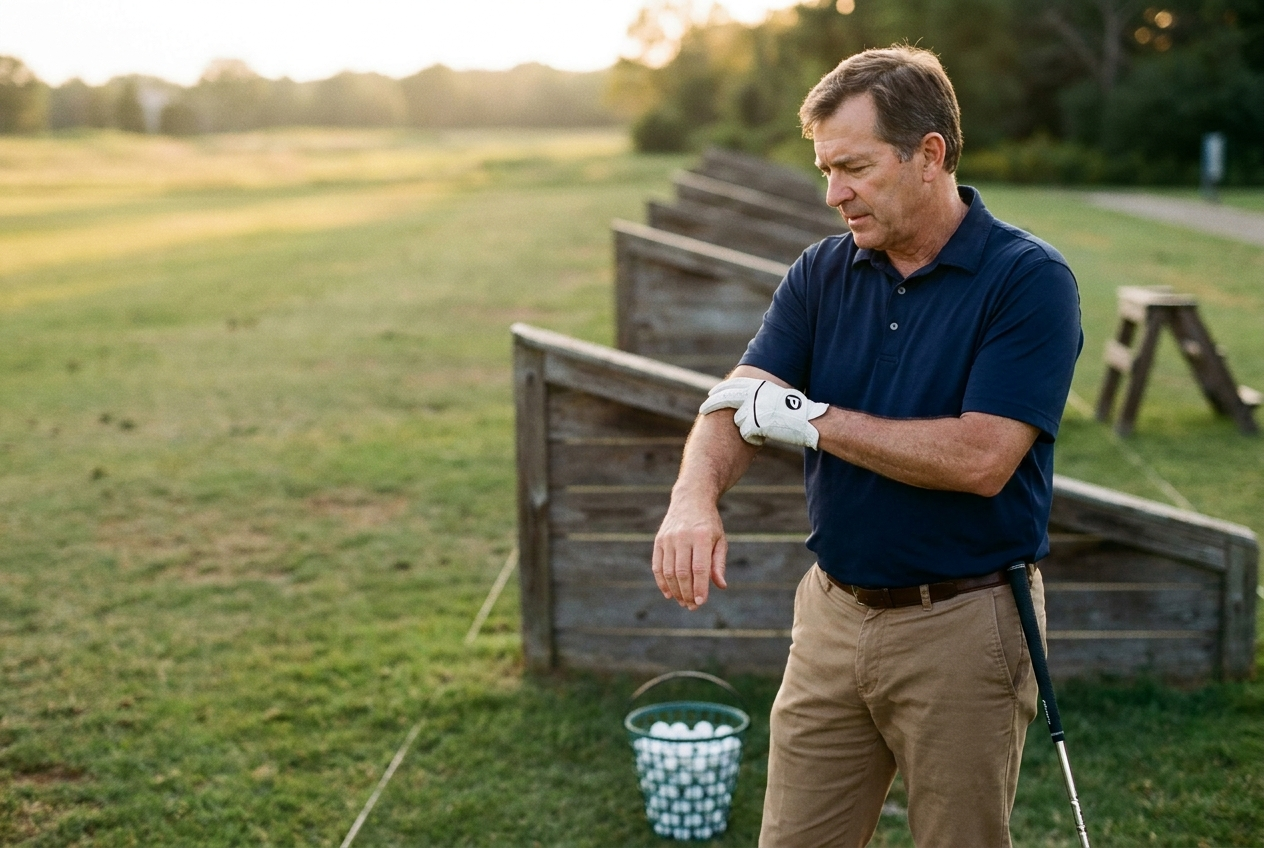
The mistake: treating golfer's elbow like an isolated elbow problem
When pain is in one spot, it feels obvious to treat only that spot. So the plan becomes rest the elbow, stretch the elbow, brace the elbow, and wait. That can genuinely help in the short term, especially when the area is irritated, because reducing the load allows the irritated tissue to calm down.
The trouble is that calming the symptom and changing the cause are two different jobs. If the same gripping, swinging, and lifting demands return unchanged, the elbow gets asked to tolerate exactly what overwhelmed it before. Nothing about the forearm's capacity, the grip endurance, the wrist control, or the way the rest of the body shares the swing has actually moved.
So the elbow does the only thing it knows how to do under that load. It complains again. Picture the golfer who takes three weeks off, feels great, then plays in a weekend tournament and hits two large buckets to warm up beforehand.
The elbow was quiet, but it was never prepared for that jump, so the spike landed on the same tissue that was overloaded the first time.
Golfer's elbow, what it actually is and what it is not
Golfer's elbow, known medically as medial epicondylitis, is an irritation of the tendons that attach the forearm muscles to the bony bump on the inside of the elbow. Cleveland Clinic describes it as a tendon problem that builds up from repeatedly bending, gripping, and twisting with the wrist and forearm, and notes that left unaddressed, it can drag on and even weaken your grip over time.
One detail matters more than it sounds. Despite the old "-itis" name, chronic golfer's elbow is usually less about active inflammation and more about a tendon that has been loaded faster than it could adapt. That reframe is the whole point.
A tendon that has lost capacity does not need to be protected forever. It needs to be rebuilt. And rebuilding capacity is a different project than waiting for inflammation to fade, which is why the rest-and-wait approach so often stalls.
It also explains why anti-inflammatory measures alone tend to disappoint over the long run: if the core issue is a tendon that lost its tolerance for load, calming inflammation that is barely there was never going to restore that tolerance.
This is also not the same condition as tennis elbow, which affects the outer elbow. The inside-of-the-elbow location is the tell, and it points straight at the muscles you use to grip and flex the wrist, the exact muscles a golf swing leans on.
It is also why a wrist or forearm that aches after a long-range session, not just during the swing itself, is often part of the same story rather than a separate problem.
The pain keeps coming back because of a load-capacity gap
If you want one idea to take from this article, it is this: recurring elbow pain is usually a gap between load and capacity. The activity demands more from the forearm and tendon than the tissue can currently tolerate, and until that gap closes, the symptom keeps returning.
Rest lowers irritation but does not build capacity
Rest is not the villain here. It is genuinely useful early, when the tissue is irritable and needs the load turned down. The problem is expecting rest to do a job it cannot do.
Time off lowers irritation, but it does not add capacity, and it can quietly let the surrounding muscles get weaker while you wait. So you come back to the same activity with a calmer tendon but no stronger, which sets up the next flare.
The frustrating part is that the calmer it feels, the more confident you are to load it hard again, which is exactly when the gap bites.
A clinical reference from the National Library of Medicine makes the pattern explicit: medial epicondylitis tends to recur when
a rapid return to high-demand activity is not supported by adequate conditioning, and it points to comprehensive programs that build the forearm, shoulder girdle, and core as the way to lower that risk. In other words, the missing ingredient is not more rest. It is rebuilding.
The relapse pattern, step by step
The loop tends to run the same way every time. Pain rises, so activity drops. Symptoms settle, so confidence returns.
Activity jumps back to where it was, and because nothing built the tissue up in between, the pain rises again. Each lap through the loop can feel a little more discouraging, and many golfers conclude the elbow is just permanently bad. It usually is not.
The cycle is simply missing the one step that changes it, which is a gradual rebuild of capacity before the return to full load. The good news hidden in that pattern is that the loop is fixable. A tendon that can be rebuilt is a very different prognosis than an elbow that is simply worn out, and most recurring golfer's elbow falls into the first category.
The grip, wrist, shoulder, and trunk connection
Here is where the "not just an elbow problem" idea earns its keep. The elbow sits in the middle of the arm, between the hand and the shoulder, so it absorbs stress from both directions.
The forearm inherits stress from both directions
If your grip demand is high, the forearm works harder to hold and control the club. If the wrist lacks control, the elbow ends up managing motion that the wrist should have handled. If the shoulder lacks endurance, the arm tends to grip and steer harder to create a sense of control.
And if the trunk and hips are not contributing to the swing, the arms produce more of the force on their own. A case report in JOSPT Cases describes exactly this approach in practice for medial elbow pain, pairing progressive loading of the tendon with
addressing the larger functional chain rather than treating the elbow in isolation.
The forearm is often just the structure that inherits everyone else's unfinished work. Think of the golfer who sits at a keyboard all week with little grip demand, then plays thirty-six holes on a Saturday.
The grip endurance was never there to begin with, so by the back nine, the forearm is doing a job it was never conditioned for, and the inner elbow is the first place that shows it.
Belief versus what is actually happening
The gap between how golfer's elbow feels and what is actually driving it is wide, which is why the obvious fixes underwhelm.
| What it feels like | What is often actually happening |
|---|---|
| The elbow is the problem | The elbow is the symptom of load it cannot yet handle |
| Rest will fix it | Rest calms it, but capacity has to be rebuilt |
| Stretching loosens the tightness | Stretching eases tension without adding tolerance |
| It is only an elbow issue | Grip, wrist, shoulder, and trunk all feed the load |
| It came back because I am fragile | It came back because the return outpaced the rebuild |
Golfer habits that keep feeding the problem
Golf has its own ways of widening the load-capacity gap, and most of them are habits rather than flaws. Over-gripping is the big one. When you squeeze the club too tightly, tension runs straight up the forearm, and the muscles that attach at the inner elbow stay switched on far longer than they need to.
Hospital for Special Surgery points out that the golf swing specifically drives up activity in the
pronator teres, an inner-forearm muscle, during the acceleration phase, and that a follow-through powered by turning the wrist over adds even more strain on the inside of the lead elbow.
Add the common pattern of an arm-dominant swing, where the trunk stops contributing, and the arms take over, and a sudden spike in practice volume, like a new weekly range habit or a golf trip, and you have the recipe the elbow keeps describing. None of these feels dramatic in the moment, which is exactly why they repeat. Pressure shots make it worse.
The tee shot you are nervous about is usually the one you squeeze hardest, so the rounds that matter most to you can quietly be the ones that load the elbow the most.
Stretching alone is usually not enough
Stretching is not useless. When the forearm feels guarded and stiff, gentle stretching can take the edge off and make movement more comfortable. The mistake is treating it as the whole plan.
Stretching lengthens and soothes, but it does not teach the tendon to tolerate greater load, and tolerance is what you actually ran out of. The physical therapy guidance from the American Physical Therapy Association centers on
progressive strengthening, starting with gentle muscle contractions and progressing to resistance work, alongside education and adjustments to your grip and swing.
That combination, load plus technique, is what closes the gap. Stretching by itself tends to leave it exactly where it was. If stretching alone had been the answer, the loop would have ended several relapses ago.
The same logic applies to braces and rubs: they can make a flare more comfortable, but comfort is not the same as the capacity that lets you play without the flare.
A better progression rebuilds capacity, not just calm
A plan that actually breaks the loop is built around gradually rebuilding what the activity demands, not just quieting the symptom for a week. It tends to move through a few connected layers.
Forearm, grip, and wrist capacity
The foundation is teaching the forearm and grip to tolerate load again, built gradually rather than aggressively. That usually means progressive strengthening of the wrist and forearm and a steady rebuild of grip endurance, so holding and controlling the club no longer sits at the edge of what the tissue can handle. Wrist curls with a light dumbbell, slow towel wrings, and farmer carries are the kind of simple staples this stage runs on.
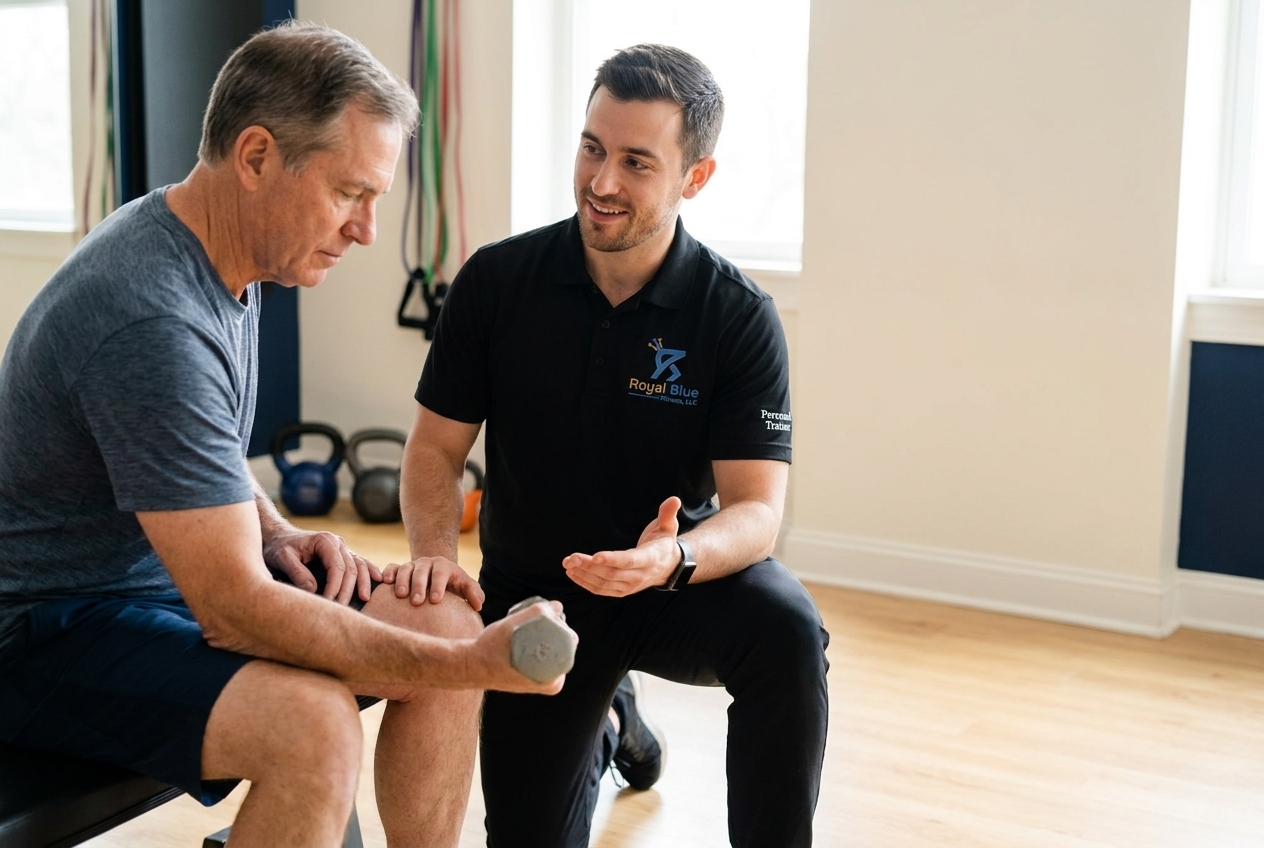
A useful sign of progress is that everyday gripping, carrying groceries, opening a jar, and holding a club at address stop feeling like a test. The wrist gets attention too, so it can move and stabilize well enough that the elbow is not left managing every small change in club or hand position.
Shoulder support, trunk rotation, and workload
Capacity higher up the chain takes pressure off the elbow. A shoulder with good stability and endurance means the arm is not gripping and steering to feel in control, and that trunk and hips actually rotate means the arms are not the only engine in the swing. Band external rotations and standing trunk rotations cover a lot of that ground. Workload is the last piece and often the most overlooked.
A recovering elbow may tolerate a small amount of activity well before it tolerates full buckets, full rounds, or back-to-back golf days, so the return is staged rather than switched back on all at once. A practical version might start with a few controlled swings and build over weeks, rather than going straight from rest to full rounds because the elbow felt fine on a quiet Tuesday.
Some elbow pain needs medical attention
Coaching complements medical care; it does not replace it. Seek guidance from a qualified professional if your elbow pain is severe or steadily worsening, follows a specific injury, comes with numbness, tingling, or weakness running into the hand, or simply is not improving despite sensible load management.
As a practical marker, NHS guidance on golfer's elbow suggests that if symptoms have not improved within
about six weeks of self-management, it is worth talking to a healthcare professional. Loading should challenge the tendon to a level that aches but settles by the next morning, not pain you push through.
Royal Blue Fitness rebuilds durable elbow capacity
If you recognize the rest-stretch-relapse loop in your own elbow, the way out is usually not another stretch for the sore spot. It is closing the gap between what your arm is asked to do and what it can currently tolerate, across the grip, wrist, shoulder, and trunk.
At Royal Blue Fitness, we look at recurring elbow pain through that wider lens: what the arm is being asked to handle, what the rest of the body is contributing, and where capacity needs to be rebuilt so the activity stops outrunning the tissue.
That work often includes grip and forearm strengthening, wrist and shoulder support, trunk rotation, and a staged return to the activity that matters to you. If you are tired of calming the same elbow over and over, a Strength and Range of Motion Assessment is a straightforward way to find the real bottleneck and start rebuilding durable capacity rather than temporary relief.
Book your assessment and stop calming the same elbow over and over.
Frequently Asked Questions
Why does golfer's elbow keep returning?
It usually returns because the symptoms calm down well before the tissue, grip endurance, and movement mechanics have actually been rebuilt. Rest reduces irritation, so the elbow feels ready, but the capacity that ran out in the first place has not been replenished. When the old gripping and swinging load comes back unchanged, the gap is still there, and the elbow flares again.
Closing that gap with a gradual rebuild is the step the loop is missing.
Is stretching enough for golfer's elbow?
Stretching can help a stiff, guarded forearm feel better, but on its own, it rarely fixes recurring golfer's elbow. Stretching eases tension without adding the load tolerance the tendon actually needs. Lasting progress usually comes from gradually strengthening the forearm, grip, wrist, and shoulder, and from managing how quickly you return to full activity.
Think of stretching as one supporting tool, not the whole plan.
What kinds of exercises help golfer's elbow?
In general, progressive strengthening of the forearm and grip, paired with wrist and shoulder work, tends to do more than stretching alone, because it rebuilds the tendon's tolerance for load. The specific exercises, intensity, and pace should fit your situation, which is where an assessment or a qualified professional helps.
As a rule of thumb, loading should feel like a tolerable ache that settles by the next morning, not pain you push through.
Should I keep golfing with elbow pain?
It depends on how the pain behaves. If it is sharp, worsening, or changing how you swing, it is wise to pause and get guidance rather than train through it. If symptoms are mild and stable, a reduced workload may be possible, but the response over the next day matters more than how it felt mid-round.
A flare that shows up the next morning is useful information that the load was too much, too soon.
How long does golfer's elbow take to settle?
It varies a great deal from person to person, and tendon issues often improve over weeks to months rather than days. The timeline tends to depend less on rest and more on how consistently capacity is rebuilt and how gradually you return to full load.
If things are not improving over several weeks of sensible self-management, that is a reasonable point to check in with a professional rather than keep repeating the same cycle.
Here are our latest articles! Click to read more.