Foot Pain While Running or Hiking? Here’s the Root Cause Most People Miss
Foot pain has a unique way of taking over. A sore shoulder is annoying and a stiff back can change your day, but foot pain follows you every time you stand up. For a runner chasing a distance or a hiker eyeing a goal trail, it does more than hurt: it quietly shrinks the plans you were proud of, turning the walk to the car, the first mile, or the start of a run into a negotiation.
The first instinct is usually to blame the shoe. Sometimes footwear matters. A shoe change, a worn-out pair, a hard trail, or a long downhill can absolutely change what your foot feels. But the root cause many people miss is load, not just load on the foot, but load moving through the foot, ankle, calf, knee, hip, terrain, and training plan.
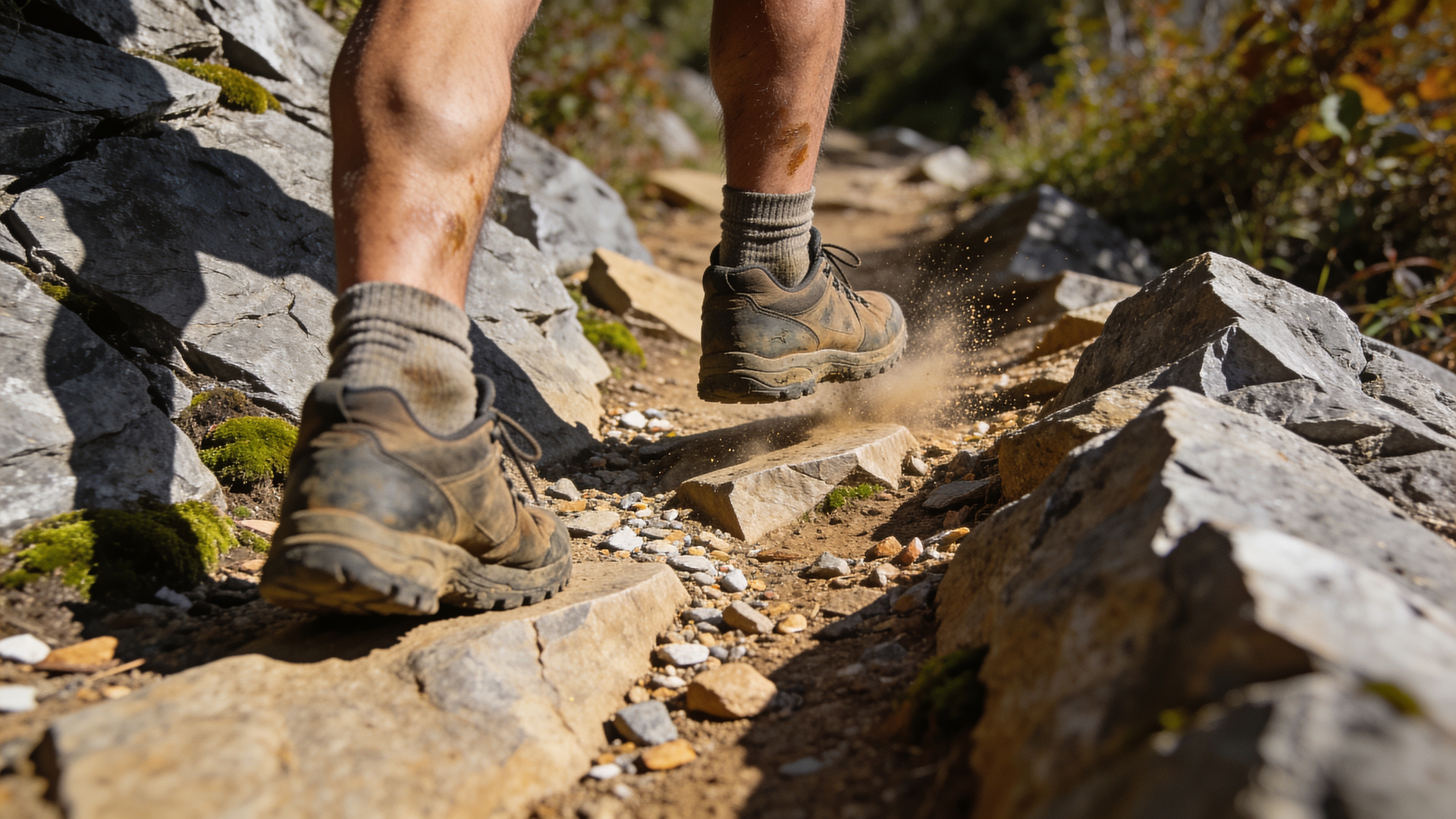
The trail answer: it is not always your shoes
Shoes are part of the conversation, not the whole conversation. A supportive shoe can help, but it cannot replace calf strength, ankle mobility, foot control, balance, and progressive exposure to the distances and surfaces you want to handle.
It helps to see how the common diagnoses actually behave.
Mayo Clinic describes metatarsalgia as pain and inflammation in the ball of the foot that can be linked with running, jumping, foot shape, and footwear.
Cleveland Clinic describes plantar fasciitis as irritation of the tissue along the bottom of the foot, often connected to activity, footwear, surfaces, and overuse. The location matters, but so does the load story behind it.
Why do running and hiking expose the foot so quickly
Running repeats impact
Running asks the foot to meet the ground repeatedly. Even a short run can add up to thousands of steps. If the foot and lower leg are not prepared for that repetition, symptoms may appear before the rest of the body feels tired.
Hiking adds terrain
Hiking changes the rules. Uphill sections demand more from the calf and forefoot. Downhill sections ask for braking. Uneven trails require the foot and ankle to adapt quickly. A backpack adds another layer of load.
Walking can still be demanding
People often underestimate walking because it is familiar. But long walks, hills, hard surfaces, and sudden increases in step count can stress the foot just like formal workouts can.
The load chain most people miss
Foot pain during activity is rarely about the foot alone. It is about how force travels through the whole lower body and how often that force repeats. Each link plays a part:
- Foot: absorbs contact and adapts to the surface
- Ankle: provides the mobility and control needed for hills and uneven ground
- Calf: absorbs and produces repeated force
- Knee: helps manage alignment and braking
- Hip: controls leg position and step mechanics
- Training plan: decides how often the whole chain has to repeat the stress
When one link is underprepared, the others, and often the foot, end up paying for it.
Different foot pain clues tell different training stories
Where and when pain shows up is a clue to what your training may be asking for.
| Clue | Possible training interpretation |
|---|---|
| Pain after a longer distance | Current load tolerance may be exceeded. |
| Pain on hills | Calf, ankle, or forefoot demand may be too high. |
| Pain on uneven trails | Balance and ankle control may need work. |
| Pain after a shoe change | The transition may have been too abrupt. |
| Pain that changes your gait | Medical evaluation may be needed. |
| Pain that becomes sharp or focal | Bone stress or another medical concern should be ruled out. |
Pain location is a clue, not a final answer
Heel, arch, ball-of-foot, toe, and top-of-foot pain can all mean different things, and the location guides the conversation rather than ending it. Heel or arch pain often tracks with how much walking, running, standing, or hard-surface load has increased. Ball-of-foot pain can follow more forefoot pressure, hills, or a shoe transition. Top-of-foot pain that is sharp or focal deserves a medical look. The same person can also have more than one contributor at once, since shoes, surface, mobility, strength, distance, and recovery all overlap.
The missing link: capacity before terrain
Many runners and hikers try to solve foot pain by changing terrain first. They avoid hills, switch trails, buy shoes, or rest. Those can be useful short-term moves, but if the foot and lower leg never build capacity, the same symptoms return when the activity returns. Outdoor organizations make a similar case: the American Hiking Society points out that staying conditioned between trips, rather than relying on the hike itself to build your fitness, is what keeps the trail enjoyable.
Sports medicine has a useful frame here. Research on
managing training load rather than guessing at it shows why sudden spikes in workload tend to cause problems. Applied to running and hiking, that means distance, elevation, pack load, surface, speed, and frequency all count, and they count together.
What foot pain training should focus on
Foot strength and control
The foot has to adapt to the ground. Training can include controlled foot work, short-foot drills when appropriate, balance work, and exercises that help the foot participate rather than simply be protected.
Calf strength and endurance
The calf is one of the biggest players in running and hiking. It helps manage hills, push-off, landing, and repeated steps, so calf capacity matters most when the goal includes trails or longer distances.
Ankle mobility and stability
A stiff or poorly controlled ankle can change how the foot meets the ground. The American Academy of Orthopaedic Surgeons foot and ankle conditioning program is one example of how ankle and foot conditioning fits into general musculoskeletal preparation.
Hip control
The hip helps decide where the leg lands and how the body handles a single-leg stance. If hip control is poor, the foot may be asked to adapt to a less stable chain above it.
The calf-foot partnership
The calf and foot should not be trained as separate islands. During running and hiking, the calf helps control the ankle and manage push-off while the foot adapts to the ground. If the calf is underprepared, the foot takes more of the stress; if the foot is not participating well, the calf overworks. The University of Utah Health Runner's Clinic describes how the calf produces power at push-off and helps control the lower leg, and how weak or poorly timed hip and glute support can leave the calf overloaded. Building calf endurance, foot control, ankle mobility, balance, and hip stability together is what lets the lower leg share the load the way it is designed to.
A trail-readiness progression
Rebuilding tolerance works best in stages rather than all at once.
| Stage | Goal | Example |
|---|---|---|
| Stage 1: Calm the signal | Reduce irritation and protect walking quality | Shorter walks, medical guidance if red flags are present, less painful terrain. |
| Stage 2: Build the platform | Strengthen foot, calf, ankle, and hip | Calf raises, balance, foot control, hip strength, controlled step work. |
| Stage 3: Add distance | Increase flat-ground tolerance | Longer walks or easy runs while tracking the next-day response. |
| Stage 4: Add terrain | Reintroduce hills and uneven ground | Short hill repeats, gentle trails, controlled downhill exposure. |
| Stage 5: Add adventure demand | Prepare for real goals | Pack load, longer trail days, faster running, or event-specific prep. |
Hiking adds problems that running does not always have
Downhill braking
Downhill hiking asks the foot, ankle, calf, knee, and hip to brake repeatedly. That can create symptoms even when flat walking feels fine.
Uneven ground
Trails require constant micro-adjustments. The foot and ankle need to respond while the hip and trunk keep the system balanced.
Pack load
A backpack changes the total load and can alter posture, stride, and fatigue. Even a moderate pack can make a familiar trail feel different.
What to change first when foot pain flares
When symptoms show up, you usually do not need to stop everything. You need to lower the dose and watch the response. Useful first moves:
- Reduce distance to lower the total number of repetitions
- Flatten the route to reduce calf and forefoot demand
- Simplify terrain to reduce stress on balance and ankles
- Keep strength work pain-limited so you build capacity without piling on impact
- Track the next-day response to see whether the body adapted or reacted
Why "walk it off" can backfire
Foot pain often tempts people to keep going because the first few steps may loosen up. Sometimes symptoms settle with gentle movement. Other times, the foot is simply being asked to tolerate more load while irritated, and the difference matters. Watch the trend: if pain decreases, your gait stays normal, and the next day feels stable, the dose may be tolerable. If pain increases, changes how you walk, becomes sharp, or lingers into the next day, the plan needs to change.
How to test a shoe change without guessing
If shoes are part of the problem, the transition matters. A new shoe should not be tested first on the longest run or steepest trail. Start with a shorter, predictable walk or easy run, then track how the foot feels during the session, that evening, and the next morning. Shoes can help, but they should be evaluated inside a training plan, not used as the entire plan.
When foot pain needs medical evaluation
Foot pain should be evaluated if it is sharp, focal, worsening, swollen, associated with trauma or numbness, or severe enough to change how you walk. Mayo Clinic describes stress fractures as tiny cracks in bone that can result from repetitive force or overuse, which is exactly why persistent focal pain should not be ignored.
The outdoor reframe
The goal is not to make every step cautious. The goal is to earn confident steps again. Foot pain often makes people shrink their world; a good training plan should help them expand it carefully, from flat ground to hills, from short walks to longer hikes, and from guessing to understanding.
How Royal Blue Fitness helps runners and hikers find the missing link
At Royal Blue Fitness, we do not diagnose foot conditions. We look at the training problem around the foot: strength, range of motion, balance, lower-leg capacity, hip control, and the activity you want to return to. In a Strength and Range of Motion Assessment, the missing link we most often find behind recurring foot pain is not the foot itself; it is limited ankle dorsiflexion or under-built calf endurance that quietly overloads the foot once hills, distance, or a pack show up.
From there we can build toward the run, hike, or trip on your calendar through our
Prepare for the Moment event-training program. If your foot pain keeps flaring every time you add distance, hills, or a pack, that is the moment an assessment is most useful. The goal is not to chase a magic shoe. It is to build a body that can handle the ground you want to cover.
Frequently Asked Questions
Why does my foot hurt when I run or hike?
Foot pain can come from many sources, including forefoot load, heel or arch irritation, footwear changes, terrain, training load, calf capacity, ankle mobility, or medical conditions that need evaluation.
Is foot pain always caused by shoes?
No. Shoes matter, but they are not the whole answer. The body also has to manage distance, hills, uneven surfaces, calf demand, foot strength, and recovery.
Can tight calves cause foot pain?
Limited calf capacity or ankle mobility can influence how force moves through the foot, especially during hills, running, and long hikes.
Should I keep hiking if my foot hurts?
Persistent, sharp, worsening, swollen, or gait-changing foot pain should be checked. You may need to reduce distance, terrain, pack load, or intensity while rebuilding tolerance.
What should foot pain training include?
Useful categories often include foot strength, calf strength, ankle mobility, balance, hip stability, and gradual exposure to hills and uneven terrain.
Can Royal Blue Fitness help with recurring foot pain during activity?
When exercise is appropriate, Royal Blue Fitness can assess strength and range of motion, identify movement and loading gaps, and build a plan for running, walking, or hiking readiness.
Here are our latest articles! Click to read more.