Functional Strength Training for Busy Moms: Strength and Mobility That Fit Real Life
Becoming a mom changes your calendar, your body, and your identity. One day you are a person with plans; the next you are a person with tiny humans and timelines that do not care about your plans.
If you are reading this, there is a good chance you miss feeling strong in your own body. Not "Instagram strong," not "I crushed a bootcamp" strong. The kind of strength that makes daily life easier: carrying a car seat without your shoulder barking, getting off the floor without a groan, climbing the stairs without feeling like your legs are made of wet cement.
This article is for the mom who wants to train but feels blocked by three real things: time, guilt, and uncertainty. We will solve those first, then lay out a simple, flexible way to combine strength and mobility work so it fits your week.
The real problem is not motivation: it is friction
Most moms do not lack motivation. You care. You have tried. The problem is that your day is already full, and much fitness advice assumes your life is empty.
Friction is anything that makes a good plan hard to start: the outfit you cannot find, the workout you have to decide on, the 45-minute block you cannot protect, the guilt that shows up the moment you sit down for yourself.
Reduce the friction and consistency becomes realistic. That is how habits actually form: repetition in a consistent context gradually builds automaticity, not perfection. If you like the research side, the classic
habit-formation study by Lally and colleagues shows how repetition plus context turns a behavior into something that feels more automatic over time.
Reframe the story: this is not selfish, it is support
When you are taking care of everyone else, "me time" can sound like an indulgence. But strength and mobility training are closer to maintenance than luxury. Like brushing your teeth, you are not doing it to be impressive. You are doing it so life works better.
If guilt creeps in, try swapping the language. You are not taking time away from your family; you are building the body and nervous system you need to stay steady in a loud, beautiful, demanding life:
- This is injury prevention for the job I do every day
- This is how I protect my energy budget for the week
- This is how I keep my back, hips, and shoulders happy
- This is how I show up with more patience and less snap
- This is how I stay strong enough to keep up with my kids, not just watch them
There is real evidence behind the mood payoff. The
CDC notes that some brain-health benefits can show up right after a single moderate-to-vigorous session, including reduced short-term anxiety, and that regular activity supports sleep and mood over time. The
Anxiety and Depression Association of America adds that regular activity lowers tension, steadies mood, and improves sleep, and that even a short bout can begin to ease anxiety, which matters when you are parenting on low sleep.
Start with a floor, not a fantasy
A lot of plans fail because the starting point is too ambitious. The goal is not the perfect routine. The goal is a floor: the smallest version of training you can still do on a hard week. A workable floor for many busy moms looks like this:
- Strength: 2 sessions per week, 15 to 25 minutes each
- Mobility: 3 to 5 snacks per week, 5 to 10 minutes each
- Walking: optional but powerful, framed as "move your body, clear your head"
This lines up with major public-health guidance. The
World Health Organization's physical-activity guidelines recommend at least 150 minutes of moderate activity per week plus muscle-strengthening on two days, and they make the reassuring point that some activity beats none and that reducing sedentary time matters too. Here is the key: when your week gets messy, you do not quit. You drop to the floor. The floor is your safety net.
Why strength and mobility belong in the same plan
Strength training builds capacity. Mobility training keeps joints moving well, helps you reach positions without compensating, and calms the stiffness that piles up from feeding, carrying, driving, and working.
Mobility alone might leave you looser but still tired carrying your kids. Strength alone might leave you stronger but rusty in the hips and upper back. Together, they make you resilient.
Common "mom body" complaints, and what they usually mean
You do not need to diagnose yourself, but naming the pattern helps you choose the right tools.
| Complaint | What it usually means |
|---|---|
| Upper back and neck tightness | Feeding posture, phone posture, and not enough upper-back strength |
| Low back fatigue | A capacity issue: lots of bending and carrying with not enough strength endurance |
| Hip tightness | Sitting, walking, and not using the hips through full ranges |
| Wrist and shoulder irritation | A volume problem from repetitive carrying, plus limited recovery |
| Feeling weak in the middle | A core and breathing-coordination issue, especially postpartum |
If postpartum core concerns are part of your story, the training approach matters. With diastasis recti you can still get strong, but start with breath-led core work, exhaling as you gently engage and avoiding breath-holding, then progress load gradually. With pelvic-floor symptoms like leaking, heaviness, or pressure, you do not have to "just live with it"; the path is coordination first, then strength and smart progressions, ideally with the right clinical support alongside.
Make it easier to start: use if-then plans
A simple coaching tool that works for busy moms is the if-then plan. Instead of relying on willpower, you tie a small action to a predictable moment. This is called an
implementation intention in psychology research, and it makes follow-through more automatic when life gets busy.
| When this happens | Then I |
|---|---|
| The coffee is brewing | Take 5 deep breaths and do 60 seconds of hip mobility |
| The baby goes down for a nap | Do 10 minutes of strength, even if it is not the full plan |
| I brush my teeth at night | Do 2 minutes of upper-back mobility |
| I am waiting for the bath to fill | Do 8 bodyweight squats and 8 countertop push-ups |
| My back feels stiff | Do a 5-minute reset instead of scrolling |
A simple strength template that works in 20 minutes
You do not need a fancy routine. You need a repeatable pattern. Two days a week, hit one exercise from each of these movement categories:
- Squat or sit-to-stand
- Hip hinge
- Push
- Pull
- Carry
- Core and breathing
Keep the weights moderate. You should finish feeling trained, not destroyed; the point is to leave room for life, the difference between getting through the day and getting through it with something left in the tank. Stanford Medicine
describes exercise as a whole-body signal that touches the heart, brain, immune system, and metabolism, which is one reason simple strength plus daily movement is so powerful.
Mobility snacks: 5 to 10 minutes that keep you moving well
Mobility work does not have to be a full class. A snack is a quick reset that gives your joints and nervous system what they have been missing all day. Three areas matter most for moms:
- Upper back and ribs: help posture, breathing, and shoulder comfort
- Hips: help walking, stairs, and getting up and down from the floor
- Ankles: help squatting, lifting, and keeping knees and hips happier
One simple rule: a mobility snack should make you feel better within a few minutes. If it consistently flares something up, adjust.
Postpartum notes: listen to your body, and get the right green lights
If you are postpartum, the timeline matters less than the signals. Healing is not linear, and your return to training should be progressive. ACOG's exercise-after-pregnancy guidance offers practical safety points and supports a start-small, build-gradually approach. If you are returning to higher-impact work like running, Stanford FASTR's postpartum return-to-sport guide maps the rebuild in phases, especially if you were athletic before pregnancy.
Hard-day plan: what to do when you are exhausted
Some days your best is not a workout. Your best is a reset, and that still counts. Pick one:
- Two minutes of breathing and gentle core engagement
- A 5-minute walk outside, even just up and down the driveway
- One set of 8 to 12 squats and a short stretch
- A mobility snack for the upper back and hips
Stop at "good," not "done." That is how you keep the habit alive.
How Royal Blue Fitness helps busy moms make this stick
If you keep trying to do this on your own and it keeps slipping, you are not failing. You are a mom doing a hard job, and you deserve a plan that respects your bandwidth. At Royal Blue Fitness in Pleasant Hill, we coach busy moms through functional strength and mobility, focusing on the basics that move the needle: getting you stronger through safe ranges, building capacity for the real tasks you do every day, and keeping the plan flexible enough to survive school schedules, sick days, and family chaos.
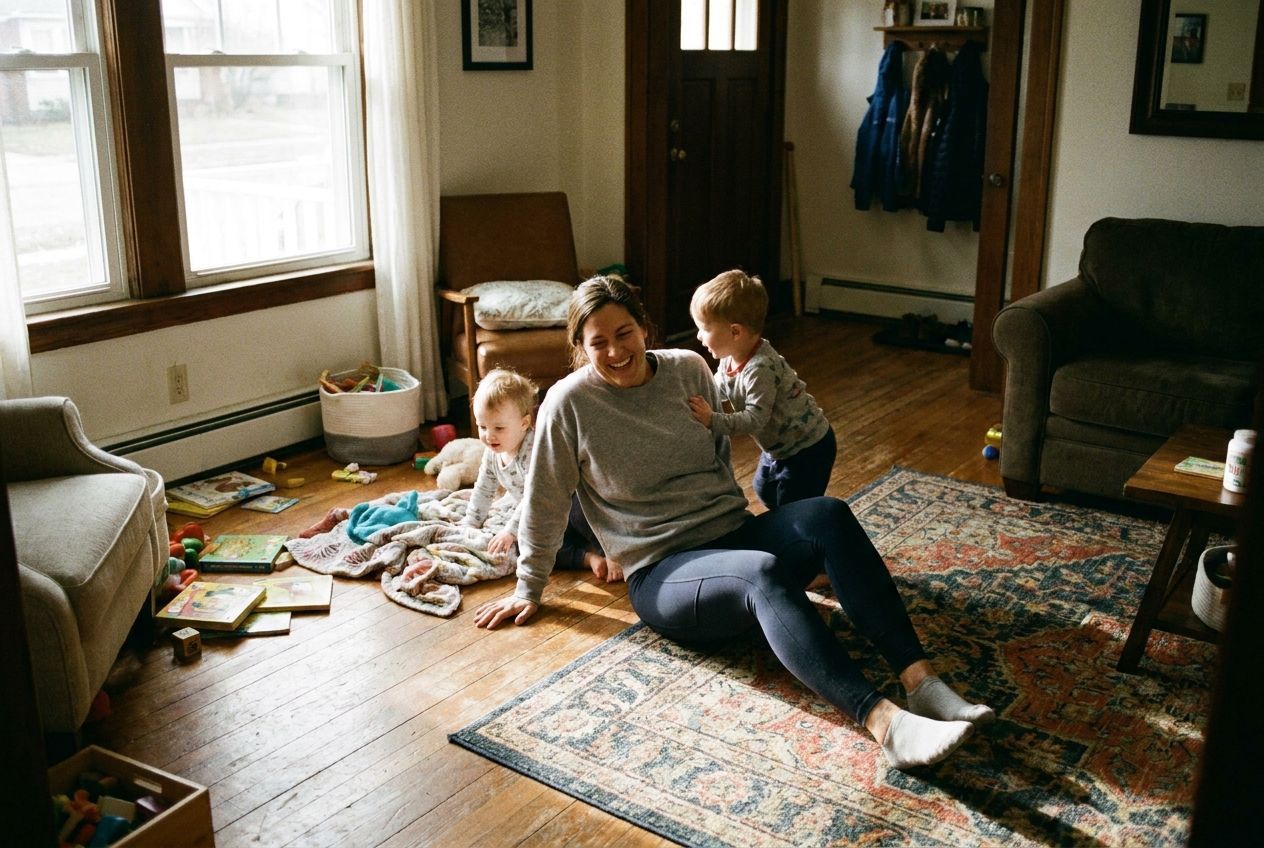
I work with a mom who hit exactly this wall in her early forties. Nothing dramatic happened; the demands just stacked. Her job got heavier, her kids got busier with more extracurriculars, and when they played they played rougher, the kind of joyful dog-pile that flattens you on the living-room floor. Those are the moments you never want to miss, but they were quietly draining a tank that work had already half-emptied. We did not chase a bootcamp. We built her strength and capacity so she could keep up at work and still be the mom who gets up off the floor for one more round.
In our assessment, the limiter we most often see in new moms is not willpower. It is pressure management plus a hip and upper-back range that got crowded out by months of feeding and carrying. That is exactly where our Women's Health Private Coaching starts: a Strength and Range of Motion Assessment, then a plan that fits your week instead of fighting it.
Closing: small training is not small impact
You do not need to earn fitness with punishment. You need a plan that feels like support. Start small, reduce friction, and return to the floor when life gets messy. Over time those small sessions add up, not because you became a different person overnight, but because you built a system your real life can hold.
Frequently Asked Questions
How much time do I really need?
A workable floor is two 15-to-25-minute strength sessions and a few short mobility snacks per week. Some consistent activity beats an ambitious plan you cannot sustain.
Is it safe to strength train postpartum?
For most moms, a gradual, progressive return is appropriate, and major guidance supports starting small and building. If you have diastasis or pelvic-floor symptoms, begin with breath-led core work and get individualized guidance before adding heavier load.
What if I can only do five minutes?
Five focused minutes counts. A mobility snack or one set of squats keeps the habit alive on a hard day, and the habit is what compounds.
Do I need equipment?
No. Bodyweight squats, sit-to-stands, countertop push-ups, hinges, and carries with household items cover the core patterns. Equipment can be added later.
Further reading
A few books that pair well with this mindset shift:
- Atomic Habits by James Clear, on identity-based habits and making good behaviors easy to start
- Tiny Habits by BJ Fogg, on shrinking a behavior until it fits your real life
- Mindset by Carol Dweck, on shifting from "I failed" to "I am practicing"
- The Power of Habit by Charles Duhigg, on the cue-routine-reward loop
Here are our latest articles! Click to read more.