Build Fitness That Lasts: 10 Atomic Habits Principles We Use To Keep You Consistent
You have probably seen it before. Motivation spikes, you overhaul your entire routine, you grind for a few weeks, then life gets busy, and everything fades. It is not that you do not care. It is that your system cannot survive in the real world.
At Royal Blue Fitness, we build fitness around habits, not hype. Our clients, busy working adults juggling work, family, and a body that is often already stressed, do best when their training fits into their lives and protects their joints rather than fighting both. That is why so much of our approach quietly mirrors the principles in
James Clear's book, Atomic Habits: small changes, repeated over time, create significant results.
Below are ten principles we draw from that work and how we apply them to help you build lifelong, joint-smart fitness habits, one small step at a time. We treat them as a framework, adapted to training and to real bodies, rather than following any single book by the letter.

1. Start with identity, not just goals
Before we set a single number with a client, we help them name who they are becoming, because the most durable shift is not from one goal to another; it is from a goal to an identity. Instead of fixating on what you want to achieve, you focus on who you want to become. "I want to lose twenty pounds" is a deadline. "I am someone who trains a few times a week and protects my joints" is a person, and your actions slowly align with the person you believe you are.
So early on, we help you put words to that identity, something like "I am someone who trains to stay strong, capable, and independent for the long haul." Your program, your check-ins, and the way we track progress all reinforce that identity rather than treating it as a one-time number. Our whole approach is built around long-term strength and healthy aging, not quick fixes, so the identity and the training point in the same direction.
2. Focus on systems, not just outcomes
Our first move with an inconsistent client is to engineer the system around them rather than demand more willpower. There is a line from Atomic Habits we come back to often: the idea that you "fall to the level of your systems" rather than rise to the level of your goals. A good system makes the right behavior the default, so you are not relying on a burst of weekly motivation to show up.
So we build a system around you: an assessment, a progressive plan, scheduled sessions, and clear checkpoints. Nothing about your program is random. You always know what to do when you walk in, and how today fits the bigger picture, which means consistency does not depend on how motivated you happen to feel that morning.
3. Embrace tiny, one percent improvements
Small, consistent improvements compound. One percent better today is unimpressive on its own, but repeated over months, it adds up to a different body and a different baseline. You do not need to overhaul your life in a week; you need a slightly better version of this week. That is not just motivational framing: research on how habits actually form shows that repeating a simple action in a consistent context is what gradually turns it automatic.
So we deliberately hunt for your one percent upgrades: one more set of a key lift, a little more depth in a squat with good form, five more minutes on a walk, a consistent lights-out time that protects your sleep. We track these small wins so you can see yourself progressing while the bigger milestones are still on the way.
4. Use habit stacking to anchor new behaviors
One of the easiest ways to start a new habit is to bolt it onto one you already have, so you do not have to remember it from scratch. The formula is simple: after something you already do reliably, you do the new thing. A few that work well for training:
After your morning coffee, do 5 minutes of mobility work.- After you finish work on training days, head straight to your session before going home.
- After you brush your teeth at night, set out tomorrow's workout clothes.
We help you map your training to anchors already fixed in your week: your commute, your kids' activities, a lunch break, or an existing routine. When a session attaches to something already automatic, it stops being one more thing to remember and becomes part of the rhythm of your day.

5. Design your environment to make training obvious
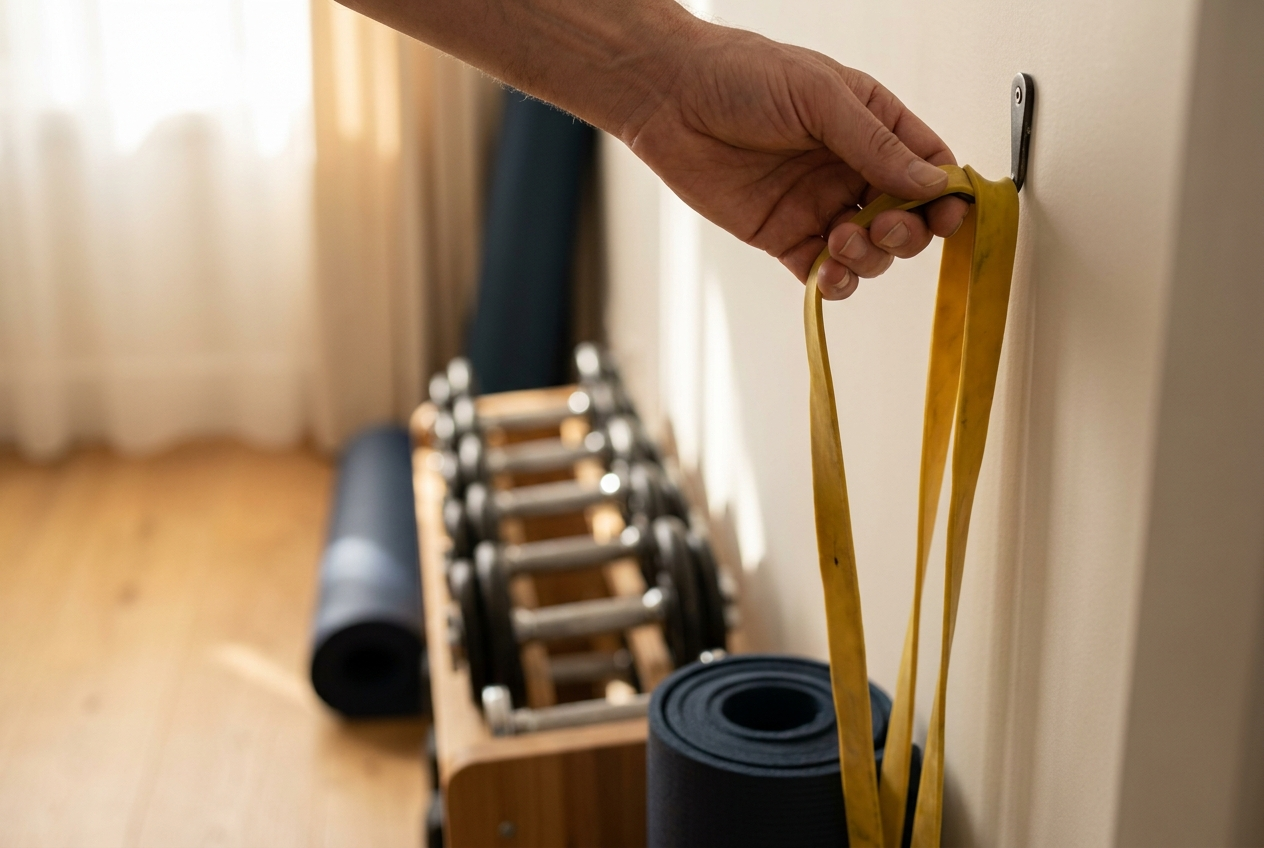
Your surroundings shape your behavior more than willpower does. Habits are triggered by the cues in our environment, so the move is to make the cues for good habits obvious and remove the ones that pull you toward the couch. Keep the packed gym bag by the door. Put the foam roller where you usually sit and scroll. Set reminders for the times you tend to drift.
In coaching conversations, we walk through this with you: choosing a training time that fits traffic and family, setting reminders in the app, or building small at-home stations so a quick drill is always within reach. The goal is to make the choice to move feel easy and visible, especially on low-energy days when a hidden plan quietly loses.
6. Lower the bar, then build from there
When you have been inconsistent, the fix is rarely a bigger plan; it is a smaller one. Make the starting version so easy you can hardly say no, then earn the right to add more once it is automatic. A realistic minimum might be a ten-minute daily walk, one strength session a week to start, or a five-minute morning warm-up.
We push hard against the all-or-nothing mindset because it is what turns one missed week into quitting altogether. Early phases often use shorter sessions, a smaller menu of exercises, and clear minimums that still count as a win on a chaotic day. Once you have proven to yourself that you can consistently hit the minimum, we layer in more volume or intensity in a joint-friendly way.
7. Plan for if-then moments before they happen
Deciding in advance what you will do when life interferes keeps you from having to improvise in a weak moment. These if-then plans are simple, and
they have a well-documented effect on follow-through: if a certain situation comes up, then you run a pre-decided response.
| Situation | Your Plan B |
|---|---|
| A meeting runs late and you miss your usual session | Do the condensed twenty-minute version that night |
| Your back feels stiff | Message your coach and switch to the pain-smart version of the workout |
| You are traveling | Use your hotel room strength and mobility routine |
So your program comes with built-in backups: shorter versions, travel-friendly options, and joint-flare alternatives. You always know your Plan B and Plan C, so a busy week or a small setback does not erase your momentum. For clients coming from rehab or managing ongoing pain, that continuity is part of the point.
8. Make progress visible and rewarding
What gets measured tends to get repeated. Seeing evidence that your effort is paying off, even when the mirror or the scale is slow to change, keeps the habit satisfying enough to continue. In fact, reviews of the research find that monitoring your progress makes you meaningfully more likely to reach a goal, especially when you record it or share it.
So we track more than weight or appearance. We watch functional markers like strength, mobility, balance, and confidence, and where it helps, we use app check-ins and structured assessments to show you concrete data: you are stronger, steadier, and moving with less guarding than before. That kind of feedback is what keeps the loop rewarding and keeps you on course.
9. Use accountability and community instead of willpower
It is easy to cancel on yourself and much harder to cancel on a coach or a group that notices when you disappear. Structured social support reliably helps people stay active, which is why accountability beats raw willpower over the long run.
So we build accountability in from day one: standing session times on your calendar, regular progress reviews rather than see-you-when-I-see-you, and honest conversations when life gets in the way so we adjust the plan instead of ignoring the gap. You are not doing this alone, and that changes how often you actually show up.
10. Never miss twice
Everyone misses a day. The rule that protects your progress is simple: never miss twice. One missed session is a blip. Two or three in a row is how a lapse quietly becomes the new pattern, so the priority after any miss is getting back on the board at the next opportunity, even if the session back is shorter or lighter.
We treat missed sessions as information, not failure. When you have a rough week, we look at what got in the way, adjust the plan or the schedule, and get you one quick win to restart the rhythm. You do not need perfect attendance. You need to be someone who always comes back, and that is the mindset that keeps people training and aging strong across years, not just seasons.
Ready to build habits that support you for life?
Atomic Habits is ultimately about building a life where the actions that support your future self feel natural rather than forced. We apply that same thinking to your training, so exercise becomes a stable, joint-smart part of your life instead of another short-lived project.
If you want structured, joint-friendly support to turn these principles into your routine, the place to start is a
Strength and Range of Motion Assessment, so your plan is built on how your body actually moves today. For anyone around Pleasant Hill or the East Bay who is tired of starting over, it is a grounded, pressure-free first step toward habits that finally stick.
Here are our latest articles! Click to read more.